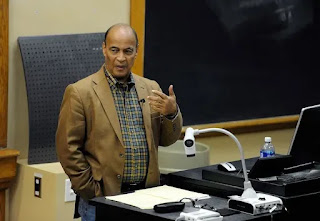
“Reinventing the past to suit the purposes of the present.”
Adolph L. Reed Jr
We must find the road to the most deprived, to the darkest strata of the proletariat, beginning with the Negro, whom capitalist society has converted into a pariah, and who must learn to see in us his revolutionary brothers. And this depends wholly upon our energy and devotion to the work.[1]
Leon Trotsky
“Direct slavery is as much the pivot upon which our present-day industrialism turns as are machinery, credit, etc. Without slavery, there would be no cotton. Without cotton, there would be no modern industry. It is slavery that has given value to the colonies, it is the colonies that have created world trade, and world trade is the necessary condition for large-scale machine industry. Slavery is, therefore, an economic category of paramount importance.”[2]
Karl Marx
One of the purposes of this excellent new book by Adolph L Reed is to preserve the voices of the last generation of Americans with a living memory of Jim Crow.[3] In the words of the English historian E. P Thompson, it attempts to rescue them from the “enormous condescension of posterity”.
The South documents Reed’s personal history almost in the manner of a memoir. However, unlike similar books, Reed presents a historical and class-based analysis of the racist Jim Crow laws.
As Barbara J Fields explains, it is important to understand the race from a historical perspective. She writes, “When virtually the whole of society, including supposedly thoughtful, educated, intelligent persons, commits itself to belief in propositions that collapse into absurdity upon the slightest examination, the reason is not hallucination or delusion or even simple hypocrisy; rather, it is ideology. And ideology is impossible for anyone to analyse rationally who remains trapped on its terrain. That is why race still proves so hard for historians to deal with historically, rather than in terms of metaphysics, religion, or socio- (that is, pseudo-) biology”.
Nothing so well illustrates that impossibility as the conviction among otherwise sensible scholars that race “explains” historical phenomena; specifically, it explains why people of African descent have been set apart for treatment different from others. But race is just the name assigned to the phenomenon, which it no more explains than judicial review “explains” why the United States Supreme Court can declare acts of Congress unconstitutional, or than Civil War “explains” why Americans fought each other between 1861 and 1865″.[4]
Reed’s defence of a historical and class-based understanding of race has led him to be heavily criticised and ostracised. Reed has opposed what he calls “race reductionism,”. In 1996, he famously described Barack Obama as a “smooth Harvard lawyer with impeccable do-good credentials and vacuous-to-repressive neoliberal politics.” [5].For Reed, class-based inequality is the historical constant, not race. Reed examines how the black middle class were treated differently than the black working class. He recounts how many black middle-class people could avoid some of the worst excesses of the murderess Jim Crow regime.
As Reed contends in his article Separate and Unequal, “Middle-class, “respectable” black people sought as much as possible to insulate themselves and their children from contact with those they considered to be class inferiors. An elaborate structure of social clubs—for example, the Links and the Girl Friends for women, the Boulé for men, Jack and Jill for children, and fraternity and sorority chapters for students and alumni—evolved to create and sustain homogeneous middle-class social networks locally and nationally. Segregation did have a levelling effect on race. Those with higher status were forced to share neighbourhoods, schools, churches, restaurants, and other public entertainments with those they would prefer not to associate with. From the system’s beginnings, a complaint about the injustice of enforced segregation was that it did not account for class distinctions among black people”.[6]
DSA
Reed has also criticised “critical race theory”, saying, “It is another expression of reductionism. On the most pedestrian level, it is an observation that what you see is a function of where you stand. At that level, there is nothing in it that was not in Marx’s early writings or Mannheim. But then you get an appropriation of the standpoint theory for identity that says, for example, all blacks think the same way. It is taxonomic, a reification. So the retort to that critique has been “intersectionality.” Yes, there is a black perspective, but what you do is fragment it, so there are multiple black perspectives because each potential—or each sacralised—social position becomes discrete. That is what gives you intersectionality.[7]
Reed’s political and class-based perspective has been too much for the Democratic Socialists of America(DSA), who had a speech of Reed’s cancelled due to objections by the AFROSOCialist and Socialists of Color Caucus over his “reactionary and class reductionist form of politics”.
1619 Project
His critique of the 1619 project has led to personal and political attacks. In a recent interview with Tom Mackaman- Reed states, “I did not know about the 1619 Project until it came out, and frankly when I learned about it, my reaction was a big sigh. But again, the relation to history has passed to the appropriation of the past in support of whatever kind of ‘just-so’ stories about the present is desired. This approach has taken root within the Academy. It is like all bets are off. Merlin Chowkwanyun and I did an article a few years ago in the Socialist Register that is a critique of disparitarianism in the social sciences, by which this or that disparity has replaced the study of inequality and its effects. As Walter Benn Michaels said, and as I have said time and time again if anti-disparitarianism is your ideology, then for you, a society qualifies as being just if 1 per cent of the population controls 90 per cent of the wealth, so long as that within that 1 per cent 12 per cent or so are black, etc., reflecting their share of the national population. This is the ideal of social justice for neoliberalism. There is no question of actual redistribution.[8]
Reed demolishes one of the myths of the 1619 project that enslaved people were introduced to America because of racism. Reed points out that the first slaves were brought over under the auspices of a wage labour system. He writes, ” the 1619 Project assumes, in whatever way, that slavery was the natural condition of Africans. And that is where the Afro-pessimism types wind up sharing a cup of tea with James Henry Hammond.”
As Niemuth points out in his defence of Reed, “The furious reaction within the DSA leadership to the invitation to Reed reveals how deeply the organisation is imbued with the reactionary and right-wing politics of racial division. The extreme hostility to any analysis based on the primacy of class expresses the interests of affluent sections of the petit bourgeoisie, who utilise racial and identity politics in the fight over positions of power and privilege within the apparatus of the state, the trade unions, academia and corporations”.
Conclusion
This concise volume deserves to be read widely and hopefully put onto university reading lists. It is hoped a younger readership picks it up and learns about a class-based and historical perspective on racism than the racialist perspective touted by the 1619 project.
About the Author
Adolph Reed, Jr., is Professor Emeritus of Political Science at the University of Pennsylvania. He is the author of numerous books and articles dealing with race and class in American society and writes regularly for the New Republic.
Further Reading
1. The cancellation of professor Adolph Reed, Jr.’s speech and the DSA’s promotion of race politics-Niles Niemuth- 18 August 2020-wsws.org
2. The New York Times’ 1619 Project and the Racialist Falsification of History: Essays and Interviews Paperback – 26 February 2021
[4] Slavery, Race, and Ideology in the United States of America-https://www.versobooks.com/blogs/5281-slavery-race-and-ideology-in-the-united-states-of-america
[7] “Reinventing the past to suit the purposes of the present”-An interview with political scientist Adolph Reed, Jr. on the New York Times’ 1619 Project-Tom Mackaman-20 December 2019-wsws.org
[8] “Reinventing the past to suit the purposes of the present”-An interview with political scientist Adolph Reed, Jr. on the New York Times’ 1619 Project-Tom Mackaman-20 December 2019-wsws.org
This article by Tony Robson first appeared on the website wsws.org)
Post Office workers are to take national strike action May 3, in opposition to pay restraint imposed in line with the public sector policy dictated by the Johnson government.
The one-day stoppage will close 114 Crown Post Offices (those run directly by the Post Office) around the country and there will be no cash deliveries or collections from 11,500 sub-post offices. The action involves over 1,000 workers including counter staff as well as clerical, administration and call centre workers.
Royal Mail van, outside the Axminster post office (Image Credit: Wikipedia/Felix O)
Members of the Communication Workers Union (CWU) voted in March by a 97.3 percent majority for strike action in a ballot turnout of 70 percent. They have rejected a miserly 2.5 percent pay rise, offered as inflation climbs to a 30-year high of 6 percent CPI and 9 percent RPI.
The proposed two-year deal includes the pay freeze for last year and a lump sum of £250 in addition to the 2.5 percent from April this year.The determination of postal workers to fight back is in sharp contrast to the CWU. While the union is making token noises about the insulting pay offer, its efforts have been directed towards preventing a struggle from taking place.
Andy Furey, CWU Assistant General Secretary, told the Independent, “Despite this union’s best attempts to avoid strike action, the Post Office has displayed no interest whatsoever in meaningful negotiations.”
The union has confined itself to evasive references to a decent and fair agreement rather than specify a demand in line with inflation and which compensates for last year’s pay freeze.Now that a national strike is taking place the CWU is seeking to head off a confrontation with the government and drive a wedge between postal workers and millions of public sector workers suffering widespread austerity.
In a press release Furey states in reference to the Post Office, “They have told us that they’re freezing pay in keeping with official government and public-sector pay policy… But that’s an outrageous and dishonest excuse as the government’s austerity measures do not apply to the Post Office and it should be borne in mind that our members worked throughout the pandemic to provide essential services to the Great British public.”
He added that “the further irony here is that our members are always being told by senior management that they are a commercial operation and required to make a profit – yet the Post Office is a profitable concern – profits made by the hard work and dedication and skill of our members.”
Health workers, teachers, refuse workers and millions of other public sector workers have served on the frontline of the pandemic in which their safety was disregarded only to be rewarded with below inflation deals. The divisive approach of the CWU must be rejected in favour of a unified fightback.
Furey argues for accepting the entire framework of cost cutting and restructuring in the name of profitability on the false pretence that workers will get their “fair share” rather than suffer stepped-up exploitation.
The state-owned Post Office was separated off from Royal Mail when the latter was privatised back in 2012, splitting the cashier and retail operations from the letter and parcel delivery service. Since then, the number of Crown Post Offices has been reduced from 373 by more than two-thirds, to 114. Fully 99 percent of Post Offices are run by an independent postmaster, or what is described as a larger franchise partner, i.e., major retail chains.
The government subsidy has been reduced from £210 million in 2012-13 to £50 million annually, according to a Financial Times article last August, “in the drive to make the Post Office commercially viable.” Post Office CEO Nick Read explained that while the plan to remove all government subsidy, except for rural branches, by 2022 has been postponed, it was still intended to be achieved by 2025-6.
Read outlined plans to introduce self-service kiosks in 2,000 to 3,000 branches following the example of Post Canada. He admitted this would be at the expense of jobs. Read also referred to a move into the pick-up and drop-off market and for the Post Office to act as an outreach for banks that have deserted the high streets in favour of online services. The Post Office has entered into agreements with Amazon and DPD in relation to parcel deliveries, rather than their exclusive handling by Royal Mail.
The sole focus of the Post Office is to maximise profits as the government subsidy is stripped out. This can only further undermine the social obligations it is formally committed to in providing an accessible service to the elderly and most vulnerable, and will be done at the expense of workers’ jobs, pay and terms and conditions.
The Post Office has been at the centre of a massive frame-up of postal workers through the Horizon scandal. Hundreds of sub-postmasters and postmistresses were wrongfully convicted to cover up the defective Horizon IT auditing system designed and installed by Japanese company Fujitsu. This was introduced across the Post Office network in 1999 at the cost of £1 billion. The defects in the IT system showed false shortfalls in branch accounts and led to 736 unsafe convictions for offences ranging from false accounting, theft and fraud between 2000 and 2014, resulting in some prison sentences.
This was only brought to light due to the legal campaign by those wrongfully convicted and their supporters, spanning a 20-year period against bitter resistance from the Post Office. At the end of 2019 the Post Office finally agreed to pay damages to 555 claimants in civil cases. Last April the Court of Appeal quashed in a single ruling the convictions against 39 postmasters, part of a total of 72 such rulings to date, with many more expected to go to court. The bill of compensation for the victims of injustice meted out by the Post Office is estimated to be £1 billion.
One of the “Post Office 39” who had their convictions overturned is Seema Misra, a mother who was eight weeks pregnant with her second child when she was sentenced in 2010 for theft and false accounting, spending four months in prison, and ordered to pay £40,000 in compensation to the Post Office. Misra stated, “The Post Office was like a mafia. They have blood on their hands. We live in a developed country, how can we let these criminals roam around freely?”
There is widespread anger among postal workers over the fact that nobody in authority at the Post Office or Fujitsu has faced criminal prosecution for what has been described as the most “widespread miscarriage of justice” in recent UK history. Both parties have been shown to have withheld evidence regarding the faulty IT system. Paula Vennells, who oversaw the cover-up and persecution of sub-postmasters, is estimated to have raked in £5 million in pay and bonuses during her time as managing director and later chief executive of the Post Office before stepping down in 2019.
Post Office workers should reject the CWU’s argument that their fight should be conducted separately from those in the public sector facing austerity. The claim that a pay rise can be achieved by accepting the pro-business framework for the Post Office of further restructuring to hike up profits is bogus.
We encourage Post Office workers to read the Socialist Equality Party statement, “The working class must mobilise to bring down the Johnson government.” This outlines a strategy to mobilise the working class independently of the Labour Party and trade unions, which act as accomplices of the government and the employers as they demand increased exploitation and social looting in the interests of the corporate and financial elite.
Given that you are a journalist in Financial Times Global Affairs department, I was a little surprised that you could only find two previously discredited and bankrupt theoreticians, namely Francis Fukayama and Samuel Huntingdon, to prove your assertion that there is no “elegant” theory to explain the “Ukraine Crisis”.Fukayama’s “End of History” hardly prepared him for the Ukraine crisis, and his train wreck of an analysis of the End of the Soviet Union was almost as bad.
An elegant document released at the time by the World Socialist Website provided a superb and, I might add, elegant rebuttal to Fukayama stating “the dissolution of the USSR provoked within the bourgeoisie and its ideological apologists an eruption of euphoric triumphalism. The socialist nemesis had, for once and for all, been laid low! The bourgeois interpretation of the Soviet Union’s demise found its essential expression in Francis Fukuyama’s The End of History. Employing a potted version of Hegel’s idealist phenomenology, Fukuyama proclaimed that the weary march of history had arrived at its final station—a US-style liberal bourgeois democracy based on the unfettered capitalist market. This was the summit of human civilisation! This theme was elaborated in countless variations by gullible and impressionistic petty-bourgeois academics, always anxious to be on what they take to be, at any given moment, the winning side of history”.[1]
As a journalist for the Financial Times, you will have access to every global media publication online and in paper form. So it is a little surprising that you ignore the one publication that would refute your premise. That publication is the World Socialist Website (wsws.org). I can only assume that you ignore this publication out of ideological consideration. It is clear from your previous writings that from an ideological standpoint, you are an anti-Marxist. If you were to suspend your ideological prejudice, you would find several articles on their website that would provide an elegant and correct perspective on the Ukraine war.
Please permit me to quote a rather elegant analysis. A letter was sent by WSWS International Editorial Board Chairman David North to a friend who requested his opinion on a recent online discussion held at a US college on the Russia-Ukraine war. David North makes the following point “Momentous events such as wars and revolutions invariably raise complex problems of causation. That is one of the reasons why the study of history is an indispensable foundation of serious political analysis. This general truth acquires exceptional importance in any discussion of Russia. This country was the site of arguably the most significant political event of the twentieth century, the 1917 October Revolution, whose historical, political and intellectual legacy still reverberates in our own time. The study of Soviet history remains critical to understanding the politics and problems of the contemporary world”[2].
Having read your columns on several occasions, I conclude that you have read very little about Russian history, particularly its revolution of 1917. Before writing such a provocative article, you should have brushed up on your history.
In doing so, maybe you would have suspended your anti-Marxism and not written a crass piece of journalism. Lastly, you write that “a strict realist wants you to believe that Putin would now be no trouble if only Nato had not moved east. Holding domestic values cheap, realism cannot explain why the sanctioning countries are almost all democracies. It cannot explain why Ukrainians want to face the west in the first place. When Putin himself cites culture and values, a realist must diagnose him with false consciousness and stress that what moves him is the dry calculation of the chessboard”.[3]
I will call upon the elegant Mr North to refute your argument. North writes, “The examination of the aggressive foreign policy of the United States since the dissolution of the USSR is not only a matter of exposing American hypocrisy. How is it possible to understand Russian policies apart from analysing the global context within which they are formulated? Given that the United States has waged war relentlessly, is it irrational for Putin to view the expansion of NATO with alarm? He and other Russian policymakers are certainly aware of the enormous strategic interest of the United States in the Black Sea region, the Caspian region and, for that matter, the Eurasian landmass. It is not exactly a secret that the late Zbigniew Brzezinski and other leading US geostrategists have long insisted that US dominance of Eurasia—the so-called “World Island”—is a decisive strategic objective”.
This is not to excuse Putin’s actions. I condemn the war in Ukraine, but as the great Spinoza said once, ” I have striven not to laugh at human actions, not to weep at them, nor to hate them, but to understand them.[4]
“If the world was emptied of all but John Lilburne, Lilburne would quarrel with John and John with Lilburne.”
Henry Marten
“Let that ugly Rascall be gonne out of the Parke, that whore-master, or els I will not see the sport.[1]
Charles I
“And therefore, Sir, to give you your due and right, I must ingenuously a•… knowledge, that I have for a long time looked upon you, as one of the great p•…lars of the Liberties of the Commons of England, and your name amongst all ju•… and unbiassed men, hath been extraordinary famous this present Parliament, therefore, and for this, you suffered an expulsion of the House, and a reproachfull a•… unjust imprisonment in the Tower of London, by the guilded men of the time who (you then discovered) carried two faces under one hood; & many monet•… (if not some yeares) you continued an ejected person from your just place in th•… House”[2]
Rash oaths unwarrantable-John Lilburne
“He was a great lover of pretty girles, to whom he was so liberall that he spent the greatest part of his estate”. He was a great and faithfull lover of his Countrey, and Never gott a farthing by Parliament. He was of an incomparable Witt for Repartes; not at all covetous; not at all Arrogant, as most of them were; a great cultor of Justice, and did always in the House take the part of the oppressed”.
John Aubrey
John Worthen’s biography of Henry Worthen is both intriguing and illuminating. It is a sympathetic portrait of one of the leading figures of the English revolution. Marten was a republican way before it became fashionable, being the only convinced Republican in the Long Parliament at the outset of the civil war and was one of the few leaders of the English revolution to be intimately connected with the Leveller movement.
The book is deeply researched, drawing extensively on letters Marten wrote while awaiting trial. He was accused of organising the trial of Charles I and being one of the signatories of the King’s death warrant. Amazingly, these letters remained intact since, during his captivity, his letters to his mistress Mary Ward were stolen and published in an attempt to destroy his reputation. However, their publication revealed a thoughtful, intelligent and tender man. Worthen’s use of them is to be commended. They are an extraordinary source material.
It would not be an exaggeration to say that the Marten was at the fulcrum of the English bourgeois revolution. But history has not been kind to Henry Marten. Today, he is a neglected historical figure. If any person needed to be rescued from the condescension of history, it was Marten. It has not helped that several conservative and revisionist historians have heaped a pile of dead dogs on his historical reputation. Many have repeated old accusations that he was a womaniser and have tended to downplay his importance or close connection to the Leveller movement.
The unseriousness of these historians is perhaps encapsulated by the article in the august publication, The History of Parliament Blog, by Dr David Scott called Sex in the Long Parliament, in which he writes, “No sex survey of the Long Parliament, however brief, can omit its supposedly most libidinous member, the arch-republican MP for Berkshire, Henry Marten. Parliamentarians and royalists alike denounced him as a libertine and ‘whoremaster’. Yet this moral outrage owed less to his womanising than to the shamelessness with which he abandoned his wife and lived openly with his mistress, to whom he seems to have remained faithful to the end of his life in 1680. The greatest sexual offence a Long Parliamentarian could commit was refusing to acknowledge it as an offence at all. If this were a defence of Marten’s reputation, I would hate to see him attacking him.[3]
Worthen does not buy into Marten being a whore-master. Charles I’s accusation, alongside many others, has been largely accepted down through the ages. A far more reasoned explanation can be found in Sarah Barber’s article for the Oxford Dictionary of National Biography. She writes, “His reputation for whoring seems to have been generated by the flagrant way in which he breached conventional mores by openly living with a common-law wife, Mary Ward, whose brother, Job, was parliamentarian commander of the fort at Tilbury. There is evidence that they were a couple from as early as 1649 when they lavishly entertained visiting dignitaries and kept liveried servants together. They may well have been a couple from Marten’s earliest time in London in 1640. If so, this was a relationship that remained constant for forty years. It was, however, adulterous, and Marten was quite open about it. Mary referred to herself and was referred to by others as Mary Marten. There were frequent plays on the word ‘leveller’ to argue that Marten’s radical political stance was, in fact, a synonym for the seduction of women, and satires on Mary to imply his possession of a ‘creature’, in the same way, that his regiment and his political power were bought. The couple had three daughters: Peggy, Sarah, and Henrietta (Bacon-hog).[4]
Perhaps the most disappointing aspect of Worthen’s book is his failure to pursue more in-depth research into Marten’s close connection to the Leveller movement, particularly his association with its leader John Lilburne. Further research is needed also regarding Marten’s time in the New Model Army and to the extent of Leveller’s ideas permeating the Army. Did Marten spread Leveller inspired ideas amongst his troops, and how did he come by the secret codes that the Levellers used to hide their correspondence?.
According to Sarah Barber, “Marten developed a close working relationship with the Leveller leaders during the late 1640s. He was closest to John Wildman, who was to marry Lucy Lovelace. Wildman was named with Marten in a cypher outlining sympathetic individuals and regiments, as well as identifying opponents, during the army agitation of summer 1647. Throughout their lives, Marten and Wildman retained their cypher letters as pen names. John Lilburne also trusted and respected Marten. The latter chaired the committee charged with examining Lilburne’s imprisonment, a committee that was unable to secure Lilburne’s release, and in Rash Oaths Unwarrantable. The Leveller published an invective against Marten. Marten was hurt by Lilburne’s personal attack and drafted a reply, ‘Rash censures uncharitable’, but did not publish it. The two seem to have mended their relationship and developed mutual respect. Marten also knew several minor Leveller figures. He took part in negotiations to draw up an Agreement of the People and was praised by Lilburne as the only parliamentarian to actively do so in late 1648. Marten approved of the idea of a fundamental constitution and was later, with Edward Sexby, to assist the frondeurs in drawing up a similar agreement for the French rebels”.[5]
Despite Worthen’s reluctance to deeply pursue Marten’s connection with the Levellers, this is a much-needed attempt to restore Marten’s historical importance. Hopefully, this book gets a wide readership and opens up a debate about the much-maligned Marten.
Notes
S. Barber, A revolutionary rogue: Henry Marten and the English republic (2000)
Henry Marten and The Levellers at the National Portrait Gallery-john Rees- www.youtube.com
About the Author
JOHN WORTHEN is a biographer and historian. Professor of D. H. Lawrence Studies at the University of Nottingham from 1994-2003, he is the author of critically-acclaimed biographies of D. H. Lawrence, T. S. Eliot and Robert Schumann.
Joel Beini et al.’s volume is premised on the idea that ‘Rentier State Theory’ (RST) can no longer serve as an explanatory principle in analyzing state dynamics in the Middle East and North Africa (MENA). The editors presuppose that only a methodology rooted in critical political economy can explain the fortunes of MENA peoples in their respective polities.
Class used to be swept under the carpet, but not anymore in this volume. A Critical Political Economy of the Middle East and North Africa prides its credentials on reversing the trend put in place by RST. Given the neoliberal domineering order, marshaling the courage to discuss class is certainly an added value. Nevertheless, what is troublesome is the rejection of causality in this volume. The editors follow Louis Althusser’s structuralist approach where “…causes are simultaneous effects; all events are situated in a relational matrix; all social hierarchies are subject to contestations. (p. 1) The flattening of causes by equating them with effects and presupposing both as free-roaming enunciations explain the revival of classless for tracing classes’ role in deciding the destinies for emancipation and more towards stultifying the dynamics of social change.
The editors claim that developmentalism is a colonial and postcolonial paradigm par excellence. Developmentalism has been responsible for the reintegration of precapitalistic modes of production into global capitalism. The contributors show that indeed, postcolonial regimes share with their respective colonial antecedents more than the former are willing to admit. Applying units of measurements such as GPDs not only hides how measurements remain littered with ideological biases but that the sophistry of numbers can replace analysis. The oversight paves the way for what the editors seize as “the triumphalist account of the European Miracle” (p. 10) which is nothing but an ideological imposition of the imperial modes of production. Developmentalism sells the illusion that peoples of the MENA region may one day become the replica of Europe.
The book is divided into two uneven parts: Part I: “Categories of Analysis” has four chapters. Kristen Alff in Chapter One illustrates how diverse practices of land tenure under the Ottomans, and contrary to Orientalist allegations, have never been a hindrance to capital accumulation. Mercantile activities have been predominant in the region but the wide-ranging practices of Middle East elites have not been capitalistically-driven. The imperialists who came by the end of the nineteenth century and all through World War II coerced Egyptians and peoples of the Levant into capitalism (p. 26). But according to Alff, the imperialists simply pressed through various Oriental regimes such as the corvée system that was already there to enforce capitalism. The only violence that capitalism introduces in the Middle East, Alff finds, is the commodification of labor (p. 42).
Max Ajil, Bassam Haddad and Zeinab Abul-Magd in Chapter Two trace the fortunes of developmentalism in Egypt, Tunisia, and Syria. The 1967 defeat before Israel brought a coup de grace for Egypt and Syria’s developmental projects. But the coup de grace implies that subterranean forces, varying between class antagonism and cold war politics (stretching to the developmental policy of careless borrowings of Muhammad Ali’s successors, a century before) had been at work. Again, it is large-scale debts that were meant to fund development that decided the fate of Arab Socialism in Egypt and Syria. (p. 61) While Egypt succumbed immediately to the infitah policy, Syria resisted but not without a considerable cost to the material well-being of its population. Tunisia’s nationalist movement was only pitted against European settlers’ supremacy. The moment that supremacy was reversed, President Lahbib Bourguiba was happy with just replacing, not undoing, the colonial system (p. 51). The contributors explain the persistent infightings in Syria today on the ground that “…the war simply is too lucrative to dissolve.” (p. 67).
Chapter Three by Timothy Mitchell dispels roaming myths regarding the role of oil both in the MENA region and the world at large. Oil supply—readers find—is governed by conglomerates whose concern is not ensuring the supply of hydrocarbons but rather the control of production and circulation for the sake of cashing in monumental profits. Once ExxonMobil, Shell, BP, and Chevron become the principal players in the market, their efforts are geared toward the orchestration of scarcity: maintaining the illusory combination of risk and rarity whereby “…earnings stretch far into the future” (p. 73). No less consequential is Mitchell’s observation that, unlike coal which helped to create mass democracies, oil accelerates regressions towards inegalitarian polities. Labor has not challenged oil conglomerates, only nation-states have. The unfortunate side of this equation is that these states become resistant to coups (p. 77). Perhaps it is better to underline how MENA states have become resistant to democratic change since by exempting populations from taxation, governments could elide the maxim of no taxation without representation. Again, RST is found to be reductive because states benefiting from oil revenues have integrated the newly generated wealth into other business ventures and created independent assets, spelling rapid growth.
Shana Marshall in Chapter Four finds that the endurance of say, Egyptian, Syrian or Algerian militaries in power despite popular contestations can be explained through the latter’s congruent connections with the global military-industrial complex. Such regional militaries are not simple to state functionaries but form a powerful class whose interests explain the need for a powerful metropolitan class for growth through expanding arms sales. In recycling oil money in Western economies, the MENA militaries become indispensable, even, invincible for the world order as it is, making a radical change exceptionally challenging. Suffice it to know that “[m]ajor arms exporters and their host governments were often at the forefront of efforts to pressure the international financial institutions to rescind demands for sharp reductions in defense spending.” (p. 91)
Part II: Country/Regional Studies: comprises seven chapters of which I am zooming only on two as they best illustrate the editors’ stance vis-à-vis class. Adam Hanieh’s fifth chapter rejects Hossein Mahdavy’s RST whereby Gulf governments have been classically approached. Hanieh posits that state and class are phenomenologically interlinked. Therefore, reliance on oil may have initially served, even fueled, consumptive habits but in the long run, it has facilitated the diversification of Gulf economies, creating a wealth-generating class, not crooked elites. This position contradicts standard accounts of the Gulf. Meanwhile, Hanieh never undermines these economies’ heavy reliance on non-citizens as this labor regime can be fatal.
Chapter Eight by Muriam Haleh Davis follows Jacques Marseille’s presupposition that starting from 1930 onward France was overburdened by her colonies, and that the idea of metropolitan France enriching itself from the colonies is but a myth. Davis posits that no rupture exists when moving from colonial to postcolonial modes of production (p. 164). What can be considered as a rupture is between pre-colonial and colonial modes of production in which the appropriation of tribal lands not only explains the proletarianization of large sways of the Algerian population but the foundation of a system that systematically worked against the historical owners of the land.
Indeed, the importance of class is not news. Nevertheless, the book stays fixated on one class: a single-player; the one that is holding power at this point. Nowhere do readers see the strife that usually accompanies competing classes, a situation that leaves the same readers wondering if editors consider lesser classes unworthy of attention or whether attempts to alter the present configuration of classes in the region are simply naïve and wasteful. Such a stance explains a static account of class; an account divorced from regimes of land tenure, oil production and circulation, arms dealerships, state control, and the challenges facing labor. The integration of class in understanding the tapestry making the MENA political economy is not there yet. Various contributors, including the last one, zoom in on the role that the lesser classes or the subaltern may play in reshaping the political economy, but overall, the contributors treat the subaltern as an immobile category: only the imperialists, the capitalists are rendered as agents of history.
Regarding the rising fortunes of capital in the Gulf, it remains a mystery how the emergence of the capitalistic class which the contributors claim to be independent of rent has neither flattened the state’s capacity for coercion nor forced it toward democratization. Such a state of affairs leaves interested audiences wondering how could such feudal monarchies maintain their grip on power if indeed there exists a solid capitalistic class, as Hanieh advances. Indeed, the crash of the real-estate sector in 2009 offers a reflective insight into how privately owned businesses could be after all a bubble as they cannot survive without state patronage because they are concentrated in non-productive sectors. The thesis of the state playing the role of “a midwife of capitalistic class formation …” (p.121) cannot stand up to scrutiny. Similarly, Chapter Eight makes it look that Algeria’s independence was a charity from the capitalists. This is no different from squeezing facts to meet a theory. All these untenable conclusions result from confusing causes with effects.
While the book traces a progressivist line from Orientalism and modernization theories, the overall approach is non-emancipatory as it is geared toward justifying the triumphant status quo, the one that emerged after the 2011 popular uprisings. With this conservative outlook, it becomes unsurprising to find the three contributors of Chapter Two concluding that these uprisings subscribe to classical bourgeois revolutions (p. 66). They do, but only when flattening cause and effect, that is, when refusing to register that the uprisings initially started as incendiary but the revolutionary momentum was crushed in consequence of the counterrevolution coercive policies, the least of which has been physical violence. Thus, the book’s approach is geared towards confusing, not explaining what indeed took place. This underlines the extent to which a triumphant regime of political economy pretends to provide a critique by simply promoting capital’s counterrevolutionary moment.
Is it possible to rework a religion in order to serve emancipatory ends? From the outset, the project seems not only futile but self-defeating. But less one precipitates, Sneed’s proposal does not apply makeup on some old synthesis. For Black religious thought has been classically a contradiction in movement: a white God can only service white supremacy, exacerbating African-Americans’ extended slavery and misery. With science fiction (novels and films) and experimental music, there emerge promising conceptions of God and religion that are subversive to white supremacy. Artistically, Sneed qualifies these conceptions as Afrofuturism. The book does not claim that blueprints are ready or that meaningful liberation is imminent. Rather, Sneed claims Afrofuturism “disrupts pervasive marking of race and destructive coding of Black bodies and existence as inferior” (p. xii). It is a field of reflection that promises to propagate toward a revolution.
The book lies in eight chapters. Chapters one and two are an expansion of the introduction. Chapters three to six are the blood-pumping parts of the argument. Seven and eight are an extension of the conclusion and the postscript. The first chapter examines how mainstream science fiction has built quite a reputation for avoiding Blackness, a metastasis of slavery and colonialism, and how Afrofuturism struggles to redress that avoidance. Sneed observes that the science fiction genre remains condescending to Black authors and audiences. And this repurposing functions in ways that are more than just reversals of white supremacy.
The second chapter clarifies the understanding that Black religious thought and Black popular culture are not mutually exclusive or simply different endeavours. It is precisely through Black popular culture that one can understand the evolving practice of Black religious thought. Differently put, Afrofuturism helps set a progressive Black religious thought. Ideologies such as Black liberation or womanist theologies should be viewed as Afrofuturist endeavours seeking to negotiate an empowering Black religious thought. Afrofuturism cannot be dubbed as naively utopian.
The third chapter finds Octavia Butler, an architect of intersectional Afrofuturism. With the dystopian moments that her Parable series accentuate, women characters, like Olmania, ensure historical continuity and exasperation with heterosexual norms. According to Sneed, Butler galvanizes Black people through Earthseed, a holistic religion that dares to revise sedimented conceptualizations of God. The trickster God proposes openings for integrating Afrofuturism into humanism.
Queerness in chapter four operates as salvation. Janelle Monáe’s select albums and androids critically target misogyny, homophobia, racism, white supremacy, and classicism. The pansexuality that defines her dramatis personae Cindi Mayweather is her signature for reinventing the world so that pathologies damaging Black experiences are reversed through Afrofuturistic imageries. The disturbing recollections that viewers experience in slave auctioning her androids as in: “Many Moons” underline the commodification of bodies; queer dance becomes her blueprint to bypass prevalent instantiations of slavery.
Chapter five specifies how Deep Space Nine (DS9) alters the trajectory set by the Star Trek franchise. With Captain Benjamin Sisko, the protagonist of DS9, Black life is no longer unidimensional. Through his “encounter with the Prophets (or wormhole aliens)” (p. 78), Benny Russel or Sisko offers a sustained critique of Black religious lives who trust in a God who is not outside space and time.
Chapter six interrogates possibilities of emancipation in Black Panther, a 2018 film, where Africa and Africans, through the imaginary republic of Wakanda, have experienced neither slavery nor colonialism. Here, too, men lie beyond salvation while women are saviours. Like her name suggests in Arabic, Nakia stands for pure plentitude. Featuring Afrofuturistic films, western monotheism and toxic masculinity are the invisible enemies.
As with every sedimented concept is contested, Sneed examines in chapter seven those creative attempts by Black liberationists to cancel time in order to undo Christian eschatology. He notes how linear temporality sets Blackness for defeat. In projecting the mythological content of Ancient Egypt into space, Afrofuturists can conceive of an eschatology that targets the destruction of white supremacy. Chronological time coerces African Americans to embrace false history as the authentic ones.
Chapter eight teases out the possibility of pressing Black science fiction to yield an Afrofuturist identity and an Afrofuturist religious identity outside the church to expand Black emancipation. The chapter reconnects the dots: Afrofuturism and Black religious thought, focusing on the Afrofuturist doing the job of bridging the gap. The conclusion showcases brief excursions into current development and productions to outline future directions for Afrofuturistic religious thought.
In stressing intersectionality (the rejection of hierarchization of oppressions) as the way forward for Afrofuturism, I am afraid that Sneed has not well registered Toni Morrison’s warning that racism functions as a distraction for the work ahead. One cannot miss the postmodernist stance of rejecting causality in intersectionality. Since equal preoccupation with gender or race flattens serious engagement with the class. Besides, it is unclear how readers process Butler’s mythical creation of Earthseed as intersectional and not as foundational. It is one way of claiming that God “…does not need to break into history, as it does not exist outside of history.” (p. 52) and is completely different to say that God is the embodiment of change or a trickster and where adherents have to develop an adaptive belief system literally. The first claim is that Butler sees nothing new under the sun because the core principle that defines humans is timeless. In the second, there is no core principle to begin with. Likewise, deeming “Monáe’s resistance to male consumption [as] not simultaneously resistant to capitalist consumption” (p. 66) questions the relevance of intersectionality as a tenable approach for Afrofuturism.
I cannot agree more with Sneed’s distinction between the erotic and pornographic in Monáe’s Dirty Computer since “Cindi is less Frankenstein’s monster and more the incarnation of the divine in cybernetic form.” (p. 68). Here, radical love becomes accessible through radical alterity à la Hegelian Christ. But while queerness is surely subversive, it cannot be revolutionary. When reading that capitalism is not the enemy, and only white supremacy and heterosexism are, then wonders if Monáe has truly seized why the capitalistic mode of production values estrangement in and for itself. This mode of production cannot stand heterosexual norms because it is precisely in heterosexuality where a real potential for bypassing capitalism lies. Historical continuity dictates the historical necessity to undo the über oppression and class exploitation. That is why eschatological destination, as elaborated in chapter seven, remains nowhere as nearly helpful. Sun Ra’s film points toward the posthuman. But restarting life on another planet is exactly what white supremacists want Blackness to do. This explains why Afrofuturism should avoid apocalyptic preoccupations and the celebration of estrangement lest it engages in half a revolution.
In studying Francophone Algerian Literature of the 1990s, a period otherwise known as the Black Decade or la Décennie Noire, Ford finds out that the literary outputs reify it instead of clarifying the conflict. Indeed, literary outputs published by celebrity figures both during the 1990s and after not only stay neutral before the ideological struggle between the secular-and-military status quo on the one hand and their Islamist contestants on the other but deem it their mission to testify for posterity.
That war was tagged cultural and simplified to the point of pitting progressivists against depressives. Such a binary portrayal gained currency during the post-Cold War context, where ideas of the clash of civilizations became the Modus Operandi. Generations of Algerian authors, Ford specifies, have uncritically fallen to that categorization less because they were complicit with the state’s narrative but more due to channels of reception in France. Often, those channels recourse to timeless portrayals that reactivated the spectacle (never the essence) of Algeria’s war of independence: enlightened Algerian democrats as Les pieds noirs against bearded medievalists, reactivating FLN recidivists. Only from February 2019 onward, the literary scene starts to disentangle this framing, counting some writers who dare to explore the black decade with less bias and a satisfying complexity.
In discussing Francophone Algerian literature, Ford follows a chronological approach. Chapter One studies testimonial novels by authors such as Rachid Mimouni. Written in realism, Mimouni’s novels, like Rachid Boujedra’s, have been behind instituting the binary and reductive approach. To their credit, Assia Djebar and Maïssa Bey practised restraint, specifying that they prefer not to subscribe to either representation or testimony.
Chapter Two explores the writings of Salim Bachi as the latter recourses to myth, a promising mode of writing that breaks with Mimouni’s testimonial fiction. The mythical undertaking registers his embrace for historical readings of the Black Decade. But 9/11 sees him falling on the trope of the clash of civilizations.
Chapter Three focuses on imaginative outputs by Habib Ayoub. Here grotesque renditions of leaders deconstruct the ways ordinary Algerians become complicit in orchestrating their own apolitical lives. Both leaders and the subaltern equally evoke the language of heroism besetting the war of independence.
Chapter Four examines Kamel Daoud’s Meursault, contre-enquête and finds that contrary to the nuanced approach besetting the work, the framing of the work and its reception by heavy French media and the polemics marking Daoud’s journalistic writings have been behind a resurgence of the old binary lenses.
Chapter Five reviews Mustapha Benfodil’s Archéologie du chaos (amoureux). Fords find this work a bold statement elucidating its author’s dissatisfaction with the testimonial mode and his radical disentangling from simplistic reading. Ford assumes that conceptual experimentations such as ‘wild readings’ or les lectures sauvages do reverse political power because complicity with the powers that be is thought to be rooted in mistaken readings.
The transition of the Algerian novel that addresses the Black Decade from the realist to the mythical to the grotesque to quasi-historical to the modernist mode of expression illustrates promising progress. Undoing the complicity of oppositional discourses with the status quo can only be possible through undoing the binary matrix that has stigmatized both the practices of power and society throughout the Black Decade and since.
Ford seems to be in awe of Benfodil’s experimentations and is somehow satisfied with the overall evolution of Francophone Algerian authors’ perception of what took place during the 1990s. Perhaps, he should read these experimentations for what they are: mere lexical excitations. Benfodil’s spectacled readings cannot allow him to fundamentally grasp the Black Decade or even the hirak of February 2019 as a class struggle. Grappling with Daoud’s fiction and journalism remains a promising path for approximating that struggle irrespective of media framings.
Victor, J. Willi, 2021. The Fourth Ordeal: A History of the Muslim Brotherhood in Egypt 1968-2018. Cambridge University Press. Hardcover: $90.76; Paperback: $30.45; ISBN-10: 1108822452; ISBN-13: 978-1108822459; pp. 588.
Lorenzo Vidino, 2020. The Closed Circle: Joining and Leaving the Brotherhood in the West. Columbia University Press. Hardcover: $80.51; Paperback: $30.00; ISBN-10: 023119367X; ISBN-13: 978-0231193672; pp. 296.
Can one emancipate with a structure that is largely non-emancipatory? And what is the exact role of the Muslim Brotherhood in the context of the massive insurrections known as the Arab Spring? Several observers underline a situation where the revolution has been present, whereas the revolutionaries have been largely missing (Bayet 2017, Traboulsi 2014). Others note that both the revolutionaries and the revolution have been active, but the reversal of the Brotherhood’s fortunes indicates a cycle wherein the counterrevolution has gained the upper hand and that ascendency has not spared the Brotherhood, even when the latter has always “avoid[ed] revolutions and revolutionary change [as they are thought to] lead to unexpected consequences.” (al-Anani 2022, 2) Still, the predomination of the counterrevolution does not in any sensible way guarantee that history will work in favour of the counterrevolution indefinitely. Much has been at play, and the following review essay accelerates the magisterial findings in both books to go beyond what each one highlights.
To begin with, Willi’s The Fourth Ordeal presumes that the demise of the Brotherhood—its fall from grace—in the coup of July 2013 is a tactical error. Differently put, had the proponents of the Society’s fourth Guide (el-Tilmsani) prevailed, the Qutbists (a vanguard subgroup within the Society that follows the ideology put forth by the radical jihadist Sayyid Qutb (1906-1966)) would have little chance in fragmenting the Brotherhood both just before the surge of the Arab Spring and after the group’s victory in the presidential elections in June 2012. In what follows, I will show that rapid ascendency, while plausible, remains untenable in the case of the Muslim Brotherhood. In other words, the demise of the Society could not have been avoided regardless of which competing wing within it had been in control. The demise of July 3rd, 2013 and the subsequent fragmentation had not been a tactical miscalculation. And rather, it has been the undistorted translation of the motoring principle within the soon-to-be a century-old movement.
My contention presupposes an unbridgeable methodological divide between strategies of and for reform and those of revolt. Since Egypt was caught amid a radically incendiary situation, the means and the mindset of reform subscribe more to the prerequisites of the counterrevolutionary moment and its demands. This is different from ascertaining that the Brotherhood is categorically (as a matter of principle) a regressive or restorative force like, say, the military. Rather, it is the Society’s pseudo-revolutionary dynamic, its political duplicity that borders on naivety, which is another facet of its theoretical poverty and distrust of radical youth forces that dictated its vulnerability to counterrevolutionary forces. The combination of all these shortcomings has dictated its fourth ordeal.
This review essay pleads for a radical distinction between the social means of a revolution, seeking a rupture with the manners of the past, and those tools aiming at reform, stressing gradualism and long-term change. Once this distinction serving a methodological axiom is set, the Brotherhood’s performance in the revolutionary situation put forth by the post-2011 situation cannot be mistaken. This distinction also serves in reading Vidino’s The Closed Circle as it zooms in on what he chooses to study: the Brotherhood’s international branch, meaning: the Brotherhood’s affiliates in Western Europe and the U.S. Perhaps to no one’s surprise, both the original/Egyptian Brotherhood and its structure in the West (Western Europe and North America) are reformist. And unlike Willi, Vidino seizes on the logical implications when opting for a reformist track, taking part in the political game and hence the reverse of fortunes coming with the impasse of its project in both Egypt, Tunisia as well as in France, Denmark, Sweden, the U.K. and, certainly, the U.S.
Both Willi and Vidino, from the start, embraced the method of oral history: conducting not a small number of interviews with rank-and-file members of the Brotherhood and certain leadership figures and dissenters both in Egypt and abroad. This method the authors contrast with the approach that reads the Brotherhood as a social movement. The advantages they advance are multiple. For interviews-based approach facilitates seeing the movement less like a solid structure and more as a social actor in the real world, combined with a heterogeneous pool of opinions across the movement’s hierarchal spectrum. In contrast with Vidino, the interviews Willi conducts are massive, and so are his readings of memoirs, brochures, and news updates on blogs and websites. Still, both authors’ command of Arabic boosts their grasp on the thematic they engage with. The result shows in a plethora of details that corroborate their thesis rooted—unfortunately in Willi’s case more than Vidino’s—more in speculation than in a solid historical reading of these facts they amassed.
In Chapter I: “The Society of the Muslim Brothers”, Willi stresses that the niche for his study lies in the lack of serious, reliable, and unbiased literature addressing the Brotherhood. Most of what exists is produced by attention-grabbing pseudo-scholars and think-tanks. Against a background rampant with simplistic studies and severely lacking in written archives, Victor’s project of doing oral history explains the importance of spelling out the details of the “great saga” (12). He does this by zooming in on al-Banna’s project of reviving the faith within a colonial context in which Egypt was a British protectorate. Contextualization is vital in beating up cliches. Willi then considers Banna’s precursors in the political revival of Islam: Mohammed’ Abduh, Jamal din Afghani and Mohammed Rachid Rida. The book does not overlook the Sufi elements in the Banna’s vision serving as a ‘pure’ fountain for the reactivation of the faith in the sociopolitical order of the 1920s and 1930s. Later, the reader encounters al-Banna’s organizational seven-step blueprint and the basic literature of the movement. He ends the chapter by reassuring Western audiences that al-Banna’s idea of the caliphate is more of a metaphor, “a catchphrase” (33) for founding a Muslim parallel to the European Union or the United States of America.
Chapter II: “The Second Founding (1968-1981)” invokes the post-1954 incarceration of the Brotherhood’s leadership under President Nacer. The latter almost cancelled the Society from existence. However, in the wake of the Arab defeat of 1967 in the war with Israel and the Student Protests of 1968, the leaders of the Brotherhood were freed from prisons and connived into Egyptian social life. But it was until President Sadaat’s tenure that Brotherhood members were grudgingly tolerated a political role. ‘Omar al-Tilmsani became the third Guide officially in 1973 and it was his gradualist approach as specified in his book, Preachers, Not Judges (1969), resonated with President Sadaat’s policy of appeasement on two levels. The first comes in the context of a rival group, Jama’at al-Muslimin (Society for Muslims). The latter aligns itself with a radical jihadi ideology as outlined by Sayyid Qutb, which was then on the rise and threatened to destabilize the country. The second, which is no less important but overlooked by Willi, is the prominence of socialist and communist parties, exerting pressure on the powers of the time. Thus, al-Tilmsani’s rendition of the Brotherhood and his balanced approach served Sadaat’s policy of personalist rule. Sadaat’s rapprochement with Tel Aviv and his eventual assassination in 1981 dictated that this arrangement with the state becomes now lacking.
Chapter II: “The Rise of the Vanguard (1981-1991)” refers to how al-Tilmisani’s adherents (proponents of gradualism in dealing with the powers that be as well as in the decision-making structure inside the Brotherhood) started losing currency to the more radical elements. Instead, it is now the vanguardist approach, those followers of Sayyid Qutb’s ideology as specified in the latter book, Signposts on the Road (1964), who are gaining momentum. Other than the takfiri and jihadi articles of faith, the vanguardists trust in the Qutb’s philosophy of jahiliyyah or modern-day structural ignorance whose raison d’être explains Society’s need for the vanguards, those people “who engage with society while practising mental and emotional withdrawal from it.” (107) With the vanguards in charge, the Brotherhood expanded both nationally (to all governorates in Egypt) and internationally (literally, worldwide). Meanwhile, it expanded into all professional syndicates and won an important number of seats in parliament.
Of capital interest in understanding the fourth ordeal of the Brotherhood is the section titled: “The Brotherhood’s Neoliberal Turn” in Chapter IV: “Brotherhood Incorporated (1991-2001).” The section traces the rise of the business-minded cadre in the Guidance Office, the likes of Khairat al-Shamir, who, while a vanguardist and jihadist, is similarly a business tycoon and strategist. The rise of al-Shamir and his cliques, Willi outlines, echoes the Brotherhood’s overall change of perspective where “Quranic ideals with newly acquired market economy concepts…the emerging Islamic discourse embraced the modern business corporation as a model through which one could articulate specifically Islamic policies and objectives.” (157) A subsequent section bearing on the consequence of the seismic turn marks the “Transformation of the Social Base” within the several-decades long Brotherhood, ending in a quasi-class struggle within the movement. Therefore, the decade preceding 9/11 not only witnessed the break up between various Brotherhood national Chapters over the first Gulf War but a rupture with classical Brotherhood formation in Egypt itself.
Chapter V: “Struggle for Leadership (2001-2011)” carefully reads the decade spanning the period between 9/11 and the kick-off of the Arab Spring as it marked a further split between the gradualists and vanguardists groups within the Brotherhood. The denialist narrative of 9/11 by people introducing themselves as members of the Society complicated the relationship with the U.S., given how neoconservative orientalists branded political Islam. The Guidance Office started a public relations campaign denying allegations of its alleged static disposition and succeeded in establishing a rapprochement with the U.S. administration. On the eve of the January 25th Revolt, Willi specifies that the Brotherhood spearheaded by the vanguards was never in its best shape. The author lists several strategically fatal decisions paving the way for its fourth ordeal.
Chapter VI: “Revolution, Rise, and Fall (2011-2013)” enumerates several strategic miscalculations that resulted in the fourth ordeal of the Brotherhood. Chief among those several miscalculations, in Willi’s opinion, is the inability of the Vanguard group to register the steam and the scale of the real and unexpected change that the revolutionary situation of post-January 25th has made possible. Victor notes a mental lag between the old school activism that marked the leadership on the one hand and the Brotherhood’s youth revolutionary zeal and ardour. Against the specific warnings of the Brotherhood’s youth, the leadership harried toward a hasty and farfetched alliance with the Egyptian military, expecting to be rewarded for its allegiance with power (al-Aswany 2021). The fiasco illustrates not only how (contrary to its youth) the negotiating cadres of the Brotherhood showed a lack of imagination but deep-seated duplicity, as shown in incidents such as the Maspero and the Blue-Bra Girl. The race for power for its own sake sealed the Brotherhood’s unfortunate fate.
Chapter VII: “The Beginning of the Fourth Ordeal (2013-2018)” starts with how General Sissi’s cracked up on the Brotherhood sit-ins in both Rab’a and al-Nahda Squares in August 2013 instead of uniting the remaining leaders, those who managed to escape or go underground in time, had fragmented them further. The crack-up, Willi finds out, has been unprecedented in intensity since Nassers’ times in the 1950s and 1960s. Naturally, the second rank leadership had its chance in steering the Brotherhood. But the vanguard group, both from prison and exile, refused to secede important prerogatives, resulting in a feud, which, whether motivated by ego or by ideology, Willi does not specify. However, he specifies that a non-negligible section in the Egyptian leadership of the Brotherhood has propagated towards the necessity of the revolutionary path, including the armed struggle against General Sissi’s dictatorship. But with the execution of Mohammed Kamel in October 2016, the revolutionary path lost currency. Rivalry and division remain, however, endemic, marking the Brotherhood to this day (the first half of 2022) even when the book closed its study in 2018.
Even if Vidino’s The Closed Circle approaches the Western chapters of the Muslim Brotherhood, it does not substantially differ from Willi’s monumental gathering of facts and analysis. Eternalization of politics and duplicity in using it or the unprincipled deployment of religion rank supreme among Vidino’s critique of the Western Brotherhood. The seven testimonial chapters are sandwiched between two introductory chapters varying between definitions and hypothesizing and two concluding ones as they synthesize the findings and read those findings beyond the amassed evidence. Hence, concerning Vidino’s volume, I am saving the readers the middle chapters because all the seven testimonies (in the seven middle chapters) are squeezed into the synthesized findings and the methodological readings that go beyond the evidence.
Chapter I, “What is the Muslim Brotherhood in the West?” starts with a methodological note regarding the sea of confusion in identifying Brotherhood organizations in the West. The reasons are multiple, but chief among which is the stigma the name recalls, given the 9/11 attacks and the steeped Orientalist portrayals that often present the movement outside space and time. Therefore, policymakers in the West are indeed in the dark, and Vidino’s volume sells its credentials to facilitate practical ways of dealing with not a small number of Brotherhood offshoots in the West. While invariably sharing the belief that Islam is complete in and for itself, the Brotherhood groups do not seek to Islamize Western societies, aiming to facilitate the integration of Muslim immigrants into these societies. Vidino identifies three major categories of Brotherhood organizations. He counts a- pure Brotherhood bodies, which prefer non-public or secretive networking; b- Brotherhood spawns where affiliated members maintain an emotional link with the original organization but are not structurally tied to it; c- there are those groups who are only distantly influenced. All the three varieties have a vested interest in being representative of Muslim communities and collaborating with governments bodies in a way that channels partnerships over funds and political capital in the countries where they are based.
Vidino outlines in Chapter II: “Joining and Leaving the Brotherhood” the criteria for selection of members and subsequently the reasons for these recruits’ disillusionment which are inducive for parting ways with the movement. As to joining, the Brotherhood selects its cadres, not the other way around. No application in the classical sense is reported. The selection criteria have to do more on signs that promise piousness and obedience. Now, concerning leaving the movement, Vidino zooms in on two principal reasons. The first is disenchantment with the leadership and or dissatisfaction with the inner workings of the Society. The second specifies the group’s ideology, particularly the Brotherhood’s gradualist approach and its political duplicity. At the end of the chapter, Vidino broaches upon the dissenters’ own life after leaving the Brotherhood, often reported as tough as the former members had had little, if at all, social life outside the movement.
All the seven chapters from the III to the IX examine those moments of recruitment in detail. They contextualize both the joining and the leaving and provide reasons for each. The format used is a testimony that the author recomposes from face-to-face interviews and email correspondence. The common thread is the appeal or radiance that the Brotherhood holds, the enchantment of the early days and months, even years, and the expectations of serving in a larger-than-life cause in a movement whose name inspires owe and pride. No less common is the stifled dissatisfactions stamping the secretive nature of the Society’s inner working, which the dissenters find no solid reason for maintaining except perhaps due to greed for power and manipulation of the lower and mid-ranking brothers. Most of the common testimonies Vidino brings note how the penchant for secrets could be quite an in place when working under or dealing with autocratic governments such as Egypt, Jordon, or Syria but certainly out of context when operating in Western democracies. Likewise, the testimonies note that leading Brothers, those involved with the real decision-making, rarely bother to read the languages of the Western societies they live in, say little as to genuine attempts at understanding these societies’ histories and complex dynamics.
Chapter X: “Joining and Leaving: What the Evidence Suggests” underlines a methodology in reading the problem of dissenting from the Brotherhood. Most dissenters left because they thought “current leaders have strayed from Hassan al-Banna’s original message.” (179). Others raised the concern of secrecy and doublespeak in the proceedings, which is thought to serve only “a small nomenklatura of interconnected activists, an aristocratic elite.” (179) Differently put, ideological convictions are hardly the reason. Only a tiny minority of the dissenters (Ahmed Akkari, Mohamed Louizi, and the American Brothers) zoom in on the motoring principle behind the various chapters of the Western Brotherhood and find it problematic. They list the leaders’ duplicity in playing politics with the powers that be. The face-saving infuriation concerning the Danish cartoons that featured Prophet Muhammed from 2003 to 2007 reveals how the key leaders can go in trading with their presumably principled defence of the faith. Other less fatal problems are listed in the chapter.
The last chapter: “The Western Brotherhood’s Future: From the Arab Spring and Beyond.” The video draws the picture of the Western Brotherhood transitioning toward post-Islamism. Contrary to Western governments’ lack of policy, Saudia Arabia and UAE cracked up on their local chapters and tagged the principal Brotherhood in Egypt (following the July 2013 coup) with its Western wing, a terrorist organization stipulating a major geostrategic turn. Adding salt to injury, as soon as the Arab Spring started, Western Brothers joined Egypt, Libya, Tunisia, and other places (their countries of origin) to assume leading positions there. Still, they left their former positions in the West empty. For converts and those Muslim staying behind in the West, that move, like Ghannouchi’s, dealt a serious blow to the image of the Western Brothers, pilling evidence of the opportunism of these leaders and the uncertain future of the Western Brotherhood as a whole. Vidino suggests that the scene is perhaps ready for post-Ikhawanism, like post-communism during the 1970s and the 1980s.
The extensive details about the extremely divergent pool of opinions between the Brotherhood’s inner circle, the small group of decision-makers, and their contestants, as well as the dissatisfactions, even the dissenting voices of second rank leaders in the provinces, as brilliantly displayed in Willi’s study, however, are never a waste of time for the perceptive reader. Such details specify that Willi has actually spelt everything except the essential, or perhaps he has gradually broached upon that essential. For if they amount to anything, these extensive details remain food for thought because they confirm how a structure or movement founded for reform cannot by any stretch of the imagination propagate towards reform’s antithesis: revolution. Such a situation does not result because of the overblown narcissistic drives of certain leaders or the fact that an ageing leadership in the Guidance Office was cut off from rapidly evolving reality, the way Will tries to convince us.
With a rapidly evolving revolutionary situation or overblown egos, leaders’ out-of-touch are solid empirical factors. However, as the historical experience of the long durée shows, they remain marginal because each of Willi’s listed factors enjoys no autonomous scenario of its own. The fact that the radical Qutbists won over the al-Telemsani-influenced members of the Shura council or became dominant in the Guidance Office does not alter the situation that the Brotherhood remains marred in theoretical poverty as literally not a single figure among its presumed thinkers dares to question the bedrock of the world’s political economy. The Brotherhood’s early bidder for the presidency before Morsi was Khairat el-Shatir, a proponent of the Qutbist ultra-conservative approach but equally an ambitious business conglomerate with literally billions of dollars. As his asset! The contradiction in combining piety and worldly success in a world deemed by Qutbists corrupt to the marrow is worthy of a study all on its own. That study can explain how the Brotherhood has had no qualms over sending emissaries to Washington DC and freely giving assurances concerning Israel’s future security. Not a small number of observers mistake this Brotherhood’s maneuverer as realpolitik. It offers a death blow to ordinary Egyptians’ expectations for a substantial rupture from Mubarak’s era. This is an example of Willi’s impressive display of facts minutely scanned but are not pressed enough to yield and distil a solid historical reading showcasing that reform cannot befriend and accommodate revolt, in the sense that it cannot meet the people’s minimum expectations in the wake of ousting an enduring dictator such as Hosni Mubarek.
The Brotherhood’s appeal to the U.S. establishment specifies two issues, not one. Apart from showcasing the leadership’s lust for political power (al-Anani 2022, 10), its readiness to play with the available-but-abusive so-called ‘rules of the game’ indicates the extent to which the movement suffers from a severe theoretical confusion. The stipulation of the theoretical clarity stands at odds with Willi’s broodings over tactical issues such as the Brotherhood’s decades of incarceration and overall underground work carried out as an opposition entity made the movement apathetic to, not just, unready to assume political rule. All these are true but theoretical muddiness made the Brotherhood it is own worst enemy because that muddiness renders it incapable of embracing its historical responsibility. Indeed, the shallowness of its theoretical foundation largely decides its incapacity of spotting an alternative to the post-1945 American order. The combination of putting people of the like of al-Shatir’s calibre in key positions in the movement illustrates that they take the laws of the market economy for granted. Similarly, their unconditional readiness to compromise on matters both delicate and of principle, such as the Palestinian Question, confirms those readings which trust in the Brotherhood as a radical alternative to Mubarek’s corrupt ways are not only slightly mistaken but fundamentally false.
Suffice it to note that ever since its inception in 1928, the Society has never introduced itself except as a fundamentally reformist movement. Why pity the Brotherhood against reformism, the reader legitimately asks? The short answer is that Islam is either revolutionary or it is not. In this context, it is worth noting that Prophet Muhammad did not rub shoulders with the Meccan capitalists of his own time, not because he was not capable or that the opportunity did not present itself. For historical accuracy, the Meccan lords pleaded with him to preside over them. And it is he who did not accept because he knew he would be serving their caravans and businesses, and he was looking for a world without caravans and businesses. In the case of the Brotherhood, as Willi’s succinct study brilliantly shows but rarely seizes on the fact that the Brotherhood had never been missing committed activists with exceptional talents and organizational skills. Therefore, to blame one faction or pity one subgroup against another is to participate in confusing, not elucidating, Egypt’s revolutionary/counterrevolutionary situation.
Vidino’s synthesis from the interviews and email exchanges puts its hand directly on the spot where it hurts the Western Brothers the most, that is, on the future of the movement as a whole. I learned how the multicultural Society envisioned by Western Brotherhood is exactly the opposite of what Western governments have in mind or plan for their nations. Pierre Durrani and Mohamed Louizi’s testimonies both note how the Brotherhood flouted multiculturalism to maintain its parallel societies or ghettos: anti-universal Muslims communicating with like-minded Muslims and cheating the hospitality extended by Western societies. For anti-universal Muslims nurse the illusion that they can conquer Rome from within one day. Rome here is that mythical Western capital in the prophetic tradition. Despite Vidino being bemoaning how Western governments lack a long-term and consistent approach to the Society, this very duplicity in bending laws and abusing multiculturalism could be behind the U.S. policy planners’ decision to let Morsi and his government down. Likely, U.S. planners did not want another heart-breaking Islamic republic, à la Iran. And in cutting the head of the mother movement in Egypt, its Western offshoots will be automatically powerless. In this context, we can read the ongoing feuds between Brotherhood leaders inside and outside Egypt, Ghannouchi’s statement in favour of post-Islamism, and the assassination of Mohamed Kamel, rendering the Brotherhood’s revolutionary bid into nought.
The powerful point of the two books is how they allow Brotherhood members to speak and allow several voices and insiders’ informed opinions to sketch the readers’, not necessarily the authors’, final analysis. The fact that the two authors speak and read Arabic, along with other languages, is an asset and facilitates their intentions to translate their humility and patience (unlike attention-grabbing Orientalists carrying out pseudo-scholarly works) to learn from the materials and synthesize their learning in these two books. The two authors are likely to transform how Islamist movements are approached and understood through such studies. Willi’s study, in particular, highlights the role of functional social movements (in a similar vein to functional states) as the American establishment does not want to divulge the Brotherhood from a functional role, namely: quelling genuine revolutionary movements or those that can propagate toward upsetting the post-1945 world order. In The Fourth Ordeal, readers find that “U.S. strategic planners used an active and conscious policy of mobilizing political Islam to crush ideologies unfavourable to U.S. interests.” (117). Unfortunately, Willi overlooks this methodological thread where he has failed in his critical observation, for the Brotherhood was specifically founded to suppress the nationalistic aspirations that emerged in 1920 (Soueif 1999, 224).
Speaking of the number of ordeals and given the reformist agenda of the Brotherhood or, more precisely, its lust for power, it is unlikely that the Brotherhood will cease playing with fire from which it bitterly tasted four times so far. Other ordeals will follow suit because, at the moment of composing these lines, reliable news reports circulate that the Brotherhood has been repeatedly involved in direct talks with representatives of General Sissi’s government, the very person who caused the Brotherhood’s demise. The fact that the Brotherhood is even willing to sit and consider proposals by Sissi’s representatives is evidence of its political naivety. Many will rebut that aspiration to play a role in the future of their country. The number of ordeals, and the vocabulary itself, as the word mihnā or ordeal in Arabic stipulates a momentary but also necessary hardship from which a positive situation will eventually follow, expresses a willingness to impersonate the naïveté of an idiot and cancel ordinary Egyptians’ historical destiny.
References:
Al-Anani, Khalil. Ed. 2021. Islamism and Revolution Across the Middle East: Transformation of Ideology and Strategy after the Arab Spring. I.B. Tauris.
Al-Aswany, Alaa. 2021. The Republic of False Truths: A Novel. Knopf: New York and London. Trans. S. R. Fellowes
Bayat, Asef. 2021. Revolutionary Life: The Everyday of the Arab Spring. Harvard University Press: Cambridge, Massachusetts & London, England.
Bayat, Asef. 2017. Revolution without Revolutionaries: Making Sense of the Arab Spring. Stanford University Press.
Soueif, Ahdaf. 1999. The Map of Love. Bloomsbury Publishing, London and New York.
Traboulsi, Fawwaz, 2014. thāwārt bilā thouwār. (Revolutions without Revolutionaries) Dar Riad al-Rais for Publication and Distribution, Beirut, Lebanon ISBN-139789953215723
“Larissa Mikhailovna Reissner’s work on newspapers and her presence on the newspaper staff made us – newspaper labourers as compared with that great craftsman in style – somehow more wary and tense. How can you treat style and form with disdain when sketches like Reissner’s are printed alongside your own? Even someone who never thinks especially much about form starts to reflect. For my part, let me say that none of the seekings of the Formalists (i.e. the advocates of formalism in literature) has made an impression on me. But the last articles of Larissa Mikhailovna Reissner made me learn a thing or two. I believe, too, that more than one generation of pupil-trainees at the State Institute of Journalism will learn the model of a good revolutionary style from her sketches”.
In Memory of Reissner-by Lev Sosnovsky
“Having dazzled many, this beautiful young woman swept like a hot meteor against the backdrop of the Revolution. With the appearance of an Olympic goddess, she combined a subtle ironic mind and the courage of a warrior. After the capture of Kazan by the whites, under the guise of a peasant woman, she went to the enemy camp for reconnaissance. But her appearance was too unusual. She was arrested. A Japanese intelligence officer interrogated her. During the break, she slipped through the poorly guarded door and disappeared. Since then, she has worked in intelligence. She later sailed on warships and took part in battles. She devoted essays to the Civil War that will remain in literature. She wrote with the same vividness about the Ural industry and about the workers’ uprising in the Ruhr. She wanted to see and know everything, to participate in everything. In a few short years, she grew up to be a first-class writer. Having passed unharmed through fire and water, this Pallas of the Revolution suddenly burned out from Typhus in the calm atmosphere of Moscow before reaching thirty”.
My Life-Leon Trotsky
“Much better to die in open combat, among comrades, with weapons in their hands. That is how I want to die. That is how hundreds and thousands die for this republic every day.”
Larissa Reisner
This new collection of work containing the writings of the outstanding Russian revolutionary Larissa Reisner was put together and published by Bookmarks which is the publishing arm of the British Socialist Workers Party. Despite having fundamental political differences with this group, the SWP and especially the translator Jack Robertson deserve significant recognition and commendation for this book.
Larissa Reisner was an extraordinary member of the Bolshevik Party. She was a leading revolutionary figure and the first woman to be a political Commissar in the revolutionary Red Army. She was also an author and journalist. Much of the work published in this collection will be unknown to the modern-day reader. Reisner is best known to English speaking readers through her book Hamburg at the Barricades.[1] Her literary output was huge. Unfortunately, little has been translated into English. Hence the significance of this new collection. This new translation by Jack Robertson is based on her collected works currently being held in the British Library. The book contains 100 pages of Larissa Reisner’s on the spot reports from the Red Army front from 1918 to 1919.
One jewel in the British Library collection held at Boston Spa is the 1948 English language pamphlet Svyazhsk: An Epic of the Russian Civil War – 1918, produced by the then Trotskyist Lanka Sama Samaja Party, founded in 1935.[2][3]
This new book concentrates on battles fought by the Red Army against White armies supported by Western imperialist governments. Reisner shows what a bloody conflict it was. The White counter-revolutionaries committed mass murder against anyone suspected of Communist sympathies, including the elderly, women and children.
Reisner refers to many key Bolshevik leaders of the era. Many held her in high regard. None more so that Leon Trotsky, commander in chief of the Red Army. In his autobiography My Life, he wrote about Reisner, saying she “flashed across the revolutionary sky like a burning meteor, blinding many… Her sketches about the civil war are literature. With equal gusto, she would write about the Ural industries and the rising of the workers in the Ruhr. She was anxious to know and see all and participate in everything.”
Amid the death and destruction of the Russian Civil War, this highly educated young woman managed to write in an informative, pulsating and almost poetic way. She writes, “It is a strange feeling to be moving about in an unfamiliar building with windows and doors slammed shut, knowing full well that a battle to the death is about to take place in this godforsaken hotel. It is a racing certainty that someone will be killed, some will survive, some will be taken, prisoner. At such moments, all the words and all the rationalisations that help preserve your presence of mind go out the window. All that remains is an acute, penetrating sorrow — and underneath it, barely perceptible, a disorienting question: whether to flee or stand your ground. In the name of what? Face screwed up, choking with tears, the heart reiterates: stay calm, do not panic, no humiliating exodus.” (36-37)
Her description of a particular event in which she witnessed the brutal slaughter by White troops of innocent bystanders as being something out of a Goya painting will stay in mind for a long time. Her work compares favourably with another outstanding chronicler of the Russian Revolution, John Reed, whose book Ten Days That Shook The World is required reading for anybody interested in this period of history.
One of the most important things that come out of her portrayal of the events of the Civil War is that she believed that the Revolution was a mass event. People were prepared to fight and die for this Revolution because a great cause inspired them. This was not just some coup organised by a handful of conspirators.
Reisner writes “Of course, individuals do not make history. However, in Russia, we had so few people and characters of his calibre. It was so difficult for them to break through the undergrowth of old and new bureaucracy that they rarely found themselves in the real-life, life-and-death struggle. It is because the Revolution had men like this, men in the highest sense of the word, that Russia was able to rally and recover. At decisive movements, they stood out from the general mass, and all of them displayed an authority – a full, genuine authority. They were aware of their heroic task and by their actions were able to rouse the rest of the wavering and pliable masses”.
Particularly striking are Reisner’s comments about the importance of the Red Army leader Leon Trotsky. In addition to Reisner’s writings, the book contains two pieces from Leon Trotsky’s My Life, A Month in Sviyazhsk and The Train. Reisner attaches great importance to Trotsky’s leadership in defence of Sviyazhsk, which turned out to be a turning point in the civil war.
One facet of her character that permeates the book is her bravery. She thought nothing of risking her own life in order to save others. One such example is when The Red Army, along with thousands of others in Kazan, fled to Sviyazhsk in 1918. Reisner believed that her husband, the Bolshevik Fyodor Fyodorovich Raskolnikov, had been taken prisoner by the Whites. She risked her neck by trying to rescue him by returning to Kazan. Her problem came when because she was such a high profile Bolshevik, she was easily recognised by a White officer. As she writes in the book, she managed to escape when a driver of a horse cab who was sympathetic to the Bolsheviks helped her, saying he “saved people like me, humbly and resolutely, just like they saved thousands of other comrades scattered all over the Russian highways.” (62)
Larissa Reissner died on 9 February 1926, in the Kremlin Hospital, Moscow, from typhoid; she was 30 years old. There is no small element of tragedy in this life cut so short. To produce such an important body of work at such a tender age is remarkable. No doubt, had she lived, she would have been able to add substantially to that work.
It is also clear that had she lived, that work would have taken on a much different character. Her close association with Leon Trotsky (she worked on Leon Trotsky’s Commission for Improvement of Industrial Products) would have undoubtedly led to her arrest and possible execution at the hands of Joseph Stalin’s counter-revolution. One thing is certain she would have defended not only herself but the Revolution from Stalinism.
It is perhaps fitting to end this review with a quote from a close associate of Leon Trotsky- Aleksandr Konstantinovich Voronsky, who wrote, “she died at the height of her powers, intellect and beauty. She died in a clinic from an unexpected, absurd and accidental illness after long-suffering had worn her out. She should have lived, however, and she should have died somewhere on the Steppes, at sea, or in the mountains, clutching a rifle or Mauser in her hands, for she was renowned for her spirit of adventure, her unceasing restlessness, her courage, greed for life and strong will. This was a fighting spirit, and, without sparing herself, she gave herself completely to the revolution”.[4]
Further Reading.
Trotsky, Leon, My Life: An Attempt at an Autobiography (Harmondsworth, 1979). X.708/22026.
[1] www.marxists.org/subject/women/authors/reissner/works/hamburg/ch02.htm[2] See Svyazhsk … An epic of the Russian Civil War-1918. Maradana : Hashim Press, 1948.LLSP [Extracted from “The Front.” Translated by John G. Wright and Amy Jensen.Larissa Reisner- From Fourth International, vol.4 No.6, June 1943, pp.184-189. https://www.marxists.org/history/etol/newspape/fi/vol04/no06/reissner.htm[3] See also Trotsky, Sri Lanka and an ‘Olympian goddess-https://blogs.bl.uk/european/2016/10/trotsky-sri-lanka-and-an-olympian-goddess.html[4] Aleksandr Voronsky-Art as the Cognition of Life-$24.95-Mehring Books
This edited volume traces the fortunes of liberalism in Egypt, not Egyptian liberalism, for almost a century and a half now. It examines the political positions of self-proclaimed liberals in the country and finds them consistently engaged in a feud against the Islamists to the extent that liberals in Egypt enforce the military, a completely illiberal force, principally to attack their political adversaries. Such an illiberal posture testifies to the contrast between rhetoric and liberal practice in Egypt, particularly when the fortunes of members of the Muslims Brotherhood are on the rise.
What triggers the research for this volume is how Egypt’s liberals could firmly stand behind the military coup of July 3, 2013, and further justify the bloodshed of hundreds in Rabaa and El-Nahda squares that followed a few weeks afterwards. For the editors and the contributors alike, the support and the justification are mind-boggling. Regardless of excuses, the book finds that in throwing all their weight and legacy behind the military establishment, Egypt’s liberals become themselves victims. How so? Given their biases against the Islamists, figures like Mohamed El Baradei, Alaa Al-Aswany, Ibrahim Eissa, Dr Saad Eddin Ibrahim, and Mohammed Abol Ghar, among others, grossly exaggerated the Islamists’ threat, mistook their target, and misread the motives behind calls to unseat President Mohamed Morsi. At heart, the military dictatorship was never against the Brotherhood or the Islamists as such, that is, for ideological reasons. General Sisi and members of the deep state were against the democratic experiment itself. The military establishment could neither fathom nor pardon whoever took part in the revolution of January 25, 2011, forcing President Mubarek, another deeply-entrenched military, to abdicate. As soon as General Sisi was done with the persecution of Islamists, he immediately turned his fury against the liberals, some of whom contributed to this volume. Even when all contributions in the book do not explicitly highlight the benefits of the liberal predicament in the country, the evidence each contribution brings specifies that anyone who dared to actively imagine a future for Egypt outside the immanent framework in favour of the military has been targeted. Given their predicament, the liberals have never ceased on this basic reality. That explains why liberals of Egypt keep crying over spilt milk. For it is precisely they who are completely passed over by the new order they helped to bring and sell as a national necessity for Egyptians.
The book contains four sections, counting exactly twelve chapters (the introduction included) and a conclusion. Like with all edited volumes, not all contributions merit the same attention, particularly when attending to the predicament of liberalism in Egypt. That explains why I am examining only those critical contributions that engage with that predicament.
Daanish Faruqi and Dalia F. Fahmy’s introductory chapter leads readers that the insurrection against President Morsi was a popular demand from the outset. Still, they think that liberals should have practised restraint and not fall in for supporting the counterrevolution, military or otherwise. By liberals, the editors trust in self-identification. Still, the book ensures that the liberals it refers to are not armchair intellectuals or fair-weather political activists (p. 4). Rather, most derided liberals have been outspoken individuals for democracy and the rule of law. Some suffered under the pre-2011 ruling establishment by languishing in prisons or being forced to exile. In order to make a case for the problematics of the book, the chapter contrasts such self-proclaimed liberals’ and democrats’ statements before and during the revolution against other statements and positions taken after the rise of the Brotherhood’s candidate to power in June 2012. Indeed, the chapter finds that the liberals’ substitution from initial commitments for civil society, freedom, and democracy has “emboldened the nation’s recidivism into authoritarian rule” (p. 10) despite a long legacy that calls for democratic order, freedom and the rule of law.
Chapter Two: Dalia Fahmy studies the structural illiberalism of Egyptian party politics. For the 2013 coup is now read as an instantiation of “an illiberal political order, enshrined and perpetuated at a systemic level.” (p. 31) As parliament under President Sisi becomes a rubber stamp for formalising the illiberal will of the executive, Fahmy is understandably enraged. That rage translates into the evaporation of decades-long liberal activism. She encourages readers to register the extent of civic and democratic regression. Indeed, the coup of July 2013 has turned “a healthy system of party politics not only absent but has been rendered constitutionally impossible.” (p. 53)
Following the structural approach that Fahmy starts, Hesham Sallam, in Chapter Three, examines how the illiberal practices during Nasser and Sadat’s rule, mostly characterised by pitting Islamists against liberals, have impacted contemporary liberals distrust of Islamists. A healthy polity can be founded—the chapter claims—by uniting the activism of both liberals and Islamists, and this can only be achieved by bypassing the preexisting and decades-long divide. Considering the period from the 1952 coup to 2011, Sallam finds that “the organisational asymmetries” (p. 83) between, on the one hand, the Islamists who clandestinely built their networks given their illegal status and the liberals, on the other, the state granted official status but simultaneously stifled their every move spelt in the long run that the Muslim Brotherhood stands in 2011 at an unparalleled advantage overall political actors including the military. Undoing an unhealthy and deeply polarising political arena can set the state for both Islamists and liberals to stop being pawns for the military, each time played against one another by giving the illusion at one point that it pampers the Islamists (between 2011 and early 2012) at another, the liberals (between late 2012 to 2013 and afterwards) while in fact, it approbates none but the eternalisation of its order.
Mohamed Elmasry, in Chapter Six, addresses the fortunes of civil society through the media. In particular, the chapter traces the illiberal turn of celebrity journalist and novelist Ibrahim Eissa who systematically demonises the Brotherhood through his live shows. Eissa’s example underlines how pretending liberals sold ordinary Egyptians the reductive image that President Morsi and the Brotherhood from which the latter emerged as incompetent and an existential threat to Egyptians: “outright treasonous to Egyptian state and society” (p. 176). Hysterical portrayals, entrenched in myths than in anything else and of the sort propagated by Eissa, led Egyptians to uncritically embrace those hegemonic narratives which paved the way for entrusting the military: finding no qualms with coup nor the massacres and other human rights abuses that followed.
In Chapter Nine, Ahmed Abdel Meguid and Daanish Faruqi find that both liberals and Islamists are more complicit in the climate of mutual distrust than what each is willing to admit. Worse, they both trusted uncritically in statism, the logic which finds only state a means of carrying out the presumed needful work of social engineering. Theoretically clouded, they both sought “a Hobbesian conception of the nature and role of the state as the sole and ultimate interpreter and implementer of the Egyptian social contract” (p. 254). This chapter finds the logic of statism that explains frenzied and depleted mindsets between ‘frenemies’ that naively handed the keys to the military-led counterrevolution. Elevating the state to the point of invisibility at the expense of the individual’s liberty results in illiberalism, pure and simple. And here comes the liberals’ historical alliance with elitist postures as they classically distrusted the populace, viewing common men as little more than mouths to feed and flesh to cloth. The two contributors find that well before Nasser’s coup of 1952, “liberal figures increasingly welcomed the idea of a left-wing reformist dictatorship, or a “just tyrant” (al-musta’bid al-‘adil) to emerge and create the conditions for a liberal civil society, purge the existing political order of its corruption and patronage networks, and then to forcibly inaugurate the modernist reforms they sought” (p. 263) Therefore, liberals’ reaction to Sisi’s coup of 2013 did not constitute a rupture, but rather a continuum, even a historical totality with earlier liberals’ firm and biased approach against ordinary Egyptians. Hence the chapter calls for an invigorating brand of liberal politics that goes beyond the constraints of state and statism because that logic can ruin the chances for a positive change, ushering in an era of post-statism.
Chapters Ten and Eleven can be read together as Emran El-Badawi and Joel Gordon contrast the careers of eminent liberal activists. El-Badawi compares the Egyptian Gaber Asfour and the Syrian Buran Ghalioun. This study finds that liberal activists’ public engagement remains opposed to their theoretical excitations regarding freedom and civil liberties. The contrast evinces severe limitations. How so? Liberal activists remain staunchly statist and vehemently against political Islam. This explains why they could not mobilise the masses (p. 297). For her part, Gordon juxtaposes Egyptian novelist Alaa al-Aswany with the satirist Bassem Youssef. Gordon finds, never falter from a long string of liberal luminaries in contemporary Egyptian history, such as Taha Hussayn and Muhammad Husayn Haykal, as they internalise secular versus religious binary division. Nowhere this internalisation manifests more than in how the counterrevolution of July 2013 capitalised on the presumed threats such as the “Brotherhoodization” of the state. Liberals’ flirtations with fascism during the 1930s (p. 318) come as a solid reminder that liberalism has not evolved much after all. When Bassem says in his final TV show: Egyptians, I apologise for misunderstanding you; you did not need a revolution, did not understand it, and did not deserve it. I will leave you this stagnant water that we tried to clear for your sake… (p. 333). In deriding his audience and people and with such bestiality, Bassem makes the book’s rationale and its zooming on the crisis of liberalism ever more pressing.
The editors deem Amr Hamzawy and Hossam Bahgat, among others, true Egyptian liberals as they vehemently condemned the ousting of the democratically elected President Morsi aside from their consistent opposition to his policies. With this background in mind, we read Hamzawy in Chapter Twelve, who counts five anti-democratic deceptions that the liberals fell into: “…contribut[ing] to the militarisation of Egyptians’ collective imagination, which began with the people’s search for a ‘military saviour'” (p. 338). These ‘liberal-made grand deceptions’ range from sequential (the entrenched belief that transition to democracy must be tenable only when poverty, illiteracy, and unemployment become past) to incremental prerequisites for the success of democracy (traced in slogans such as nothing is more important than…), national necessity, religion station of politics and politicisation of religion, state above all else. The deceptions do not stop as deceptions but degenerate toward emboldening the military to mount its coup, aborting the brief democratic experiment in the country and initiating “a break from history and human values.” (p. 339)
Emad El-Din Shahin brings the volume to its conclusion by recalling robust and renewed faith in liberalism. Towards this end, he reminds readers of the bleakest day for liberals where El Baradei stood with Sisi in the coup announcement on July 3, 2013. Shahin calls for a new brand of liberalism, “grounded in the nuances of particularities of Egyptian society, and construct an indigenous liberal model with its creative frame of reference” (p. 362). He recommends that in order for true liberals to reconstitute their project, they will have first to disavow neoliberal forces from their midst. At a second level, they will have to undo the religious-secular divide. Other than being misleading, the divide gives regressive forces leverage to exploit the dynamic forces of society, liberals, and Islamists.
Methodologically considered, the volume remains at its strongest when it sticks to its own proclaimed long durée approach, tracing the governing dynamic that dictated the work of the long liberal history in Egypt. To embrace this approach, none but Hesham Sallam underscores its utility: “Simply put, history did not begin on January 25, 2011” (p. 63). The statement is almost Hegelian in perspective; it brings that significant evidence has been amassed, and any approach worthy of its own has to interrogate that experience critically. The method serves students of social movements lest crude opportunism and a predisposition for clientelism become explanatory principles.
In Chapter Six, Mohamad ElMasry’s stipulations vis-à-vis the Egyptian press can be confusing for readers. One wonders if it is indeed the lack of professionalism on the part of the Egyptian news outlet that led to the sinister portrayals of the Brotherhood. How does this explanation corroborate/sit with the method of the long durée? The author keeps referring to technicalities such as the Egyptian press system, which stays receptive to this anti-Brotherhood discourse as if such a system or any other has an autonomous existence of its own. Arguments such as lack of sound journalistic training and journalists without journalism degrees translating “a completely servile media apparatus” (p. 179) do not explain how liberals went into bed with the military. The same applies to arguments that chase Morsi’s slips of the tongue or his alleged Brotherhoodization of the country. Elmasry does not broach upon the role of foreign influence and Gulf Sheikhdoms’ mortal fear of the success of the democratic experiment in Egypt. Indeed, the Sheikhdoms pumped their petrodollars behind the restoration of the L’ancien régime.
More troublesome, though and given his Islamist biases, Khaled Abou El Fadl, in Chapter Eight, remains fixated with what he calls the “secularly minded and secularised intelligentsia whose thinking on democracy and constitutionalism is hopelessly opportunistic and muddled.” (pp. 235-6) He does not say how much opportunistic and how much muddled because other contributors find more muddled thinking than pure grab or opportunism. With opportunism, one will be zooming on another category of the Egyptian elite, les arrivistes, but these are neither liberals nor truly influential. The military establishment knows that this category has no symbolic capital. Meanwhile, true liberals like El-Baradei or Aswany, referred to by name in the volume, cannot be dubbed as carpetbaggers or bootlickers. To keep counting them so is a methodological genocide. A purely legalistic approach, concerned solely with legitimacy and social contract as methodological armaments, happens to be the counter-revolutionists’ approach. Despite what looks like an incendiary critique of liberals in Egypt and the depleted human existence in the abstract, Abou El Fadl maintains that the elites are endowed with the power to generate ideas, not that material reality generates ideas and determines their circulation. But he is right to note, though, that “the actual coup was a mere formality” (p. 250) since what he calls the ‘secularised intelligentsia’ already had had power firmly in its hand, and the Brotherhood accepted to engage in a game lost well in advance. Precision is key. The secularised intelligentsia had nothing to do with the coup; it was the military with the global capitalists behind them that planned and carried out the restoration.
In his contribution, Hamzawy rushes to conclude that initially, Egyptians “wanted a true liberal order” (p. 340), and it was the military establishment that thwarted that popular demand. Nothing can be further from the truth since Egyptians massively voted for the candidate of the Muslim Brotherhood in 2012. Still, Hamzaway does not reject developmentalism as he criticises the liberals’ trust in linear approaches to modernity and their defence for an authoritarian order under the guise of waiting until the time Egypt scores a level of development conducive to democracy. This future is constantly postponed (p. 341). In outlining the final deception, Hamzawy overlooks how the state with classical national borders is no longer a viable player under the neoliberal global order. Specifically, it is precisely that powerful state that has to be liquidated for commodities to circulate and for capital to keep extracting value.
Emad El-Din Shahin, a professor at the American University of Cairo, was sentenced to death in 2015 on the alleged charges of destabilising the country, refusing domestication and elitism. Despite his credentials as a true liberal, and like other contributors, Shahin keeps fixated on the palliative. When some medicament is not working, the sensible policy is to seek a second opinion and try a new medicine. Perhaps worse than these confusions, the editors and contributors alike still believe in the existence of what is an extinct class, the Egyptian bourgeoisie (p. 365), a class which, after WWI, had universally gone extinct. In recommending disengagement from the authoritarian state, readers are left wondering why future liberals of Egypt would behave any differently? That explains how Egypt and the Contradictions of Liberalism cannot be a critical reconsideration or revision, as the editors want us to understand, but a re-legitimisation. Instead of a project for the future that Egyptians should axiomatically adopt, anyone reading the recommendation, in conclusion, cannot overlook an onerous retrenchment project of liberal democracy. The amount of indisputably historical evidence this volume brings amounts to how that conventional wisdom of a renewed faith in the liberal project has exhausted its utility.