Minority Rule: Adventures in the Culture War by Ash Sarkar, published by Bloomsbury (£18.99). 2025

“I’m literally a communist, you idiot.”

Ash Sarkar

If it is possible to place a given person’s general type of thought based on his relation to concrete practical problems, it is also possible to predict approximately, knowing his general type of thought, how a given individual will approach one or another practical question. That is the incomparable educational value of the dialectical method of thought.

Leon Trotsky

“Every sociological definition is, at the bottom, a historical prognosis.”

Leon Trotsky

A recurring theme written about by both left and right-wing contemporary writers, politicians and historians is that the working class has all but disappeared and is no longer the revolutionary force it once was.

Another theme so beloved by the right-wing has been the concept of “the end of history.” In January 1992, Francis Fukuyama, at the time a neo-conservative academic and a former US State Department official, published The End of History and the Last Man. Fukuyama wrote:

“All countries un­dergoing economic modernisation must increasingly resemble one another: they must unify nationally based on a central­ized state, urbanise, replace traditional forms of social organiza­tion like tribe, sect, and family with economically rational ones based on function and efficiency, and provide for the universal education of their citizens. Such societies have become increas­ingly linked with one another through global markets and the spread of a universal consumer culture. Moreover, the logic of modern natural science would seem to dictate a universal evolu­tion in the direction of capitalism.“[1]

In a counter article, the Classical Marxist David North wrote, “It is painful to read the gloating stupidities that were churned out by Western academics in the wake of the demise of the Soviet Union. Seemingly every journal devoted to politics, current affairs or culture felt obliged to publish a special issue devoted to the supposed rout of socialism. The word “End” or “Death”, or “Fall” or a synonym had to be included somewhere in the title.”

In Minority Rule, Ash Sarkar attempts, admittedly somewhat badly, to refute both premises mentioned above. Although Sarkar has described herself as  “Literally a Communist”,[2] Like some other pseudo-lefts before her, she uses Marxist phraseology but in reality has no faith in the revolutionary capacity of the working class, saying that they have succumbed to the right-wing media offensive and have abandoned the class war for the “culture war”, her term, not mine. Sarkar’s other thesis, which complements the first, is that fears of minority rule of one kind serve to legitimate minority rule of another sort. This thesis is hardly new or Marxist.

Sarkar cultivates the image of a “sassy social commentator”. She has a large online presence, boasting over half a million followers across her social media platforms, not bad for a so-called Communist. She is well paid for her services. Bloomsbury published Minority Rule, with a “major deal”, which means they paid her a hefty advance. She is a senior editor at Novara Media,[3] . Teaches at the Sandberg Institute in Amsterdam, and writes for The Guardian and The Independent.

I am at a loss to find another avowed Communist who has been allotted so much space by so many bourgeois media outlets. She has been compared to the political scoundrel Tariq Ali. Like Ali, she has become a useful Pseudo left safety valve in times of trouble. Perhaps one should compare her treatment to that dished out against the orthodox Marxists from the World Socialist Website that have recently come under sustained attack from Google and other bourgeois media.[4]  

In a book that is over three hundred pages, it is difficult, if not impossible deal with every pearl of wisdom emanating from the pen of Sarkar, but a few are worth discussing. On pages 24 and 25, she describes a conference in Liverpool at which Roger Hallam was one of the main speakers. Hallam is the leader of XR, which single-handedly failed with its perspective to reverse the degradation of the planet. XR proposes the same model of capitalism with a green environmental tinge, backed up with protests, promoted by successive Green and similar parties worldwide. Sarkar then somewhat incredulously compares Hallam with Leon Trotsky, both she believes are wounded revolutionaries.

In the book, she offers limited criticism of so-called “Left-liberals” who have promoted identity politics. Sarkar’s offer up a somewhat confused understanding of the term herself. It is clear from the book that Sarkar is not completely hostile to “identity politics” or the growing number of pseudo-left organisations that promote it as a means of dividing the working class. She writes, “Identity has become the dominant preoccupation for both the left and the right”.

I somehow doubt that Sarkar has read any thing from the World Socialist Website but in his foreword to the book The Frankfurt School, Postmodernism and the Politics of the Psuedo lefts editorial Board Chairman David North provided a concise “working definition” of the pseudo-left and it preoccupation of identity politics  as follows: 1) It is “anti-Marxist, rejects historical materialism, embracing instead various forms of subjective idealism”; (2), It is “anti-socialist, opposes the class struggle, and denies the central role of the working class and the necessity of socialist revolution in the progressive transformation of society”; (3) It “promotes ‘identity politics,’ fixating on issues related to nationality, ethnicity, race, gender and sexuality in order to acquire greater influence in corporations, the colleges and universities, higher-paying professions, trade unions and in government and state institutions, to effect a more favourable distributions of wealth among the richest ten percent of the population”; and, (4) “in the imperialist centres of North America, Western Europe and Australasia, the pseudo-left is generally pro-imperialist, and utilizes the slogans of ‘human rights’ to legitimize, and even directly support, neo-colonialist military operations.”[5]

According to her Wikipedia page, Sarkar has many political influences. Her main one appears to be the radical, pseudo-left artist and writer Franco “Bifo” Berardi. According to Sybil Fuchs, “Berardi is a philosopher, writer, media activist and long-standing critic of capitalism. He was expelled from the Italian Communist Party in the 1960s because of alleged ‘factionalism.” He is considered to be the leader of Italy’s anarchist movement. In the 1980s, he worked with Félix Guattari in developing an alternative psychoanalysis, and in the ’90s, he promoted so-called cyberpunk. His most recent book, Futurability (2017), was published by Verso Press. In 2009, he wrote a counter-manifesto to the famous Futurist Manifesto authored by Filippo Tomaso Marinetti in 1909.”[6]

Despite her yelling at the top of her voice that she is a Communist, it was her support for Jeremy Corbyn that showed her real political colouration. Like all pseudo-lefts, she threw her lot in with Corbyn’s election campaign. She writes in her book, “In hindsight, I was self-deluding and hubristic; I got swept up in the fantasy of what a socialist government could be like. There were far more people in the country who weren’t like me than those who were.”[7]

As the real Marxist Chris Marsden wrote “Corbyn was advanced by Britain’s pseudo-left groups such as the Socialist Workers Party and sections of the Labour and trade union bureaucracy as proof that the rightward lurch of the Labour Party, beginning in the 1970s, encompassing Neil Kinnock’s betrayal of the miners’ strike of 1984-85 and culminating in the New Labour government of Tony Blair and Gordon Brown could be reversed. Corbyn promised an end to austerity, Thatcherite free-market nostrums and war crimes such as Iraq in 2003.

The enthusiasm generated saw Labour claw back in the 2017 election some of the 5 million votes lost under Blair and Brown between 1997 and 2010. But this recovery has collapsed, amid growing disenchantment among those who backed Corbyn and abstention and a shift to other parties by workers who see no reason whatsoever to remain loyal to Labour.”[8]

While everyone is allowed to be wrong once, and Sarkar did renounce her membership, it only goes to show that despite all her bravado and so-called “Communism”, she could not see past her nose and see what a stinking political corpse the Labour Party was and is.

Although Sarkar correctly states that “the politics we’ve got are a reflection of the balance of class forces within society”, she fundamentally underplays one of those “class Forces”, Fascism. Whether in the UK in the form of Farage or the fascist in the White House in the guise of Donald Trump whom she calls a Popular Nationalist. Even after 300 pages of so-called political analysis, she says next to nothing in the book about the dangers of fascism.

In his introduction to the book The Rise of Trump and the Crisis of American Democracy, Joseph Kishore makes the following point that the return of Donald Trump to power represents “the violent realignment of the American political superstructure to correspond with the real social relations that exist in the United States. He continues, “Trump’s rise and return to power is not an aberration but the product of deep-rooted crises in American and world capitalism. His administration is carrying out a historic restructuring of the state, tearing apart the remaining democratic constraints on oligarchic rule, and preparing for global war.”

Sarkar is not a Marxist but a glorified pseudo-left. She is opposed to the development of an independent socialist movement of the working class. To build this movement, an unrelenting struggle against all forms of pseudo-left and opportunist politics is needed.


[1] Francis Fukuyama, The End of History and the Last Man, January 1992)

[2] During a heated TV debate about Trump and Obama on ITV, she said: “I’m literally a communist, you idiot.”

[3] novaramedia.com/

[4] An open letter to Google: Stop the censorship of the Internet! Stop the political blacklisting of the World Socialist Web Site!- http://www.wsws.org/en/articles/2017/08/25/pers-a25.html

[5] www.wsws.org/en/special/pages/pseudoleft.html

[6] Documenta 14 exhibition in Kassel, Germany: The censorship and defaming of art-   www.wsws.org/en/articles/2017/09/06/docu-s06.html

[7] Minority Rule Adventures in the Culture War – Ash Sarkar

[8] UK general election result confirms protracted death of the Labour Party-https://www.wsws.org/en/articles/2019/12/19/poll-d19.html

George Orwell and the “Marxist Left”

“Who Controls the Present Controls the Past…

George Orwell 1984

“If you want a picture of the future, imagine a boot stamping on a human face—forever.”

George Orwell 1984

“All animals are equal, but some are more equal than others.”

Animal Farm

“But if thought corrupts language, language can also corrupt thought.”

George Orwell

In the most recent edition of The Orwell Society Journal, John Rodden wrote an article[1] defending George Orwell from a “Never Ending Siege”. According to Rodden, no day goes by without Orwell coming under sustained attack from both left and right writers or journalists.

In the first part of his article, under the heading The Hate Campaign: From Two Minutes to a Hundred Years Rodden examines one of the more recent and sustained attacks on Orwell from the poison pen of Naoise Dolan writing in the Financial Times[2]. The FT donated an inordinate amount of space for her to bemoan Orwell’s influence: She writes, “ George Orwell died in 1950, but he’s in the newspapers nearly every day. In the past few years alone, the British press has quoted him on whether Britain is an unserious country, whether book blurbs are degenerate and why a good British pub should be revolting.

Writers ask what he would have made of the end of British coal, and repeat his counsel on how to make the perfect cup of tea. They cite him on why English people love queueing, the importance of having hobbies, and why “cancel culture” is a poor substitute for free speech. They ask what he can teach us about Israel and Palestine, and when Britain will tire of its culture wars. One might just as well ask when Britain will tire of the obligatory Orwell reference.”

Naoise Dolan is an Irish novelist, while I have nothing against novelists, it would appear that Dolan has not read too much Orwell or perhaps not understood what she has read. She would also appear to be weighed down by an extraordinarily large axe, looking for a place to grind it.

Rodden breaks his article down into seven parts. In the first part, he perhaps inaccurately states that Orwell “hated the Marxist Left”. A wildly inaccurate generic term if ever I saw one. It would be an understatement to say that Rodden is loose with his wording, something that Orwell hated. Just read his essay Politics and the English Language.

The “Marxist Left “ is a vague term meaning just about every radical group under the sun. Although in the end Rodden is forced to make the distinction between the Marxist Left, by which he means the Stalinist British Communist Party, who are the Far Left, Rodden does not elaborate. The term usually denotes radical groups such as the Socialist Workers Party (SWP), who do not hate Orwell; in fact, one of its leading members is an expert on Orwell.[3]

The Stalinists, on the other hand, had good reason to hate Orwell, and for more than two minutes. Orwell, who called himself a democratic socialist, first came to prominence in the 1930s for the powerful social criticism of Down and Out in Paris and London and The Road to Wigan Pier. The Stalinists hated these two books. The general secretary of the British Communist Party, Harry Pollitt, accused Orwell of “slumming it” and  “bourgeois snobbery”.

He wrote, “If ever snobbery had its hallmark placed upon it, it is by Mr Orwell. If on his return from Mandalay he had bought one or two penny pamphlets on socialism and the working-class movement, what fatal experiences he could have saved himself from, because one never gets to know the movement by slumming. I gather that the chief thing that worries Mr Orwell is the “smell” of the working-class, for smells seem to occupy the major portion of the book. Well, pardon me if I say at once, without any working-class snobbery, that it’s a lie.”[4]

However, what put the Stalinist noses severely out of joint was the publication of Orwell’s Homage to Catalonia. According to Fred Mazelis: “ When Homage to Catalonia was published, Orwell was virtually ostracised for this account of the Spanish Civil War, which laid bare the Stalinists’ treachery against the Spanish and international working class. The Stalinists and their supporters were enraged by the book’s exposure of their role in strangling a genuine revolutionary movement through the same bloody methods then being utilised inside the USSR. In the ensuing years, Orwell found it increasingly difficult to get his writings published.”[5]

In section two, Spain and the Communists, Betrayal of the Left, Homage to Catalonia 1938, Rodden ends the paragraph with the strange assertion that the Russian secret police spied on Orwell and may have targeted him for elimination. Given what we know about Orwell and his wife, it is pretty clear that if Orwell’s wife had not acted when she did, they would have both been murdered by the Stalinists in Spain.

Orwell spent the last few years before his death coming to terms with the betrayal of the Russian Revolution and the rise of Stalinism. Orwell’s Animal Farm was his second attempt at reckoning with Stalinism, his first being the book Homage to Catalonia. At 120 pages, the book Animal Farm can be read on many levels. As John Newsinger points out, “The politics of the book were pretty straightforward: a capitalist farmer had been quite properly overthrown by the worker animals, and an egalitarian socialist system had been introduced on the farm. The pigs had then betrayed the revolution with the revolutionary Snowball (Trotsky) driven out and the dictator Napoleon (Stalin) establishing a murderous police state”.[6]

Right-wing ideologues have attempted to portray the book as anti-revolutionary. Orwell refuted this slander, saying, “I meant the moral to be that revolutions only effect a radical improvement when the masses are alert and know how to chuck out their leaders as soon as the latter have done their job. The turning point of the story was supposed to be when the pigs kept the milk and apples for themselves (Kronstadt). If the other animals had had the sense to put their foot down, then it would have been all right…I was trying to say, “You can’t have a revolution unless you make it for yourself; there is no such thing as a benevolent dictatorship.”

Although Homage to Catalonia was a devastating exposure of the counterrevolutionary nature of the Stalinists, he was to some extent blinded by his bitter experiences with the pro-Stalinist intellectuals and the smug pro-Stalinist liberals. Although his analysis of these people was usually accurate, his method was largely a subjective one. He dismissed the historic significance of the Russian Revolution and saw nothing left to defend in this revolution.

Mazelis writes, “This finds expression in Animal Farm and especially in 1984. While there is much that is powerful in these books, Orwell’s outlook also made it possible for them to be used by the anti-communists. Stalinism itself, of course, bears the major responsibility for dragging the name of socialism through the mud.”[7]

Orwell certainly did not write 1984 to drag Socialism through the mud. Published in June 1949, it came out amid rising Cold War tensions.  As Richard Mynick explains, “The novel’s police state bore an obvious resemblance to Stalin’s USSR. Coming from Orwell—a self-described democratic socialist who was deeply hostile to Stalinism—this was unsurprising. But while Orwell was too clear-sighted to conflate Stalinism with socialism (writing, for example, “My recent novel [‘1984’] is NOT intended as an attack on socialism…but as a show-up of the perversions…which have already been partly realized in Communism and Fascism.…”), his Cold War-era readership was often blind to this distinction. His cautionary notes (“The scene of the book is laid in Britain…to emphasize that the English-speaking races are not innately better than anyone else and that totalitarianism…could triumph anywhere”) were largely overlooked, and in the public mind, the novel’s grim prophesy (“If you want a picture of the future, imagine a boot stamping on a human face—forever”) attached itself mainly to political systems seen as enemies of Western-style capitalist “democracies.”

Yet Nineteen Eighty-Four was no endorsement of the West. It posits only an unaccountable elite that rules in its interests and maintains power by taking state-run mind control to its logical extreme. It examines what’s operationally involved in compelling a population to submit to exploitative rule, without regard to the nominal form of economic organisation. Put a bit differently, the book considers the psycho-social machinery of unaccountable state power in general, regardless of whether it originates from a ruling bureaucracy or finance capital. It explores the general problem of maintaining social stability in a highly unequal society, which can be done only through some combination of repression and controlling the population’s consciousness.”[8]

In section six, The Anti Intellectual Brigade, Rodden examines E.P. Thompson’s attack on Orwell. Thompson criticised Orwell from the right, not the left; he compared Orwell to “a man who is raw all down one side and numb on the other. He is sensitive—sometimes obsessionally so—to the least insincerity upon his left, but the inhumanity of the right rarely provoked him to a paragraph of polemic.”

Thompson spent most of his academic career distancing himself from his former life inside the British Communist Party. His criticism of Stalinism was not from an orthodox Marxist position; instead, he advocated a type of “socialist humanism”. Thompson at an early age rejected the classical Marxism of Leon Trotsky; despite later breaking with Stalinism, it is clear that Thompson’s subsequent historical and political writings still retained ideological baggage from his Stalinist past.

As Rodden’s article shows the discussion over Orwell’s work and, more importantly, his opposition to Stalinism continues unabated today. At a recent election meeting held by the UK Socialist Equality Party, a member of the audience used Orwell’s book Animal Farm to conclude that revolutions have always been defeated. In his reply, Chris Marsden said that despite Orwell being a brilliant writer and an opponent of Stalinism, he nonetheless drew pessimistic conclusions from the victory of Stalinism in the former USSR.

One example of this confusion was his turning over some 35 of these names, a year before he died in 1950, to a secret government unit called the Information Research Department. This arm of the British Foreign Office had been set up to organise anti-Soviet and anti-communist propaganda. Marsden made the point that the co-leader of the Russian Revolution and his Left Opposition opposed Stalinism from the standpoint of Marxism and had faith in the working class overthrowing it. They worked under extraordinary political and physical pressure to provide a Marxist opposition to Stalinism, something Orwell could never have done.


[1] The Never Ending Siege-Orwell and the Left The Orwell Society-Journal no 25 spring 2025

[2] How George Orwell Became a Dead Metaphor-https:www.ft.com/content/83625fad-f101-4712-ba2b-483b87ef0e12

[3] See John Newsinger -Hope Lies in the Proles

[4] George Orwell, Snobby Truthteller- Blaise Lucey- litverse.substack.com/p/george-orwell-snobby-truthteller

[5] George Orwell and the British Foreign Office- http://www.wsws.org/en/articles/1998/09/orw-s09.html

[6] Nineteen Eighty-Four and all that-https://socialistworker.co.uk/socialist-review-archive/nineteen-eighty-four-and-all/

[7] George Orwell and the British Foreign Office- http://www.wsws.org/en/articles/1998/09/orw-s09.html

[8] A comment: Revisiting George Orwell’s Nineteen Eighty-Four in 2010- http://www.wsws.org/en/articles/2010/06/1984-j12.html

Hitler’s People- The faces of the Third Reich 624pp. Allen Lane. £35. Richard J. Evans

 “Not every exasperated petty bourgeois could have become Hitler, but a particle of Hitler is lodged in every exasperated petty bourgeois”.

Leon Trotsky

“For the first thirty years of his life, Adolf Hitler was a nobody. Here lies the utterly compelling paradox.

Richard Evans

“Because I knew better, I was disturbed from the start by the one-sided delegation of blame on German industry, banks, etc.”

Gotz Aly

Although the figure of Adolf Hitler looms large over Richard Evans’ new book, it is first and foremost a biographical study of Hitler’s inner circle. It offers a new way to understand the rise of Fascism in Germany without conceding too much ground to other historians, such as the right-wing Daniel Goldhagen, who blamed “ordinary Germans” for the rise of Nazi Germany.[1]

Never one to shy away from controversy, Evans, in his introduction, makes the bold claim that without Hitler, there would have been no attempt at a “Thousand Year Reich”, and the Holocaust would have never happened. I am at a loss the see how Evans would have come to that conclusion. I am pretty sure that the German bourgeoisie would have found a willing executioner somewhere amongst its Petty Bourgeoisie.

But if we are going to indulge in counterfactuals, a better one would be the great Russian revolutionary Leon Trotsky once said, “ Had I not been present in 1917 in Petersburg, the October Revolution would still have taken place – on the condition that Lenin was present and in command. If neither Lenin nor I had been present in Petersburg, there would have been no October Revolution: the leadership of the Bolshevik Party would have prevented it from occurring – of this, I have not the slightest doubt! If Lenin had not been in Petersburg, I doubt whether I could have managed to conquer the resistance of the Bolshevik leaders … But I repeat, granted the presence of Lenin, the October Revolution would have been victorious anyway”.[2]

Evans draws upon previous writers, such as Joachim Fest’s bestseller The Face of the Third Reich,  published well over half a century ago. The book is meticulously researched and uses large secondary literature as well as recently published primary sources.  As Mary Fulbrook correctly states, Evans “ stands on the shoulders of giants,” acknowledging his debt to Ian Kershaw, whose two-volume biography of Hitler has so far not been surpassed.

However not wanting to be too negative Mary Fulbrook’s’ Bystander society, Laurence Rees The Nazi Mind and Gotz Aly Hitler’s beneficiaries is now joined by Richards Evans in promoting a view point that not only Nazis but large swathes of the German population were responsible for war and the subsequent Holocaust. Indeed, Evans does not go quite so far as Daniel Goldhagen so in her review Fulbrook, is critical of Evans’s attack on historians like Daniel Goldhagen, who shift the blame for the holocaust away from the Nazis and blame “ordinary Germans”. She writes, “ Antisemitism of varying hues is, of course, a refrain throughout, but oddly, the Holocaust remains slightly out of focus, with only cursory and slightly misleading summaries of key controversies, as between Christopher Browning and Daniel Goldhagen. Evans rattles rapidly over several approaches, ending up – surely unintentionally? – by implying that recent scholarly consensus around “interpretations that stress the specificities of the German situation” necessarily entails support for Goldhagen’s ahistorical reification of a supposed German mentality of “eliminationist antisemitism”.

In noting the impact of the Law for the Restoration of the Professional Civil Service of April 7, 1933, on “individuals of ‘non-Aryan descent’ or in other words, Jews”, Evans, in effect, compounds Nazi assumptions by omitting to point out that “non- Aryans” covered even individuals with only a single Jewish grandparent, some previously unaware of any Jewish ancestry or not considering themselves Jewish by religion, let alone “race”. The intricacies of the Nuremberg Laws of 1935 are similarly skated over too briefly, inadvertently buttressing the notion of clear distinctions between “Jews” and non-Jewish Germans. The complexities arising from historical assimilation and high rates of conversion and intermarriage in Germany could have been explored in more detail in the chapter on Luise Solmitz.”[3]

That Evans approaches the problem of German Fascism through “the potted biographies of 18 men and five women” can only take one so far. Although Evans does not subscribe that all Hitler’s henchmen were made up of madmen or psychopaths, his grasp of how these men and women were not only able to pursue a genocidal war and murder 6 million Jews in the Holocaust is tenuous at best. The first step of any historian studying this subject is to comprehend the forces that drive the social—or, more precisely, the antisocial—activity of man. Unless this is undertaken first, then Historical science and political theory will be seen to be helpless in the presence of such unfathomable evil.

In his review of Evan’s book historian Richard Overy makes this startlingly inaccurate point “Those who gravitated to the Nazi movement and gained power and status as a result made a conscious decision. Evans is at pains to emphasise that Germans did have a choice in whether to reject the regime, or what it asked them to do, and he cites at the end the story of a German woman from Hamburg who fled to Denmark in protest when her Jewish employer was arrested. At the same time, he rightly reminds us that this was a regime rooted, ultimately, in the exercise of terror. Under such circumstances, the room for choice is limited. Outright rejection of the regime meant a couple of SA thugs on the doorstep dragging you off for a beating, or worse; choosing to oppose risked the guillotine or the camp. The number of brave people who did reject was small. For most people, choice was circumscribed.”[4]

Overy leaves out one minor detail: the defeat of the German workers’ movement. When fascism came to power, the working class ceased to exist as an organised political and social force. Neither Evans nor Overy examines the role of Stalinism and Social |democracy that led to the rise of Fascism and the smashing of the workers’ movement.

In Evans’ book, the socialist movement is all but invisible. Not a single reference is to be found, in the course of his book, to Karl Marx, Frederick Engels, Ferdinand Lassalle, August Bebel or Wilhelm Liebknecht. He does not mention the anti-socialist laws of 1878–90 implemented by the regime of Bismarck. The Social Democratic Party, the first mass party in history, which by 1912 held the largest number of seats in the German Reichstag, is not mentioned. There is no reference to the 1918 revolution or the uprising of the Spartacus League. These omissions cannot be explained as an oversight. Evans cannot deal with the German socialist movement because its historical existence represents a refutation of the theoretical premise of his book. There was a socialist opposition to German Fascism. The German working class were betrayed by Stalinism and Social democracy.

As the Marxist writer David North points out, “ the victory of fascism was not the direct and inevitable product of anti-Semitism, but the outcome of a political process shaped by the class struggle. In that process, the critical factor was the crisis of the German socialist movement, which was, it must be pointed out, part of a broader political crisis of international socialism. Hitler’s rise was not irresistible, and his victory was not inevitable. The Nazis were able to come to power only after the mass socialist and communist parties had shown themselves, in the course of the entire postwar period, to be politically bankrupt and utterly incapable of providing the distraught masses with a way out of the disaster created by capitalism.  Yet without an examination of the emergence of the German socialist workers’ movement, it is impossible to understand the nature and significance of modern anti-Semitism.[5]

Although Evans is coming to the end of an illustrious career, he still maintains his indifference to orthodox Marxism. Not only does he ignore the writings of the Russian Marxist Leon Trotsky on the rise of German Fascism, but a simple study of his other major works including the superb  The Class, the Party and the Leadership pamphlet would have yielded an infinitely better understanding of the rise of German Fascism than countless academic studies that he has no doubt studied.  

Trotsky writes, “There is an ancient, evolutionary-liberal epigram: Every people gets the government it deserves. History, however, shows that the same people may in the course of a comparatively brief epoch get very different governments (Russia, Italy, Germany, Spain, etc.) and that the order of these governments doesn’t at all proceed in the same direction: from despotism – to freedom as was imagined by the evolutionist liberals. The secret is this, that a people is comprised of hostile classes, and the classes themselves are comprised of different and in part antagonistic layers which fall under different leadership; furthermore, every people falls under the influence of other peoples who are likewise comprised of classes. Governments do not express the systematically growing “maturity” of a “people” but are the product of the struggle between different classes and the different layers within the same class, and, finally, the action of external forces – alliances, conflicts, wars and so on. To this should be added that a government, once it has established itself, may endure much longer than the relationship of forces which produced it. It is precisely out of this historical contradiction that revolutions, coup d’etats, counterrevolutions, etc., arise.

The very same dialectic approach is necessary in dealing with the question of the leadership of a class. Imitating the liberals, our sages tacitly accept the axiom that every class gets the leadership it deserves. In reality, leadership is not at all a mere “reflection” of a class or the product of its free creativeness. Leadership is shaped in the process of clashes between the different classes or the friction between the different layers within a given class. Having once arisen, the leadership invariably rises above its class and thereby becomes predisposed to the pressure and influence of other classes. The proletariat may “tolerate” for a long time a leadership that has already suffered a complete inner degeneration but has not as yet had the opportunity to express this degeneration amid great events. A great historic shock is necessary to reveal sharply the contradiction between the leadership and the class. The mightiest historical shocks are wars and revolutions. Precisely for this reason, the working class is often caught unawares by war and revolution. But even in cases where the old leadership has revealed its internal corruption, the class cannot immediately improvise a new leadership, especially if it has not inherited from the previous period strong revolutionary cadres capable of utilising the collapse of the old leading party. The Marxist, i.e. dialectic and not scholastic interpretation of the inter-relationship between a class and its leadership does not leave a single stone unturned of our author’s legalistic sophistry.[6]

Richard Overy, at the end of his review, poses the question Could it happen again? The simple answer to that question is that it already has. Trump in America is the first fascist in the White House. In the English-language edition of Why Are They Back? Historical Falsification, Political Conspiracy and the Return of Fascism in Germany Christian Vandreier makes this point “In Germany, for the first time since the end of the Nazi regime a far-right party [Alternative for Germany—AfD] has 90 deputies in the federal parliament. “Why Are They Back? is about how this shift to the right was politically and ideologically prepared. “The fascists are not a mass movement but are a hated minority. However, the ruling elite is once again promoting fascism and right-wing ideology to suppress opposition to its militarism and worsening social inequality… That is why an independent movement of the working class is the only way to fight this danger.”

Notes


Daniel Goldhagen, Hitler’s Willing Executioners: Ordinary Germans and the Holocaust (New York: Alfred A. Knopf, 1996)

Leon Trotsky, The Struggle Against Fascism in Germany (New York: Pathfinder Press, 1971),

F.L. Carsten, The German Workers and the Nazis

Why Are They Back? Historical Falsification, Political Conspiracy and the Return of Fascism in Germany, Christian Vandreier

Trotsky, Diary in Exile (London 1958), pages 53-54.     www.marxists.org/archive/cliff/works/1989/trotsky1/00-preface.html#n2

The Myth of “Ordinary Germans”: A Review of Daniel Goldhagen’s Hitler’s Willing Executioners-https://www.wsws.org/en/special/library/russian-revolution-unfinished-twentieth-century/15.html

The Rise of Trump and the Crisis of American Democracy- Mehring Books 2025

Chance and necessity in history: E.H. Carr and Leon Trotsky compared

January 200 Ann Talbot


[1] Hitler’s Willing Executioners: Ordinary Germans and the Holocaust Paperback – 3 Mar. 1997

[2] Trotsky, Diary in Exile (London 1958), pages 53-54.     www.marxists.org/archive/cliff/works/1989/trotsky1/00-preface.html#n2

[3] Ordinary people: The Führer’s accomplices, high and low https://www.the-tls.co.uk/history/twentieth-century-onwards-history/hitlers-people-richard-j-evans-book-review-mary-fulbrook

[4] Hitler’s People by Richard Evans review-https://www.historytoday.com/archive/review/hitlers-people-richard-evans-review

[5] The Myth of “Ordinary Germans”: A Review of Daniel Goldhagen’s Hitler’s Willing Executioners-https://www.wsws.org/en/special/library/russian-revolution-unfinished-twentieth-century/15.html

[6] The Class, the Party and the Leadership https://www.marxists.org/archive/trotsky/1940/xx/party.htm

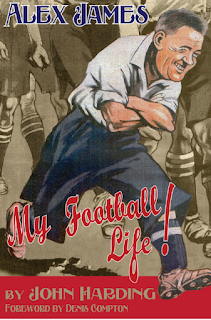
Alex James: Life Of A Football Legend, by John Harding, 16.99. Empire Publications 2024

The term “Arsenal legend” is used so frequently in the modern era that it can lose all its meaning or aura. But in the case of Alex James, it is an apt phrase. Even the legendary Matt Busby thought he was one of the all-time greats, and the great Liverpool manager Bill Shankly called him a “genius” and a “nightmare to play against”.

The first thing that comes to mind when reading this book is why bother reading about a player, no matter how good, who died nearly 74 years ago, and last played for Arsenal two years before Hitler invaded Poland.

From a footballing standpoint it is clear from even a cursory look at video footage of Alex James that he was an exceptional player and according to Ham & High Sport “In pantheon of Arsenal greats, he stands shoulder to shoulder – at the very least – with the likes of Dennis Bergkamp, Tony Adams, Frank McLintock and Joe Mercer.”[1]

People follow football teams for many different reasons. For me, I think the same way as Dennis Bergkamp: “When you start supporting a football club, you don’t support it because of the trophies, or a player, or history; you support it because you found yourself somewhere there — found a place where you belong.” While this is true in my case, I also fell in love with Arsenal because of its history.

My first season supporting Arsenal was the 1970/71 season. Many things attracted me to Arsenal. I mentioned its rich history, but what got me hooked was not only the atmosphere and the smell of fresh hot dogs, but Highbury was a thing of aesthetic beauty, so much so that its Art Deco design is still a listed building.

My first game, funny enough, was sitting in virtually the same seats as the Arsenal fan and writer Nick Hornby sat when his dad took him to his first game in the West Upper stand. The film Fever Pitch starring Colin Firth[2] Shows Hornby’s amazed look as he took in his first game. Another thing that attracted me was that Arsenal seemed to embody a classy way of doing things and embodied the mantra “ Play up and Play the Game”.[3]

It is to John Harding’s credit that he has reintroduced James to a modern readership. First published in 1988, this reissue in 2024 is updated with new stories and pictures. “Since the first release, I have added lots of new material and have changed my stance on James’ footballing role, Reprinting my book with new material, especially after leaving Highbury relatively recently in terms of the club’s history, seemed like a good opportunity to revisit his story – and to reintroduce him to a new generation of supporters, because we should not forget what Alex James meant to Arsenal.

“I am too young to have seen him play, but when I first started going to Arsenal back in the late 1950s, many people around me had seen him. “I grew up on stories about him, and he became a hero – James simply struck a chord with me. For me, Alex James was Highbury.”  The book is meticulously researched and is one of the best books on the history of  Arsenal Football Club. James was admired and deeply appreciated by his fellow professionals.

As a young boy, the great Tom Finney[4] Saw James play at Deepdale, Preston, saying  “James was the top star of the day, a genius. There wasn’t much about him physically, but he had sublime skills and the knack of letting the ball do the work. He wore the baggiest of baggy shorts, and his heavily gelled hair was parted down the centre. On the odd occasion when I was able to watch a game at Deepdale, sometimes sneaking under the turnstiles when the chap on duty was distracted, I was in awe of James. Preston were in the Second Division and the general standard of football was not the best, but here was a magic and a mystery about James that mesmerised me.”

While James and his fellow professionals’ lifestyle is a million light years away from the pampered multi-millionaires of today with their private jets, His lifestyle also set him apart from his fellow workers of his day.

As John Harding writes in his Oxford Dictionary of National Biography article, “James was a flashy, charismatic figure, easily identifiable on the field of play by his baggy shorts and flapping shirt and perfectly captured for posterity by the great sporting cartoonist of the inter-war years, Tom Webster (whose cartoon Harding uses for the cover of his updated  Book). Off the field, he was regularly in the news, usually demanding a higher wage or a transfer. James enjoyed the West End lifestyle available to a London-based player and was a regular habitué of fashionable cafés and bars. He was a prolific spender and a snappy dresser, but was unfortunate to be a sporting star at a time when footballers, though as well known as film stars, were paid a pittance by comparison.

He made strenuous efforts to cash in on his ‘image’: he was a sports demonstrator at Selfridges, he had regular columns in national newspapers, and he appeared in advertisements for cigarettes and sports goods. But when he retired in 1937, he had accumulated little, partly because he had no real business acumen. In 1938, he went to Poland to coach the Polish national side—a position he enjoyed but which came to an abrupt end when Germany invaded Poland in August 1939. During the war, James served as a gunner in the Royal Artillery’s maritime division stationed on the east coast. In 1947, he rejoined Arsenal as a reserve team coach, but he contracted cancer and, after a short illness, died on 1 June 1953 in the Royal Northern Hospital, Holloway, London. He was cremated at Golders Green crematorium.”[5]


[1] https://www.hamhigh.co.uk/news/21388151.remembering-arsenal-legend—alex-great/

[2] https://en.wikipedia.org/wiki/Fever_Pitch_(1997_film)

[3] https://exhibits.lib.byu.edu/wwi/influences/vitai.html

[4] https://en.wikipedia.org/wiki/Tom_Finney

[5] James, Alexander Wilson (1901–1953) John Harding doi-org.lonlib.idm.oclc.org/10.1093/ref:odnb/3414723-2004

160 George Orwell’s papers saved after a Public Protest.

“There are lots of people with lots of money who’d like a trophy. But you then lose track of them and they disappear, until they pop up on the market again.”

Prof Jean Seaton

‘I hope I shall get the chance to write the truth about what I have seen. The stuff appearing in the English papers is largely the most appalling lies, more I can’t say, owing to the censorship.’ –

George Orwell, May 1937

All animals are equal, but some are more equal than others

Animal Farm-George Orwell

“The horrible thing about the Two Minutes Hate was not that one was obliged to act a part, but, on the contrary, that it was impossible to avoid joining in. Within thirty seconds, any pretence was always unnecessary. A hideous ecstasy of fear and vindictiveness, a desire to kill, to torture, to smash faces in with a sledgehammer, seemed to flow through the whole group of people like an electric current, turning one even against one’s will into a grimacing, screaming lunatic. And yet the rage that one felt was an abstract, undirected emotion which could be switched from one object to another like the flame of a blowlamp”.

1984

About 160 historically important George Orwell papers have been acquired by University College London. The Gollancz Papers, as they were known were at risk of being sold to the highest bidder at auction.

The papers contain Orwell’s correspondence, contracts and readers’ reports relating to his earliest novels, dating from 1934 to 1937. The papers relate to four of his earliest published works – A Clergyman’s Daughter, Keep the Aspidistra Flying, The Road to Wigan Pier and Inside the Whale . His analysis of the politics of 1930s Europe, shaped his world viewpoint. The newly acquired papers contain manuscript notebooks, personal papers and the first handwritten notes of some of Orwell’s most famous words and phrases, such as “Two Minutes Hate”, “Newspeak”, and “War is Peace. Ignorance is strength. Freedom is slavery”.

The collection acquired by UCL had originally belonged to Orwell’s publisher, Victor Gollancz, who founded one of the 20th century’s most important left-wing publishing houses. Publishing several of Orwell’s early novels. However he refused to publish three of Orwell’s major political books, Homage to Catalonia, Animal Farm and Nineteen Eighty-Four.

Gollancz was particularly hostile to Orwell’s Homage to Catalonia. Gollancz thought Orwell was a Trotskyist and was hostile to Stalinism. Although no Trotskyist, Orwell was hostile to Stalinism. Orwell’s Homage to Catalonia is an important written by a gifted and honest writer committed to exposing the truth.

“Written in 1937, it is a moving account of the heroic revolutionary struggle of the Spanish people against fascism and for socialism. Above all, it provides irrefutable proof by an independent living witness to the crimes committed by the Stalinist bureaucracy in Spain and its betrayal of the Spanish revolution. Orwell’s account was a vindication of the analysis that had been made by Leon Trotsky and the International Left Opposition of the Soviet bureaucracy, whose policies had by then become utterly counterrevolutionary on a world scale.”[1]

A spokesman for University College London (UCL) said the papers were “a valuable piece of Britain’s cultural heritage”. UCL already has the world’s most comprehensive research material relating to Orwell. The purchase by UCL was done with the help of the National Heritage Memorial Fund and the Friends of the Nations’ Libraries to stop the collection falling into the hands of a few money-grabbing collectors. Anger was also expressed at the condition of the papers, which had been “languishing in dozens of rusty, dusty filing cabinets”.

The Orwell papers were owned by the Orion Group, which was in turn owned by Hachette. Hachette had no interest in the cultural value of the papers. Their decision to sell to the highest bidder because they were closing down the warehouse where the papers were stored had been condemned as an act of “Cultural vandalism”. According to Rick Gekoski in his 2021 book, Guarded by Dragons, “No one on the Orion board cared where they went, or to whom.”[2]

How Orion came to get the papers was explained by Richard Young, who writes, “Gollancz continued as an independent publishing house even after the death of Victor Gollancz in 1967, under the guidance of his daughter Livia. In the late 1980s, however, the business was sold to new owners and went through several changes of ownership in the 1990s, ending up under the Orion Group. In 2012, Orion was faced with a problem, in that the archive of Gollancz was by then housed in a warehouse on the south coast, along with archives from several other publishing houses. The warehouse provider planned to close the facility in the coming years, and so faced with this, Orion took the opportunity to put the archive up for sale.

So, what exactly is a publishing house archive? Essentially, it consists of two main elements: so-called file or archive copies of the books published by the firm, and secondly, the correspondence or publishing files relating to each of the published works. Gekoski did his best to place the entire correspondence archive with an institution. Those tapped included the British Library, as well as Universities in the UK and the US. The price tag of 1 million pounds, which Orion was seeking, proved to be a stumbling block, however, and all negotiations to sell the archive (which included significant George Orwell correspondence) in its entirety fell through.[3]

The capitalist speculators of the Orion company stands in stark contrast to the “extraordinary generosity” of Orwell’s only son of Richard Blair, who with his own money purchased 50 letters to donate them to UCL’s Orwell Archive, to stop them being gobbled up by vampire collectors and according to him “Then they’re never seen again.

Orwell’s biographer D J Taylor concurred with Blair, saying, “This is a fantastic treasure trove from the point of view of Orwell and publishing history … Literary manuscripts have a terrible habit of disappearing”.


[1] www.wsws.org/en/articles/2002/04/orwe-a11.html

[2] Guarded by Dragons: Encounters with Rare Books and Rare People Paperback – 19 Jan. 2023

[3] Orwell and the Gollancz Archive -orwellsociety.com/orwell-and-the-gollancz-archive/

You Can’t Please All Memoirs 1980-2024 by Tariq Ali (Verso Books, £35

This is the second book of a two-part memoir from the renowned political scoundrel Tariq Ali,[1]

The book is a bit of a car crash from an editorial standpoint. Hoping from different subjects and containing significant family memories. Born into a prominent family in Lahore, Ali’s uncle was the chief of Pakistan’s military intelligence. Ali remained heavily tied to the Pakistani ruling elite.

He was friends with Benazir Bhutto, the daughter of Pakistani Prime Minister Zulfikar Ali Bhutto. In his 2008 book, The Duel: Pakistan on the Flight Path of American Power, Ali wrote, “I knew [Benazir Bhutto] well over many years. The People’s Party needs to be re-founded as a modern and democratic organisation, open to honest debate and discussion, defending social and human rights, uniting the many disparate groups and individuals in Pakistan desperate for any halfway decent alternative, and coming forward with concrete proposals to stabilise occupied and war-torn Afghanistan. This can and should be done.”

From a political standpoint, given that Ali has been involved in countless major political betrayals, his use of the phrase “You Can’t Please All” for his book title exhibits a tremendous degree of cynicism on his part.

The book reels off several key political events without revealing Ali’s political involvement, such as the revolutionary upsurges of 1968–1975. He was an eyewitness in Moscow to the fall of the Soviet Union. His book on the subject is dedicated to Boris Yeltsin. He became close friends with the bourgeois nationalist Hugo Chavez.

The narrative is littered with anecdotes, reflections, notes and stories. It contains several portraits of fellow Pabloites, such as Ernest Mandel and Pseudo-left intellectuals, and collaborators who founded and relaunched ​New Left Review: E. P. Thompson, Perry Anderson and Robin Blackburn.

You Can’t Please All has been heavily reviewed in all major bourgeois media outlets. On the whole, the book has been met with favourable reviews. Pseudo-left groups such Counterfire have been especially fawning with Chris Bambery writing “ Reading You Can’t Please All, I was reminded of a saying we have in Scotland that someone is a ‘Man O’Pairts’, as one definition puts it, ‘ an all-rounder, broad in knowledge and at the same time practical.’ Tariq Ali is certainly that: an agitator, a historian and a theorist; novelist, playwright and film-maker; gourmet, cook and a traveller; debater and polemicist and more. “[2]

Ali began his early political life in the International Marxist Group, the British section of the Pabloite United Secretariat, whose fundamental opposition to Trotskyism centred on its rejection of the counterrevolutionary role of Stalinism and the need for a political revolution in the Soviet Union, instead attributing to the bureaucracy a progressive political mission.

In the book, Ali mentions his enormous political debt to his friend and mentor, Ernest Mandel. Mandel (1923 –1995) was the long-time leader of the revisionist United Secretariat. Born in 1923 in Frankfurt, Germany, he joined the Trotskyist movement in Belgium after the outbreak of the Second World War. Following the war, and still in his early twenties. His early life was dominated by his opposition to the theory that Stalinism had a progressive role to play in revolutionary politics. He renounced his previous opposition to Stalinism because of the emergence of Pabloism in the late 1940s.[3]

Max Boddy makes these central points: “ Mandel’s embrace of Pabloism did not flow from an incorrect economic theory, but the reverse. His economic analysis was based on his rejection of the revolutionary role of the working class as the gravedigger of capitalism. Mandel adapted to the restabilisation of bourgeois rule after the immediate post-war crisis. He put forward that the contradictions which led to the breakdown of world capitalism in 1914, and which propelled the working class into revolutionary struggles, had been overcome. Mandel sought to provide the economic justification for the rejection by Pabloism of the revolutionary role of the working class. He claimed capitalism had reached a new stage, in which the imperialist powers had resolved the inner contradictions that resulted in the barbarity of the early 20th century. He initially referred to this new period as neo-capitalism.”[4]

Ali’s political life in the International Marxist Group was supplemented by his involvement with the radical magazine New Left Review and the Pabloite publishers Verso. NLR’s origins lay in the merger of Universities & Left Review, run by ex-Stalinist Raphael Samuel and Cultural theorist Stuart Hall[5] alongside E.P. Thompson’s The New Reasoner. Apart from Perry Anderson, the majority of the founding members of the NLR were members of the IMG.

The orientation championed by the ULR and The New Reasoner was not towards the working class but to the radicalisation that was taking place inside the universities, and young people were the prime target of the editors.  While rejecting a revolutionary Marxist perspective, they sought to attract young people to the magazine on an entirely utopian socialist basis. Their uncritical absorption of the method of the Frankfurt School theorists meant, in essence, that Samuel and the ULR shared the same theoretical premise that the working class was not an agency for revolutionary change. They instead took on board critical theory, which saw the “emphasis moved from the liberation of the working class to broader issues of individual agency.” E.P. Thompson also shared this orientation.

The Marxists inside the Socialist Labour League and its publication Labour Review conducted a fight against the left radicalism of Samuel, Hall and E P Thomson. It opposed the various ideological trends that emerged from the collapse of Stalinism; these trends became known as “Western Marxism”. Foremost amongst them was the publication New Reasoner, which in 1960 became the New Left Review. Founded by former CPGB historian E.P. Thompson, its supporters claimed to be developing a “humanist” and English version of Marxism that repudiated Lenin’s theory of the vanguard party, which was blamed for the emergence of Stalinism.

The SLL’s Brian Pearce warned of the dangers of founding the New Left Review without thorough assimilation of the struggle waged by Leon Trotsky against Stalinism. Pearce warned of the dangers of an uncritical attitude by the ULR editors towards their past affiliation to Stalinism and their hostility towards the orthodox Marxist in the SLL. He writes, “Nothing could be more dangerous today than a revival of the illusions which dominated that ‘old Left.’ One of the chief sources of the confusion and worse in ‘new Left’ quarters, and in particular of their hostile attitude to the Socialist Labour League, is to be found in the fact that though these people have broken with Stalinism they have not undertaken a thorough analysis of what they repudiate, have not seen the connection between the contradictory features of Stalinism at different times or even at one time, and so they remain unconsciously open to influence by false ideas absorbed during their period in the Stalinist camp”.[6]

During the entire 800 pages of this book, Ali never explains anywhere any of his “political peregrinations”. As David Walsh writes, “ Why he supposedly adopted Trotskyism in the late 1960s, or why he abandoned it some years later; why he wanted to disrupt Labour Party activities at one moment and later tried to install himself as a member. He embodies the French expression, “Before 30 a revolutionary, after 30, a swine!”—except, in his case, the swinishness developed early on and just grew.”[7]

Ali still plays lip service to political events and is rolled out at meetings and conferences to deliver his political pearls of wisdom, but in reality, he is merely looking for “ greener pastures” and has become a major bourgeois commentator and gun for hire. When asked in an interview what the left can do today, he comments.

“Starmer is dreadful. I’m in no doubt that his policies will create a space that, at the moment, the far right will try to fill. We need to respond. But we can’t simply do what we did in the past, in the same ways. In the 1970s, the Anti-Nazi League and Rock Against Racism were vital, but the world has changed, the situation is different, and we need appropriate responses.

It won’t be easy, but you know it wasn’t always easy in the 1960s and 1970s. It took time to build the anti-Vietnam War movement. We were constantly under surveillance and harassment from the state.

Over the last few decades, we have witnessed the growth of dynamic movements, like Stop the War. Today, the struggle around Palestine has brought large numbers into action. The horrors of Gaza, the complicity of the Western governments in the slaughter, and the scale of the resistance movement on the streets will shape a generation.

But we need to think about organisational outcomes, establishing networks and rebuilding a progressive political alternative.

For the left, the Labour Party is finished. We should encourage the small number of left Labour MPS (especially those who had the whip removed) to work with the Independent MPS and together to try to offer an alternative vision and voice for me aside and said, “Look, I’ll tell you what the problem is. This isn’t Spain, which is part of Europe. This is a country far away. So, just transporting you guys over for political propaganda would cost us a lot of money, and we don’t have that much. Then, we have to make sure that you guys are protected. Because this isn’t a war fought with rifles, the Americans are bombing us all the time, they will kill some of you.”[8]

As David Walsh writes, it is the response of a middle-class freebooter who has lost his audience. Now officially “a former Marxist,” Ali had even less responsibility toward the working class than when he was a member of the International Executive Committee of the “United Secretariat” of the Pabloite “Fourth International.”

Notes

1.   Ernest Mandel, 1923 –1995- A critical assessment of his role in the history of the Fourth International- This collection of three lectures by David North places United Secretariat leader Ernest Mandel’s political contributions in the context of the struggles within the Fourth International during and after World War II. Mehring Books- $3.00

2.   The Heritage We Defend 2018 edition of the foundational 1988 work by David North, chairman of the International Editorial Board of the World Socialist Web Site, contains a new preface, photo section, and an extensive glossary.

3.   Mr Tariq Ali’s Radical Mumbo Jumbo- Workers Press March 7th 1972 https://www.marxists.org/history/etol/newspape/workers-press-uk/n707-mar-07-1972-Workers-Press.pdf


[1] keith-perspective.blogspot.com/2025/04/street-fighting-years-by-tariq-ali.html

[2] www.counterfire.org/article/you-cant-please-all-memoirs-1980-2024-book-review/

[3] See The Heritage We Defend- David North, Mehring Books.

[4] The ICFI’s exposure of Ernest Mandel’s “neo-capitalism” and the analysis of the global economic crisis: 1967–1971- http://www.wsws.org/en/articles/2023/09/09/rvtn-s09.html

[5] Cultural theorist Stuart Hall (1932-2014): A political career dedicated to opposing Marxism- https://www.wsws.org/en/articles/2014/03/05/hall-m05.html

[6] Some Lessons from History: The Left Review, 1934–1938

(November 1959) https://www.marxists.org/archive/pearce/1959/11/left-review.htm

[7] UK’s Stop the War Coalition: A bogus antiwar movement in the service of the Labour Party-https://www.wsws.org/en/articles/2015/11/30/stwc-n30.html

[8] Rashid Khalidi The Neck and The Sword Interviewed by Tariq Ali-New Left Review May\June 2024https://newleftreview.org/issues/ii147

Street Fighting Years- By Tariq Ali Verso 208pp £12.95

‘If the Vietnamese peasants can do it, why can’t we?’

Tariq Ali

He embodies the French expression, “Before 30 a revolutionary, after 30, a swine!”—except, in his case, the swinishness developed early on and just grew.

David Walsh

The dialectics of history have already hooked him and will raise him up. He is needed by all of them; by the tired radicals, by the bureaucrats, by the Nepmen, the upstarts, by all the worms that are crawling out of the upturned soil of the manured revolution. He knows how to meet them on their ground, he speaks their language, and he knows how to lead them. He has the deserved reputation of an old revolutionist, which makes him invaluable to them as a blinder on the eyes of the country. He has will and daring. He will not hesitate to utilise them and to move them against the Party. Right now, he is organising himself around the sneaks of the party, the artful dodgers.

Leon Trotsky

Statement of 1924 on Joseph Stalin’s growing power base, in Stalin, An Appraisal Of The Man And His Influence (1966); also in Stalin’s Russia 1924-53 by Michael Lynch, p. 18

All the parties of capitalist society, all its moralists and all its sycophants will perish beneath the debris of the impending catastrophe. The only party that will survive is the party of the world socialist revolution…

Leon Trotsky

Their morals and ours: and, The moralists and sycophants against Marxism (ed. 1968)

Street Fighting Years is the first part of a two-part biography.[1] By Tariq Ali, one of the best-known and one of the worst political opportunists and scoundrels ever to disgrace the workers’ movement. This new edition from Verso covers Ali’s litany of betrayals throughout the sixties and beyond. This edition includes a new introduction, as well as the famous interview conducted by Tariq Ali and Robin Blackburn with John Lennon and Yoko Ono in 1971.

After Street Fighting Years was written, Ali was already looking for “greener pastures,”. He became a darling of the bourgeois media, a novelist and a political pundit. He told the Guardian in May 2010: “It’s a problem people have had to come to terms with at different times in history: what do you do in a period of defeat?”

Ali came from a high-class family in Lahore. His uncle was the chief of Pakistan’s military intelligence. Ali went to England to study at Oxford. In 1968, he joined the International Marxist Group 1968. The IMG was the British section of the Pabloite movement. This was a retched organisation that, according to David Walsh, specialised in “political provocation, with more than its share of ‘naughty schoolboys.’ Dressed in Mao caps and the latest gear, they would occasionally show up at picket lines or in working-class neighbourhoods. Mostly, they stayed on the university campuses. Their supporters helped produce journals such as the Black Dwarf and the Red Mole.”[2]

Ali’s book covers the decade of the 1960s and into the 1970s, which were years of political, social and economic upheaval both in Europe and around the world. That the Capitalist system was able to survive during this period was thanks to the Stalinist and social democratic parties, and the trade unions, which used their mass influence to control the struggles and lead them to defeat. Ali, in his book, provides a left cover for these organisations.

Ali dedicates his book to another fellow political scoundrel, Ernest Mandel. According to a statement by the Socialist Equality Party, Ali was Mandel’s disciple. The leader of the Pabloite organisation in Britain could not contain his enthusiasm for perestroika and its initiators. He dedicated his book, Revolution From Above: Where Is the Soviet Union Going?, published in 1988, to Boris Yeltsin. His moving tribute declared that Yeltsin’s “political courage has made him an important symbol throughout the country. Ali, describing his visits to the Soviet Union, informed his readers that “I felt really at home.” The policies of Gorbachev had initiated the revolutionary transformation of Russian society from above, Ali asserted. There were those, he noted cynically, who “would have preferred (me too!) if the changes in the Soviet Union had been brought about by a gigantic movement of the Soviet working class and revived the old organs of political power—the soviets—with new blood. That would have been very nice, but it didn’t happen that way.” Ali then offered a succinct summary of the Pabloite perspective, which combined in equal measures political impressionism, naiveté, and personal stupidity.”[3]

Ali’s treachery and outright stupidity were welcomed by other pseudo-left groups. Paul Foot, writing for the UK Socialist Workers Party, wrote in the Literary Review, “He may be a rotten Marxist, but he’s the best raconteur the British Left has seen since the war. So spoke a sectarian friend of mine some fifteen years ago about Tariq Ali. I agree with both propositions. I will join sectarian battle with Tariq before this is over (where better than in the Literary Review, none of whose readers agree with either of us) but it is worth saying right away that there is no time of the day or night when any sane person would be sorry to see Tariq Ali and to talk with him. He laughs most of the time, especially at himself and his comrades. He is the most marvellous and melodious public speaker, with a deep love and care for the English language. What he is like speaking in his first language is beyond imagining.”[4]

Ali’s book catalogues all the major revolutions and political upheavals, but in a very cursory and superficial manner and without examining the major defeats and reasons behind several high-profile defeats.  Take France 1968, Ali writes, “In France, there was the largest General Strike in capitalism’s history and when the trade union bureaucrats went up to the workers and said ‘the bosses want to share a bit more of the cake with you’, the response from rank-and-file workers was ‘No! We want the whole bakery.” Ali played a not small part in the defeat of the French working class in the events of May-June 1968.[5]

Another revolution mentioned by Ali is the Portuguese Revolution. He writes, “In 1975, the Portuguese workers, peasants, students, soldiers and young officers brought society to the brink of revolution. They created a feeling that a fundamental change to society was possible and was within our grasp. And we felt that revolutionary change in Portugal would feedback, deepen and revive our movement across the rest of Europe.” Despite occasional setbacks and defeats, the period as a whole bred confidence in ordinary people and a deepening radicalisation that lasted up until about 1975.

These “occasional setbacks” are the bloody defeats of revolutions that swept throughout Europe and beyond. None more so than the terrible defeat that the Portuguese working class suffered and is still dealing with the aftermath even today.

On April 25 1974, a coup by lower-ranked army officers overthrew Portugal’s fascist Estado Novo government. The coup opened the way for a massive mobilisation of the working class, which had not been seen in Portugal before. It was one of the most important revolutions since the Second World War and caught the international bourgeoisie completely by surprise. It would take nearly two years to defeat the revolution. With relatively little violence or bloodshed, the Portuguese bourgeoisie could take back power at the expense of a few limited reforms. The popular front government established by the revolution, which contained a significant Communist Party presence under the leadership of Álvaro Cunhal, handed over power without a murmur from the numerous pseudo-left groups.

Despite his catalogue of betrayals, Ali is still lionised in the bourgeois press. When asked What do you think are the prospects for the left today? He writes

“Starmer is dreadful. I’m in no doubt that his policies will create a space that, at the moment, the far right will try to fill. We need to respond. But we can’t simply do what we did in the past, in the same ways. In the 1970s, the Anti-Nazi League and Rock Against Racism were vital, but the world has changed, the situation is different, and we need appropriate responses. It won’t be easy, but you know it wasn’t always easy in the 1960s and 1970s. It took time to build the anti-Vietnam War movement. We were constantly under surveillance and harassment from the state.

Over the last few decades, we have witnessed the growth of dynamic movements, like Stop the War. Today, the struggle around Palestine has brought large numbers into action. The horrors of Gaza, the complicity of the Western governments in the slaughter, and the scale of the resistance movement on the streets will shape a generation. But we need to think about organisational outcomes, establishing networks and rebuilding a progressive political alternative. For the left, the Labour Party is finished. We should encourage the small number of left Labour MPS (especially those who had the whip removed) to work with the Independent MPS and together to try to offer an alternative vision and voice for the future. We need some type of home, not necessarily a formal political party, for the 200,000 who left Labour when Corbyn was marginalised and kicked out; a home to those from the Palestine and anti-imperialist movements; a home for the old and new left. I think we face a long period of rebuilding, there is no quick fix. But if we sit back and do nothing, things will only get worse.”[6]

As this answer shows, Ali has no qualms about ditching his radical past for a financially comfortable existence as a bourgeois commentator. There is no trace of his “brief spurt of leftism, which fizzled out by the late 1970s.

As David Walsh points out “Ali has never explained, anywhere, for any of his political peregrinations: Why he supposedly adopted Trotskyism in the late 1960s, or why he abandoned it some years later; why he wanted to disrupt Labour Party activities at one moment and later tried to install himself as a member. He embodies the French expression, “Before 30 a revolutionary, after 30, a swine!”—except, in his case, the swinishness developed early on and just grew.”


[1] You Can’t Please All: Memoirs 1980-2024

[2] The presence of Tariq Ali at the “Socialism 2010” conference- http://www.wsws.org/en/articles/2010/06/tari-j18.html

[3] Perestroika and Glasnost in the USSR- http://www.wsws.org/en/special/library/foundations-us/56.html

[4] Paul Foot-Rotten Marxist, Nice Bloke Street Fighting Years

By Tariq Ali Collins 208pp £12.95

[5] www.counterfire.org/article/tariq-ali-memories-of-the-struggle-reloaded/

[6] www.counterfire.org/article/tariq-ali-memories-of-the-struggle-reloaded/

The Rise of Trump and the Crisis of American Democracy-The World Socialist Website-Mehring Books 2025

 “Hell is empty, and all the devils are here”

William Shakespeare-The Tempest

“I don’t believe lies are something to stand on. I believe lies are something to build on.”

― Philip Roth, Our Gang

“Facts are stubborn things; and whatever may be our wishes, our inclinations, or the dictates of our passion, they cannot alter the state of facts and evidence.”

― John Adams

“The Senator was vulgar, almost illiterate, a public liar easily detected, and in his “ideas” almost idiotic, while his celebrated piety was that of a traveling salesman for church furniture, and his yet more celebrated humour the sly cynicism of a country store. Certainly there was nothing exhilarating in the actual words of his speeches, nor anything convincing in his philosophy. His political platforms were only wings of a windmill.”

― Sinclair Lewis, It Can’t Happen Here

In his introduction to this book Joseph Kishore makes the following point that the return of Donald Trump to power represents “the violent realignment of the American political superstructure to correspond with the real social relations that exist in the United States.”

He continues “Trump’s rise and return to power is not an aberration but the product of deep-rooted crises in American and world capitalism. His administration is carrying out a historic restructuring of the state, tearing apart the remaining democratic constraints on oligarchic rule, and preparing for global war.”

Why is this analysis made by the World Socialist Website so important. Because the analysis, published by the World Socialist Web Site (WSWS) following Trump’s second election, not only traces the emergence of Trump, but the political forces also that enabled him, they provide an essential strategy for opposing his government.

While there is a violent realignment of the American political superstructure to correspond with the real social relations that exist in the United States a similar process taking place in the working class. The working class will need to realign its politics to meet head on the new challenge. Part of that process is a systematic study of the articles contained in this book.

Leon Trotsky was fond of saying that the motive force of history is truth and not lies. The correct and truthful analysis made by the World Socialist website has been met by a number of Pseudo Left organisations with hostility at the temerity of calling Trump a Fascist.

Alan Woods, leader of the Revolutionary Communist International (RCI), the successor to the International Marxist Tendency (IMT), published an article that starkly illustrates the complacent and anti-Marxist orientation of his political tendency. Revealingly titled “Trump victory: a kick in the teeth for the establishment,” the article echoes Trump’s fraudulent claims of being an anti-establishment figure while downplaying the immense dangers posed by a Trump presidency to the working class.[1]

Woods writes “The ruling class of America – firmly supported by the governments of Europe – was determined to keep him [Trump] out of office, by fair means or foul. After Trump was ousted in the 2020 election, everything was done to prevent him from standing again… All the numerous attacks against him rebounded and turned against those who were seen – correctly – as being involved in a conspiracy to prevent him from re-entering the White House.”[2]

The World Socialist Website opposed Woods complacency writing “This portrayal is false. The ruling class was not “determined to keep [Trump] out of office.” Significant sections of the financial and corporate elite, including billionaires like Elon Musk and Peter Thiel, actively supported Trump, viewing his authoritarian and pro-business agenda as a means of furthering their own class interests. Others, like Jeff Bezos, have proclaimed their support for Trump after the election.” [3] The article went on to reiterate its position that Trump and his allies were fascists.

The writer Sinclair Lewis was well aware of people like Woods who downplayed the fascist danger writing “The tyranny of this dictatorship isn’t primarily the fault of Big Business, nor of the demagogues who do their dirty work. It’s the fault of Doremus Jessup! Of all the conscientious, respectable, lazy-minded Doremus Jessup’s, who have let the demagogues wriggle in, without fierce enough protest.”[4]

While the development of an American fascist oligarchy is a new development the fear of an American oligarchy is not. In his book John Adams and the Fear of an American Oligarchy Luke Mayville shows that Adams who was the second American president spent most of his adult life warning about the development of an American Oligarchy. In a letter to Thomas Jefferson dated 2 September 1813 he writes. Now, my Friend, who are the aristoi.? Philosophy may Answer “The Wise and Good.” But the World, Mankind, have by their practice always answered, “the rich the beautiful and well born.” And Philosophers themselves in marrying their Children prefer the rich the handsome and the well descended to the wise and good.”[5]

While it is one thing to describe Trump and his gang as fascists it is another to set his dictatorship in the same context as the rise of Hitlerite fascism in 1933. David North, the chairman of the International Editorial Board of the World Socialist Web Site and national chairman of the Socialist Equality Party (US), in his introductory remarks to the post-election online webinar “The Election Debacle and the Fight Against Dictatorship,” warned:

Now, it is not the position of the SEP and the WSWS that the accession of Trump to the presidency is the equivalent of Hitler’s 1933 victory. The United States is not Weimar Germany, and the transformation of the United States into a police state dictatorship backed by a mass fascist movement will not, whatever Trump’s intentions, be achieved overnight.  But it would be politically irresponsible, and contribute to the success of Trump’s aims, not to recognize the dangerous implications and real consequences of last Tuesday’s election. At the very least, it is necessary to take Trump at his word.[6]

Not all are inclined to take Trump at his word. In a recent collection of essays entitled Did it Happen Here, Perspectives on Fascism and America the British historian Richard Evan took Umbridge that Trump is a fascist, and his gang constituted an albeit small fascist movement.

He writes “The temptation to draw parallels between Trump and the fascist leaders of the 20th century is understandable. How better to express the fear, loathing and contempt that Trump arouses in liberals than by comparing him to the ultimate political evil? But few who have described Trump as a fascist can be called real experts in the field, not even Snyder. The majority of genuine specialists, including the historians Roger Griffin, Matthew Feldman, Stanley Payne and Ruth Ben-Ghiat, agree that whatever else he is, Trump is not a fascist.”[7]

It is perhaps a little surprising that a historian of Evans calibre should be so complacent and wrong. His solution to the crisis of American democracy is also wrong and sows’ dangerous illusions. He writes “Whether the US and its citizens succeed in preserving democracy and its institutions depends largely on whether they succeed in identifying what the real threats are and developing appropriate means to defeat them. Imagining that they are ­experiencing a rerun of the fascist ­seizure of power isn’t going to help them very much in this task. You can’t win the political battles of the present if you’re always stuck in the past.

It is recommended that those workers and youth who recognize that Trump is threatening dictatorship, and is a fascist should carry out a thorough a study of the analysis made on the World Socialist Web Site and especially the articles contained in this book and prepare themselves for the coming momentous battles.


[1] Trump victory: a kick in the teeth for the establishment-https://marxist.com/trump-victory-2024.htm

[2] Trump victory: a kick in the teeth for the establishment-https://marxist.com/trump-victory-2024.htm

[3] Alan Woods, leader of pseudo-left RCI, hails election of Trump as “kick in the teeth” to US ruling class.wsws.org

[4] Sinclair Lewis, It Can’t Happen Here

[5] John Adams to Thomas Jefferson, 2 September 1813- founders.archives.gov/documents/Jefferson/03-06-02-

[6] Alan Woods, leader of pseudo-left RCI, hails election of Trump as “kick in the teeth” to US ruling class

[7] Why Trump isn’t a fascist- https://www.newstatesman.com/world/americas/north-america/us/2021/01/trump-fascist

Christopher Hill: The Life of a Radical Historian Michael Braddick Verso, pp. 320, £35

Marx “Men make their history, but they do not make it just as they please; they do not make it under circumstances chosen by themselves, but under circumstances directly encountered, given and transmitted from the past.

Karl Marx

“But history is neither watchmaking nor cabinet construction. It is an endeavour toward better understanding.”

Marc Bloch

“We develop new principles for the world out of the world’s own principles. We do not say to the world: Cease your struggles, they are foolish; we will give you the true slogan of struggle. We merely show the world what it is really fighting for, and consciousness is something that it has to acquire, even if it does not want to.”

Karl Marx, (1843)

“The ‘great’ national historian Macaulay, vulgarises the social drama of the seventeenth century by obscuring the inner struggle of forces with platitudes that are sometimes interesting but always superficial.”

Leon Trotsky

Michael Braddick is to be commended for writing the first and only biography of the Marxist historian Christopher Hill. Having said that it is a little surprising that the Pabloites at Verso book publishers want Hill to be known as a radical historian rather than a Marxist one. Whether Braddick protested over this is unknown to me but throughout the book he clearly believes Hill was a Marxist from an early age.

The book is professionally written and researched. If Thomas Carlyle looked to clear Oliver Cromwell’s reputation from under a pile of dead dogs Braddick had to do the same with Hill. By any margin this is a significant and ground-breaking book. Although given the statue and importance of Hill, it is still hard to believe this is the first biography of the great man.

As Braddick correctly portrays Hill was a mass of political and social contradictions he was both a Fellow of the British Academy and the Master of Balliol College, Oxford, a paid-up member of the British Communist party and gave lectures at the British Socialist Workers party summer schools on a regular basis.

Braddick had his work cut out in examining and placing Hill in the context of the time. With his fifteen books and dozens of articles, Hill fundamentally changed how we understood the English Revolution and popularised the theory that there was a bourgeois revolution in 1640s England. Hill’s theory came under sustained attack from the Stalinists inside the Communist Party of Great Britain. Hill’s essay The English Revolution of 1640 was the catalyst for a wide-ranging and divisive battle within the groups and beyond. Stalinists which included leading historians inside the group and leading members of the central committee of the Communist party took exception to Hill’s characterisation of the English Revolution as ‘Bourgeois.’ They, therefore, opposed the conception that the 1640s revolution represented major a turning point in the transition from feudalism to capitalism. Anyone who sided with Hill’s position was accused of “Hillism.”[1].

Hill influenced how a generation of students and general readers saw the English Revolution. Although his viewpoint that the events of the 1640s constituted a revolution was rejected and attacked by a group of revisionist historians and writers. Undeterred Braddick still believes that general readers and academics still must define their position on the period from his perspective.

Hill’s reluctance to take on the revisionists politically did not stop the Pseudo lefts in the SWP from using Hill to try a launch an unsuccessful struggle against them. The historical revisionism that struck the study of the English Revolution began in earnest in the 1960s. Its central aim was to refute both the Whig and Marxist interpretation of the English Revolution and, in doing so, conceal the true political and class nature of the Revolution. John Rees was a former member of the Socialist Workers. Party (now a member of Counterfire). At the time he was a member of the SWP and like all Pseudo Left organisations, the SWP was extremely reluctant to take to the battlefield against a coterie of revisionist historians. The SWP would sooner wait till it set up a connection with left-leaning historians, such as Hill and Brian Manning and let them do the fighting. To say the results of this policy were mixed was an understatement.

In an article John Rees wrote in 1991, “We have waited some considerable time for Christopher Hill to enter the lists against the revisionist historians of the English Revolution. Of course, Hill has taken the occasional pot-shot at the revisionists in articles and lectures, some of which form the basis for this book. But generally, he seems to have stayed a little aloof, cultivating a disdain which still lingers in this book’s introduction, where he claims, ‘We should not take these fashions too seriously: they go in cycles, and it is no doubt my age that makes me a little sceptical of latter-day “revisionist” historians who try to convince us that there was no revolution in 17th century England, or that if there was it had no long-term causes or consequences.[2]

Before reading any history book one should always take on board the great E H Carr’s maxim “Study the historian before you begin to study the facts.”[3] Braddick is not a Marxist historian and is heavily influenced by the French historian Fernand Braudel who championed the idea of the “longue durée.”

As “Simon Jenkins wrote “Michael Braddick is a true Braudelian. He is a historian not of who, what and when but of how and why. From Stonehenge to Brexit and Danegeld to coronavirus, his concern is for the setting of history, its intellectual and physical environment, and “the capacity of British people to use political power to get things done.”[4]

Although Braudel had strengths he also had very deep-seated weaknesses. As the Marxist writer Ann Talbot points out, “If Braudel’s approach to history has its strengths, it also has disadvantages. These relate to two areas-historical change and socio-political history. Braudel was a conservative historian who, although living in a country whose name was synonymous with revolution, was averse to change, particularly sudden changes of a revolutionary character. He attempted to develop a form of socio-economic history that did not rely on Marxist concepts and stressed continuity rather than change.”[5]

Throughout the book Braddick constantly grapples with the conundrum of what was Hill politically. Braddick uses the term Marxist without really examining precisely what that means. Hill was never an orthodox Marxist and was never remotely close to Leon Trotsky or the Trotskyists inside the Fourth international who defended Marxism from its Pabloite and Pseudo Left revisionists. As Ann Talbot writes “The fact that Hill was not among the most politically advanced elements of the party—those who then joined the Fourth International—is a greater tribute to them than it is a criticism of him. His work showed him to be a better historian than he was a political thinker.”

I somehow doubt that Braddick contacted or looked at the work of the Marxists of the World Socialist Website. If he, had he would have found an excellent and thought-provoking essay on Hill by Ann Talbot.

As Ann Talbot asks in her excellent obituary of Christopher Hill, “What any serious reader interested in history or politics wants to know is, when we read Hill’s books, are we reading the work of an apologist for the Stalinist bureaucracy or of someone who was genuinely struggling to make a Marxist analysis of an aspect of English history? It must be said that this is a complex question. Not everyone who was attracted to the bureaucratically degenerated Communist Party could be classified with the Webbs. The most gifted and outstanding representatives of the British intellectual elite, whether poets, novelists, scientists, musicians or historians, associated themselves with the Communist Party because the old institutions of church and state had lost their hold over the imaginations of the young while the Soviet Union seemed to embody all that was new, modern and progressive.”[6]

One thing that does surprise me is that a historian of John Rees’s expertise was not invited to write a major review of Braddick’s book. Rees did a review for his political organisation Counterfire.[7] Rees tends to imply in this quote below that Hill and the Communist Party historians Groups adoption of Peoples history and the so-called Marxist-humanist current was a valid part of classical Marxism. He writes:

“Hill’s Marxism was certainly formed originally in the 1930s while he joined the Communist Party. Even then, the historians within the Communist Party were certainly not a pale reproduction of Moscow orthodoxy. In part, they were simply more deeply engaged in the study of their various periods and were producing material in greater depth than could be covered by the generalities of the orthodoxy. This part of the review I have no qualms about. It is this part that I have an opposition to. He continues:

“This was not necessarily a hostile counter position. Generalisations and specific research can often interact in productive ways: generalisation is amended by specific findings, and specific findings altered when placed in a general context. However, that may be, by the time Hill and other members of the Communist Party Historians Group (CPHG) left the party in 1957 in the wake of the Russian invasion of Hungary, they were also being shaped by the so-called Marxist-humanist current of that time. This current had deep roots in Marx’s method, in particular the early writings then for the first time becoming widely available. It obviously was adopted, and methodologically defended, by Hill’s friend and comrade Edward Thompson. It was also common coin for Hill, Rodney Hilton, Victor Kiernan, Brian Manning, and other former members of the CPHG.”

This so-called Marxist-humanist current produced “Peoples History” As Ann Talbot succinctly puts it “the Communist Party sponsored a form of “People’s History,” which is typified by A.L. Morton’s People’s History of England in which the class character of earlier rebels, revolutionaries and popular leaders was obscured by regarding them all as representatives of a national revolutionary tradition. This historical approach reflected the nationalism of the bureaucracy, their hostility to internationalism and their attempts to form an unprincipled alliance with the democratic capitalists against the fascist Axis countries. People’s history was an attempt to give some historical foundation to the policies of Popular Front—the subordination of the working class to progressive sections of the bourgeoisie and the limiting of political action to the defence of bourgeois democracy—which supplied a democratic facade to the systematic murder of thousands of genuine revolutionaries, including Trotsky. It was the approach that Christopher Hill was trained in, along with E.P. Thompson, Rodney Hilton and Eric Hobsbawm, who were part of the Marxist Historians Group and came under the influence of Maurice Dobb and Dona Torr.” Hil was enough of a Marxist is not completed absorbed by Morton’s Peoples History genre, but he did keep Morton’s national approach to historical questions. And the influence of the popular front politics and national outlook of Stalinism stayed with him most of his career.

Overall Braddick’s book has been met with serious and mostly favourable media responses. One ridiculous and dissenting voice appeared in the form a review entitled A Stalinist chump at Oxford, the Civil War historian who misjudged his own times by Richard Davenport-Hines in the TLS (Times Literary Supplement) He writes:

“Four years ago, Braddick published an ambitious study of political agency, spanning the period from Neolithic to Brexit Britain, entitled A Useful History of Britain: The politics of getting things done. It is a compelling study of people outside ruling institutions mustering their organizational strength, preparing themselves for action and maximizing their collective force to achieve social and material change: every chapter bears Hill’s traces. Braddick’s epigraph for his Useful History – Marc Bloch’s remark that “a man may wear himself out just as fruitlessly in seeking to understand the past, if he is totally ignorant of the present” – would serve Hill equally. He misjudged the conditions in which he lived the first half of his life, and therefore interpreted the past in terms that could be skewed or incomplete.”[8]

To justify is hack work he enlists other historians to do his dirty work saying “There was formidable criticism of Hill’s method, and especially of his arrangement of research notes by predetermined categories. “Whatever Christopher Hill reads seems to provide him with additional support for views he already holds,” Keith Thomas noted. Briggs judged that his “highly dubious categorization” was essential to his work’s “creative richness.” John Morrill reproached him for neglect of archival sources and original letters. Others objected that he plucked quotations out of context, omitted material that contradicted his arguments and made excessively bold jumps in his conclusions.”

Davenport- Hines’s hack review aside Braddick’s excellent biography not only situates Hill’s life and work in its historical context but looks to rescue Hill for a new generation of readers. As Ann Talbot said “As a historian he stands far above his detractors and his books deserve to be read and reread, and if with a critical eye, it should always be with the knowledge that his limitations and faults as much as his great historical insights and innovations are the product of his time. He may be bettered, but never dismissed, and only bettered by those who have studied him closely.”

[1] Document 12 (1947) the Basis and Character of Tudor Absolutism-Ideology, Absolutism, and the English Revolution: Debates of the British Communist Historians, 1940-1956 (2008) David Parker-Lawrence & Wishart.

[2] Revisionism refuted-https://www.marxists.org/history/etol/writers/rees-j/1991/xx/engrevrev.html

[3] What is History? (1961)

[4] Ideas made us: The resilience, so far, of our political institutions. Aug. 20, 2021- TLS.

[5] Europe Between the Oceans by Barry Cunliffe- ww.wsws.org/en/articles/2008/10/book-o09.html

[6] “These the times … this the man”: an appraisal of historian Christopher Hill- http://www.wsws.org/en/articles/2003/03/hill-m25.html

[7] Christopher Hill redux- https://www.counterfire.org/article/christopher-hill-redux-book-review

[8] https://www.the-tls.co.uk/lives/biography/christopher-hill-michael-braddick-book-review-richard-davenport-hines

Comment on the Daily Telegraph review of John Rees’s book, Fiery Spirits Christopher Thompson

Let me begin by agreeing that the origins of large-scale petitioning on political and religious matters can be found in the records of the movement for a Presbyterian settlement for the Church of England in the 1580s. This was the precedent for the later petitioning activities in the early to mid-Stuart period. However, petitioning itself was common at all levels of English and Welsh society on local and other matters by then. Recognising that such appeals were one of the common features of bargaining between the Crown, the Privy Council and other organs of the State and Church at that time is appropriate. Charles I’s critics in the 1620s and again by 1640 utilised such means.

We can see this in the coordinated petitions submitted to the Short Parliament in the spring of 1640 and later in and after November 1640 when the Long Parliament met. The leaders of the so-called ‘Junto’, men like the 2nd Earl of Warwick, Viscount Saye and Sele, the 2nd Lord Brooke, John Pym, Oliver St John and others, understood the importance of exercising pressure on the King and his advisers to secure what they regarded as essential concessions.

Valerie Pearl showed in her 1954 D.Phil. thesis and her 1961 book based on her thesis how these men worked together with their radical allies in the city of London to bring popular demonstrations, charges against recalcitrant proto-Royalists and petitioning to this end. These activities were not necessarily as spontaneous as figures like Brian Manning and Christopher Hill supposed. Take just one example: the M.P.s for London. Cradock and Venn were well known to Warwick and the others from their involvement in the activities of the New England and Massachusetts Bay Companies: Samuel Vassall was one of Warwick’s tenants; Isaac Pennington was, like Warwick, one of the supporters of Samuel Hartlieb’s activities.

Owen Rowe was Warwick’s brother-in-law from 1625 to 1645. Warwick had important connections with seamen and shipbuilders in London stretching back to the mid-1610s and onwards to the end of 1648. The Providence Island Company’s financial affairs throw a revealing light on the connections of these peers and gentlemen with mercantile figures before 1640 and, indeed, in later ventures after the start of the Civil War.

I ought to add that ascribing the term ‘revisionist’ to John Rees creates a problem since this is the description usually applied to those historians who, from 1976, undermined and replaced the older Whig and Marxist explanations for the events of the 1640s. Perhaps, I may be allowed to add the heretical thought that the English Revolution or the Great Rebellion (or, as I prefer to call it, this ‘grand soulevement’) took place against the background of a significant improvement in the position of the larger landowners since 1600, as W.R.Emerson argued and which, were I a Marxist, might explain why these conflicts began and why the post-1649 settlements failed and the Restoration took place.