Biography as demonology: Aidan Beatty’s The Party is Always Right: The Untold Story of Gerry Healy and British Trotskyism
This review is by David North. Here is a link to the article- https://www.wsws.org/en/articles/2024/09/18/nizy-s18.html
Professor Aidan Beatty’s The Party is Always Right: The Untold Story of Gerry Healy and British Trotskyism is a malicious piece of political hack work posturing as a biography. The book discredits its author and meets none of the standards that are expected of what is being advertised as a scholarly work. The book is nothing of the sort. Beatty has produced a crude diatribe against Trotskyism and its historic efforts to construct a revolutionary party rooted in Marxist theory and based on the working class.
Historians who undertake the arduous task of writing a serious biography—among the most difficult of genres—often introduce their work with an effort to explain to their readers why they embarked on a project that usually requires years of intensive research. When the subject of study is a political figure, the interactions of the individual and the epoch in which he or she lived are immensely complex. There is a profound truth in the adage that a man resembles the age in which he lives more than he resembles his father. A vast amount of work is required, not to mention a command of the historical landscape and intellectual subtlety, to understand the historically conditioned personality, psychology, motivations, aims, ideals, decisions and actions of another human being.
Whether the writers admire or despise their subject, they are still obligated to understand in historical terms the person about whom they are writing. When the author genuinely admires his subject, he or she must still retain a critical distance that avoids a descent into hagiography. The great biographies of political figures—Samuel Baron’s study of Plekhanov, J.P. Nettl’s two volumes on Rosa Luxemburg, Isaac Deutscher’s Trotsky trilogy—managed to maintain an objective attitude toward subjects for whom they clearly felt great empathy. Perhaps even more challenging was the task confronting Ian Kershaw, who devoted years of work to the study and explanation of the ideological, political and psychological motivations of one of the worst mass murderers in history, Adolf Hitler.
In the preface to The Prophet Unarmed, the second volume of his Trotsky biography, Isaac Deutscher recalled Carlyle’s description of the task he confronted as the biographer of Oliver Cromwell. Like Carlyle with the leader of the English Revolution, Deutscher had to drag the leader of the October Revolution “from under a mountain of dead dogs, a huge load of calumny and oblivion.”[1] Beatty has set out to do precisely the opposite. His aim is to bury Healy beneath as much muck and slime as Beatty was able to gather. There is not a trace of scholarly objectivity, let alone intellectual integrity, in the work produced by Beatty. Nor was it his intention to write a legitimate biography. His project is mired in a calculated deception. In the Acknowledgements that precede the text, Beatty writes: “I can’t remember when I first ever heard of Gerry Healy, but by the very start of 2020 I had begun to gather material on him…” [p. ix] This duplicitous statement is a cover-up by Beatty of his real reasons for writing this book. Some truth in advertising is in order.
Beatty did not stumble, as he falsely claims, upon the name of Gerry Healy in 2020. From 2014 to 2018, Beatty worked as an adjunct academic at Wayne State University in Detroit, where the Socialist Equality Party and its youth organization, the International Youth and Students for Social Equality, have been active for years—distributing literature, holding numerous well-advertised public meetings, and recruiting members. Their presence on the WSU campus has been bitterly opposed by the Democratic Socialists of America, which has gone so far as to solicit the services of campus security forces to disrupt the activity of the SEP and IYSSE. Beatty, while teaching at Wayne State, was a member of the Metro Detroit Democratic Socialists of America, which functions as an adjunct of the Michigan Democratic Party. According to the KeyWiki entry on the Michigan DSA (which identifies Beatty as a member), “Democratic socialists in southeastern Michigan possess a level of influence within the Michigan Democratic Party of which many American leftists dream.”
Now living in Pittsburgh, where he teaches at Carnegie Mellon University, Beatty is an active member of the DSA and a bitter opponent of Trotskyism, which he identifies with an adherence to the class-grounded politics of orthodox Marxism. Beatty’s extensive Twitter/X archive includes numerous repostings of statements by and tributes to Alexandria Ocasio-Cortez, Bernie Sanders and other Democratic Party luminaries.
A factional polemic for the DSA
It is evident that the narrative presented by Beatty in explaining the origins of his book is based on a lie, whose purpose is to palm off as a scholarly work a factionally motivated political polemic.
Beatty claims that the outbreak of the COVID-19 pandemic in 2020 unexpectedly provided him with “a lot of time on my hands,” and thus enabled Beatty “to delve further and further into the world of the Workers Revolutionary Party (WRP).” [p. ix] This is a fraudulent narrative, disproven by Beatty’s own account of his career. From 2016 until 2023, he was intensely engaged in researching, writing and editing his book, titled Private property and the fear of social chaos, which was published last year.
Far from having lots of free time, Beatty stated in the Acknowledgements of the latter work: “I completed the final revisions in a spare bedroom converted to an office and virtual classroom in the midst of the COVID-19 pandemic.”[2] Authors of scholarly works will attest to the fact that the final stages of preparing a text for publication are nerve-racking and require intense concentration. So how did Professor Beatty, who also calls his readers’ attention to the demands on his time arising from parenting obligations, manage to research and write and shepherd through the publication process an entirely different project—about a subject he claims to have previously known nothing—while simultaneously engaged in the writing of another book, which occupied the central place in his academic career?
Further questions must be raised about the financing of this project. He writes in the Acknowledgements: “My research in Britain was funded by the Program on Jewish Studies and the World History Center at the University of Pittsburgh, who were generous enough to see the Jewish, Israeli-Palestinian and global connections of this project.” Professor Beatty fails to identify the nature of these “global connections” and how he managed to convince organizations with pronounced Zionist sympathies to finance a biography of an Irish-born Trotskyist who indefatigably defended the struggle of the Palestinian people against the oppression of the Israeli state. One doubts that these institutions feared that Beatty would deliver a final product that evinced sympathy for Healy’s politics. Beatty should answer these questions by making the text of his applications for funding available.
The excavation and accumulation of dreck requires not only the financial support of institutions with deep pockets. It alsotakes time and effort. Beatty obviously had substantial assistance from the DSA. Beatty also secured the support of Pluto Press, the publishing house of a political tendency founded more than 45 years ago by factional opponents of Healy, the Workers Revolutionary Party and the ICFI.
At the very time when Beatty was engaged in his “research,” leading members of the DSA were posting on Twitter memes of ice picks and celebrating the assassination of Leon Trotsky. This obscene campaign was of such an extensive scale that the SEP sent on May 22, 2021 an open letter to Maria Svart, the national director of the DSA, demanding that the DSA “unequivocally denounce and repudiate the Twitter posts, and statements in any other media, that revive Stalinist lies and celebrate the assassination of Trotsky.” The letter continued, “The DSA must make clear that the propagation of Stalinist lies, thereby sanctioning not only past but also future attacks on the Trotskyist movement, will not be tolerated and is incompatible with membership in its organization.”
The letter to Svart, which I wrote in my capacity as the SEP’s national chairman, stated:
The essential political purpose of their campaign against Trotskyism is 1) to poison the political environment within the DSA with reactionary anti-Marxist filth appropriated from Stalinism, and 2) to attract to the DSA socially backward people who are drawn to the anti-communist, chauvinistic and—let’s not beat around the bush—anti-Semitic subtext of denunciations of Leon Trotsky. Judging from tweets that have been posted in support of the DSA leaders’ attacks on Trotsky, the campaign is drawing around your organization extremely reactionary elements who should have no place within a genuinely progressive, let alone socialist organization.[3]
Ms. Svart did not reply to this letter nor repudiate the attacks. Beatty’s exercise in character assassination began while these attacks were in progress and, clearly, is a continuation of the same operation. Healy is only the proximate target. The broader purpose underlying Beatty’s repulsive narrative is to denounce Trotskyism and the efforts to construct a revolutionary socialist party of the working class. As Beatty states, his biography
is also, more seriously, a story about Trotskyism, the political tradition that birthed Healy as an activist and which he also, in turn, helped (re)create. It is a cautionary tale about the tendency that Trotskyism has always had towards schisms and personal animosity and about the inherent flaws in “democratic centralist” parties that often brook no dissent and can even act as incubators for predatory men like Gerry Healy. [p. xvi-xvii]
Beatty’s smut-filled diatribe consists almost entirely of a recycling of denunciations and outright lies circulated by bitter enemies of Healy with personal axes to grind, most of whom abandoned socialist politics decades ago and have evolved into virulent anti-communists.
Beatty’s volume recalls Marx’s description of the Daily Telegraph: “By means of an artificial system of concealed plumbing, all the lavatories of London empty their physical refuse into the Thames. In the same way the capital of the world spills out all its social refuse through a system of goose quills, and it pours out into a great central paper cloaca—the Daily Telegraph.”[4] Mocking the newspaper’s unscrupulous and scandal-mongering proprietor, Levy, Marx wrote that his skill “consists in its ability to titillate with a rotten smell, to sniff it out a hundred miles away and to attract it.”[5]
A description that applies to Beatty and his book. He, too, is a great “sniffer,” pursuing the ghost of Healy wherever Beatty’s nose takes him. The smellier the tale, the more anxious he was to capture it and include it in his volume. Toward this end, Beatty, in the course of his exercise in “odorography,” even posted a notice on the internet, calling for Healy-haters to come forward and provide him with material. And, of course, he found plenty of pathetic little helpers, a motley crew of political nobodies anxious to have their individual tales of woe committed to print and immortalized by Professor Beatty. Had he sent them a personal welcoming card, it might well have included the phrase which, as Marx recalled in his answer to Levy, was posted at the entrance of the public toilets of ancient Rome: “Here … it is permitted to make bad odors!”[6]
A biography without history
Beatty begins his text with the following declaration: “This is a book about an authoritarian and abusive Irishman named Gerry Healy, and about the political world he helped create…” [p. xvi] This phrase alone is sufficient to discredit the claim that Beatty’s work is a legitimate biography. Who would take seriously a “biography” that began: “This is the story of a sex-obsessed abusive womanizer named John Fitzgerald Kennedy,” or “This is the story of an alcoholic manic-depressive named Winston Churchill.” Books like this have been written, but they do not pretend to be scholarly efforts, and they are dismissed by knowledgeable critics.
Even more absurd, from the standpoint of reality and legitimate biography, is Beatty’s assertion that his book “is about the political world he [Healy] helped create…” [p. xvi] Entirely absent from Beatty’s account is any discussion, let alone analysis, of the world that created Healy. This is a book without historical context. Aside from providing a few poorly sourced details about Healy’s family background, there is no overview of the Ireland of 1913, the year of his birth, and the 10 years that followed. The social conditions of Ireland, the Easter Sunday revolution and the eruption of the civil war, the years of British terror, the formation of the Republic, the politics of Irish nationalism, the partition of the country and the leading political personalities of the era are ignored. The names James Connolly, Michael Collins and Éamon de Valera never appear. All the basic questions relating to the interaction of objective conditions and the life of an individual that would preoccupy a serious biographer are ignored by Beatty, despite his own Irish origins.
Beatty not only leaves out the history of Ireland; he takes little notice of that of England, where Healy spent virtually all his adult life. Beatty writes virtually nothing about the tumultuous history of the British labour movement. The political and social events that shaped the labor movement in which Healy was to play such a prominent role go unmentioned: the betrayal of the British General Strike of 1926, the entry of Labour Party leader Ramsay MacDonald into the National Coalition government of 1931, and the infamous “cutting of the dole” by that government do not merit a single sentence.
Trotsky wrote extensively on British politics and intellectual life. His most important work on British history, politics and its class struggle, Where is Britain Going?, written on the eve of the British General Strike, is not included in Beatty’s bibliography. Nor does Beatty reference the three-volume collection of Trotsky’s writings on Britain, which was published by New Park, the publishing house of the Workers Revolutionary Party, in the 1970s.
As for post-war Labour and trade union history, that, too, is largely ignored. The massive Labour landslide of 1945—whose consequences played a major role in the conflicts that arose within the British Trotskyist movement—merits only a few sentences. The major conflicts of the quarter-century that followed, and the underlying political issues, are either totally ignored or dealt with in the most cursory manner. The names of Clement Attlee, Aneurin Bevan, and Harold Wilson do not appear in Beatty’s text. The famous left Labourite, Michael Foot, with whom Healy had extensive dealings in the 1950s, merits a single mention. The many strikes and social struggles in which Healy played a major role are all but ignored. The contents of the publications founded by Healy and the Socialist Labour League—Newsletter and Workers Press—are hardly referenced.
Beatty’s neglect of the national context of Healy’s work is even more glaring in his treatment of the decisive international issues, fundamental to any discussion of the Trotskyist movement. The historical origins of the Trotskyist movement are barely referenced. The theoretical and political struggles that developed inside the Russian Communist Party, which gave rise to the Left Opposition led by Trotsky in 1923, are all but ignored. The conflict between the perspective of the Opposition and that of the Soviet bureaucracy led by Stalin is dealt with in a single sentence: “In opposition to the Stalinist position that the USSR should develop Socialism in One Country, Trotskyists advocated Permanent Revolution, in which Communism would spread rapidly and globally.” [p. 3] This vulgar simplification, written at the level of a secondary school teenager, testifies to Beatty’s ignorance of the subject with which he pretends to deal.
The Trotskyist movement emerged in response to monumental political events that were to determine the course of 20th century history, which, in addition to the British General Strike, include the 1927 defeat of the Chinese Revolution, the catastrophic victory of Nazism in Germany, the defeat of the Spanish Revolution, and the Moscow Trials and Stalinist terror. These world-historical events are all but ignored. To the extent that they are mentioned in passing, it is only for the purpose of casting aspersions, without the slightest credible documentation, on Healy’s motives for joining the Trotskyist movement.
Leon Trotsky with members of the Left Opposition
In dealing with Healy’s political activities, Beatty simply ignores three central events in the former’s political career: 1) Healy’s role, under the leadership of the pioneer American Trotskyist, James P. Cannon, in the 1953 founding of the International Committee in the struggle against Pabloism; 2) Healy’s remarkable intervention in the crisis of the British Communist Party in 1956-57 following Soviet leader Nikita Khrushchev’s exposure of Stalin’s crimes; and 3) Healy’s political leadership in 1961-63 of the opposition within the International Committee to the unprincipled reunification of the US Socialist Workers Party with the Pabloite International Secretariat.
Beatty’s omissions are not a matter of oversight. They are deliberate. Beatty cynically justifies the biography’s failure to reference documents: “All historians, in some way or another, are familiar with the problem of a lack of archival sources,” Beatty writes. “Trotskyism … poses an opposite problem. Rather than there being a lack of documentary evidence, there is too much of it.” [p. xx]
Documentary evidence posed a problem for Beatty because the written record contradicts and is incompatible with the factional narrative he set out to construct. Not intending to write a biography grounded on scholarly research, Beatty decided to solve the problem of “too much” factual material by limiting his use of archival material to the barest minimum and relying on gossip that he palms off as “oral history.”
Invective and political distortion
The result of this “method” is not a biography but a horror story, in which a real political figure is reduced to a monstrous caricature, and the history of the British Trotskyist movement is portrayed as a terrifying Grand Guignol, i.e., the socialist movement as it might be imagined in the perfervid imagination of a virulent anti-communist. As Beatty writes in the second paragraph of his preface, his biography of Healy is “a story of violence and scandals, sexual abuse, cults, conspiracy theories, misguided celebrities, and possibly also international espionage and murder…” [p. xvi]
The barrage of invective continues: “Like a familiar Dickensian archetype, Healy’s physical ugliness was often evoked as a sign of a deeper, more profound political and moral ugliness.” [p. xvi] Healy as Fagin, Sweeney Todd and Jack the Ripper. All this can be dismissed as the spewings of an author totally consumed by personal hatred of his subject.
To create the image of Healy as a monster, Beatty is compelled to remove one element that is critical to a biography: a factually accurate and objective reconstruction of the life of the subject. The reader will learn nothing in Beatty’s book about Healy, a figure who was a central actor in all the great struggles and debates facing the British and international working class for nearly a half-century. Born in Galway, Ireland, Healy rose from young migrant worker in England during the Great Depression to the foremost figure of British Trotskyism in the post-World War II era. For long years Healy fought indefatigably to defend the revolutionary perspective of working class power against Stalinism, social democratic reformism, Pabloite opportunism and related forms of petty-bourgeois radical politics.
Instead of carefully researched and substantiated facts, Beatty spins out a web of conjecture. Throughout the book, he speculates about what Healy “probably knew,” “probably preferred,” “may have” done, “apparently wanted,” or, most astoundingly, had been “possibly channeling.” [pages 49, 75, 76, 100, 138]
Beatty’s references to actual events in Healy’s life generally involve a distortion of his underlying political motivations. One glaring example is Beatty’s comment on Healy’s attempt to enlist in the military during World War II. He writes: “[H]ow this squared with his Trotskyist opposition to the war was unclear, though his political entanglements meant he was turned down for military service and thus never had to address this obvious double standard.” [p. 10]
There was no double standard whatsoever involved in Healy’s effort to enlist, which was entirely consistent with the war-time program of the Fourth International and the Workers Internationalist League (WIL) of which Healy was a member.
Trotsky and the Socialist Workers Party were intransigent opponents of pacifism, and rejected as a matter of principle avoidance of the draft and military service by party members. They insisted that party members of military age, under conditions of universal wartime military conscription, participate in the experience of the mass of working class recruits. Based on the Transitional Program, the founding document of the Fourth International, and discussions between Trotsky and James P. Cannon, the SWP adopted what became known as the Proletarian Military Policy. The SWP, under Trotsky’s guidance, worked out a comprehensive program of demands for which members would campaign among their class brothers serving in the military.
James P. Cannon
In The History of British Trotskyism to 1949, Martin Upham reviewed in detail the Proletarian Military Policy and its implementation in Britain. He explains that “Trotsky had been involved in a lengthy discussion with SWP members on attitudes towards war preparation. He advised against draft avoidance and argued for using military training to acquire skills of arms.” Upham wrote:
The need for a positive programme in wartime made a deep impression on the WIL and from the late summer of 1940 it tried to counter embryonic Vichyism with its Military Policy: elected officers, government-financed trade union-controlled training schools, public ownership of the armaments industry and a class appeal to German soldiers.
Upham’s study is accessible online and is even listed in Beatty’s bibliography.[7] But in a manner typical of Beatty’s method and consistent with his efforts to smear Healy, he ignores the facts presented in Upham’s study and speculates that Healy’s efforts to enlist were “perhaps” motivated by a desire for “a more stable income as a married man…” [p. 10]
Beatty spares no effort to slander Healy and manufacture an image of the man and the party that he led, which bears no resemblance to reality. Attempting to discredit the Trotskyist movement among the largely student and middle-class milieu of the DSA, Beatty writes, “There was also a general homophobia within the party, or, at best, an apathy to gay issues.” [p. 86] He alleges, without any supporting evidence, “When two women asked to join the party and revealed to Healy that they were lesbians, he not only rejected them but then also mocked them to other party members.” This story is most certainly a malicious lie.
It is contradicted by an article, referenced by Beatty, on the subject of homosexuality that was published in The Newsletter, the organ of the British Trotskyists, in its edition of September 14, 1957. It was a lengthy commentary on the recently issued Wolfenden Report, which called for the repeal of the draconian laws criminalizing gay sex. The Newsletter prominently reported on and endorsed the findings and recommendations of the Report, comparing homosexuality to “other basic human activities, such as eating and sleeping.” The Newsletter clearly stated that “Homosexuality is common not merely throughout the human race and human history, but is frequently observed among higher animals.”[8] It insisted that there existed no defensible reason for persecuting people for what is normal human behavior. While citing this article, Beatty misrepresents its content, quoting part of a sentence out of context to give the impression that the British Trotskyists considered homosexuality an “unfortunate part of the individual.” [p. 86]
Despite the British Trotskyists’ longstanding and public opposition to the persecution and stigmatizing of homosexuality, Beatty promotes the false claim made by one of his interviewees, that “Gay people were not even allowed to join because of an assumption that they could be blackmailed by the state.” No documents are, or could be, presented to support this slander.
Healy was a socialist, not the backward brute portrayed in Beatty’s narrative. As far back as the late 19th century, in response to the case of Oscar Wilde, socialists had denounced the persecution of gay people. The Bolshevik regime had repealed laws that criminalized homosexuality. Healy’s own attitude toward homosexuality combined his Marxist outlook with a broad and sympathetic attitude toward the complexities of human behavior.
Neither the SLL nor the WRP opposed the admission of gays into the party and its leadership. Such a reactionary stance would have been incompatible with the Trotskyist movement’s defense of democratic rights and its opposition to all forms of repressive persecution. Moreover, it was well-known to Trotskyists of Healy’s generation that Rudolf Klement, the martyred secretary of the Fourth International, murdered by the Stalinists in 1938, was a homosexual. At meetings of the WRP held annually to pay tribute to the memory of Trotsky and other martyrs of the Fourth International, Klement’s portrait was always among those prominently displayed.
A biography of Gerry Healy … without Healy’s words or voice
Almost entirely missing from Beatty’s book are the words and voice of Healy. Virtually nothing of what Gerry Healy wrote or said during a career in revolutionary socialist politics spanning more than a half-century appears in Beatty’s biography. The final citation to anything that Healy wrote appears on page 41 of the book’s 148 pages of text. Beatty mentions in passing that Healy “was capable of high quality writing” [p. 16], but he provides no examples.
At one point, Beatty writes that there was “an oddly sycophantic tone to many of Healy’s letters to the SWP” [p. 17] during the period of his close collaboration with Cannon during the 1940s and early 1950s. Beatty does not provide examples that support this claim. He also fails to cite correspondence between Cannon and Healy, especially during the struggle against the Pabloites, which reflected the latter’s maturity as a political leader and was a significant factor in Healy’s growing prestige and authority in the Fourth International.
Beatty does not allow the voice of Healy to be heard because it reveals an immensely intelligent and thoughtful man with vast experience and a subtle understanding of the problems that arise in the development of the cadre of a revolutionary party and the building of a collective leadership. A letter from Healy to Cannon, written on July 21, 1953 in the midst of the fight against Pablo’s efforts to liquidate the Fourth International, testifies to Healy’s exceptional qualities as a political leader:
From experience, we have learned that the strength of a national section lies in the maturity of its cadre. Maturity flows from the collective way in which a cadre works. This, as you know, does not arise from the brilliance of this or that individual in a particular field. It arises from the historical selection of devoted people who supplement each other’s talents by learning to work as a team. Like the development of the class struggle itself the development of those who comprise the cadre is an uneven one. You find people who have many weaknesses in some directions, playing a powerful positive role inside the cadre. This is, in fact, not only the great strength of the cadre, but also its weakness. A responsible, mature leader has these things fixed in his mind at all times.
Another factor which plays a role, is the receptiveness of the cadre toward changes in the political situation. Some people have quite a flair for this, and make useful contributions in assisting the cadre forward. Yet, it is possible to find on occasions, in comrades who make turns easily, a certain feverishness which can flow from a basic instability rooted in class questions. An experienced cadre checks from time to time these manifestations, and enables the comrade or comrades concerned, to go forward toward a new, more advanced, stage of development. On the other hand, a cadre will always contain such people because they are an essential reflection of the development of the class itself.
Experience has taught us that the construction of a cadre takes time and many experiences. In spite of the inflammable international situation you cannot short-cut cadre building. In fact, the two things are dialectically related. The more explosive the situation, the more experienced a cadre must be in order to deal with it. The long time taken in developing a cadre then begins to pay off big dividends. What appears previously to be a long difficult process now changes into its opposite.
Those of us who have gone through this process in national sections are familiar with its intricacies. Because of its enormous collective power, a cadre is also an intricate instrument. The wise leader must attune himself to the need for sharp changes, and what is all important, the way to prepare the cadre for such changes. He must know his people, and how sometimes to help the “lame ones” over the stile. Leadership is not a question of theoretical ability only, one must know the cadre.
… A national leadership must learn to know its country and itself, an international leadership must know the world, and embody the collective experience of the national sections.[9]
Beatty’s refusal to cite from Healy’s documents, letters and speeches, means that the real individual personality does not appear in his book. There is virtually no discussion of, or even reference to, the struggles Healy led and the policies he fought for. Beatty offers no realistic description of Healy’s political persona.
Beatty does reference the recruitment of well-known writers and artists into the party. He is particularly fixated on actress Vanessa Redgrave’s membership. But Beatty does not attempt to explain what it was about the Socialist Labour League in the late 1960s and Healy himself that led a substantial section of intellectuals and artists to join the party.
Trevor Griffiths, Healy and The Party
Beatty briefly refers to The Party by the late socialist playwright Trevor Griffiths. It was premiered in London in 1973. It is based on a series of Friday night meetings, attended by Healy, known as John Tagg in the play, with intellectuals and artists against the backdrop of the revolutionary events of May-June 1968 in France. The Healy-Tagg character was performed by Sir Laurence Olivier, which is itself not only an indication of the seriousness of Griffiths’ play, but also of the complexity of Healy’s personality. An actor of Olivier’s caliber would not have been required to portray the two-dimensional fiend conjured up by Beatty.
Griffiths’ play focused on the response of middle-class intellectuals and artists to the immense social upheavals of the 1960s. Healy-Tagg has been invited to attend a gathering of members of this milieu. True to form, the only line from the play quoted by Beatty is the derogatory comment of one cynical character, a middle-class feminist, who describes Tagg—before his arrival at the meeting—as “irrelevant” and “a brutal shite.”
The dramatic high point of the play, as Griffiths recalled in 2008 in an interview conducted by World Socialist Web Site arts editor David Walsh,[10] is Tagg’s reply to one of the attendees, who has presented a demoralized analysis of the political situation based on the New Left ideology of that period. Throughout the intellectual’s long discourse, dismissive of the working class and replete with references to Marcuse and other heroes of petty-bourgeois radicalism, Tagg listens quietly. Finally, at the conclusion of the discourse, Tagg rises from his seat and answers the middle-class critique of the perspective of working class revolution. As recalled by Griffiths in the 2008 interview, Healy-Tagg “takes over the meeting. Is the meeting in a sense and delivers a speech which lasts for 22 minutes, uninterrupted. Which is certainly, since [George Bernard] Shaw, the longest political speech ever delivered on the British stage.”[11]
It is appropriate to quote extensively from this speech. Griffiths attended many of the informal gatherings, and the Tagg speech is largely a transcription of Healy’s remarks. The speech is a record not only of Healy’s remarkable intellectual depth and eloquence, even when speaking extemporaneously, but also of his perceptive appraisal of the crisis of the middle-class intelligentsia:
If our analysis is correct, we’re entering a new phase in the revolutionary struggle against the forces and the structures of capitalism. The disaffection is widespread: in London, in Paris, in Berlin, in the American cities; wherever you care to look, bourgeois institutions are under sustained and often violent attack. New forces are rising up to throw themselves into the fray. The question is: How may they be brought to help the revolution? Or are they simply doomed forever to be merely “protests” that the “repressive tolerance” of “late capitalist” societies will absorb and render impotent? (Pause.) We shall need some theory, to answer questions like those. But I suspect the theory will not be entirely in accord with that which we have heard expounded by our comrade here tonight. (Pause.)
There’s something profoundly saddening about that analysis. And, if I might be permitted a small digression, it seems to reflect a basic sadness and pessimism in you yourselves. You’re intellectuals. You’re frustrated by the ineffectual character of your opposition to the things you loathe. Your main weapon is the word. Your protest is verbal—it has to be: it wears itself out by repetition and leads you nowhere. Somehow you sense—and properly so—that for a protest to be effective, it must be rooted in the realities of social life, in the productive processes of a nation or a society. In 1919 London dockers went on strike and refused to load munitions for the White armies fighting against the Russian revolution. In 1944 dockers in Amsterdam refused to help the Nazis transport Jews to concentration camps.
What can you do? You can’t strike and refuse to handle American cargoes until they get out of Vietnam. You’re outside the productive process. You have only the word. And you cannot make it become the deed. And because the people who have the power seem uneager to use it, you develop this … cynicism … this contempt. You say: The working class has been assimilated, corrupted, demoralized. You point to his car and his house and his pension scheme and his respectability, and you write him off.
You build a whole theory around it and you fill it with grandiloquent phrases like “epicentres” and “neocolonialism.” But basically what you do is you find some scapegoat for your own frustration and misery and then you start backing the field: blacks, students, homosexuals, terrorist groupings, Mao, Che Guevara, anybody, just so long as they represent some repressed minority still capable of anger and the need for self-assertion. (Pause.)
Well. Which workers have you spoken with recently? And for how long? How do you know they’re not as frustrated as you are? Especially the young ones, who take the cars and the crumbs from the table for granted? If they don’t satisfy you, why should they satisfy the people who actually create the wealth in the first place? You start from the presumption that only you are intelligent and sensitive enough to see how bad capitalist society is. Do you really think the young man who spends his whole life in monotonous and dehumanizing work doesn’t see it too? And in a way more deeply, more woundingly? (Pause.)
Suddenly you lose contact—not with ideas, not with abstractions, concepts, because they’re after all your stock-in-trade. You lose contact with the moral tap-roots of socialism. In an objective sense, you actually stop believing in a revolutionary perspective, in the possibility of a socialist society and the creation of socialist man. You see the difficulties, you see the complexities and contradictions, and you settle for those as a sort of game you can play with each other. Finally, you learn to enjoy your pain; to need it, so that you have nothing to offer your bourgeois peers but a sort of moral exhaustion.
You can’t build socialism on fatigue, comrades. Shelley dreamed of man “sceptreless, free, uncircumscribed, equal, classless, tribeless and nationless, exempt from all worship and awe.” Trotsky foresaw the ordinary socialist man on a par with an Aristotle, a Goethe, a Marx, with still new peaks rising above those heights. Have you any image at all to offer? The question embarrasses you. You’ve contracted the disease you’re trying to cure. (Pause.) I called this a digression, but in a way it describes very accurately the difficulty I experience when I try to deal with our comrade’s … analysis.[12]
Healy-Tagg proceeds to review the revolutionary struggles of the working class during the previous half-century and the catastrophic impact of the treachery of Stalinism and social democracy. He insists upon the essential role of revolutionary leadership, emphasizing that “those leaderships will develop from new revolutionary parties which in turn will base themselves in and on the class they seek to lead. There is only one slogan worth mouthing at this particular historical conjunction. It is: ‘Build the Revolutionary Party.’ There is no other slogan that can possibly take precedence.”
He concludes with words that addressed the political and moral dilemma of petty-bourgeois left intellectuals:
The party means discipline. It means self-scrutiny, criticism, responsibility, it means a great many things that run counter to the traditions and values of Western bourgeois intellectuals. It means being bound in and by a common purpose. But above all, it means deliberately severing yourself from the prior claims on your time and moral commitment of personal relationships, career, advancement, reputation and prestige. And from my limited acquaintance with the intellectual stratum in Britain, I’d say that was the greatest hurdle of all to cross. Imagine a life without the approval of your peers. Imagine a life without success. The intellectual’s problem is not vision, it’s commitment. You enjoy biting the hand that feeds you, but you’ll never bite it off. So those brave and foolish youths in Paris now will hold their heads out for the baton and shout their crazy slogans for the night. But it won’t stop them from graduating and taking up their positions in the centres of ruling class power and privilege later on.[13]
Healy-Tagg’s critique of the self-centered individualism of petty-bourgeois radicals, who briefly dabble in socialist politics before moving on to make their careers, is even more relevant today than it was back in the late 1960s and early 1970s. How timely a restaging of this play would be, with, perhaps, the brilliant actor Brian Cox taking on the role of Tagg.
Beatty’s misuse of “oral history”
Rejecting from the outset serious archive-based research or other standard elements of scholarly work, Beatty justifies his biography as a legitimate product of oral history. Of course, biographers should, if possible, conduct interviews with individuals acquainted with the subject. But the historian must conduct such interviews critically. Not all testimony is reliable. The relation of the interviewee to the subject must be carefully appraised. The historian must be able to distinguish between flattery and slander, between facts and gossip, between truth and lies. The historian must determine whether the claims of one or another interviewee are reliable, whether they are supported by evidence of a more objective character, i.e., documents.
In a trial, not all testimony is admissible. There are rules of evidence whose purpose is to prevent unreliable and unsubstantiated testimony and even outright lies from misleading a jury.
The rules observed by Beatty have the exact opposite purpose: the only testimony that Beatty allows to be entered into evidence and presented to readers is that of haters of Healy. Beatty’s procedure can be summed up as follows: “If you have nothing good to say about Healy, I’m all ears.” In a social media post soliciting informants, Beatty promised “all interviews will be handled with the utmost care, no interviews will be made publicly available and can be recorded anonymously.” This is the sort of pledge that the FBI offers to Mafia informants. The use of anonymous witnesses in what purports to be a biography precludes the verification of their statements and allegations by scholars and readers.
Beatty got what he was looking for. The testimony upon which Beatty’s oral history is based consists exclusively of allegations made by Healy’s political enemies, and whose subjective hatred of Healy is embedded in their repudiation of revolutionary politics decades ago. Though I was among those contacted by Beatty for an interview, he abruptly broke off contact—“I’m muting this conversation” was his final text message on May 5, 2022—after Beatty realized that I would not provide him with the smut he was looking for.[14]
An example of Beatty’s unscrupulous misuse of “oral history” as a means of filling his narrative with allegations against Healy that are entirely unsubstantiated is his description of the relationship between Healy and his wife Betty. He writes: “They [Healy and his wife] had been mostly estranged since the early 1970s; Betty had supposedly once told Mike Banda that Gerry Healy was ‘a madman’ and felt some sense of guilt that, by supporting him financially, she had enabled him.” [131]
“Supposedly once told” means that there is no reliable evidence that Betty Healy ever made such a statement. The footnote that accompanies this statement references the memoir of ex-WRP member Clare Cowen, My Search for Revolution, in which she writes that she “remembered something Aileen [Jennings] had told me. Betty had warned Mike and Tony years before: ‘You’re tied to a madman.’”[15] So reconstructing the basis upon which Beatty introduces the “madman” allegation against Healy, it turns out that he is relying on Clare Cowen’s recollection of what she had been told by Aileen Jennings. It is not clear from where Jennings had learned of Betty Healy’s alleged warning. Did it come from Betty Healy herself? From Michael or Tony Banda? Or perhaps from someone, unidentified, to whom one of the Banda brothers might have relayed this story? We are in the realm of double, triple or even quadruple hearsay, and have no way of knowing whether this incriminating statement was ever made.
After introducing the totally unsubstantiated “madman” allegation, Beatty continues: “According to Dave Bruce, Betty Russell [Healy] ‘roundly despised’ Gerry, ‘but not as much as she roundly despised his supporters’ and she tried in a coded way to warn people about him. Bruce says he has fond memories of Russell.” [131]
Beatty introduces no verifiable evidence that would substantiate Bruce’s incredible statement. Did Betty Russell Healy tell Bruce directly that she “roundly despised” her husband? Why would she impart such intensely personal information to a member of the WRP staff who was approximately 35 years younger than her? Did Betty Healy know David Bruce so well that she would take him into her confidence, entrusting him with private feelings that she otherwise only communicated “in a coded way.”? The story is totally unbelievable, and its use by Beatty testifies to his lack of intellectual integrity and the degraded character of his book.
Relying on the slanders by Tim Wohlforth
In addition to the interviews that he conducted with Healy haters, Beatty relies heavily on an anti-communist tract titled The Prophet’s Children: Travels on the American Left, by the late Tim Wohlforth, a former leader of the Workers League (WL) who, after seriously compromising its political security, deserted the WL, turned sharply to the right, denounced the Trotskyist movement as a “cult,” and eventually evolved into an open supporter of American imperialism, authoring in 1996 an essay agitating for the US bombing of Serbia, titled “Give War a Chance.”
The prominence given to Wohlforth’s denunciation of Healy is a glaring example of Beatty’s deliberate falsification of the historical record. As part of a lengthy chapter entirely devoted to portraying Healy as a violent and paranoid dictator, Beatty presents the following account of the events surrounding Wohlforth’s removal from the post of national secretary of the Workers League (predecessor of the SEP) in August 1974:
The WRP’s American sister party, the Worker’s [sic] League, expelled its own leader, Tim Wohlforth, in 1974 when it was discovered that his partner, Nancy Fields, had an estranged uncle who worked for the CIA. Wohforth’s account of this is genuinely disturbing (and is confirmed by Workers League member Alex Steiner, who was also present). Healy’s accusations were produced during a stage managed move against Wohlforth at an international party meeting in Montreal. Allowing tensions to build over several days, Healy finally dropped his bombshell during a marathon all-night meeting, when attendees were bleary-eyed and exhausted and more liable to go along with Healy’s actions. The CIA connection, though, was a ruse. Wohlforth had observed at an international meeting a few months earlier, in April 1974, that Healy’s purging of Thornett had cut off devoted and skilled party members and thus hurt the WRP at a critical point of early development. Healy did not tolerate such criticism. His willingness to use violence against his erstwhile comrades, already a well-established trait, came more to the surface within the WRP. [p. 62-63]
There is not a single truthful or factually accurate statement in the paragraph quoted above. Beatty’s presentation is a grotesque falsification of the well-documented circumstances of Wohlforth’s removal from the post of Workers League national secretary. As Wohlforth’s book is the published work most frequently cited by Beatty, the extensive use of the perjured narrative demolishes his own credibility.
First, a minor point, the summer school was not held in Montreal, but in Sainte-Agathe, which is about 60 miles north of the city. Far more important, neither Wohlforth nor Nancy Fields were expelled from the Workers League. One month after his removal from the post of national secretary, Wohlforth sent a letter to the Political Committee of the Workers League, dated September 29, 1974, announcing his resignation from the Workers League. This letter is published in Volume Seven of Trotskyism Versus Revisionism. The same volume includes the reply sent by then ICFI Secretary Cliff Slaughter to Wohlforth, dated October 6, 1974, calling on Wohlforth to withdraw his resignation. Wohlforth never replied to this letter. Instead, Wohlforth rejoined the Socialist Workers Party, thereby repudiating his previous 14 years of political struggle against the SWP’s betrayal of Trotskyism, and from which he had been expelled in 1964. Fields, who had broken off all communication with the WL, also joined the SWP.
Trotskyism Versus Revisionism, Volume Seven, is included in Beatty’s bibliography. His decision to ignore the documents contained in this volume makes his narrative all the more deceitful.
The account provided by Beatty of the meeting at which the national committee of the Workers League voted unanimously to remove Wohlforth from the post of national secretary and suspend Nancy Fields from membership is entirely false. But before proceeding to the refutation of Beatty’s narrative, it is necessary to review the events, based on published documents, that led to the decisions taken by the WL national committee on August 31, 1974.
During the 12 months that preceded the WL summer school (not “international party meeting”) of August 1974, the party experienced a devastating organizational crisis that was precipitated by the sudden elevation of Nancy Fields in the summer of 1973 into the leadership of the Workers League. The change in her political status was based entirely on the beginning of an intimate relationship in July 1973 between Fields and Wohlforth.
The Fourth International and the Renegade Wohlforth, published by the Workers League in 1975, provided a detailed account of the organizational havoc unleashed by Fields with the support of Wohlforth, who had abdicated his own political responsibilities as he focused on his personal relationship:
Wherever she went, Fields left behind a trail of political destruction. She became Wohlforth’s inseparable traveling companion and hatchet woman. They jetted around the country to the tune of thousands of dollars in a wrecking operation the likes of which had never been seen in the Workers League. They closed down branches, threatened members with expulsions, and employed the crudest factional intrigues to drive comrades out of the Workers League.
The so-called “national tours” of Wohlforth and Fields had more the character of a honeymoon than a political intervention.[16]
In a letter to Gerry Healy dated July 19, 1974, Wohlforth provided a detailed account of the organizational devastation of the Workers League—without, however, providing any information about the central role played by Nancy Fields in this extreme crisis.
In answer to the question about your coming to our camp and conference let me just give you some information on the League. It has been going through a very remarkable period. I have figured that since “X” [the reference is to the editor of the Bulletin, Lucy St. John] left about a year and a half ago, some 100 people have left the League. The figure refers only to people in the party for some time and playing important roles, not those who drift in and out, the usual sorting out of membership. The bulk of these people left in the period of the preparation for and since the summer camp last year which was the decisive turning point in the history of the League.
Even this figure does not show the full impact of the process. Almost half of those who left were from New York City. Almost half the National Committee and Political Committee were involved. Virtually the entire youth leadership were also involved. …
We are, of course very much of a skeletal movement these days … We are virtually wiped out as far as intellectuals are concerned—one big bastardly desertion. What is done on this front I have to do along with Nancy. We have nothing anymore in the universities—and I mean nothing. The party is extremely weak on education and theoretical matters. …
As far as the trade unions are concerned our old, basically centrist work in the trade unions, especially SSEU, has collapsed precisely because of our struggle to change its character and turn to the youth.[17]
The arrival of this letter set off alarm bells in London. Healy requested that Wohlforth come to London to discuss the situation in the Workers League. During discussions held with Wohlforth in mid-August 1974, Healy inquired about the role of Nancy Fields in the party leadership, whom Wohlforth had chosen to accompany him as a delegate to a conference of the International Committee that had been held in April 1974. Her attendance had surprised the British leadership, as Fields had no significant political history in the Workers League and was entirely unknown to the ICFI leadership.
With all his vast experience in revolutionary politics, spanning more than four decades, Healy noted the coincidence of Fields’ sudden elevation into a position of immense authority and the extreme crisis within the Workers League. Wohlforth was asked directly on August 18, 1974 if he had any reason to believe that Fields may have connections to the state. Wohlforth replied that there was no reason to believe that any such connection existed. In fact, Wohlforth lied to Healy and other members of the WRP leadership who were present at that discussion. Wohlforth knew, but had chosen not to reveal, that Fields had the closest family connections with a high-level member of the US Central Intelligence Agency. During the week that followed, the British leadership obtained information about Fields’ family background that had been concealed by Wohlforth.
The 1974 Workers League school
The Workers League summer school was held during the last week of August 1974. Due to the massive loss of membership, there were insufficient cadre to provide direction for the large numbers of working class youth who were in attendance. Wohlforth himself had prepared neither a political report nor lectures. A chaotic situation developed, as the remaining cadre of the party struggled to maintain some semblance of organizational discipline at the camp.
Contrary to Beatty’s claim that Healy had allowed “tensions to build over several days” Healy arrived at the school on August 30, 1974. That evening a meeting of the National Committee was held. The meeting opened with Healy asking NC members for an evaluation of the political situation within the Workers League. This question produced an explosive response from the NC members, who provided a detailed account of the chaos that existed in the organization.
The National Committee met again on the evening of August 31, 1974. It was scheduled for 9 p.m., an earlier starting time not being possible because all the cadre were totally preoccupied with maintaining some semblance of order at the camp. When the meeting opened, Healy brought to the attention of the NC the information that the WRP leadership had received about Nancy Fields. Wohlforth then falsely stated that the facts related to Fields’ background were well known within the Workers League. This lie was flatly contradicted by all the NC members in attendance. At no point in the meeting was Nancy Fields accused of being a CIA agent. The charge brought against Wohlforth and Fields was that they had deliberately withheld information about her family connections from the party leadership, and that these connections had been treated by Wohlforth as a purely personal matter. Moreover, Wohlforth had brought Nancy Fields to a conference of the ICFI, where those in attendance included delegates from Spain and Greece working under conditions of illegality, without informing the international leadership of her background.
For these reasons, the National Committee voted unanimously to remove Wohlforth from his position as national secretary and to suspend the membership of Nancy Fields, pending an investigation by the ICFI into the precise nature of her family relations and the serious breach of security. Both Wohlforth and Fields voted in support of this resolution.
The ICFI investigation into Nancy Fields
Beatty’s assertion that the issue of the CIA “was a ruse” is a lie that is clearly contradicted by the documentary record. The International Committee proceeded with its investigation despite the refusal of Wohlforth and Fields to participate. The Commission of Inquiry issued its findings on November 9, 1974. It stated:
We found that TW did withhold information vital to the security of the IC and its 1974 conference. When asked directly, in the presence of three witnesses, on August 18, 1974, in London about the possibilities of any CIA connections of NF, he deliberately withheld the facts, thus placing his own individual judgment before the requirements of the movement. He later stated he did know of these connections, but did not consider it important to say so.
The inquiry established that from age 12 until the completion of her university education, NF was brought up, educated and financially supported by her aunt and uncle, Albert and Gigs Morris. Albert Morris is the head of the CIA’s IBM computer operation in Washington as well as being a large stockholder in IBM. He was a member of the OSS, forerunner of the CIA, and worked in Poland as an agent of imperialism. During the 1960s a frequent house guest at their home in Maine was Richard Helms, ex-director of the CIA and now US Ambassador in Iran. …
We found that the record of NF in the party was that of a highly unstable person who never broke from the opportunist method of middle-class radicalism. She adopted administrative and completely subjective methods of dealing with political problems. These methods were extremely destructive, especially in the most decisive field of the building of leadership. TW was fully aware of this instability, and bears the responsibility for bringing NF into leadership. He found himself left in an isolated position in which he eventually concealed NF’s previous CIA connections from the IC. He bears clear political responsibility for this.[18]
The Commission found, based on the limited information to which it had access at that time: After interviewing and investigating all the available material, there is no evidence to suggest that NF or TW is in any way connected with the work of the CIA or any other government agency. The inquiry took into account TW’s many years of struggle for the party and the IC, often under very difficult conditions, and urged him to correct his individualist and pragmatic mistakes and return to the party.
We recommend that TW, once he withdraws his resignation from the Workers League, returns to the leading committees and to his work on the Bulletin, and has the right to be nominated to any position, including that of National Secretary, at the forthcoming National Conference in early 1975. We recommend the immediate lifting of the suspension of NF, with the condition that she is not permitted to hold any office in the Workers League for two years.[19]
The Commission’s report concluded: The inquiry urgently draws the attention of all sections to the necessity of constant vigilance on matters of security. Our movement has great opportunities for growth in every country because of the unprecedented class struggles which must erupt from the world capitalist crisis. The situation also means that the counterrevolutionary activities of the CIA and all imperialist agencies against us will be intensified. It is a basic revolutionary duty to pay constant and detailed attention to these security matters as part of the turn to the masses for the building of revolutionary parties.[20]
These published documents, of which Beatty is aware but has chosen to ignore, demolish his false but politically preferred narrative, from the standpoint of the interests of the DSA, of Wohlforth’s “expulsion.”
Moreover, Beatty’s claim that “Wohlforth had observed at an international meeting a few months earlier, in April 1974, that Healy’s purging of Thornett had cut off devoted and skilled party members” is demonstrably false. In fact, in April-May 1974, the WRP led a powerful campaign to defend Alan Thornett against his victimization by the management of the British-Leyland plant in Cowley, where Thornett held the position of senior convenor. Confronted with strike action by Cowley workers and broad-based rank-and-file support throughout Britain, organized by the WRP in a campaign personally directed by Healy, British-Leyland backed down and reinstated Thornett.
The political conflict with Thornett first developed not in April, but in the autumn of 1974. It was precipitated by Thornett’s unprincipled formation of a faction in secret collaboration with an opponent organization. While the International Committee, in its subsequent analysis of this conflict, sharply criticized Healy’s ill-advised and precipitous resort to organizational measures without the necessary political clarification, the Thornett affair was not related to and did not in any way detract from the seriousness of Wohlforth’s reckless violation of the security of the Workers League and International Committee.
Alex Steiner: A dishonest witness
As for Beatty’s claim that Wohlforth’s account of the meeting at which he was removed from the post of national secretary “is confirmed by Workers League member Alex Steiner, who also was present,” this is another example of Beatty incorporating into his text the false testimony of dishonest individuals. The supposed confirmation of Wohlforth’s account by Steiner, who was interviewed by Beatty twice, on May 17, 2022 and July 4, 2023, is false. In fact, Steiner was not, and could not have been, present at the National Committee meetings of August 30 -31.
The facts are these: Alex Steiner was among those who left the Workers League in late 1973 as a consequence of Fields’ wrecking operation. However, during his meeting with Wohlforth in August 1974, Healy suggested that an effort be made to win back to membership comrades who had recently left the organization, and that they be invited to meet with the remaining members of the National Committee at the upcoming summer school to discuss their membership status. When Wohlforth returned to the United States and reported this proposal to the remaining members of the Political Committee, I strongly endorsed this proposal. I personally telephoned Steiner (the telephone was then the fastest means of communication), and urged him to make the trip to Canada.
Steiner arrived at the camp with a substantial number of former Workers League members on the afternoon of August 30, 1974. A meeting of the National Committee was then held, at which Healy asked that the committee entertain a motion for the readmission of all these former members. The motion was adopted unanimously, and the reinstated comrades were warmly welcomed. They then left the camp, and were not in attendance at the subsequent meetings of the National Committee.
It should be added that Steiner enthusiastically supported the decisions taken by the National Committee. He and I worked closely together to revive the party’s theoretical and educational work, which had been disrupted by Wohlforth and Fields. In May 1975 Steiner attended a conference of the International Committee, at which he spoke forcefully on the experience through which the Workers League had passed. He also voted in support of the proposal to initiate an investigation into the assassination of Leon Trotsky. Steiner and I co-authored The Fourth International and the Renegade Wohlforth. For a period of several years, Steiner remained politically active within the Workers League. But the growing difficulties in the political situation, and the trauma of the brutal assassination in October 1977 of a leading member of the Workers League, Tom Henehan, deeply discouraged Steiner, who was always prone to extreme pessimism. After a final conversation, in which Steiner stated that “Life is grim,” he left the movement in the autumn of 1978. He reestablished cordial relations with the Workers League in the aftermath of the split with the Workers Revolutionary Party, but Steiner never rejoined the movement. In the aftermath of the events of 9/11, reacting to the wave of political reaction that accompanied the invasions of Afghanistan and Iraq, Steiner swung violently to the right.
As is often the case with political renegades who abandon and betray the ideals of their youth, Steiner developed a pathological hatred of his former comrades who retained their commitment to the fight for socialism. For the last 15 years he has focused his limited political energies on the production of a blogsite, to which he contributes three or four articles a year, devoted almost exclusively to vicious denunciations of the ICFI, SEP and me personally.
One further point must be made about Beatty’s portrayal of the Wohlforth incident as an example of the WRP as “a paranoid entity.” This slander is contradicted by information included in Beatty’s volume, which clearly establishes that Healy’s concerns about the security of the WRP were an entirely justified response to the efforts of British state intelligence agencies and police to disrupt and even destroy the WRP.
Beatty acknowledges that the WRP and other left-wing organizations were subjected to continuous surveillance, infiltration and harassment by the state intelligence agencies. He quotes the speech given at Healy’s funeral by Ken Livingstone, former London mayor and Labour Party MP, in which he declared that there had been a “sustained and deliberate decision” by the intelligence agencies of the British state “to smash” the WRP. [p. 109] Beatty writes that “there is a well-documented history of political interference by British intelligence agencies and the police, mainly targeting the left…” [p. 111] He concedes that “The observations of the historian David Chard about accusations of FBI interference in the American New Left and Black Power movement are apposite for the WRP…” [p. 111] Beatty also notes: “Already, in January 1954, Healy was the subject of MI5 monitoring because of an ongoing surveillance of Charles Van Gelderen, a South African Trotskyist of Dutch Jewish ancestry.” [p. 111] Beatty admits that “it is empirically true that the Workers Revolutionary Party were under police monitoring and that there were police informants within the party providing information on multiple aspects of the WRP’s activities. He also concedes that “The WRP was enough of a police interest to have its Derbyshire school raided by the police in 1975,” but then proceeds to dismiss the attacks as merely “a catalyst for a bout of paranoia in the party.” [p. 112]
The political crisis of 1985-86
Beatty’s “biography” is not an account of a political life, but, rather, a catalog of the sins attributed to Healy by his enemies. The Healy presented by Beatty is one-dimensional and unchanging. The crisis that erupted within the WRP in 1985 is portrayed as the inevitable outcome of the accumulated sins of Healy’s life, rooted in the “moral ugliness” invoked by Beatty in the book’s preface. In his recounting of the events of 1985, Beatty is focused on the allegations of sexual misconduct on the part of Healy. This is the sole element of the crisis that is of real interest to Beatty. There is not to be found in Beatty’s narrative any substantial reference to, or discussion of, the critical issues of theory, program and perspective that underlay the eruption of the crisis in the summer of 1985.
Beatty barely mentions the extensive criticism made by the Workers League, between 1982 and 1985, of Healy’s distortion of Marxist theory and the WRP’s political opportunism. Beatty writes only: “Between October and December 1982, David North, leader of the Workers League, the WRP’s sister-party in the United States, had begun to tentatively criticize Healy’s pseudo-philosophical posturing, always a taboo move within the ICFI.” [p. 90] If this move was “taboo,” why did I take this step? Moreover, this “tentative” criticism consisted of dozens of pages, which subjected Healy’s writings on philosophy to a detailed analysis.
Beatty does not quote a single sentence from this extensive critique. Nor does he mention, let alone cite, the even more detailed criticisms of the entire political line of the Workers Revolutionary Party that I presented at a meeting of the International Committee in February 1984. He also fails to reference any of the hundreds of pages of documents, produced by the International Committee majority between October 1985 and February 1986, despite the fact that all these documents are publicly available in print and online.
In June 1986, in the aftermath of its split with the WRP, the International Committee published a detailed analysis of the protracted political degeneration of the Workers Revolutionary Party. Covering the entire history of the WRP, How the Workers Revolutionary Party Betrayed Trotskyism 1973-1985, which I co-authored with the Sri Lankan Trotskyist leader Keerthi Balasuriya,proved that the fundamental cause of the crisis was the WRP’s increasingly nationalist and opportunist political orientation. Based on a meticulous review and analysis of documents, the ICFI traced the retreat of the WRP from the principles and program that the British Trotskyists had defended for so many years. It subjected to a meticulous examination the policies pursued by the WRP in Britain and internationally. The International Committee proved that the source of the crisis within the WRP, and of Healy’s personal degeneration, was rooted in its opportunist abandonment of the historic perspective of the Fourth International, based theoretically on the theory of permanent revolution.
How the Workers Revolutionary Party Betrayed Trotskyism
This critical document is ignored by Beatty. It is not even listed in his book’s bibliography. Instead, Beatty is fixated on the sex scandal. His heroes in the crisis are a group of political scoundrels, operating surreptitiously and without any declared program, who worked on the staff of the WRP. Their idea of a political struggle consisted of planting electronic listening devices in Healy’s office in order to gather salacious material that would be used to compromise him. None of the individuals engaged in this operation were interested in initiating a political struggle to stop the opportunist degeneration and re-establish the authority of Trotskyism in the WRP. Rather, the purpose of focusing on the sex scandal was to preempt the necessary discussion, demanded by the ICFI, of the political source of the crisis in the WRP.
The International Committee was by no means indifferent to the conduct of Healy. In fact, it opposed all those within the WRP leadership, including Cliff Slaughter and Mike Banda, who sought to prevent a thorough investigation of Healy’s conduct, which was demanded by David Hyland, a member of the WRP central committee. The ICFI supported Hyland’s principled demand and defined Healy’s conduct in political terms as an abuse of the cadre of the Fourth International. On October 25, 1985, the International Committee adopted unanimously a resolution expelling Healy and endorsing his expulsion from the WRP. But in contrast to the leaders of the WRP, with the exception of David Hyland, who wished only to focus on the scandal and what they hypocritically called “revolutionary morality,” the ICFI insisted on issues of program and principle. The ICFI resolution declared:
In expelling Healy the ICFI has no intention of denying the political contributions which he made in the past, particularly in the struggle against Pabloite revisionism in the 1950s and 1960s.
In fact, this expulsion is the end product of his rejection of the Trotskyist principles upon which these past struggles were based and his descent into the most vulgar forms of opportunism.
The political and personal degeneration of Healy can be clearly traced to his ever more explicit separation of the political and organizational gains of the movement in Britain from the historically and internationally grounded struggles against Stalinism and revisionism from which these achievements arose.
The increasing subordination of questions of principle to immediate practical needs centered on securing the growth of the party apparatus, degenerating into political opportunism which steadily eroded his own political and moral defenses against the pressures of imperialism in the oldest capitalist country in the world.
Under these conditions his serious subjective weaknesses played an increasingly dangerous political role. Acting ever more arbitrarily within both the WRP and the ICFI, Healy increasingly attributed the advances of the World Party not to the Marxist principles of the Fourth International and not to the collective struggle of its cadre, but rather to his own personal abilities.
His self-glorification of his intuitive judgments led inevitably to a gross vulgarization of materialist dialectics, and Healy’s transformation into a thorough-going subjective idealist and pragmatist.
In place of his past interest in the complex problems of developing the cadre of the international Trotskyist movement, Healy’s practice became almost entirely preoccupied with developing unprincipled relations with bourgeois nationalist leaders and with trade union and Labour Party reformists in Britain. His personal life-style underwent a corresponding degeneration.
Those like Healy, who abandon the principles on which they once fought and refuse to subordinate themselves to the ICFI in the building of its national sections must inevitably degenerate under the pressure of the class enemy. There can be no exception to this historic law.The ICFI affirms that no leader stands above the historic interests of the working class.[21]
These twelve paragraphs provide a depth of insight into the crisis of the WRP and, one must add, an understanding of the life, legacy, and tragedy of Gerry Healy, that is entirely absent in Beatty’s 213 pages of scandal-mongering hack work.
Conclusion
Beatty has written not a biography, let alone an “untold story.” It is, rather, a diatribe, consisting of old thrice-told slanders—directed not only against Healy, but also the Trotskyist movement. He invokes the memory of Tim Wohlforth as the sage to whom all those on the left should turn for direction. “As Tim Wohlforth saw,” Beatty writes, “a radical non-Leninist socialism might be a little messy and chaotic but it also has a far better chance of actually building something long-lasting within the interstices of Western capitalism.” [p. 134]
Beatty chose the wrong person as the subject for his biography. Gerry Healy was a revolutionary, not a reformist. He devoted virtually all his political life to constructing a party that would overthrow capitalism, not live within its “interstices” like fungus between the toes. “I am,” Healy would occasionally remark, “in the business to end business.” And everyone who encountered Healy during his best years on the political battlefield knew that he meant it.
Healy was, as Trotsky once said of Lenin, “warlike from head to foot.” Healy’s political demise began in the 1970s when he began to retreat from a revolutionary perspective and seek opportunist shortcuts. But during the many years in which he fought for Trotskyism—against the powerful Stalinist and social democratic bureaucracies and their Pabloite accomplices— Healy was an inspiring figure. During the decades that followed World War II, when the labor movements were dominated by reformist bureaucracies and large sections of the Fourth International abandoned Trotskyism, Healy continued the fight for the World Party of Socialist Revolution.
After Gerry Healy’s death on December 14, 1989, I wrote a lengthy obituary. During the previous seven years, I had been compelled to conduct a political struggle against the opportunist trajectory of Healy and the WRP. The documents of that conflict, written between 1982 and 1986, comprise many hundreds of pages of text (of which not a single sentence is quoted by Beatty). The conflict assumed an extremely sharp form and culminated in 1985 in the resolution, of which I was a co-author, authorizing Healy’s expulsion. Such conflicts are not conducted in a spirit of warm-hearted magnanimity. The extent of Healy’s political degeneration, and the degraded forms that it took, could not but arouse anger and a sense of betrayal among his former comrades. But in writing Healy’s biography, I was obligated to provide an objective appraisal of the man, his work and his legacy. I concluded the obituary as follows:
For a long and difficult period, Gerry Healy was a crucial human link in the historical continuity of the Fourth International. For decades he fought against Stalinism and opportunism. In the end, he broke beneath the pressure of this tremendous struggle. But the best of what he achieved in his long career lives on in the International Committee of the Fourth International; and the resurgent international revolutionary workers movement, learning both from his achievements and failures, will not fail to pay proper tribute to his memory.[22]
Thirty-five years after Healy’s death, I see no reason to change this appraisal.
Beatty’s Epilogue
Aidan Beatty concludes his book with a chapter titled “Epilogue: Twenty-first-century Healyism.” It is devoted to an attack on the present-day International Committee, the Socialist Equality Party in the United States, and me personally. Toward the latter end, Beatty has made extensive use of Ancestry.com to inform his readers of my family background (“European Jewish refugees”), including information related to the musical career of my grandfather Ignatz Waghalter, from whom I inherited my middle name (but, alas, not his talent), the name of my father, who died when I was three years old, the identity of my stepfather and his career as a businessman, and my mother’s activities in the arts and business. Beatty reports that I “was blessed with cultural capital, as well as raw economic capital.” [p. 138] His main informant for this inquiry into my family is Alex Steiner, whose political hostility is seasoned by personal animosity and subjective jealousy. The FBI will appreciate Steiner’s services as an informer.
In the writing of the Epilogue, Beatty has traveled a substantial distance from Gerry Healy, the subject of his so-called biography. But there is a definite continuity, in as much as his purpose is not only to expose my Jewish family background, for those who might be interested in or troubled by it, but also to continue his denunciation of the SEP’s unflagging commitment to Trotskyism and revolutionary socialist politics. Beatty writes that “the SEP’s privileging of class over all else has ended up not just downplaying race and gender, but outright sexism and racism.” He denounces the World Socialist Web Site’s “bad faith attacks on the recent crop of democratic socialist politicians, Alexandria Ocasio-Cortez especially, but also Bernie Sanders and Jeremy Corbyn.”
Clearly, this Epilogue has been tacked on to the book by Beatty, not only as retribution for my unwillingness to contribute anti-Healy filth to his biography, but above all to counter the growing influence of the SEP and WSWS among members of the DSA and its periphery of student youth who are increasingly alienated by its role as a political accomplice and agency of the imperialist war-mongering and pro-genocide Democratic Party.
In any event, the purpose of this review has been to answer and expose Beatty’s fraudulent biography of Gerry Healy. An extensive reply to the Epilogue, which is directed against the WSWS, the SEP and me, will be provided at another time.
Endnotes
[1] Isaac Deutscher, The Prophet Unarmed, Trotsky 1921-1929 Volume II (New York: Vintage Books, 1965), p. v
[2] Aidan Beatty, Private property and the fear of social chaos, (Manchester: Manchester University Press, 2023) p. ix
[3] https://www.wsws.org/en/articles/2021/05/22/dsal-m22.html
[4] Karl Marx, Herr Vogt, in Marx-Engels Collected Works, Volume 17 (New York: International Publishers, 1981), p. 243
[5] Ibid, p. 246
[6] Ibid, p. 243
[7] https://www.marxists.org/history/etol/revhist/upham/09upham.html
[8] https://www.marxists.org/history/etol/newspape/newsletter/newsletter-v-1-no-19-14-september57.pdf
[9] Trotskyism Versus Revisionism: A Documentary History, Volume One, “The Fight Against Pablo in the Fourth International”, (London: New Park Publications, 1974), pp. 143-44
[10] https://www.wsws.org/en/articles/2008/12/man1-d11.html
[11]Ibid
[12] Trevor Griffiths: Plays, (London: Faber and Faber, 1996), pp. 149-52
[13] Ibid, p. 155
[14] The complete record of the exchange of messages between Beatty and me can be accessed at https://www.wsws.org/en/articles/2024/08/13/dxgf-a13.html
[15] Clare Cowen, My Search for Revolution (Leicestershire: Matador, 2019), p. 334
[16] Trotskyism Versus Revisionism, Volume 7 [Detroit: Labor Publications, 1984] p. 169
[17] Ibid, pp. 172-73
[18] Ibid, pp. 270-71
[19] Ibid, pp. 271-72
[20] Ibid, p. 272
[21] Fourth International, Volume 13, No. 2, Autumn 1986, p. 52
[22] David North, Gerry Healy and his place in the history of the Fourth International (Detroit: Labor Publications, 1991), p. 117

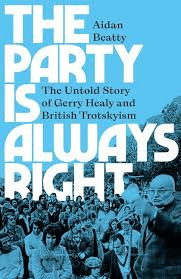


 A Trumpet of Sedition