David Unger’s new book is the true story of José Andrés, an award-winning chef, food activist, and founder of World Central Kitchen.[1] This disaster relief organisation helps working-class communities when catastrophe hits. Although primarily aimed at children, adult readers learn much from Unger’s understated and thoughtful text.
The book is beautifully illustrated by Marta Alvarez Miguéns, a freelance illustrator based in La Coruña, Spain. Her previous works have included A Tiger Called Tomás, Dinosaur Lady and Shark Lady, which was named a Best STEM Book by the Children’s Book Council and the National Science Teachers Association.
Jose Andres and his organisation are very busy at the moment. Every day, a new disaster, war, appears, coupled with the massive growth of world poverty and hunger. According to The State of Food Security and Nutrition in the World 2022, published by the Food and Agriculture Organization (FAO), the World Food Programme (WFP), the International Fund for Agricultural Development (IFAD), the United Nations Children’s Fund (UNICEF), and World Health Organization (WHO), have reported that up to 828 million people, nearly 11 per cent of the world’s population, faced hunger in 2022. The number has grown by about 140 million since the start of the pandemic.
There is no doubt about Andres’s sincerity and bravery in alleviating world hunger and poverty, saying, “What we’ve been able to do is weaponise empathy. Without empathy, nothing works.”.But the cruel reality is that Andres’s work is insufficient to defeat world hunger and poverty.
Jean Shaoul writes, “World leaders are acutely aware of the repercussions of the spiralling cost of food as workers demand pay increases and take to the streets in protest over their deteriorating living conditions in rich and poor countries alike. But the fight for decent wages, affordable food, necessities and a massive increase in wages means that the working class must unite across workplaces, industries, countries and continents in a global political struggle against the capitalist class and its governments and to put an end to the imperialist war.”[2]
Almost a decade ago, in May, 2014, I was able to go to Trinity Hall in the University of Cambridge to hear John Walter of the University of Essex reflect on the development of his career from his time as an undergraduate in Cambridge, his period at the University of Pennsylvania and, subsequently, as an academic historian on the University of Essex’s campus in Wivenhoe. It was a privilege to be there and to hear him discuss the work of historians who had influenced him as well as the intellectual trajectory of his own studies. One thing, however, did strike me very forcibly on that occasion, namely, that no measures had been taken to record what he had said. That was a misfortune and a loss to future historians.
Since then, largely as a result of the deeply regrettable impact of the Coronavirus pandemic, many universities have adopted the practice of allowing their seminars to be accessible via the internet. I can sit in my small study overlooking the wood and river to the south of my house and watch a large number of historians delivering papers on their research and work to live audiences and to larger groups of postgraduates and historians online. This has made it possible for me to listen to and see major figures in my own field of early modern history, people like Nicholas Tyacke, John Morrill, Blair Worden, Keith Thomas, Alan Macfarlane, Richard Cust, Peter Lake and many others. I have also been able to sit in on papers given by younger historians, many of whom are likely to become significant players in the discipline in the years ahead.
Nonetheless, most of the seminars I have witnessed online have taken place in the United Kingdom at the Universities of Oxford and Reading or at the Institute of Historical Research in the University of London. It has been much more difficult to find such seminars in countries like Canada and the United States of America, in Australia or New Zealand or on the European continent. I have certainly become aware of a great deal of interesting research and writing being done in those places but seeing and hearing their work being discussed is much more of a problem. Perhaps, there may be those historians who can help on this issue out there.
“It’s not all rubbish,” cried Amory passionately. “This is the first time in my life I’ve argued Socialism. It’s the only panacea I know. I’m restless. My whole generation is restless. I’m sick of a system where the richest man gets the most beautiful girl if he wants her, where the artist without an income has to sell his talents to a button manufacturer. Even if I had no talents, I’d not be content to work ten years, condemned to celibacy or a furtive indulgence, to give some man’s son an automobile.”
F Scott Fitzgerald, This Side of Paradise (1920)
“‘Her voice is full of money,’ he [Gatsby] said suddenly. That was it. I’d never understood before. It was full of money—that was the inexhaustible charm that rose and fell in it, the jingle of it, the cymbals’ song of it. … high in a white palace, the king’s daughter, the golden girl. …”
The Great Gatsby
“Russia is your example of a beneficent violence, I suppose?” “Quite possibly,” admitted Amory. “Of course, it’s overflowing just as the French Revolution did, but I’ve no doubt it’s really a great experiment and worthwhile.”
The Great Gatsby
Fitzgerald’s superb novel is set in the summer of 1922. The plot is about a young man from the Midwest, Nick Carraway. Carraway sells bonds on Wall Street and lives on Long Island. As Fitzgerald points out, Carraway lives in a small house compared to the huge mansions surrounding him. The enigmatic Jay Gatsby owns one. Gatsby lives close to a philandering husband, Tom Buchanan, who represents older money to Gatsby’s new wealth. Gatsby has made his millions (through bootlegging and stock fraud in partnership with gangster Meyer Wolfsheim.
As the Marxist art critic David Walsh writes, “Fitzgerald’s work is a brilliant effort, easy to underestimate in its brevity, delicacy and the simplicity of the drama. The novel has something of the diaphanous sensibility of Keats, the author’s favourite poet. At the same time, it is an angry, scathing work, as thoroughgoing a debunking of the “American dream” as there ever has been”.
The Great Gatsby is a deceptive book. While it is only 146 pages long, it is an extraordinarily insightful look into the intellectual and social life of the top echelons of the American ruling elite during the first part of the 20th century.
As Walsh writes, “ A novel is not a history book or a political manifesto. The important artist accumulates thoughts, feelings, moods and themes over the course of years and works them into concrete and coherent imagery charged with meaning. Any serious work also includes ambiguities, complexities, and “asymmetrical” elements that are not easily reducible to immediate social analysis. However, the individual artist does not draw his or her conceptions and emotions from empty space, nor are they simply the expression of eternal psycho-biological urges. Significant artistic ideas and representations are always shaped by collective human experience by historical and social development. Fitzgerald thought a good deal about political events and social life. His books and letters only have to be read carefully for that to become apparent. Born in 1896, the novelist belonged to a generation deeply affected by the First World War, the Russian Revolution and subsequent developments.”[1]
Fitzgerald’s very subtle hints about the racist and fascist outlook of a section of the American bourgeoisie are dropped into the text like a bombshell. One example is when Tom Buchanan talks about a book he has read called The Rise of the Colored Empires, “by this man Goddard.” He goes on: “The idea is if we don’t look out, the white race will be—will be utterly submerged. It’s all scientific stuff; it’s been proved.”Fitzgeralds’ fictionalized reference is to Lothrop Stoddard’s The Rising Tide of Color Against White World-Supremacy (1920). A deeply reactionary. Stoddard was a Nazi sympathizer and anti-communist who wrote “Bolshevism: The Heresy of the Underman” and “Social Unrest and Bolshevism in the Islamic World.”
Fitzgerald was not a Marxist or Communist, although he certainly knew his way around Marx’s great works such as Das Kapital Walsh writes, “One need not overestimate the references in Fitzgerald’s letters to “We Marxians…,” “I’m still a socialist …,” “I’m a Communist enough …”, to grasp the degree to which he knew his way around these issues.
The Great Gatsby works on many levels. Aside from being a great story, Gatsby is a stinging attack on the rich in America. In a line that could describe America’s ruling elite today, Fitzgerald writes, “They were careless people, Tom and Daisy—they smashed up things and creatures and then retreated into their money or their vast carelessness, or whatever it was that kept them together, and let other people clean up the mess they had made. …”
Gentlemen, we can neither ignore the history of the past nor create the future. I would like to warn you against the mistake that causes people to advance the hands of their clocks, thinking that thereby they are hastening the passage of time. My influence on the events I took advantage of is usually exaggerated, but it would never occur to anyone to demand that I should make history. I could not do that even in conjunction with you, although together, we could resist the whole world. We cannot make history; we must wait while it is being made. We will not make fruit ripen more quickly by subjecting it to the heat of a lamp, and if we pluck the fruit before it is ripe, we will only prevent its growth and spoil it.
Otto Von Bismark
“During the lifetime of great revolutionaries, the oppressing classes constantly hounded them, received their theories with the most savage malice, the most furious hatred and the most unscrupulous campaigns of lies and slander. After their death, attempts are made to convert them into harmless icons, to canonise them, so to say, and to hallow their names to a certain extent for the “consolation” of the oppressed classes and with the object of duping the latter, while at the same time robbing the revolutionary theory of its substance, blunting its revolutionary edge and vulgarising it.”
― Vladimir Ilyich Lenin, The State and Revolution
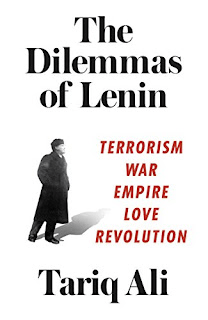
It has been one hundred years since the death of Vladimir Lenin. I had intended to mark the occasion with a review of one of his books. Therefore, I must apologise to my readership that I chose instead to review a book by such a political scoundrel and political opportunist of the worst sort.
Ali was born into a prominent family in Lahore. His uncle was the chief of Pakistan’s military intelligence. While studying at Oxford, he joined the International Marxist Group in 1968. The hallmark of the IMG was the British section of the Pabloite movement, a group specialising in political provocation.
Ali is Verso’s go-to man on anything connected with Lenin. This says more about Verso’s politics than it does about Ali. Given Ali’s close association with Stalinism, he should not be allowed anywhere near Vladimir Lenin. Ali supported Gorbachev and Perestroika in the Soviet Union in the late 1980s.
He believed Perestroika was a great advance for socialism. He even dedicated his book Revolution From Above: Where Is the Soviet Union Going?, published in 1988, to Boris Yeltsin, who later presided over capitalist restoration in the USSR. He said of Yeltsin that his “political courage has made him an important symbol throughout the country and that “The scale of Gorbachev’s operation is, in fact, reminiscent of the efforts of an American president of the nineteenth century: Abraham Lincoln.”
The Dilemmas of Lenin contains no new research and a very limited insight into the mind and actions of Lenin. Ali is correct in saying that the Russian Revolution would not have happened without the brain of Lenin, as Ali points out in his introduction, “ First things first. Without Lenin, there would have been no socialist revolution in 1917. Of this much, we can be certain. Fresh studies of the events have only hardened this opinion. The faction and later the Party that he painstakingly created from 1903 onward was not up to the task of fomenting revolution during the crucial months between February and October 1917, the freest period ever in Russian history. A large majority of its leadership, before Lenin’s return, was prepared to compromise on many key issues. The lesson is that even a political party – specifically trained and educated to produce a revolution – can stumble, falter and fall at the critical moment.”[1]
Ali deals at length with the “Lenin cult” and the attempt by the Stalinists to turn Lenin into a harmless liberal icon. Lenin believed this would happen to all the leaders of the Bolshevik party, writing, “During the lifetime of great revolutionaries, the oppressing classes constantly hounded them, received their theories with the most savage malice, the most furious hatred and the most unscrupulous campaigns of lies and slander. After their death, attempts are made to convert them into harmless icons, to canonise them, so to say, and to hallow their names to a certain extent for the “consolation” of the oppressed classes and with the object of duping the latter, while at the same time robbing the revolutionary theory of its substance, blunting its revolutionary edge and vulgarising it.”[2]
While Ali deals with the early attack on Lenin’s revolutionary edge, his failure to examine more modern-day attempts to bury Lenin under many dead dogs is unforgivable and hard to understand. However, when one starts to investigate Ali’s political trajectory, only one conclusion can be drawn: Ali has no interest in defending Lenin’s “revolutionary edge”. The only ones interested in re-establishing Lenin’scontemprary importance are the Trotskyists of the International Committee of the Fourth International(ICFI).
In a two-part Series, the Marxist David North defends Lenin’s revolutionary edge from the blunt blade of Professor Sean McMeekin. McMeekin wrote an article for the New York Times in which he accused Lenin, amongst other things, of being a German Spy.[3] His article was based on his 2017 book The Russian Revolution: A New History, which North said” cannot be described as a work of history because McMeekin lacks the necessary level of knowledge, professional competence and respect for facts. McMeekin’s book is simply an exercise in anti-communist propaganda from which no one will learn anything.”[4]
He continued, “Why did he write the book? Aside from the lure of easy money (anti-communist works are usually launched with substantial publicity and guaranteed positive reviews in the New York Times and many other publications), McMeekin has a political motive. At the start of this year, the World Socialist Web Site wrote: “A spectre is haunting world capitalism: the spectre of the Russian Revolution.” McMeekin is among the haunted. He writes in the book’s epilogue, “The Specter of Communism,” that capitalism is threatened by growing popular discontent, and the appeal of Bolshevism is again on the rise. “Like the nuclear weapons born of the ideological age inaugurated in 1917, the sad fact about Leninism is that once invented, it cannot be uninvented. Social inequality will always be with us, along with the well-intentioned impulse of socialists to eradicate it.” Therefore, “the Leninist inclination is always lurking among the ambitious and ruthless, especially in desperate times of depression or war that seem to call for more radical solutions.” McMeekin continues: “If the last hundred years teach us anything, we should stiffen our defences and resist armed prophets promising social perfection.” [5]
In some ways, Ali and McMeekin are two sides of the same coin. Both attempt to bury Lenin’s revolutionary struggle, his true legacy and contemporary importance. The only organisation on the planet that can truly celebrate and thank Lenin for his insight and revolutionary struggle and bring him to a new audience is the orthodox Marxists of the ICFI.
I have been following the contributions to the debates on the future of British Studies on the NACBS website with considerable interest. There is a degree of pessimism in some of these contributions about the prospects for this field in general and about the employment prospects for existing and aspiring academic historians in particular. There are sound reasons for these apprehensions, not least because governments and universities’ administrations across the English-speaking countries are focused on wealth creation, on subjects that improve the performance of their economies like the sciences, technology and mathematics. Amongst the wider public in the United Kingdom and elsewhere, on the other hand, there is intense interest in the past, in the histories of countries and communities, localities, social groups and individuals. In that sense, historical studies are in robust health and are likely to remain so. It is to the credit of the Royal Historical Society in the United Kingdom that it has responded to the threats to History Departments here by developing a strategy to contact public decision makers about the merits of the subject and its importance in the cultural and intellectual life of this country.
I do not think that it is very likely that historical subjects will come under threat in universities like those at Oxford and Cambridge. Elsewhere, I fear that some accountants and administrators see history as a soft and dispensable target. This is a profound mistake. Nonetheless, I do believe that historians engaged with the past of the British Isles should begin to make a more active use of the resources of the internet to establish links to archival resources for the subject, to create more enduring on-line institutions to promote the subject, to make available teachers and teaching to those unable to gain entry to courses at universities, to supply suitable teaching materials and so on. Sites like Philosophy Bites have been highly successful in addressing the needs of those interested in that subject. The Open University has been able to reach outside traditional audiences to address the interests of those beyond the customary audiences for the discipline of history.
The time to start preparing alternatives as a supplement to and support for the subject has arrived. It is not a counsel of despair but one of prudent anticipation and preventative action here and across other English-speaking countries. It is not a perfect solution but it may help to avert a worse outcome.
How the events of the 1640s and 1650s and their consequences are to be assessed is one of the enduring issues that historians of the British Isles have to face. The analysis of their varying interpretations is in itself a subject of continuing interest. By and large, historians based in these islands and in English-speaking countries overseas have shown less interest in and devoted less time to the studies undertaken by historians, by historical sociologists and political scientists in other countries. Nonetheless, such studies do exist and throw an interesting light on how these events were seen and are now interpreted elsewhere.
Mateo Ballester Rodriguez’s essay published in 2015 is one such example. It is partly a bibliographical description of the limited printed publications that appeared in the Iberian peninsula and the apparently exiguous manuscript material dealing with the conflicts in England in the period from 1640 to 1660. But it has some opening remarks by Rodriguez himself on the significance of the disputes over sovereignty in England and some further remarks covering the observations of figures from the world of political science on the same subject. Many of the latter like Liah Greenfeld or Hans Kohn or John Breuilly have not appeared on my horizon before.
Rodriguez’s formulation of his own analysis is relatively straightforward. He held that there was a struggle between the supporters of traditional beliefs in the divine rights of monarchs who stood at the apex of English society and the adherents of novel ideas about the location of national sovereignty in the institution of Parliament. On the whole, Anglicans and Catholics supported King Charles I while radical Puritans were committed to religious toleration and thus to Parliament’s cause.Absolutist political theorists like Thomas Hobbes were rejected by advocates of legal equality like the Levellers and, later, by John Locke. Admittedly, the conflicts of the first and second Civil Wars divided English people of all ranks but Parliament’s victory on the battlefields ensured that the new concept of authority resting in the nation and embodied in Parliament was secured. Kings and the Church of England were disposed of. One or two echoes of Christopher Hill’s work were clearly reflected.
Liah Greenfeld apparently argued that the idea of the nation as the repository of political authority, as the basis of political authority and the object of loyalty was first embraced in England during its Revolution. Hans Kohn came to the view that the Revolution represented the first example of modern religious, political and social nationalism. On the other hand, John Breuilly thought that it was difficult to make the nation the repository of the principle of sovereignty or to figure out how that principle could be institutionally embodied in the Rump and the Parliaments of the Protectorate. In any case, the phenomenon disappeared when political stability was re-established after the Restoration in 1660. Very little of the intriguing and intense debates in the British Isles ever found their way into the hands of the subjects of the Iberian Habsburgs in print or in manuscript as Rodriguez went on to show. Ideological considerations and the practice of self-censorship undoubtedly played a part in this outcome even though, in Holland and Venice, interest in such events was much more obvious.
It is tempting to criticise some of these contentions. How far printed publications in the British Isles reflected the balance of contemporaries’ opinions is difficult, perhaps impossible, to determine. Highly interesting though they are, the views of groups like the Levellers and Diggers may not be as indicative of wider political opinions as their admirers in more modern times believe. Puritans were not in any event all of one kind nor were they uniformly advocates of religious toleration. All the regimes in England after 1646, in Scotland and Ireland after 1651 depended on military force to remain in power. Once the confidence of the soldiery was lost and the supporters of Protectoral or republican rule became too divided, the return of monarchical rule and of the pre-1640 state churches was increasingly likely. Historical sociologists and political theorists alike need to look more closely at the historical evidence before they venture onto the turf of historians.
“We congratulate the American people upon your re-election by a large majority. If resistance to the Slave Power was the reserved watchword of your first election, the triumphant war cry of your re-election is Death to Slavery.”
“Scratch beneath the surface of any debate about race in American history, and there you will find a struggle for power, ultimately political power.”
Scorpion’s Sting James Oakes
“A slave-owner who through cunning and violence shackles a slave in chains, and a slave who through cunning or violence breaks the chains – let not the contemptible eunuchs tell us that they are equals before a court of morality!”
― Leon Trotsky, Their Morals and Ours
The relationship between Abraham Lincoln and the institution of slavery is very complex. To Oakes’s credit, he has written a book that is not only well-researched but, as David Holahan writes in USA Today. “ brings clarity and insight to a political conundrum of bewildering complexity.”
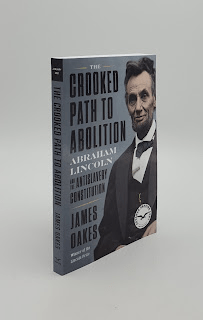
As James Oakes’s book The Crooked Path to Abolition: Abraham Lincoln and the Antislavery Constitution suggests, there is not an easy path to understanding the relationship between Lincoln and the question of slavery. From an early age, Lincoln hated slavery but was not an abolitionist. According to James Oakes, Lincoln “never called for the immediate emancipation of the slaves. He never denounced slaveholders as sinners and never endorsed the civil or political equality of Blacks and whites… He never opened his home to fugitive slaves. He endorsed voluntary colonization of free Blacks… He certainly spoke at colonization meetings… but never at an abolitionist meeting.”[2] Although not a Marxist historian, Oakes believes a dialectical relationship exists between Lincoln and the struggle to end slavery.
Oakes is a historian who is careful with the words he uses. Again, as the title suggests, there was no straightforward path to the abolition of slavery. Oakes spends a significant part of the book examining the United States Constitution, which perhaps unsurprisingly does not contain the word “slavery”. Slaves are referred to euphemistically as “persons” who are “held to service.” As Oakes further points out, the Constitution contains much that is useful to both slaveholders and abolitionists who point out that words “persons” and “liberty” support their cause. Oakes does not sugarcoat the fact that at the time the Constitution was written, slavery was on the ascendency, with 13 American states still practising chattel slavery.
Oakes does not see the Constitution through rose-tinted glasses, and his book attempts to place it in a more objective light, writing, “Parse every clause of the Constitution, peer into the minds of its authors, and you may never find the antislavery document revered by so many ordinary men and women, Black and white.”
As the Marxist writer Tom Mackaman points out, “The American Revolution made incarnate the thought of the Enlightenment, the period of intellectual rebirth that undermined the divinely sanctioned feudal order of the Middle Ages, and that grew in tandem with the incipient capitalist economy. Just as scientists—natural philosophers as they were then called—such as Copernicus, Galileo and Newton challenged the feudal-religious conception of the natural world, so Enlightenment political philosophers began to raise questions about the political world—but not the social, which was only dimly understood prior to Marx. Why did kings rule? What was the purpose of government? What were the rights of man? Ultimately, in answer to these questions, the Enlightenment established that there existed natural rights—that is, rights that preceded government or that existed in a state of nature. [3]One natural right identified was the right to private property. Another was the right to freedom of self-ownership. However, the right to property, as James Oakes has pointed out, was increasingly viewed to be the outcome of self-ownership and the right to dispose of one’s labour. “The property which every man has in his labour, as it is the original foundation of all other property, so it is the most sacred and inviolable,” This political conundrum that Oakes mentions in the book was one that Lincoln would grapple with until his political murder in 1865.
In his review of Oakes’s book, Richard Kreitner concurs, writing, “This explication of the antislavery reading of the Constitution represents Oakes at his best, showing how clauses that seemed to protect slavery also opened, for a growing number of antislavery politicians, doors to its potential abolition. The Constitution was a mess of contradictions; it limited the possibilities of antislavery politics but offered opportunities, too. Competing interpretations of the Constitution “emerged in reaction to each other,” Oakes writes, adapting to new issues and claims by the other, each invoking the founders to support its view. The South’s increasingly aggressive twisting of the Constitution and demands for slavery’s protection developed as much in response to growing antislavery assertiveness as the other way around.”[4]
Like all of Oakes’s books, The Crooked Path educates and increases one’s knowledge. He brings a clarity of thought, which is rare among historians of his subject matter. I like reading his books, but from my standpoint, his most important contribution to historical clarity has been his decision to take to the battlefield against what he called the “new consensus history”[5]. Over the last five years, Oakes has been sharply critical of the various revisionist narratives, including the historical racialism of the 1619 Project.
Oakes believes most contemporary scholarship offers only “a history or politics and of hopelessness.” Oakes wrote in above mentioned article in 2017, “The new consensus history has shaped large swaths of the American past, from the American Revolution of the eighteenth century to the “long” Civil Rights movement of the twentieth century. Here, I focus primarily on my field of inquiry—slavery, antislavery, and the Civil War—where the drift toward consensus has been startling. Everywhere you look, historians are collapsing fundamental social distinctions—between slavery and racial discrimination, for example, between being married and being enslaved, between the free labour system of the North and the slave labour system of the South. The social bases of political conflict thus erased, consensus historians go on to suppress the significance of antislavery politics, even to the point of denying that politics played any role whatsoever in the destruction of slavery. These crucial erasures are once again explained by a reference to a broad political consensus—not the liberal consensus of Hofstadter and Hartz, but the smothering, all-consuming consensus in favour of “white male supremacy.” It’s still consensus history; it’s just a different consensus.”
One revisionist narrative Oakes is particularly hostile to has been the racialist viewpoint emanating from the New York Times 1619 Project. For readers unfamiliar with the Vergangenheitsbewältigung, visit the wsws.org[6]. This website has extensive coverage from a Marxist perspective. In a recent interview with the historian Tom Mackaman on wsws.org, Mackaman asked the following: “ Another aspect of the way the 1619 Project presents history is to imply that it is a uniquely American phenomenon, leaving out the long history of chattel slavery, the history of slavery in the Caribbean. Oakes answered, “ And they erase Africa from the African slave trade. They claim that Africans were stolen and kidnapped from Africa. Well, they were purchased by these kidnappers in Africa. Everybody’s hands were dirty. And this is another aspect of the tendency to reify race because you’re attempting to isolate a racial group that was also complicit. This is conspicuous only because the obsession with complicity is so overwhelming in the political culture right now, but also as reflected in the 1619 Project. Hypocrisy and complicity are basically the two great attacks. Again, not a critique of capitalism. It’s a critique of hypocrisy and complicity. Here, I agree with Genovese, who once said that “hypocrites are a dime a dozen.” Hypocrisy doesn’t interest me as a critique, nor does complicity.[7]
1. February 1, 1959, issue of Commentary John Higham “The Cult of the ‘American Consensus’
2. The New York Times 1619 Project and the Racialist Falsification of History- Edited by David North and Thomas Mackaman-Mehring Books.
3. Slavery in White and Black-Elizabeth Fox-Genovese and Eugene Genovese
Books by James Oakes
The Radical and the Republican: Frederick Douglass, Abraham Lincoln, and the Triumph of antislavery Politics (2007);
Freedom National: The Destruction of Slavery in the United States, 1861–1865 (2012).
The Scorpion’s Sting: antislavery and the Coming of the Civil War (2014).
[1] Address of the International Working Men’s Association to Abraham Lincoln, President of the United States of America-https://www.marxists.org/archive/marx/iwma/documents/1864/lincoln-letter.htm
[2] “The Crooked Path To Abolition: Abraham Lincoln and the Antislavery Constitution,” by James Oakes. £21.99-WW Norton & Co
“The whole agrarian history of Ireland is a series of confiscations of Irish land to be handed over to English settlers. These settlers, in a very few generations, under the charm of Celtic society, turned more Irish than the aborigines. Then a new confiscation and new colonisation took place, and so in infinitum.”
Frederick Engels
‘If I’m ever proven wrong, I’ll shut up and get off the stage.’
Tom Reilly
“Such issues are beyond good manners, sir. Catholicism is more than a religion. It is a political power. Therefore, I am led to believe there will be no peace in Ireland until the Catholic Church is crushed.”
Oliver Cromwell
“This ancestor of Lord Lansdowne, the founder of the noble Lansdowne family, Sir William Petty, landed in Ireland in 1652 with a total capital of all his fortune of £500. But he came over in the wake of Cromwell’s army and got himself appointed ‘Physician to the Army of Ireland’. In 1662, he was made one of a Court of Commissioners of Irish Estates and also Surveyor-General for Ireland. As the native Irish were then being hunted to death, or transported in slave-gangs to Barbadoes, the latter fact gave this worthy ancestor of a worthy lord excellent opportunities to ‘invest’ his £500 to good purpose.”
James Connolly
“What is History but a fable agreed upon?”. Napoleon I.
A new book on Oliver Cromwell is always welcome, but this one is a major disappointment. I would not go as far as to say that it wastes both the reader and author’s time but it comes pretty close to that. It is not Reilly’s fault but now all new work on Cromwell will be defined by its attitude to the magnificent three volumes of Letters, Writings, and Speeches of Oliver Cromwell.[1]His book does not fair very well.
Despite being an amateur historian, books by Tom Reilly are worth reading. He has come under significant attack for what is seen as an unhealthy fixation with Cromwell. However, not all the criticism from modern academia has been fair, and some have been borderline abusive. The book is not without some merit. It is well written and researched and, to a limited degree, re-establishes Cromwell’s authentic voice. How much of the real Cromwell appears remains to be seen. My criticism of his robust and somewhat rose-tinted defence of everything Cromwell did fails to place Cromwell in a more objective context.
Before the invasion of Ireland, Cromwell had to do two necessary things, both crucial to a successful invasion of Ireland. First was the execution of Charles I. Although, in the short term, far from stabilising an already unstable ruling elite, the execution led sections of the bourgeoisie to pursue negotiations with the Royalists in England and Ireland. One of the reasons for the invasion was to subdue a possible Royalist/Catholic revolt and to secure Cromwell’s and a large section of the English bourgeoisie’s strategic political and economic interests in that country. Second, Parliament charged Cromwell to deal with the growing radicalisation of the New Model Army. One manifestation of this radicalism was the Leveller inspired revolt over the army being shipped to Ireland to put down the revolt.
Most criticism of Reilly has centred on his passionate defence of Cromwell’s role in Ireland.[2] In his new book, Reilly continues his theme that Cromwell was not to blame for the massacres. He writes, “We should apologise to Cromwell’s family for blackening his name, for making him a monster. We are teaching our children propaganda that perpetuates anti-English prejudice.”
Suppose we take out of the equation Reilly’s hyperbole and infatuation. In that case, we are left with the fact that Oliver Cromwell was a leading member of the English bourgeoisie and, alongside others, not only made a lot of money out of the conquest of Ireland but, if it happened today, would be guilty of war crimes.
The English Bourgeoisie, from the beginning saw Ireland as a money-making adventure. As an incentive to make the conquest easier, it got Parliament to pass an “Adventurers Act” in 1642 to invite the “Middling Sort” to invest in the army. The greater the investment, the greater the return of land. Cromwell had loaned over 2,000 pounds and had been promised land in Leinster. Christopher Hill correctly states Cromwell’s conquest of Ireland was “the first big triumph of English imperialism and the first big defeat of English democracy”.While many of the bourgeoisie stumped up money for their adventure in Ireland, Parliament felt a little more cooperation was a need and this came in the form of a series of ordinances which was a demand for money with menaces. In February 1648: it issued An Ordinance For raising of Twenty thousand pounds a Month for the Relief of Ireland.
Frederick Engels states, “ In the 17th century, the whole of Ireland, except the newly Scotchified North, was ripe for a fresh confiscation. So much so that when the British (Puritan) Parliament accorded to Charles I an army for the reduction of Ireland, it resolved that the money for this armament should be raised upon the security of 2,500,000 acres to be confiscated in Ireland. And the “adventurers” who advanced the money should also appoint the officers of that army. The land was to be divided amongst those adventurers so that 1,000 acres should be given them, if in Ulster for £200 — advanced, in Connaught for £300, in Munster for £450, in Leinster for £600. And if the people rose against this beneficent plan, they are Vendéens! If Regnard should ever sit in a National Convention, he may take a leaf out of the proceedings of the Long Parliament and combat a possible Vendée with these means.[3]
In another part of the same letter, Engels makes this point: “The 80,000 Protestants’ massacre of 1641. The Irish Catholics are here in the same position as the Commune de Paris. The Versailles massacred 30,000 Communards and called that the horrors of the Commune. The English Protestants under Cromwell massacred at least 30,000 Irish and, to cover their brutality invented the tale that this was to avenge 30,000 Protestants murdered by the Irish Catholics.”
The Irish socialist James Connolly, while not blaming the English bourgeoise for everything that occurred to the Irish people after the conquest of Ireland in the latter part of the seventeenth century, but wrote “ Just as it is true that a stream cannot rise above its source, so it is true that a national literature cannot rise above the moral level of the social conditions of the people from whom it derives its inspiration. If we would understand the national literature of a people, we must study their social and political status, keeping in mind the fact that their writers were a product thereof and that the children of their brains were conceived and brought forth in certain historical conditions. Ireland, at the same time as she lost her ancient social system, also lost her language as the vehicle of thought of those who acted as her leaders. As a result of this twofold loss, the nation suffered socially, nationally and intellectually from a prolonged arrested development. During the closing years of the seventeenth century, all the eighteenth, and the greater part of the nineteenth, the Irish people were the lowest helots in Europe, socially and politically. The Irish peasant, reduced from the position of a free clansman owning his tribeland and controlling its administration in common with his fellows, was a mere tenant-at-will subject to eviction, dishonour and outrage at the hands of an irresponsible private proprietor. Politically, he was non-existent. Legally, he held no rights; intellectually, he sank under the weight of his social abasement and surrendered to the downward drag of his poverty. He had been conquered, and he suffered all the terrible consequences of defeat at the hands of a ruling class and nation who have always acted upon the old Roman maxim of `Woe to the vanquished’.[4]
I do not hold out much hope that Reilly’s next Cromwell adventure will produce a more objective study. I will examine Cromwell and Ireland: New Perspectives, which emerged in 2020. Reilly can write more books and hold more conferences, but the reality is that his hero is not as innocent as he makes out. Perhaps his next book should contain a few warts.
[1] The Letters, Writings, and Speeches of Oliver Cromwell: Volume 1: October 1626 to January 1649 (Speeches & Writings of Oliver Cromwell) Hardcover – 7 Sept. 2022by Andrew Barclay (Editor), Tim Wales (Editor), John Morrill (Editor)
[2] See Cromwell and Ireland: New Perspectives Hardcover – 30 Nov. 2020
by Professor Martyn Bennett (Author, Editor), Raymond Gillespie (Editor), Scott Spurlock (Editor)
[3] Engels To Jenny Longuet-Marx & Engels on the Irish Question, Progress Publishers, Moscow 1971, pp. 326-329-https://www.marxists.org/archive/marx/works/1881/letters/81_02_24.htm
It is hard to imagine that it is ten years since the passing of Dave Hyland. I first met him in Hammersmith, London, on February 8 1986. The split inside the Workers Revolutionary Party had just taken place, and the Internationalist faction, of which I was a member, had assembled for the 8th congress only to be barred from the meeting by police called by the Slaughter\Banda faction.
I joined the WRP in 1983 after a nine-month candidate membership, which I think was a record for any revolutionary organisation. When I told my parents about the membership, I expected some hostility, but my mother said, “At least it will keep him on the streets”. This quote will be the title of my autobiography. My path towards membership in the WRP was pretty tortuous, and I will not burden readers with the details of the many organisations I joined, which, in reality, were thoroughly reactionary.
Joining the WRP was like a breath of fresh air. I felt comfortable being a member. I had prepared myself by reading and collecting classical Marxist literature. I bought so much literature from the Militant organisation that they sent two girls around to my house in an attempt to recruit me. I did not stay long in that party, which I quickly saw was a front for the Labour Party.
Inside the WRP, I read books and pamphlets about their history and that of the ICFI. A basic part of membership was, of course, newspaper selling. I never really read the WRP’s Newsline which was nothing more than a comic to me and did not advance my intellect one iota. That bothered me, but I did not understand why the paper was so low compared to the youth movement’s paper, The Young Socialist. The youth paper carried articles from the US section of the Workers League. One such article was David North’s Leon Trotsky and the development of Marxism. In my limited outstanding of Trotskyist politics, the Workers League was far superior to the WRP. It was only after the split and the publication of How the WRP Betrayed Trotskyism did I fully understood why.
As I said, my first meeting with Dave was in Hammersmith. He was handing out booklets that contained a wealth of material on the split and various topics. One of which was Security and the Fourth International. I had read the two books produced by the ICFI, so I was very familiar with a subject that fascinated me and was eager to read more. I still have the booklets I got from him. It isn’t easy to sum up a man’s character in such a brief meeting, but my abiding memory was of his energy. He was a fighter of very similar stature to the American Trotskyist James P Cannon. Hyland had what Trotsky called the “physical power of thought.”
As I got to know him, while it was hard to become friends in a revolutionary party, it did not stop me from having the utmost respect and admiration for him. Outside of David North, he was the most important figure in my political development. He had many important characteristics. He was well-read despite having a hard-working life and raising a family, which was probably the most important family in the political life of the British Section, if not the ICFI. He was very approachable and easy to talk to and I like to feel we had immediate political and personal rapport. One memory sticks out. It was during my victimisation in 1987. I was preparing for an important meeting and having problems writing a speech. At the time, he was National Secretary of the British section of the ICFI, yet he still found the time late into the night to coach me and make changes to the speech.
During my time in the party, I had known that Dave was not well but did not know until his death how terrible his illness was. So, unlike many who were close to him at the end, his death did come as a great shock to me, and it saddens me terribly that he had to suffer with such extremely aggressive rheumatoid arthritis for more than 20 years. But as David North wrote, “Despite the gravity of his illness, Dave had manifested powers of resistance that seemed to defy scientific explanation. His willpower, his desire to live and to participate in life as fully as possible, exerted itself as a real physical force.”
In his appreciation of Hyland, Nick Beams said, “Marxism bases itself on the objective laws of society. But it has nothing in common with any fatalism or passivity. At crucial turning points in the historical process, the decisions made by individuals and their struggles based on those decisions prove to be the decisive factor. Dave’s decision to fight for the programme of the IC was one such decision”. It was his finest hour. In my heart and mind, Comrade Dave will never be forgotten. As David North said, “ He will be remembered by his comrades and remain an inspiring example of revolutionary steadfastness and principle for generations to come.”
Sunday’s Postal Rank and File online meeting was one of the most important for two reasons. Firstly, it comprehensively nailed the lie that Falconer Review has delivered “justice” for reps and members victimised during the year-long dispute at Royal Mail.
The Communication Workers Union(CWU) has openly lied to its membership. As a victimized CWU rep has said on the wsws.org, the union has trampled on the time-honoured principle “an injury to one is an injury to all.”
The second reason is that it discussed the question of leadership. Leadership is an art and takes time to develop. It will not happen overnight. It is clear from the meeting and the numerous articles on wsws.org that the CWU is now an arm of corporate management. The betrayal carried out by the CWU is unprecedented in the postal worker’s history. It will undoubtedly become a template for other union bureaucracies to carry out similar betrayals. The question posed in the meeting is what can postal workers do about it.
Again, as was raised in the meeting, it is not a question of lack of fight. The numerous votes for official and unofficial strike action proved that postal workers were itching to prosecute a fight against Royal Mail but were saddled with leadership from day one that worked to betray the strike.
This brings me to the point raised by Simon that postal workers were “sheep” unthinkingly following their leadership. Leadership is a complex matter. As the great Russian revolutionary Leon Trotsky wrote, “Our author substitutes mechanistic determinism for the dialectic conditioning of the historical process. Hence the cheap jibes about the role of individuals, good and bad. History is a process of class struggle. But classes do not bring their full weight to bear automatically and simultaneously. In the process of struggle, the classes create various organs which play an important and independent role and are subject to deformations.
This also provides the basis for the role of personalities in history. There are naturally great objective causes that created the autocratic rule of Hitler, but only dull-witted pedants of “determinism” could deny today the enormous historical role of Hitler. The arrival of Lenin in Petrograd on April 3, 1917, turned the Bolshevik party in time and enabled the party to lead the revolution to victory. Our sages might say that had Lenin died abroad at the beginning of 1917, the October Revolution would have taken place “just the same.” But that is not so. Lenin represented one of the living elements of the historical process.
He personified the experience and the perspicacity of the most active section of the proletariat. His timely appearance in the arena of the revolution was necessary to mobilise the vanguard and provide it with an opportunity to rally the working class and the peasant masses. Political leadership in the crucial moments of historical turns can become just as decisive a factor as the role of the chief command during the critical moments of war. History is not an automatic process. Otherwise, why leaders? Why parties? Why programs? Why theoretical struggles?[1]
To conclude, Postal workers work extremely hard and are a very disciplined bunch of workers. They have not always followed their leaders and have on numerous occasion sought to break the strangled hold of the bureaucracy but to no avail. The meeting posed the question of a new type of leadership. The CWU is dead. It is just that nobody has buried it yet. It is down to the most politically conscious workers to create a new leadership. Those in attendance in the meeting must now give that lead.
[1] The Class, the Party-and the Leadership-https://www.marxists.org/archive/trotsky/1940/xx/party.htm





 A Trumpet of Sedition