Football Writing Festival: Arsenal Special at the British Library

(This is a summary of the conversation between journalist Henry Winter and the author Nick Hornby. A full transcript and recording of the whole festival can be made available on request.)
Date Time: 2026-03-28 11:31:38
Location: British Library
Interviewee: Nick Hornby
Author Nick Hornby reflects on Arsenal fandom, football culture, and how Fever Pitch reframed football writing through human relationships and identity. Interviewer Henry Winter explores changes in stadium culture, player activism, commercialisation, and the global nature of club allegiance.
Introduction
1. Nick Hornby: Celebrated writer best known for Fever Pitch, he discusses how Arsenal became a constant in his life, the human dynamics behind football fandom, the evolution of fan culture from the 1970s to the Premier League era, and the tension between entertainment and trophies. He also touches on player activism, racism in sport, and the universality of his book across clubs and cultures.
2. Henry Winter: Football journalist and panel host guiding the conversation through Arsenal history, modern football media (including podcasts), stadium atmosphere changes, economics of fandom, player-community engagement, and comparisons of past versus present football quality. He frames questions that draw Hornby’s reflections on identity, culture, and the modern game.
Key Points
1. Fever Pitch positioned football fandom as a lens on human relationships, offering a universal narrative beyond club rivalries.
2. Arsenal served as a lifelong constant for Hornby, providing reliability and identity amid personal change.
3. Stadium culture has shifted from volatile standing terraces to safer, commodified experiences, altering crowd dynamics and accessibility.
4. Modern players increasingly engage in activism and community work, reflecting a conscientious generational change.
5. Globalization of football detaches local identity from strictly local players; commitment to the shirt matters more than nationality.
6. Racism persists across leagues, but club cultures (including Arsenal’s) can mitigate its impact through values and leadership.
7. The entertainment-versus-trophies debate remains central to fandom; Hornby values both, noting how modern football quality and scheduling affect careers.
8. Football’s unscripted drama complements Hornby’s scripted literary world, highlighting sport’s unique emotional appeal.
Insights
1. Nick Hornby
– Framed Fever Pitch as a human-interest narrative that helped non-fans (including women) understand male identity and fandom.
– Arsenal provided a reliable anchor through life, distinguishing the club’s enduring presence from transient childhood pursuits.
– Experienced and observed the 1970s/80s terrace culture, including volatility, policing, and the social dynamics of crowds.
– Believes modern players have responsibilities to communities and appreciates the rise of athlete activism while cautioning against overhyping.
– Argues that commitment to the shirt matters more than nationality; globalization can still produce deep fan-player bonds.
– Acknowledges racism’s persistence and the importance of club values in confronting it.
– Balances appreciation for entertainment with the desire for trophies; reflects on modern football’s intensity and player longevity.
2. Henry Winter
– Highlights the evolution of football media (podcasts) and the breadth of Arsenal storytelling.
– Discusses changes in stadium experience, pricing, and atmosphere, and the impact on younger fans’ access.
– Probes player activism, community work, and club-led initiatives, positioning Arsenal as exemplary in engagement.
– Raises the issue of social media-driven player followings and how star departures affect club visibility.
– Frames debates about Premier League quality, scheduling, and their effect on player careers and performance.
Chapters
1. Henry Winter: What triggered Fever Pitch—love of Arsenal, a relationship, a particular game?
Nick Hornby: The book emerged from defense mechanisms and a desire to explore human relationships through football; Arsenal was a constant that anchored his life and identity.
Henry Winter: Notes the human-interest angle and how the book blended numbers/sport with personal dynamics.
2. Henry Winter: How did your relationship dynamic manifest in your love for a constant like a football team?
– Nick Hornby: Arsenal provided reliability; unlike childhood hobbies, football offered a lifelong path, connecting personal identity to a crowd and community.
3. Henry Winter: Did you end up playing yourself?
– Nick Hornby: Implies limited personal play; emphasizes spectating and the social aspects of being in crowds.
4. Henry Winter: Did you send your old teacher a copy of the book?
– Nick Hornby: Reflects on searching for companionship and crowd belonging; conversations at matches were often impersonal yet communal.
5. Henry Winter: Is it about the crest on the front rather than the name on the back—are you Arsenal or football?
– Nick Hornby: The intensity of feeling drew him in; the club’s symbolism mattered deeply regardless of individual players.
6. Henry Winter: Did you analyze crowd behaviors and policing at the time?
– Nick Hornby: Recalls chairman’s notes, policing issues, and a “jail cell” in the North Bank; shares anecdotes about being confined with opposition fans.
7. Henry Winter: Liveliest away ground experiences?
– Nick Hornby: Suggests volatility at certain grounds; highlights the 70s/80s away-day culture and mates’ behavior.
8. Henry Winter: Younger fans (18–24) are priced out—how has your and your son’s experience changed? Is standing safer now?
– Nick Hornby: It’s safer; standing itself isn’t the issue—culture and context matter; modern stadiums changed dynamics from late 80s onward.
9. Henry Winter: Thoughts on Arsenal’s stadium design, murals, and concourses?
– Nick Hornby: Praises heritage elements but criticizes overpriced concourses; contrasts early days with fewer ads/amenities.
10. Henry Winter: Do kids follow players more than clubs? Impact of stars like Salah leaving?
– Nick Hornby: Acknowledges player-driven social media dynamics; stresses instilling commitment to the shirt over star transience.
11. Henry Winter: Athlete activists—do you like this conscientious generation?
– Nick Hornby: Appreciates player engagement in community; supports responsibility of wealthy young players while avoiding overstatement.
12. Henry Winter: What’s it like meeting idols you grew up watching?
– Nick Hornby: Initially uncomfortable transitioning from fan to peer at signings; later accepted it; notes Fever Pitch’s cross-club resonance, even among foreign players seeking to understand English fan culture.
13. Henry Winter: Did Fever Pitch contribute to broader understanding of fandom?
– Nick Hornby: Yes; aimed to articulate a universal fan-club relationship, avoiding tribal derision; helped non-fans understand male identity and passion.
14. Henry Winter: Trophies or entertainment—what matters more?
– Nick Hornby: Values both; engages with debates on Premier League quality, scheduling, and the physical demands on modern players.
15. Henry Winter: No winter break, increased Champions League games—impact on careers?
– Nick Hornby: Improved pitches, boots, and nutrition help, but heavier schedules may shorten peak years; luck and care influence longevity.
16. Henry Winter: Young talent like “Max”—should he go to the World Cup?
– Nick Hornby: World Cups aren’t for work experience; recognizes special talent but urges caution; balances club and national priorities.
17. Henry Winter: Arsenal title vs. England World Cup—which matters more?
– Nick Hornby: Expresses hope and pragmatism; suggests World Cup ambitions face strong competition; leans toward club success while acknowledging national dreams.
18. Henry Winter: Comparing the Oscars to football awards—what’s better?
Nick Hornby: Celebrates the privilege of witnessing Arsenal regularly; sport provides unique, immersive joy akin to live arts.
19. Henry Winter: Do you appreciate football’s unscripted nature more as a writer?
Nick Hornby: Football’s unpredictability complements his scripted work; while “you couldn’t script that” is cliché, sport’s drama remains compelling.
20. Henry Winter: Thoughts on racism in sport and “black Arsenal” histories?
Nick Hornby: Racism persists across leagues; club culture can help; emphasizes that prejudice follows players and must be confronted systemically.
21. Audience Q: Any new superstitions like sugar mice or lint bunnies to influence results?
Nick Hornby: Jokes about trying new rituals; notes annual disappointment; remains open to playful superstitions.
22. Audience Q: When did you start supporting Arsenal, and how do you view fewer English players now?
Nick Hornby: Early attachment formed when squads were more English; argues proximity isn’t nationality—what matters is players’ commitment to the club and its values, not where they’re from.
Next Arrangements
– Tighten broad questions with specifics (seasons, matches, policies) to elicit concrete anecdotes and sharper contrasts between eras.
– Add targeted follow-ups on complex topics (e.g., “Which Arsenal initiative most impressed you and why?” “What stadium change most altered fan behavior?”) to deepen analysis and avoid generalities.
– Balance nostalgia with present-day detail using evidence-based comparisons (e.g., “1989 at Highbury versus a 2024 Emirates match—what single difference most changes the fan experience?”) for clear, informative takeaways.
Black Arsenal, co-edited by Clive Chijioke Nwonka and Matthew Harle, published by Weidenfeld & Nicolson on 29 August 2024 (£35).

“When it comes to thinking about politics and race, we cannot always rely on culture as a way to remedy deeper structural questions. Having particular players or particular footballing cultural moments as a point of identification is immense. However, it cannot be a deliberate or a forced thing.”
Clive Chijioke Nwonka
“The theory of race, specially created, it seems, for some pretentious self-educated individual seeking a universal key to all the secrets of life, appears particularly melancholy in the light of the history of ideas. In order to create the religion of pure German blood, Hitler was obliged to borrow at second hand the ideas of racism from a Frenchman, Count Gobineau [4], a diplomat and a literary dilettante. Hitler found the political methodology ready-made in Italy, where Mussolini had borrowed largely from the Marxist theory of the class struggle. Marxism itself is the fruit of the union among German philosophy, French history, and British economics. To investigate retrospectively the genealogy of ideas, even those most reactionary and muddleheaded, is to leave not a trace of racism standing.”
Leon Trotsky: What Is National Socialism? (June 1933)
Black Arsenal was published to coincide with the start of the 2024/25 season. It is co-edited by Clive Chijioke Nwonka, Associate Professor of Film, Culture, and Society at University College London (UCL), and writer Matthew Harle. It is the first of its kind. The book was remarkably 10 years in the making, with a stunning amount of research undertaken.
Asked about the origins of the book, Nwonka said, “Well, it was me thinking a lot about my own background as a person and things that had inspired me. I had started working at the London School of Economics, and I was thinking about the role of race in culture and the ways of thinking associated with it. I was being introspective with myself and realising that John Barnes was important to me in terms of being my first source of inspiration and recognition.
Then that led to the inspiration for Black Arsenal. I was at university, trying to make sense of what this concept meant and what other factors might be involved. The chapter ‘Defining Black Arsenal’ is all about the genesis of that idea. Then you start looking at history and why Black people in London gravitate mostly towards Arsenal.
Whether you are from south London or wherever, and then you realise there is a history that goes beyond Ian Wright, back to the 60s and 70s, to Brendon Batson, Paul Davis. It goes back to what Islington was in the 70s. It goes back to the JVC centre and the community work the club were doing in the 80s. All these factors were already in place before Ian Wright arrived in 1991.”[1]
The book examines the black history of Arsenal football club from a broadly academic standpoint. It also features contributions from former players such as Ian Wright and Paul Davis, as well as contributions from Paul Gilroy, Gail Lewis, and personal responses from Clive Palmer, Ezra Collective, and writer Amy Lawrence.[2].
The timing of the book could not be more prescient. Since its publication in 2024, there has been a significant and distinct growth in racist and fascist forces. Recently, as Chris Marsden writes, “Unite the Kingdom demonstration in August this year was the largest far-right mobilisation in British history. Estimated at between 100,000 and 150,000, participation in London exceeded the numbers usually mobilised by anti-Muslim demagogue Tommy Robinson and extended beyond his usual support base of football hooligans and fascist thugs. This core periphery was boosted by the presence of workers and their families, including from among the most deprived layers, who have swallowed the far-right’s message blaming social distress and the collapse of essential services on migration.[3]
It should be noted from the start that Arsenal have not always had a spotless anti-racism stance. Like most businesses, it has made its fair share of mistakes regarding its stance on racism. During the refurbishment of the old Highbury North Bank in 1992, Nwonka recalls, “I remember as a kid, the first week of the Premier League season, there were all these half-rebuilt stadiums because of the Taylor report [into ground safety after the Hillsborough disaster]. Of course, no one wants to watch a building site on Sky Sports – so the idea came up that you cover it up with these illustrations of your imagined fanbase.” The original North Bank mural was an artist’s impression of a sea of white faces, with red and white scarves, which had to be replaced with a more inclusive mural.
The contributions from Paul Davis and Ian Wright are important, as they were key figures in the development of a more integrated Arsenal team. Davis paved the way for Ian Wright and later generations of players. Ian Wright was a game-changing signing from Crystal Palace. Always the rebel, he appealed to both black and white younger working-class fans. He, in turn, set the stage for Patrick Vieira, Thierry Henry, and Bukayo Saka.
Despite being seen as a bit of a rebel, Wright and Arsenal, for that matter, have not been shy in exploiting the commercial possibilities of such a global and multi-racial fan base. Nike and now Adidas have moved quickly in exploiting Arsenal’s multicultural teams for profit; Nwonka thinks there is a danger of such exploitation.
“With things like the Arsenal Africa shirt or the Jamaica shirt,” he says, “they have been quite open about the fact that they recognise that there was a consumer base that will find the resonance in something that pays homage to Afro-Caribbean culture. However, I have been attending the Notting Hill Carnival since I was four years old. Moreover, you would always see Arsenal shirts there all the time, rather than those of QPR, Brentford, Fulham, or Chelsea. However, what some brands often do is invest in what they imagine to be Black culture, whereas Black Arsenal, I believe, begins with Black people.”
Football has been a global game since its inception, played worldwide. However, with the advent of satellite television from companies such as Sky, the game has reached a far greater level of global integration.
As David Storey relates, “ Football has always had essential linkages connecting places. Some clubs were formed by, or as a result of, British migrants, and in some instances, this is still reflected in contemporary football. Football has always had essential linkages connecting places. Some clubs were formed by, or as a result of, British migrants, and in some instances, this is still reflected in contemporary club names or colours. Athletic Bilbao’s origins and English name are attributed to English migrant workers in the Basque Country (Ball, 2003). A similar explanation accounts for Young Boys in Switzerland, Go Ahead Eagles in the Netherlands, and The Strongest in Bolivia, among others (Goldblatt, 2007). The shirt colours worn by Juventus were reputedly borrowed from Notts County (the world’s oldest professional club) shortly after the Italian club’s formation (Lanfranchi club names or colours.
Despite this early evidence of international linkages, English football remained somewhat insular for many years (2001). Despite this early evidence of international linkages, English football remained somewhat insular for many years, with restrictions on the importation of foreign players. While the migration of professional footballers is a long-standing phenomenon, and relatively pronounced in countries such as Spain, France, and Italy, the migration of players into or out of Britain was much less apparent (Taylor, 2006). However, recent years have seen substantial numbers of footballers from other parts of the world arriving in the Premier League (and into the lower tiers in the English league system). This internationalisation has occurred alongside the increasing commercialisation of the game.”[4]
While I wholeheartedly recommend this book, it should be of interest not only to Arsenal fans but also to the broader reading public. The historical study of black footballers who played for Arsenal is a legitimate pursuit. However, much of the content of the book is dominated not by a class attitude towards racism, but by too many contributions, including Nwano’s, that see the rise of racism through racially tinted glasses.
Nwonka addressed this, saying, “Of course, I have got a small quantity of criticism from some quarters. One person, when I first posted about the Black Arsenal idea, wrote to me to say: ‘I have been going to Arsenal since the 1970s. I do not see race; I watch football.’ I thought to myself: ‘Well, I am not going to sit here and tell someone whether they should or should not see. However, have you stopped and thought that maybe the reason that you do not see race when you go to Arsenal is that Arsenal has normalised racial difference in a way that some other clubs have not? Moreover, that may be an important thing to recognise?”Nwonka’s original idea for the book was for it to be dominated by appropriate references to French poststructuralists and the postmodernist and pseudo-revolutionary Frantz Fanon, who was and is a darling of the Pseudo-Left groups. Fanon and Poststructuralists were among other pioneers of the anti-Marxist Critical race theories, which is a “body of academic writing that emerged in the US in the late 1980s and early 1990s, which combines postmodernism and subjective idealist philosophy with historical revisionism and racial sectarianism. Although written in a different form, the book remains dominated by these anti-working-class theories that prioritise race over class
[1] www.arsenal.com/news/dr-clive-nwonka-talks-new-black-arsenal-book
[2] https://en.wikipedia.org/wiki/The_Athletic
[3] Britain’s largest far-right protest capitalises on Starmer’s xenophobic, anti-working-class agenda
[4] Football, place and migration: foreign footballers in the FA Premier League
David Storey- Geography, Summer 2011, Vol. 96, No. 2 (Summer 2011), pp. 86-94
Published by: Taylor & Francis, Ltd
Rebels for the Cause: The Alternative History of Arsenal Football Club by Jon Spurling, Mainstream Publishing, Paperback – 30 Sept. 2004

“Football, beer, and above all, gambling filled up the horizon of their minds. To keep them in control was not difficult.”
George Orwell, 1984
‘All that I know most surely about morality and obligations, I owe to football.’ –
Albert Camus
‘In football, everything is complicated by the presence of the opposite team.’-
Jean-Paul Sartre
‘Five days shalt thou labour, as the Bible says. The seventh day is the Lord thy God’s. The sixth day is for football.’ –
Anthony Burgess
‘And life is itself but a game at football.’ –
Sir Walter Scott
‘I fell in love with football as I was later to fall in love with women: suddenly, inexplicably, uncritically, giving no thought to the pain or disruption it would bring with it.’ –
Nick Hornby, Fever Pitch
‘Rugby is a game for barbarians played by gentlemen. Football is a game for gentlemen played by barbarians.’ –
Oscar Wilde
Perhaps it is a little harsh to say that, try as he might, Jon Spurling will not reach the literary heights of the authors above; this book, which includes 15 interviews and forty other contributions, is nonetheless a well-written and researched piece of social history that examines the dark side of Arsenal Football Club.
Spurling’s examination of the so-called Arsenal rebels, both on and off the pitch. Spans almost 120 years, and it is a million miles away from the sanitised version of the game today. A game, it must be said, that is not so much a competition as a playground for the increasing number of oligarchs that own the game. In the past, the team with the most points won the league; now it is the team that spends the most money. This season belongs to Liverpool, who have just spent half a billion on new players.
Spurling’s book situates Arsenal’s checkered history against a backdrop of volatile social, political, and economic change. While it is hard to pick a favourite piece of Arsenal history, Spurling’s focus on the founding of the club is my favourite. Both owners and players alike belonged to a rogues gallery, each outcompeting the other for skullduggery and violence.
Arsenal’s founders were David Danskin and Jack Humble. The so-called ’20s soccer Tsar, Sir Henry Norris, was the first to bring free-market economics to Highbury, a hundred years before David Dein.
Despite being a fan for over 50 years, the names from Arsenal’s early years were only vague in my mind., Henry Norris or Wilf Copping were planted in my mind by my father, who first introduced me to the Arsenal family. Like Spurling, I have long known that we were a hated club, and not just by Tottenham fans. Although having been the cause of Tottenham’s relegation back in 1928 did raise a laugh. Reading this book, it becomes clear why hatred runs so deep. Millwall fans were not the first to sing, ‘No one likes us, we don’t care.’
Another name mentioned by my father was Ted Drake. According to my dad, Drake was one of the most gifted players ever to wear the red and white shirt. On this occasion, it is correct that Spurling calls him a Highbury legend who said of Highbury ‘For all the thirties grandeur of Highbury, it’s still only bricks and mortar at the end of the day. Magnificent stands provide the backdrop to a splendid house. But it’s the people within – the fans and players – that have made Highbury a marvellous home for the Arsenal. And for me, that is really what Highbury is all about.”
The writer Brian Dawes has a similar arsenal of history to mine, saying, “I’ve visited and worshipped at the stadium regularly for nearly fifty years now and have invariably regarded it as my second home. I’ve always felt comfortable there, and it’s always been so much more than just a place to watch a game of football. It’s that rarest of places, one that you know was meant specifically for you the first time you view the lush turf and admire the symmetry of the classic east and west stands. You may share it with thousands of fellow fans and the generations of Arsenal followers who preceded you, but Highbury is your spiritual home. The history of the place grabs you by the throat in a way that compels you to learn all there is to know about all the great players who’ve ever graced the hallowed turf. Highbury is an ongoing home shared by players and fans alike, and each cares for the place with their own personal memories.”[1]
My first season supporting Arsenal was the 1970/71 season. Many things attracted me to Arsenal. I mentioned its rich history, but what got me hooked was not only the atmosphere and the smell of fresh hot dogs, but Highbury was a thing of aesthetic beauty, so much so that its Art Deco design is still a listed building.
I watched my first game, coincidentally, near where the Arsenal fan and writer Nick Hornby sat when his dad took him to his first game in the West Upper stand. The film Fever Pitch, starring Colin Firth, shows Hornby’s amazed look as he takes in his first game. I had that same feeling. I always thought from that moment on, it seemed that Arsenal had a classy way of doing things and embodied the mantra “ Play up and Play the Game”.
From my standpoint, one of the most interesting chapters of the book is entitled “Cold War”. According to Wikipedia, “In November 1945, with league competition still suspended, Arsenal were one of the teams that played a Dynamo Moscow side touring the UK. With many players still serving abroad in the armed forces, Arsenal were severely depleted and had to use six guest players, including Stanley Matthews and Stan Mortensen, which led Dynamo to declare that they were playing an England XI. The match, at White Hart Lane, kicked off in thick fog and Dynamo won 4–3, after Arsenal had led 3–1 at half-time. Although the score is generally agreed upon, accounts of the match diverge thereafter; even the identity of the goal scorers is disputed. English reports alleged that Dynamo fielded twelve players at one point and tried to pressure the referee into abandoning the match when they were losing; in turn, the Soviets accused Arsenal of persistent foul play and even alleged that Allison had bet money on the result, a claim that was later retracted. The acrimony after the match was such that it inspired George Orwell to write his 1945 essay The Sporting Spirit, in which he opined on the nature of sport, namely that in his view “it is war minus the shooting”.
I was already five years into my love affair with Arsenal when, at the tender age of 16, I started devouring the books of George Orwell. But I never knew he was a Gooner. Born in India, Orwell became a fan in the late 1920s. He also watched the great Arsenal side of the 1930s. His The Sporting Spirit is one of the finest pieces of “sports writing” of any generation, and his political evaluation of the game itself is worth a quote.
Orwell writes, “Now that the brief visit of the Dynamo football team has come to an end, it is possible to say publicly what many thinking people were saying privately before the Dynamos ever arrived. That is, that sport is an unfailing cause of ill-will, and that if such a visit as this had any effect at all on Anglo-Soviet relations, it could only be to make them slightly worse than before. Even the newspapers have been unable to conceal the fact that at least two of the four matches played led to much bad feeling. At the Arsenal match, I was told by someone who was there that a British and a Russian player came to blows, and the crowd booed the referee. The Glasgow match, someone else informs me, was simply a free-for-all from the start. And then there was the controversy, typical of our nationalistic age, about the composition of the Arsenal team. Was it really an all-England team, as claimed by the Russians, or merely a league team, as claimed by the British? And did the Dynamos end their tour abruptly to avoid playing an all-England team? As usual, everyone answers these questions according to their political predilections. Not quite everyone, however. I noted with interest, as an instance of the vicious passions that football provokes, that the sporting correspondent of the Russophile News Chronicle took the anti-Russian line and maintained that Arsenal was not an all-England team. No doubt the controversy will continue to echo for years in the footnotes of history books. Meanwhile, the result of the Dynamos’ tour, insofar as it has had any result, will have been to create fresh animosity on both sides.[2]
This is a fine book and well worth a read. While it will appeal to Gooners all over the world, fans outside the Arsenal world will appreciate it just as much.
[1] Highbury: The Story of Arsenal in N5- http://www.arsenal-world.co.uk/feat/edz3/book_review_highbury_the_story_of_arsenal_in_n5_281111/index.shtml
[2] The Sporting Spirit-Tribune, 14 December 1945-https://www.orwellfoundation.com/the-orwell-foundation/orwell/essays-and-other-works/the-sporting-spirit/
Alex James: Life Of A Football Legend, by John Harding, 16.99. Empire Publications 2024
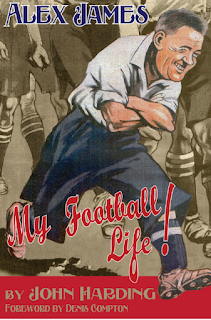
The term “Arsenal legend” is used so frequently in the modern era that it can lose all its meaning or aura. But in the case of Alex James, it is an apt phrase. Even the legendary Matt Busby thought he was one of the all-time greats, and the great Liverpool manager Bill Shankly called him a “genius” and a “nightmare to play against”.
The first thing that comes to mind when reading this book is why bother reading about a player, no matter how good, who died nearly 74 years ago, and last played for Arsenal two years before Hitler invaded Poland.
From a footballing standpoint it is clear from even a cursory look at video footage of Alex James that he was an exceptional player and according to Ham & High Sport “In pantheon of Arsenal greats, he stands shoulder to shoulder – at the very least – with the likes of Dennis Bergkamp, Tony Adams, Frank McLintock and Joe Mercer.”[1]
People follow football teams for many different reasons. For me, I think the same way as Dennis Bergkamp: “When you start supporting a football club, you don’t support it because of the trophies, or a player, or history; you support it because you found yourself somewhere there — found a place where you belong.” While this is true in my case, I also fell in love with Arsenal because of its history.
My first season supporting Arsenal was the 1970/71 season. Many things attracted me to Arsenal. I mentioned its rich history, but what got me hooked was not only the atmosphere and the smell of fresh hot dogs, but Highbury was a thing of aesthetic beauty, so much so that its Art Deco design is still a listed building.
My first game, funny enough, was sitting in virtually the same seats as the Arsenal fan and writer Nick Hornby sat when his dad took him to his first game in the West Upper stand. The film Fever Pitch starring Colin Firth[2] Shows Hornby’s amazed look as he took in his first game. Another thing that attracted me was that Arsenal seemed to embody a classy way of doing things and embodied the mantra “ Play up and Play the Game”.[3]
It is to John Harding’s credit that he has reintroduced James to a modern readership. First published in 1988, this reissue in 2024 is updated with new stories and pictures. “Since the first release, I have added lots of new material and have changed my stance on James’ footballing role, Reprinting my book with new material, especially after leaving Highbury relatively recently in terms of the club’s history, seemed like a good opportunity to revisit his story – and to reintroduce him to a new generation of supporters, because we should not forget what Alex James meant to Arsenal.
“I am too young to have seen him play, but when I first started going to Arsenal back in the late 1950s, many people around me had seen him. “I grew up on stories about him, and he became a hero – James simply struck a chord with me. For me, Alex James was Highbury.” The book is meticulously researched and is one of the best books on the history of Arsenal Football Club. James was admired and deeply appreciated by his fellow professionals.
As a young boy, the great Tom Finney[4] Saw James play at Deepdale, Preston, saying “James was the top star of the day, a genius. There wasn’t much about him physically, but he had sublime skills and the knack of letting the ball do the work. He wore the baggiest of baggy shorts, and his heavily gelled hair was parted down the centre. On the odd occasion when I was able to watch a game at Deepdale, sometimes sneaking under the turnstiles when the chap on duty was distracted, I was in awe of James. Preston were in the Second Division and the general standard of football was not the best, but here was a magic and a mystery about James that mesmerised me.”
While James and his fellow professionals’ lifestyle is a million light years away from the pampered multi-millionaires of today with their private jets, His lifestyle also set him apart from his fellow workers of his day.
As John Harding writes in his Oxford Dictionary of National Biography article, “James was a flashy, charismatic figure, easily identifiable on the field of play by his baggy shorts and flapping shirt and perfectly captured for posterity by the great sporting cartoonist of the inter-war years, Tom Webster (whose cartoon Harding uses for the cover of his updated Book). Off the field, he was regularly in the news, usually demanding a higher wage or a transfer. James enjoyed the West End lifestyle available to a London-based player and was a regular habitué of fashionable cafés and bars. He was a prolific spender and a snappy dresser, but was unfortunate to be a sporting star at a time when footballers, though as well known as film stars, were paid a pittance by comparison.
He made strenuous efforts to cash in on his ‘image’: he was a sports demonstrator at Selfridges, he had regular columns in national newspapers, and he appeared in advertisements for cigarettes and sports goods. But when he retired in 1937, he had accumulated little, partly because he had no real business acumen. In 1938, he went to Poland to coach the Polish national side—a position he enjoyed but which came to an abrupt end when Germany invaded Poland in August 1939. During the war, James served as a gunner in the Royal Artillery’s maritime division stationed on the east coast. In 1947, he rejoined Arsenal as a reserve team coach, but he contracted cancer and, after a short illness, died on 1 June 1953 in the Royal Northern Hospital, Holloway, London. He was cremated at Golders Green crematorium.”[5]
[1] https://www.hamhigh.co.uk/news/21388151.remembering-arsenal-legend—alex-great/
[2] https://en.wikipedia.org/wiki/Fever_Pitch_(1997_film)
[3] https://exhibits.lib.byu.edu/wwi/influences/vitai.html
[4] https://en.wikipedia.org/wiki/Tom_Finney
[5] James, Alexander Wilson (1901–1953) John Harding doi-org.lonlib.idm.oclc.org/10.1093/ref:odnb/3414723-200
Sober. My Story. My Life. By Tony Adams and Ian Ridley, Simon & Schuster £9.99
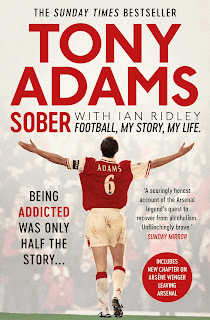
“I’ve got no angst of the past any more. I’ve cleaned that up – I’m 28 years without a drink or a drug. I’m comfortable in my skin for the first time in my life. I’ve grown up. There are no tentacles from the past now.”
Tony Adams
‘I have an illness. I’ve accepted that.’
Paul Merson
Tony Adams’ two books, addicted and now Sober, make it abundantly clear that his struggles with alcoholism have impacted greatly on his life and relationships with other people.
Astonishingly, Addicted was published in 1999 while Adams was still Arsenal and England captain. Addicted, like its sequel, Sober was a brutally honest account of his life as a recovering alcoholic. “I walk the walk today. I’m fully recovered but still go to regular meetings and three, four prisons a year, passing the message on to the newcomer that help is out there.”
Sober, published in 2018, covers the last five years of Adams’s playing career and his attempts at football management. Like Addicted, Sober is written with the help of writer Ian Ridley. Ridley is an excellent writer. How much of the book Adams wrote would be interesting to know, but his voice comes from the pages. Ridley himself is a recovering alcoholic. In a 2017 interview Ridley explains how he first met Adams.
“I knew Tony of course, with him playing for Arsenal and England and me a national paper football correspondent, but he had little liking for the press. We met properly, introduced by Paul Merson, when Tony got sober in August 1996. I had been sober from my alcoholism for about eight years by that time. With Addicted, he wanted to get across to people who might have a drink problem that there was a solution and help available. I recall a wonderful moment when it was nominated for the William Hill Sports Book of the Year award in 1998. It didn’t win, but at the award ceremony, a waiter came up to me with a glass of mineral water and said: “I’m sorry your book didn’t win, Mr Ridley, but if it’s any consolation, I read this book a couple of months ago, realised I had a problem, went to AA, and I’ve been sober ever since. The hairs on the back of my neck stood up. I rang Tony. “That’s why we wrote it,” he said. “Not to win awards but to help people.”[1]
When asked by the interviewer so why the sequel?. Ridley replied, “Tony wanted to do Sober 20 years on to show that it is possible to have a great life without the booze. He also wanted to tell people what happened after Arsenal. There is plenty of new material, including Sporting Chance and Tony’s times as Portsmouth coach when they won the FA Cup. He also talks about his experiences in Azerbaijan and China, when he suffered a heart attack in the former and virtually a nervous breakdown in the latter.”
The book, unsurprisingly, is dominated by the language of AA and recovery. Adams is proud of his long struggle to found Sporting Chance, a charity dedicated to helping athletes and women with addictions. In a Guardian interview, he describes reaching rock bottom and needing help: “I needed a lot of pain. Alcohol gave me a good hiding; prison, intensive care, pissing myself, shitting myself, still not giving up. Do you know what I mean? Sleeping with people I didn’t want to sleep with. I have to remind myself at the end of my drinking, I did not want to live, but I didn’t know how to kill myself. I was at a ‘jumping off point’, as we call it. I got there, and only then could I ask for help.”[2]
Adams’s life in management was not as successful as his playing career. As one reviewer recounts, Adams “ took various courses and coaching badges before trying his hand at management with Wycombe. After resigning there, he returned to education before joining Portsmouth as Harry Redknapp’s assistant during their high-spending days, including an FA Cup victory. He ultimately became manager after Harry left but appears never to have had much chance due to budget cuts before asking to be fired to save himself from resigning. From here, Adams’s career took an odd, international turn. After briefly coaching in Azerbaijan, he stepped into a general manager/consultant-type role in building a small Azerbaijani team from the ground up. This was followed by a connection with a Chinese football investor as Adams took on a general consulting role for Jiang Lizhang, who owned a club in China and purchased Granada in Spain.”[3]
The book will appeal to a wide audience outside of football. For Arsenal fans. It contains Adam’s insight about his footballing journey. The latest publication includes a new chapter on Adams’s relationship with the former Arsenal manager Arsene Wenger. Both books cover this relationship. Adams has enormous respect and fondness for Wenger; however, their relationship blew hot and cold. Perhaps the new book’s most controversial aspect is Adams questioning Arsene Wenger’s coaching.
Adams also criticised Wenger for staying too long at Arsenal: “He probably had an addiction. He couldn’t let go at the end – he’s a typical addict. He’s completely obsessed with the game every single minute. It maybe cost him relationships, and I think it cost him his job and inability to let go. It’s been bloody depressing for the last 10 years. What is to blame? “Recruitment. It’s been very poor. You get players two ways: academy or buy them in. We haven’t had the money to buy them through the transition, and I don’t think we have had the network, to be honest; 17 backroom staff gone, six scouts gone, Stevie Morrow [head of youth scouting] gone, probably the best academy scout in the country sacked. To bring players through agents it might be the way the game is going, but not how I would build. “The whole club had different values. It was smaller. It’s a different game. It’s a business now. That level of connection within the club, a disconnect with the fans, is a real issue in the game.”
Perhaps if I were being super critical, I would say that the book does not go into the deep connection between sports such as football and the huge rise of gambling, drug taking and alcoholism in society. Paul Merson’s recent documentary was a damaging indictment of the Gambling Industry’s profit-making out of human misery.[4] As Adams states, “Of the 30% of patients who come to the clinic with an addiction, 70% have a problem with gambling. “Addictions within football, we’re talking gambling,” The Premier League, it’s a bit of an epidemic to be honest.” Sober could have used the numerous academic articles that have looked into the connection between Sports and alchoholism.
In his paper, Carwyn Jones argues “ that football plays a questionable role in promoting two potentially problematic activities, namely drinking alcohol and gambling. Gambling and alcohol companies sponsor clubs and competitions and pay to advertise their products at the stadium and during television coverage. Consequently, millions of fans, including children, are exposed to the marketing of these restricted products. The latter are exposed despite regulations prohibiting such advertising and promotion in other contexts. The promotion of these activities to children and adults increases levels of consumption, which in turn increases the number of problem drinkers and gamblers in society. High-profile footballers play a further role in normalising drinking and gambling. They are role models whose actions influence others. Their excessive drinking and gambling activities provide poor examples for football fans, young and old.”[5]
Sober is an excellent companion book to Addicted. Like Addicted, it is a brutally honest appraisal of Tony Adams’s addiction and mental health struggles. In achieving sobriety, he has become an inspiration to other recovering addicts and alcoholics.
References
1. Alcoholism and recovery: A case study of a former professional footballer
Carwyn JonesView all authors and affiliations Volume 49, Issue 3-4
2. FOOTBALL, ALCOHOL AND GAMBLING: AN UNHOLY TRINITY?
CARWYN JONES- Vol. 51, 2 – 2015 Pag. 5–19
3. Chapter 7 – The interrelationship between alcoholism, depression, and anxiety Richard Tindle , Farah Ghafar, Eid Abo Hamza Ahmed A. Moustafa The Nature of Depression-An Updated Review 2021, Pages 111-133
[1] www.sportsjournalists.co.uk/books-and-reviews/ridleys-20-year-journey-with-tony-adams/
[2]http://www.theguardian.com/football/2020/jan/31/tony-adams-alcohol-gave-me-good-hiding-i-needed-pain-sporting-chance-arsenal
[3] allsportsbooks.reviews/category/soccer/page/5/
[4] Hooked: Addiction and the Long Road to Recovery- by Paul Merson- Headline Book Publishing – September 16 2021-atrumpetofsedition.org/its-up-for-grabs-now/
[5] Football, Alcohol and Gambling: An unholy trinity? KINANTHROPOLOGICA Vol. 51, 2 – 2015
Revolution: The Rise of Mikel Arteta’s Arsenal by Charles Watts is published by Harper Collins, £20

“All great football managers are revolutionaries at first. Take Arsenal’s Arsene Wenger. Appointed in 1996, he was Leon Trotsky: the general brimming with new ideas, ferocious energy and seemingly countless different ways of doing things. By the time Wenger was eased out in 2018, he was north London’s Leonid Brezhnev, the leader of the Soviet A revolution in a particular area of human activity is an important change in that area.”
“ A revolution in a particular area of human activity is an important change. The nineteenth century witnessed a revolution in ship design and propulsion….the Industrial Revolution. Synonyms: transformation, shift, innovation, upheaval. More Synonyms of Revolution.”
Collins Dictionary
The title of Charlie Watts’s new book is Revolution. The word means many things to many people. In the context of this book, it is about a football manager who turned around a failing club by initiating a revolution. Harper Collins has called this book a “first of its kind.”
The writer of Revolution is Goal’s Arsenal correspondent Charles Watts. The biggest challenge facing any writer about football is to tell us something we did not know, which is very difficult given the scrutiny every club gets from the media. To his credit, Watts does exactly that. A significant part of the book concentrates on how the new Arsenal manager, Mikel Arteta, managed to change the toxic culture at the club and reconnect with the fans.
One spectacular and emotional way he has done this is using the English singer Louis Dunford’s song The Angel as an anthem played and sung at the beginning of every home game. Dunford was born and raised in north London, released a single called ‘The Angel’ in February 2022, and Gooners have picked up the chorus, which goes:
North London Forever
Whatever the weather
These streets are our own
And my heart will leave you never
My blood will forever
Run through the stone
The new Arsenal Football Club manager, Mikel Arteta, was a former Arsenal captain from the Basque region of Spain. His first coaching job was under Manchester City’s Pep Guardiola. He has been compared to Arsenal’s former great manager, Arsene Wenger. Like Wenger, Arteta has revolutionised this old club.[1] In a limited sense, Watts is correct in saying that Arteta would prove to be a revolutionary, and the results of this Revolution are showing in his new team now.
Charles Watts is a man of many sides. He is part of the Arsenal press pack and has been a fan since 1989. A year in which all Arsenal fans cherish the memory of. [2]Although close to the Arsenal establishment, his book does not glorify the club or its personnel. Nor is it a biography of Arteta, as it contains little of his life or upbringing. It concentrates on how Arteta has continued the legacy of Wenger. Arteta acknowledges the past by displaying a giant Wenger picture and quoting Wenger at Arsenal’s London Colney training complex. He also invited Wenger to return as a spectator to the Emirates last Boxing Day.
Arteta, like Wenger, lives and breathes football. Both are highly intelligent men. According to Watts, outside of his family and football, Arteta has little other interest except barbecuing. Even in a bitter London winter, he uses these to bond with his staff and players leading former Arsenal player Bacary Sagna to say, “Before I could say hello, he was hammering me about formations. All I was doing was looking for the snacks.”
Perhaps the book’s most interesting and insightful parts are when Watts examines the nuts and bolts of Arteta’s Revolution. Watts is more a chronicler than an interpreter of events. Most Arsenal fans would have seen much of Arteta’s Modus Operandi in the extremely interesting 2021-22 Amazon Prime Video’s All Or Nothing series. Arteta operates on very simple principles revolving around “non-negotiables”. These are chiefly mutual respect and taking responsibility on the pitch. He sees Arsenal as a collective rather than a set of disparate individuals.
A brutal example of how Arteta applies his method is the treatment of Pierre-Emerick Aubameyang. When his captain and leading scorer missed a COVID test, broke lockdown regulations by having a tattoo, and arrived back late from compassionate absence. Auberyang already had a catalogue of poor timekeeping. Arteta was ruthless. He even compiled a dossier of Aubameyang ‘s misdemeanours for the Arsenal legal team. The £56 million player man left on a free transfer to Barcelona.
As was said earlier, Watts is not completely in Arsenal’s pocket and to his credit, as Dan from the website Just Arsenal writes:“He puts any connections to one side and gives both sides of an argument. Other journalists would have feared impacting their relationships with the club and/or Arteta, but Watts doesn’t only write what those two want to hear. For example, he strongly implies the belief held by many that Ozil was dropped for non-football reasons, giving strong facts to back up that theory. I won’t give spoilers, but it’s fascinating how, essentially on Zoom, the squad were asked to agree to a wage reduction to save staff jobs during the pandemic. When Arsenal couldn’t get the 75 per cent agreement they needed (Arteta steps in and convinces some to change their mind), Watts asks why Ozil was the only name leaked to the press. He bravely points out that Arsenal lied. 55 staff were still made redundant despite their employer being worth 6.3 billion! He also questions why Matt Smith was on the bench in the Cup Final at the expense of Ozil purely for footballing reasons. (Smith would never kick a ball for our first team).[3]
While Watts is a gifted writer and communicator, he shies away from examining Arteta and the club in the context of the growing financialisation of football. Football is big business. FIFA, the world governing body, controls a budget of 4bn Euros. Although he briefly mentions that Arsenal was involved in the attempted creation and debacle of a European Super League, his analysis is superficial. As Robert Stevens writes, “The corporate interests in control of the ESL clubs misjudged the popular mood. They were surprised by the backlash against their proposals—reflecting the growing anger against the parasitic billionaire oligarchy and the capitalist system that sustains it. But they remain determined to press ahead. Perez declared on Thursday, after nine of the 12 founding teams had withdrawn, “We’re going to continue working… the project is on standby.”Plans for a Super League are not an aberration. It, or something like it, is the logical next step in a sport increasingly dominated by giant corporate and financial interests. The conflict between UEFA and FIFA on the one hand and the ESL founder owners on the other is a competition between two business models, each designed to ensure the lion’s share of revenues for the top clubs.[4]
Watts’s book is one of the better footballing books. A must for any Arsenal fan and a very good Christmas present. As Watts writes: “Arsenal’s rise back towards the summit of English football under Mikel Arteta has been a journey that has captivated the fanbase and brought an energy to Emirates Stadium that hasn’t been seen since the move from Highbury in 2006. Arteta has made some difficult decisions and faced some massive challenges during his short time in north London, but in doing so, he has changed the culture of a club that just a few years ago seemed to have totally lost its way.“Whatever happens between now and the end of the season, Arsenal are back on track and in Arteta, they have one of the sharpest minds in European football pushing the club forwards. I’m excited and privileged to tell this story.”
[1] en.wikipedia.org/wiki/Arsenal_F.C.
[2] www.amazon.co.uk/89-How-Arsenal-did-impossible/dp/B075G6J28L
[3] www.justarsenal.com
[4] Billionaires’ European Super League proposal shelved amid mass opposition from football fans
Robert Stevens-https://www.wsws.org/en/articles/2021/04/24/supe-a24.html
Hooked: Addiction and the Long Road to Recovery- by Paul Merson- Headline Book Publishing – September 16 2021

Hooked is Paul Merson’s brutally honest and eminently readable memoir about his thirty-year addiction to drugs, gambling and drinking. This is not your run-of-the-mill footballer’s memoir, as it was nominated for the Whitbread book prize and serialised in The Times newspaper.
Merson was a professional footballer winning two First Division titles with Arsenal and was arguably one of the finest players of his generation. But for all his football career and beyond, he was addicted to alcohol, drugs, and gambling. His addictions, coupled with deep depression, led him to thoughts of suicide ‘I’ve come to realise that I’m powerless over alcohol … I’m an alcoholic. My drinking and gambling have left a lot of wreckage.’I wanted to kill myself. I couldn’t go on anymore. I couldn’t see a way out.’
Fortunately, he managed to face his demons, saying, ‘One day, I was walking home from the pub late on a Sunday evening, and I thought I’ve had enough of feeling like this, every day of my life. I rang up Alcoholics Anonymous the next day, and since then, I haven’t had a drink.’
Merson estimates he lost over £7 million on gambling since becoming addicted, playing cards as a teenager. He even took the deposit he and his wife had saved for a new home and spent it on gambling. Although not mentioned in the book, when Merson was asked by Cambridge and Imperial College London researchers to have his brain hot-wired to one of their machines, it went haywire when he felt tempted to have a bet. His brain was docile when shown images of family life and beautiful natural scenery, and when shown dice throwing or a roulette wheel, it went mad.
Merson’s story is by no means unique, as one person a day dies from a gambling-related suicide. It is estimated by the Gambling Commission that there are over two million people in the UK who have a gambling addiction. Most of these people run up large debts and are prone to depression; some end up killing themselves.
While Merson is heavily critical of the gambling industry, his book does not delve into the capitalist nature of the gambling industry. The industry is one of the most predatory enterprises, predicated on the mantra that the ‘house’ always wins. Merson’s despair is felt by millions of people like him, and the betting companies like Bet365 prey on this despair and make millions out of it. It is no accident that Britain’s highest-paid CEO has built her fortune on online gambling. Recently Denise Coates made an obscene £265 million.
As Jean Shaoul writes, “Gambling revenues are overwhelmingly based upon the exploitation of the poor as well as those on the threshold of poverty, for whom the dream of winning provides a means of escaping a world of constant nagging worry over how to make ends meet, horrendous journeys to work and then being exploited in low-wage jobs by highly paid bosses. General statistics for gambling, including online betting, show that just under half the UK’s population (48 per cent) participate. After this, breakdowns focus on gender and age rather than income and social class. However, betting shops are most likely to be found in Britain’s poorest communities, with the east London borough of Newham hosting 86 shops, including 18 on one high street, each with their permitted maximum of four fixed-odds betting terminals (FOBTs) that can take £100 bets every 20 seconds. This contrasts with 56 in the southwest London borough, which has a similar population but is considerably wealthier.[1]
Merson does not sugarcoat this terrible period of his life, and his book is an unflinchingly honest memoir of his battle with addiction. He is now recovering, having not touched a drop of alcohol or gambled. But his biggest problem is whether he could continue sober. In his own words, he says, “This is it. This is the last chance saloon.” I hope he makes it, not because I am an Arsenal fan and Merson was one of a group of outstanding, talented footballers, but because he is trying to survive.
Perhaps more importantly, Hooked has opened up a national debate about addiction, depression and the damage they cause. As Shaoul states, gambling is an unhealthy industry emphasises social inequality, acting as a cash nexus, transforming everyone and everything into a commodity. Its growth is another example of social decay, a parasitic enterprise that appeals to the worst instincts: greed, individualism and indifference. Such diseased enterprises are the norm today, with governments embracing gambling at the same time as profits of the banks and other financial institutions have become ever more reliant on forms of speculation, divorced from the creation of social wealth, such as trading in currency futures.”[2]
[1] Britain’s highest paid CEO built fortune on online gambling- Jean Shaoul- https://www.wsws.org/en/articles/2018/12/05/casi-d05.html
[2] Britain’s highest paid CEO built fortune on online gambling- Jean Shaoul- https://www.wsws.org/en/articles/2018/12/05/casi-d05.html
 A Trumpet of Sedition