Introduction: A System Exposed in Its Naked Brutality
The insights in Scam: Inside Southeast Asia’s Cybercrime Compounds go beyond exposing a criminal underground. They reveal how modern capitalism operates, eliminating its ideological illusions. As noted, these compounds exemplify “the most extreme manifestation of the essential logic of capitalism; these are human beings that enjoy no rights beyond those of the commodity: to be bought, sold, and used.” This point is crucial. The authors show that this isn’t a deviation but the inevitable outcome of a global system built on extracting surplus value from increasingly vulnerable, disposable, and surplus populations.
The scam compounds—fortified complexes in Cambodia, Laos, Myanmar, and the Philippines—are not anomalies. They operate as state-approved capitalist ventures, are integrated into global financial systems, and depend on the same labour control, coercion, and profit-motivated methods that drive the world economy. The book’s findings underscore an important point the WSWS has long stressed: modern slavery is not just a leftover from pre-capitalist eras but a core feature of today’s capitalism.
The Scam Compound as a New Form of Capitalist Production
Industrialised Fraud as a Labour Regime
The scam compounds exemplify a new, hybrid form of capitalist production: they commodify deception itself, employing trafficked workers who are both victims and coerced tools of exploitation. Workers are compelled “to become the instruments of exploitation against others,” caught in a “victim-offender trap.” This is not just crime; it is organised, hierarchical, profit-driven production on a global scale. The compounds operate through shift systems, quotas, performance metrics, punitive discipline, vertical management, and financialised profit extraction. Essentially, they resemble the Amazon warehouse, Foxconn factory, and Uber.
The Role of Surplus Humanity
The Asia-Pacific region’s share of “66 per cent of the world’s modern slaves” is intentional. It results from large-scale surplus populations generated by agrarian collapse, IMF-led structural adjustments, export-focused industrialisation, land dispossession, and climate-driven displacement. These millions of people serve as the human foundation for both sweatshops and scam operations. Capitalism not only accepts these conditions but depends on them.
State, Crime, and Capital: A Single Integrated Apparatus
A key politically sensitive point in the document is its claim that “systemic impunity” is not a flaw but the norm in the capitalist state within these regions. The compounds are not secret criminal hideouts but are: Licensed casinos, tax-paying tech parks, Joint ventures with political elites, and protected by police and military forces. The distinctions between state, business, and organised crime are nonexistent—they are fully integrated. Although this situation is not unique to Southeast Asia, it is more visible there. The scam compound exemplifies how the capitalist state can function under high inequality and global capital flows: as a tool to safeguard profits, irrespective of legality, morality, or human cost.
The Liberal‑Reformist Dead End: The Limits of the Verso Framework
As the book in question was published by Verso, it is worth looking at the politics promoted by the publisher. Verso Books holds a unique place in today’s intellectual scene. It is the most prominent “radical” publisher in the English-speaking world, but also one of the most politically tame. Its catalogue features detailed explorations of global capitalism’s horrors—such as sweatshops, border controls, environmental destruction, and financial exploitation—yet it often stops short of advocating the revolutionary actions that its evidence suggests are necessary.
Although Verso’s output “meticulously documents capitalist horrors, it ultimately channels opposition into dead-end political conclusions. This is not just a flaw; it defines Verso’s role: managing dissent, transforming systemic critique into marketable radicalism, and preventing outrage from developing into revolutionary consciousness. Its degeneration is therefore political, structural, and historical, not merely editorial.
The Political Economy of Radical Publishing
Verso originated within the New Left Review environment, which itself developed after the 1956 crisis of Stalinism and the decline of traditional Communist Parties. Its founders aimed to establish a space for independent Marxist scholarship, separate from both Soviet orthodoxy and Western social democracy. However, the fall of the USSR, neoliberal changes in academia, and the commercialisation of “radical theory” have shifted Verso from being a platform for Marxist discussion to a niche brand within left-wing critique.
Today, Verso operates under the same market logic as any other cultural enterprise: it must sell books, cultivate a brand, appeal to a professional-managerial audience, and avoid alienating liberal institutions, NGOs, and academia. It also must stay within the ideological boundaries of the capitalist state. This structural position shapes its politics, preventing Verso from advocating the overthrow of capitalism, since its survival depends on reproducing the class relations it criticises. Therefore, there’s a contradiction: Verso markets radical ideas as a commodity while simultaneously neutralising their revolutionary potential.
The Ideological Function: Radicalism Without Revolution
Verso’s political decline is most evident in the genre typified by Scam: Inside Southeast Asia’s Cybercrime Compounds. This book reveals a shocking brutality—trafficked workers coerced into large-scale fraud, shielded by alliances between the state and criminal networks—yet the political scope stays limited to: “better regulation,” “international cooperation,” “corporate accountability,” “ethical consumerism,” and “strengthening civil society.”
The founder of the Global Slavery Index suggests consumers should “ask the company where it was made,” a view that simplifies structural exploitation into individual choices. This encapsulates Verso’s approach: a systemic critique that ultimately issues a moral urging. The literature that arises from this approach: identifies capitalism’s crimes, explains how it operates, details its victims, reveals its hypocrisies, and then offers solutions that preserve capitalism. This is not radicalism but left-wing liberalism with a Marxist visual style.
The Class Basis of Verso’s Degeneration
To grasp Verso’s political direction, it’s essential to analyse the class forces it appeals to. Its primary audience includes: academics, NGO professionals, graduate students, cultural workers, journalists, and the progressive segment of the professional-managerial class. This group opposes the ruling class but is wary of the working class. They advocate for social justice yet fear social revolution. Their goal is to regulate capitalism, not dismantle it. They pursue moral purity rather than engaging in class struggle.
Verso’s catalogue reflects this social position. Its books critique capitalism’s excesses but stop short of challenging its fundamental structure. They support reforms that do not threaten property rights, promote activism that does not confront state authority, and celebrate movements driven by moral outrage rather than class analysis. Furthermore, these publications favour identity-based frameworks over class-based explanations. This approach explains why Verso can publish works on slavery, trafficking, and exploitation without concluding that only expropriation of capital by the working class can eliminate these issues.
The Commodification of Dissent
Verso’s decline is closely linked to the wider commodification of radical politics. In the neoliberal age, dissent has become a commercialised niche. Radical critique is often packaged, branded, and marketed to an audience that treats it as a lifestyle choice. Verso’s role is to offer: the semblance of radicalism, the language of critique, the aesthetics of Marxism, and the moral comfort of “being informed” — all without endangering the material interests of its readership. That’s why Verso books frequently conclude with appeals to NGOs, calls for increased “awareness,” demands for transparency, pleas for ethical consumption, and proposals for regulatory change. These are not revolutionary tactics; instead, they serve as means of draining revolutionary energy.
The Political Consequences: Paralysis in the Face of Crisis
The world faces an unprecedented crisis: widespread inequality, worsening climate change, mass migration caused by war and ecological collapse, authoritarian regimes, disrupted global supply chains, a resurgence of slavery and forced labour, border militarisation, and rising imperialist conflicts. The Scam Compounds are not isolated incidents but part of a larger ongoing pattern of exploitation. This includes Amazon warehouses with injury rates exceeding those in logging and mining, gig-economy workers considered “independent contractors,” sweatshops in Bangladesh and Vietnam, migrant detention centres in the US and EU, Foxconn’s suicide nets, and quasi-indentured labour in the global shipping industry. The same relentless pursuit of profit fuels these issues—driving Amazon warehouse conditions, the gig economy, and catastrophic factory collapses and suicides. The scam compound is capitalism stripped of its facade.
Why Policing Cannot Solve the Problem
The push for transnational policing—like Interpol task forces, crypto-tracking, and border enforcement—relies on a major misconception. These scam hubs are not outside the system; they are embedded within it, serving as profitable points in global capital flows. Policing cannot eliminate them because it addresses only symptoms, not root causes. It ends up reinforcing the repressive tools of the capitalist state, shifting exploitation elsewhere, criminalising migrants and trafficked workers, and leaving the profit system intact. No amount of transnational policing… will abolish this industry.”
Conclusion: The Future Is Being Written in Sihanoukville
The scam compounds aren’t just a peripheral horror; they serve as a warning—a preview of the future capitalism is heading toward as its crisis worsens. With the rise of automation, climate disasters, and geopolitical instability, the ruling class will increasingly depend on Coercive labour systems, criminalised profit-making, State-backed violence, Digital monitoring, and disposable populations. The scam compound is not the final form but a prototype. Only the organised, global effort of the working class can stop this slide into a world in which the Sihanoukville model becomes widespread.
Benjamin Weil’s article, despite its focus on inequality, precarity, and platform economy hierarchies, remains firmly within the realm of bourgeois reformism. Its goal is the ongoing survival of capitalism, presented more benignly with an “inclusive” regulatory approach. Using the language of solidarity and rights, Weil’s suggestions essentially amount to requesting that the capitalist state better oversee the exploitation it already oversees.[1]
To grasp why this framework remains politically sterile, it is essential to start from the Marxist view that the commodification of human intimacy is not an anomaly but a fundamental aspect of capitalist social relations.
The Commodification of Intimacy: A Product of Capitalist Social Relations
The article’s core slogan—“sex work is work”—is viewed as a political goal, meant to be recognised through legislation and state support. However, while this view helps defend against criminalisation, it hides a deeper truth: under capitalism, all things are transformed into work because they become commodities. The real question isn’t whether selling sexual services counts as “work,” but rather the social system that forces people to sell their bodies, time, emotions, and innermost abilities to get by.
Marx and Engels vividly outlined this dynamic. In The Communist Manifesto, the authors argue that the bourgeoisie has reduced human relationships to self-interest and monetary exchange, converting all human worth into “exchange value.” The rise of OnlyFans does not signal a democratisation of pornography. Still, it continues this logic into the most personal areas of life, driven by algorithms, payment systems, and the global economy. The platform economy doesn’t free people; it monetises their activities. It doesn’t give power; it extracts it. It doesn’t promote democracy; it creates stratification.
The Pseudo‑Left’s Framework: Reform Without Revolution
Benjamin Weil accurately points out the incoherence of the “sex worker” label and the absurd spectacle of celebrities using the slogan for their own branding. However, his proposed solution — “solidarity from top to bottom” and “permanent protections” provided by the capitalist state — leads to a political dead end.
The capitalist state does not serve as a neutral protector of rights; instead, it functions as a tool for class domination. Its laws—such as FOSTA-SESTA and the Earn It Act—have repeatedly increased efforts to criminalise, monitor, and marginalise sex workers. Asking this state for protection is like requesting the arsonist to control the fire.
This represents the typical approach of identity-based reformism: recognising a genuine social harm and attempting to fix it within the existing system that causes it. It struggles to conceive of a world beyond capitalism and advocates only for kinder management of capitalist exploitation.
What the Article Cannot Theorise: Inequality as a Structural Feature, Not a Distortion
The article criticises how earnings are concentrated among the top 1 per cent of creators, highlights the racial biases embedded in platform algorithms, and discusses the gap between celebrity “sex workers” and those pushed into online sexual labour out of economic necessity. However, it views these issues as distortions within an otherwise legitimate industry.
This is a significant misconception. These inequalities are not exceptions but rather the usual operation of capitalism. The gig economy—exemplified by OnlyFans—is capitalism in its most current and pure form: removing employer responsibilities, fragmenting workers, and transferring all risks to individuals.
David Walsh’s analysis of singer Kate Nash’s shift to OnlyFans highlights a broader social issue: a society that marginalises its artists, pushing them into pornography out of shame and neglect. This also reflects the millions who, during the pandemic, turned to online sexual work—not because they felt empowered, but because capitalism provided no alternative for their survival.
The pseudo-left uses terms like “agency,” “choice,” and “bodily autonomy” to mask underlying coercion. It presents economic pressure as a form of self-expression.
The “Sex‑Positive” Industry: A Pseudo‑Left Apologia for Capitalist Degradation
Today, few ideological groups are as reactionary yet as skillfully marketed as the NGO and academic “sex-positive” industry labelled as “progressive.” Operating under the guise of empowerment, autonomy, and liberation, this scene acts as a political cleanser: it disguises capitalist exploitation as a colourful array of “choices.” This sector serves as the ideological extension of a large commercial system that gains from turning intimacy into a commodity, fragmenting social life, and capitalising on the desperation of millions.
Rather than contesting the social pressures that force people to commodify their bodies, the sex-positive industry instead celebrates this tendency as a form of self-expression. It serves as an ideal ideological partner to a system that has turned every aspect of human capability—physical, emotional, and sexual—into a marketable good.
The Ideological Function of “Sex Positivity”
The sex-positive framework didn’t arise as a bold critique of capitalist morality. Instead, it functions as a market-friendly rebrand of sexual commodification. Its main principles — “agency,” “choice,” and “empowerment” — are directly borrowed from neoliberal ideology. These same ideas are applied to defend zero-hour contracts, gig-economy insecurity, and the reduction of social protections.
When NGOs, academics, and media personalities promote “sex positivity,” it often comes across as a moral obligation: people are expected to embrace the commodification of intimacy, or else be labelled prudish, conservative, or “anti-sex,” which is a severe criticism in this context. This does not represent true liberation. Instead, it acts as a form of censorship against dissent, all in the interest of capitalism.
The NGO‑Academic Complex: A New Clerisy of Capitalist Morality
The sex-positive industry depends on a complex network of NGOs, foundations, university departments, and media outlets. Their funding comes from sources like corporate philanthropy, tech companies, and state-aligned foundations, underscoring their class affiliation. Instead of opposing capitalism, they act as its ideological subcontractors.
These institutions primarily perform three roles: They depoliticise exploitation by presenting sexual commodification as just another form of ‘work,’ thereby concealing the underlying coercive structures that force millions into it. They individualise systemic issues by framing poverty, unemployment, and social neglect as personal “choices” that lead to entry into the industry. Additionally, they lend moral legitimacy to capitalist platforms, with companies like OnlyFans and Pornhub described as “empowering tools’ instead of profit-driven entities that benefit from human desperation. This creates an ideological framework that turns capitalist exploitation into a lifestyle brand.
The Academic Wing: Postmodern Apologetics for Exploitation
Scholars supporting the sex-positive industry—mainly from gender studies and postmodern theory—have developed a language that obscures exploitation. Their terminology mixes Foucauldian micro-politics, intersectional terms, and neoliberal voluntarism. For example: coercion is called “choice,” economic desperation is labelled “agency,” alienation is described as “self-expression,” and platform exploitation is termed “entrepreneurship.” This is not genuine scholarship but ideological obscuration.
These scholars view the capitalist market as a neutral space where people negotiate meaning, identity, and pleasure. They are unable to imagine social relations beyond the commodity form because their entire theoretical framework rests on rejecting the concept of class.
NGOs and the Business of “Empowerment”
The NGO sector has realised that promoting “sex positivity” is a profitable brand. They offer numerous workshops, conferences, “empowerment” seminars, and consulting services. Although they claim to “support sex workers,” their true role is to divert discontent from class struggle, focusing instead on seeking state recognition, regulatory changes, and philanthropic funding. Their political outlook is rooted in sustaining capitalism, masked with an inclusive, rainbow-colored image. Rather than fighting exploitation, they tend to manage it.
The Pseudo‑Left’s Role: Sanitising the Market
The pseudo-left, which includes the DSA-influenced scene in the US, the NGO-Labourist groups in Britain, and similar organisations worldwide, has fervently embraced sex-positive ideology. This change is deliberate. These groups have abandoned their socialist roots and now prioritise lifestyle, identity, and personal expression over the goal of dismantling capitalist property systems.
For these individuals, turning intimacy into a commodity isn’t seen as a social tragedy but as a form of “resistance.” They praise the entrepreneurial “creativity” of OnlyFans creators, ignoring broader problems like unemployment, declining wages, and weak social safety nets that push people toward these platforms. Their viewpoint promotes recognising, regulating, and even celebrating exploitation instead of eliminating it.
What the Sex‑Positive Industry Cannot Admit
The sex-positive movement often overlooks the essential fact that prostitution, pornography, and the commercialisation of intimacy are rooted in a class society. Engels showed that these issues emerge alongside private property and the oppression of women. They are not timeless, natural, or solely expressions of freedom; rather, they are manifestations of alienation.
Accepting this would mean recognising that true liberation depends on dismantling capitalism, which would immediately cut the sex-positive industry off from its sources of funding, institutional backing, and ideological roots. Therefore, they hold on to the illusion that the market can be made more humane, that exploitation can serve as a form of empowerment, and that commodification can lead to liberation.
The Marxist Position: Abolition, Not Celebration
Marxists oppose the core idea of the sex-positive industry: that turning intimacy into a commodity aligns with human freedom. Their goal isn’t to sanitise or destigmatise exploitation but to eliminate the social relations that enable it.
A socialist society, characterised by collective ownership and democratic control of the means of production, would remove the economic pressures that push people into commodified sexual labour. It would establish the material basis for truly free human relationships, free from monetary influence. The sex-positive industry struggles to envision such a society. Marxists are actively working to create it.
Conclusion: The Pseudo‑Left’s Moral Bankruptcy
The NGO-academic sex-positive industry does not truly promote liberation. Instead, it acts as a complex ideological tool that justifies capitalist exploitation by masquerading as empowerment. Its role is to persuade individuals to accept their own degradation, turning structural coercion into a matter of personal choice, and to frame the commodification of intimacy as a victory for autonomy.
Marxists oppose this reactionary politics by advocating for the struggle for socialism, which is the only way to create a society where people no longer have to sell their bodies, emotions, or intimacy to get by.
The Historical Materialist Perspective: Prostitution as a Product of Class Society
Engels, in The Origin of the Family, Private Property and the State, argued that prostitution and the sexual double standard are not innate aspects of human existence but are shaped by class society — particularly the monogamous family structure that emerged alongside private property. The commercialisation of sexuality is inherently linked to the broader commodification of labour.
Viewing sex work as a fixed, natural category means abandoning the perspective of historical materialism. Alternatively, seeing it as a legitimate industry in need of improved regulation implies accepting the enduring nature of capitalist social relations.
The Real Solution: Abolition, Not Sanitisation
The working class cannot attain liberation by simply regulating how their bodies are commodified. The fight is not just for a “safe home to sell” sexual services, but for a society where nobody is forced to sell intimate access to their body.
This calls for more than just legislative change; it necessitates dismantling the capitalist system that equates all human interactions with exchange value. A socialist overhaul — including ending private ownership of production means and empowering the working class with democratic control over the economy — is essential for ending prostitution and the commercialisation of intimacy. Only in such a society can human relationships be freed from the cash nexus and reconstituted based on equality, solidarity, and genuine freedom.
The article’s call to “instate the obvious” flips reality. What needs to be established is not just acknowledging that “sex work is work,” but realising that a society based on the commodification of everything — including human intimacy — should be dismantled. Reform efforts cannot resolve capitalism’s contradictions; they can only contain them. Marxists’ role is not to humanise exploitation but to eliminate it.
[1] Sex Work is (Gig) Work: Assessing the OnlyFans effect: Benjamin Weil The Baffler, MAY-JUN 2022, No. 63 (MAY-JUN 2022), pp. 78-86
Pip: A BBC documentary tears the veil off OnlyFans and somehow manages to indict everyone except the economic system running the whole operation. Impressive restraint.
Mara: freerein61 takes that contradiction apart in a piece that connects platform capitalism, the pseudo-left's defence of commodification, and what the collapse of sustainable cultural work actually looks like on the ground. Let's start with the BBC investigation itself and what it reveals — and conceals.
BBC Investigation, Platform Capitalism, and the Pseudo-Left's Alibi
Pip: The BBC went inside OnlyFans expecting to find bad actors. What the post argues is that they found the system working exactly as designed — and then flinched from saying so.
Mara: The piece sets the frame directly: "he is following a business model that is discussed openly in these forums." The agent who threatened a woman and her daughter, who sent masked men to strangle her in her own home, is not a rogue element. He is the informal enforcement arm of a platform taking a twenty percent cut and disclaiming responsibility for everything downstream.
Pip: Which is the rentier logic in its purest form. OnlyFans generated $684 million in pre-tax profits last year by extracting value from labour it does not employ, policing exploitation it does not acknowledge, and parasitising creators it does not protect.
Mara: And the BBC's response to all of this is to invoke the Online Safety Act and interview the UK's anti-slavery commissioner. The post argues that framing matters enormously here: calling it "modern slavery" portrays extreme exploitation as a rare crime rather than a structural feature. It "individualises exploitation, prosecutes the worst offenders, and leaves the economic structure that produces the desperation intact."
Pip: So the documentary functions less as exposure and more as pressure-release — enough outrage to satisfy viewers, not enough analysis to threaten the system producing the outrage.
Mara: The post makes the same argument about the pseudo-left. The "sex work is work" position, it contends, is not progressive but capitalist realist — it accepts that all human relations must become commodities and frames resistance as prudishness. The post puts it plainly: "No amount of regulation can make the commodification of the human body humane."
Pip: The comparison to justifying nineteenth-century child labour lands harder than it should.
Mara: There is also a sharp economic dimension. The piece points to Kate Nash losing money on every tour and turning to OnlyFans to cover costs — streaming paying $0.00173 per play, touring costs up forty percent since the pandemic, eighty percent of music revenue captured by one percent of artists. The post's argument is that sexual commodification is not a choice but a forced response to the collapse of culturally supported work.
Pip: The language of agency, the post notes, belongs to a class for whom OnlyFans might be a lucrative side hustle. "For Rebecca from South Wales, it was a trap."
Mara: The Marxist position the post advances is abolition of the conditions, not sanitisation of the market: expropriating tech monopolies, socialising digital platforms, treating cultural labour as a public good. Regulation, it argues, cannot humanise a market whose violence is not accidental but structural.
Pip: The violence, as the post puts it, is capitalism without its ideological mask — which is perhaps the one thing the BBC documentary accidentally got right by showing it.
Mara: The thread running through all of this is what happens when a system has no use for most of its people and no language for saying so honestly.
Pip: Next time, presumably, the BBC will commission a follow-up about Uber drivers and call it a labour story. We'll be here.
The collective singing of “Sunshine on Leith” by Hibernian fans has become a powerful symbol in modern Scottish football culture. Thousands of predominantly working-class voices unite to express a deep bond with their locality, shared memories, and collective identity, standing in stark contrast to the fragmented, commercialised nature of contemporary capitalism. The emotional impact of these gatherings is clear. However, appreciating their true meaning calls for a careful look at the historical and social factors that have influenced both Leith and the sport of football itself.
Media-promoted sentimental stories—such as “community spirit,” “local pride,” or “the magic of football”—mask deeper contradictions. These moments go beyond simple nostalgia or harmless rituals; they expose a collective social identity formed under conditions where capitalism has systematically eroded it. The ongoing presence of these expressions serves as a subtle form of resistance against the social damage caused by decades of deindustrialisation, privatisation, and the dominance of profit in all aspects of life.
A working‑class community transformed by capitalism
Leith, formerly Edinburgh’s port district, developed through the efforts of dockers, shipbuilders, and industrial workers who supported Scotland’s maritime economy. Its community identity was shaped by dock work, shipbuilding, and related industries that fuelled Scotland’s maritime trade, highlighting that these occupations were more than jobs—they formed the backbone of a cohesive working-class community.
Hibernian FC was born in this context. Established in 1875 by Irish immigrant workers, it was originally a symbol of community rather than a business. Many football clubs throughout Britain originated similarly—from factories, rail depots, mines, and working-class neighbourhoods. These clubs were formed by workers, for workers.
The social foundations supporting these institutions have been gradually eroded. Leith’s docks, once a defining feature, are now either shut down or repurposed into commercial and residential developments targeting a different socioeconomic group. Unstable service-sector roles have replaced traditional industrial jobs. Consequently, the working class has become divided, displaced, and pushed to the margins of politics.
This process was intentional, resulting from deliberate policies by successive governments—both Labour and Conservative—working on behalf of the financial and corporate elite. The dismantling of industrial jobs was part of a wider restructuring of capitalism aimed at maximising profit, and this trend has been pursued relentlessly since the 1980s.
Football under capitalism: from collective institution to commercial asset
The development of football mirrors this broader social change. Originally, clubs served as community hubs, but they have now shifted into profit-driven enterprises. Ownership has become more distant and less responsible to fans. Ticket prices have risen beyond what many working-class supporters can afford. Fans are no longer viewed as participants in a shared cultural tradition; instead, they are seen as consumers whose emotional connections are exploited for financial gain. “The songs, the rituals, the collective emotion—these are remnants of a truly popular, working-class culture. However, they now exist within an institution that is increasingly commercialised and disconnected from the community that created it.”
This situation is not exclusive to Hibernian. Throughout Europe, football has evolved into a global entertainment industry led by corporate interests, television broadcasters, and billionaire club owners. Meanwhile, the working class — the original creators and supporters of the sport for over a hundred years — is becoming increasingly marginalised.
However, the emotional impact of football remains strong because it fulfils needs that capitalism cannot: those for community, solidarity, and shared experiences. These needs are genuine, not mere illusions, as they stem from the social nature of human labour. They go beyond the limited scope of capitalist individualism.
“Sunshine on Leith”: sincerity in an age of commodification
The Proclaimers’ “Sunshine on Leith” exemplifies this vividly. Composed by two musicians from Leith, the song delivers a clear, emotionally honest declaration of heartbreak, resilience, and love for their hometown. It includes the lines: “My heart was broken, my heart was broken / Sorrow, sorrow, sorrow, sorrow…”
This passage avoids irony or postmodern detachment, emphasising the song’s authentic sincerity, which enhances its impact. When thousands of fans sing together, it’s more than a performance; it’s a shared emotional experience. These moments are powerful because they pierce the cynicism and commodification that dominate current culture, revealing a collective consciousness that capitalism has not yet eliminated.
However, these moments also expose the boundaries of cultural expression in capitalist society. The heartfelt essence of “Sunshine on Leith” cannot be fully expressed in a system that atomises individuals, fragments communities, and reduces all human relationships to market transactions.
Trotsky, culture, and the future of human solidarity
Leon Trotsky’s ‘Literature and Revolution’ emphasises that, during the socialist revolution’s transitional phase, the working class would not develop an isolated “proletarian culture”. Instead, they would adopt and reshape the cultural achievements of previous eras. This understanding is vital.
The working class should not dismiss its cultural traditions. Instead, it needs to understand them through a historical lens—as outcomes of shared life under exploitation, and as visions of a future society where culture isn’t a commodity but a universal human right.
The emotional essence of “Sunshine on Leith”—the desire for connection and the validation of shared experiences—is not narrow or purely local. It is deeply human. However, capitalism limits these expressions to temporary instances, leaving the fundamental social needs unfulfilled.
Only by abolishing capitalist social relations—such as ending private ownership of the means of production, establishing workers’ power, and reorganising society based on human needs—can we create the conditions in which such cultural expressions become commonplace rather than rare exceptions.
Conclusion: culture points beyond capitalism
While the mass singing of “Sunshine on Leith” doesn’t resolve the issues facing working-class life, nor replace political activism, it serves as a reminder of both the destruction caused by capitalism and the creative potential of the working class.
It briefly captures the hidden sense of collective solidarity within society. It highlights the human desire for community, which capitalism fails to fulfil. Additionally, it suggests a future where culture is viewed not as a commodity but as a collective expression of free, connected people.
The goal is not to romanticise these moments but to see them as signs of a deeper social contradiction—and to work toward socialist societal transformation, the only way to address it.
I have just received John’s comment on my WordPress website [1]. “ How does publishing through Amazon (of all of places) square with the general view here? The simple answer to this question is that publishing on Amazon does not square at all with my politics. From the age of sixteen, I considered myself a Marxist, and I will eventually die a Marxist.
If it has escaped John’s notice for a long time, it has been impossible for a revolutionary Marxist to be published. The Writer George Orwell, who was not a Marxist, found it very difficult to find a publisher for his book Homage to Catalonia. Orwell was savvy enough to know that “Freedom of the Press” had been “ Something of a fake because, in the last resort, money controls opinion”.
This was true in Orwell’s time and is even more true today. Unless you have access to a revolutionary Marxist party with its own printing press, you will not get published. No small or big publishing house will publish an orthodox or classical Marxist. The use of Amazon as an avenue to get my work published and reach a large audience does not endorse Amazon as a capitalist enterprise.
It may have escaped John’s notice, but all publishing houses, big or small, are run on capitalist lines. To accept or decline an offer from one of these or to publish on platforms such as Amazon does not mean one denies one’s politics it is but a means to an end. If every author turned down the opportunity to be published because the publishing company was a capitalist nothing of worth would have been published. John’s argument is false, and I do not accept it.
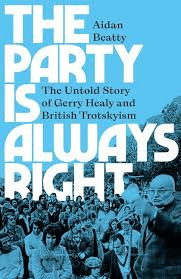
Despite being subtitled “The Untold Story of Gerry Healy”, this book contains nothing new and is a rehash of all the old lies and slanders that have been heaped on Healy and the Trotskyist movement for decades. The historian Thomas Carlyle was fond of saying that he had to clear a large pile of dead dogs off the body of Oliver Cromwell to reach the real person underneath. The same could be said of Beatty’s book. However, once all the dead dogs have been removed from this book, all you are left with is a worthless pile of crap.
While Beatty’s book is probably his own work, Pluto Press must be held accountable for publishing this hack work. As David North writes, Beatty’s book is a political hit job, not a scholarly biography. There are many questions about the writing of this piece of hack work. There is good reason to believe that Mr. Beatty is not the sole author of this work and that he had substantial assistance in collecting this mass of odoriferous material. As it is published by Pluto Press, which is affiliated with a political tendency hostile to the International Committee, one can reasonably assume that it provided Beatty with substantial support in the “researching” and writing this volume.”
I did ask Pluto Press for a review copy and was granted one by James K, to whom I gave my address. The book never arrived. The non-arrival coincided with the publication of David North’s review on the World Socialist website.
Pluto Press, who are largely made up of renegades from Marxism, has its own axe to grind against orthodox Trotskyism. It gave free rein to the political scoundrel Paul Le Blanc to write on the back cover saying, “’Displaying scant sympathy for Gerry Healy, the substantial groups that Healy led, and the Leninist-Trotskyist traditions that Healy claimed to represent, Aidan Beatty nonetheless produces a very readable, meticulously documented take-down that will be seen as a “must-read” source on left-wing politics from the 1930s to the dawn of the twenty-first century.’
This book is so bad it is difficult to know where to start. Writing a biography is an extraordinarily complex and time-consuming event. Writing a political biography is an art form. At 148 pages long, Beatty’s piece of art barely rises above second-grade level. There are many examples of excellent biographical writing. Currently, I am reading Bernard Crick’s biography of George Orwell[1]. It took Crick ten years to write. Whether Crick agrees with Orwell’s politics or not, it is a superb read and deserves every plaudit it has got. Honestly, Beatty is not fit to tie Crick‘s shoelaces.
The Marxist writer David North writes, “ Historians who undertake the arduous task of writing a serious biography—among the most difficult of genres—often introduce their work with an effort to explain to their readers why they embarked on a project that usually requires years of intensive research. When the subject of study is a political figure, the interactions of the individual and the epoch in which they lived are immensely complex. There is a profound truth in the adage that a man resembles the age in which he lives more than he resembles his father. A vast amount of work is required, not to mention a command of the historical landscape and intellectual subtlety, to understand the historically conditioned personality, psychology, motivations, aims, ideals, decisions, and actions of another human being.
Whether the writers admire or despise their subject, they are still obligated to understand in historical terms the person about whom they are writing. When the author genuinely admires his subject, they must still retain a critical distance that avoids a descent into hagiography. The great biographies of political figures—Samuel Baron’s study of Plekhanov, J.P. Nettl’s two volumes on Rosa Luxemburg, and Isaac Deutscher’s Trotsky trilogy—managed to maintain an objective attitude toward subjects for whom they clearly felt great empathy. Perhaps even more challenging was the task confronting Ian Kershaw, who devoted years of work to the study and explanation of the ideological, political, and psychological motivations of one of the worst mass murderers in history, Adolf Hitler.”[2]
The Psuedo Left community has welcomed Beatty’s book. Jacobin’s David Broder, from the main pseudo-left journal of the pro-genocide Democratic Party, interviewed DSA member Aidan J. Beatty. Beatty was allowed free rein to spew out his slanderous allegations against Gerry Healy and the British Trotskyists that they employed violence against political opponents and party members.
Beatty writes, “There is quite a notorious incident in 1966 when Ernie Tate, a Northern Iridefenceer of the International Marxist Group, was very violently attacked by a group of Healy’s supporters outside a party meeting in London; Healy was present for this and essentially supervised the assault. The attack was bad enough that not only was Tate hospitalized, but Healy was later forced to appear at a meeting with Isaac Deutscher and apologize. This assault was unplanned, but as I say in the book, “Healy propagated an aura of total ruthlessness but could benefit from that aura, since potential followers believed he was ruthless, in a kind of feedback loop. One former member told me that he never questioned that the party had to be structured in a very top-down, authoritarian manner because that would be needed to carry out a revolution in Britain. In general, I think many people who stuck with Healy accepted the verbal and physical abuse because they believed it was necessary to maintain discipline or because the revolution was more important than their own personal well-being.”[3]
Beatty supplies no new evidence and repeats every slanderous accusation against Healy and the SLL. David North replies to this piece of garbage history, “Libelous” is the appropriate word. Healy and the Socialist Labour League went to court to demand that two publications that had printed the allegations—Socialist Leader and Peace News—retract the story and issue a public apology to Gerry Healy. “A conscientious historian, adhering to the appropriate standards of scholarship, would have carefully researched all available sources to uncover what actually occurred in 1966. But Beatty is not a principled scholar. His book is anti-Trotskyist hack work”.[4]
Beatty’s biography relies heavily on oral history. However, his interviews are all with former members of the SLL/WRP who have personal axes to grind or are renegades from Trotskyism, such as Tariq Ali, who is an outright political scoundrel with a history of betrayal as long as my arm. Beatty’s interviews were not conducted critically, and the majority, if not all, testimonies in the book are unreliable. North says, “ The relation of the interviewee to the subject must be carefully appraised. The historian must be able to distinguish between flattery and slander, between facts and gossip, and between truth and lies. The historian must determine whether the claims of one or another interviewee are reliable, whether they are supported by evidence of a more objective character, i.e., documents”.
Suffice it to say Beatty did not ask me for an interview, which I would have refused and told him where to go. On a personal note, I joined the WRP in 1982/83. I think my probation period was nine months, a record inside the Trotskyist movement. The first few years were difficult for me, and I left just before the split occurred. I had no idea how politically sick the WRP was at the time. Perhaps the highlight was being taken to Vanessa Redgrave’s house just before the split. She was supposedly downsizing and wanted to get rid of her Library. I paid her a lot and got many books, including the proof copy of One Long Night: A Tale of Truth by Maria Joffe, translated by V. Dixon. If Mr North is reading this article, I would like to donate it to your Library where it belongs.
After the split, I joined the Minority and had the best time of my life, politically speaking. As Lenin was fond of saying, “There are decades where nothing happens, and there are weeks where decades happen.” That is exactly what happened during the split.
I only met Healy twice. He was cordial and polite. The first time was at an international Workers’ school in Derbyshire before the split. There was a lot of confusion there, and I left early. It was probably the worst decision of my political career as I missed the opportunity to meet and talk to the international comrades from the ICFI. I heard Healy speak three times twice before the split and once after it. Despite the political degeneration that was taking place, Healy was still a fantastic speaker. To see him in his prime would have been a sight to behold. The third time I heard him was after the split. He was a broken man, both physically and politically. He was the leader of the Marxist Party, and they held a public meeting in London. The ICFI wanted to tape the meeting and had planned an intervention. During Healy’s speech, I cannot remember what he said a member of the French section of the ICFI got up and accused Healy of capitulating to Pabloite opportunism. Suffice it to say you could have heard a pin drop. Unfortunately, my tape machine hidden inside my jacket ended, and a very audible click was heard. I was immediately manhandled out of the meeting by a phalanx of goons, and my machine was stripped of its tape. Before Professor Beatty rips this story out of context and uses it to justify his lie that Healy was a violent maniac, I would like to say that at no time in my albeit brief time in the WRP did I feel threatened or witness any violence towards me or others.
This brings me to Beatty’s motive for writing such a book. It must be said Beatty’s book is not the only diatribe written against the Trotskyist movement. Beatty’s soulmate in anti-Trotskyism is John Kelly, who is still an avowed Stalinist and has written two books recently.[5]
Beatty’s book is different in the respect that it is factionally motivated. North explains, “ What then is the connection between Beatty’s so-called Healy biography and his denunciation of the SEP and WSWS in the Epilogue? It is a dishonest attempt to link Healy’s abusive behaviour in the 1970s and 1980s to the Marxist class-based politics of the Socialist Equality Party.
Beatty writes: “The SEP has its roots in the Workers League that had once been led by Tim Wohlforth and closely influenced by Gerry Healy. Developing the ideas it learned from the WRP, the SEP’s privileging of class over all else has ended up not just downplaying race and gender, but outright sexism and racism.” [6]
North says, “By this point, the political motivations underlying Beatty’s book become all too clear. He is writing not as a historian but as a political flack for the Democratic Party. He denounces the SEP for its “ultra-leftist perspectives on current events and bad faith attacks on the recent crop of democratic socialist politicians, Alexandria Ocasio-Cortez especially, but also Bernie Sanders and Jeremy Corbyn.” What he calls “bad faith” is the well-known Marxist critique of the middle-class political agents of imperialism.
The last words of this article should be from David North. “Whatever the truth may be, one thing is certain: with the writing of this miserable book, Mr. Beatty has dealt a blow to his professional reputation from which it will never recover. Despite the tragic character of his final years, Gerry Healy will be remembered as a significant figure in the history of the British working class and the international struggle for socialism. All that he contributed to the defence of the revolutionary perspective against the betrayals and crimes of the Stalinists and social democrats over many decades will not be forgotten. But unhappily for Beatty, the fate of books and their authors are inextricably linked. The evil men write lives after them. This is the book for which Beatty will be remembered.”.
[1] George Orwell: A Life Paperback – 30 July 1992
[2] Biography as demonology: Aidan Beatty’s The Party is Always Right: The Untold Story of Gerry Healy and British Trotskyism-www.wsws.org/en/articles/2024/09/18/nizy-s18.html
[3] The Damage Gerry Healy Wrought-Jacobin.com/2024/09/gerry-healy-trotskyism-wrp
Contemporary Trotskyism: Parties, Sects Social Movements in Britain by John Kelly. Routledge-2018 295 pages
This new book on the history of contemporary Trotskyism is the first of its type by an academic. In my original review of this book, I said it is commendable for a major publisher like Routledge to produce such a book, but I now retract that sentiment. Kelly’s book is a lightly researched hack work. It is also a bit rich for an avowed Stalinist to write a book on the history of contemporary Trotskyism. A member of the British Communist Party during the 1980s Kelly still seems to have kept all the ideological baggage of his membership. His political friends in the Stalinist Morning Star concur: “It is an almost impenetrably confusing picture, which the author does his best to unravel. It’s an uphill task given the characteristic sectarian feature of Trotskyite organisations, resulting in frequent splits and divisions at both a national and international level[1].
One striking aspect of the few reviews that have appeared so far in the Pseudo Left press is their mild criticism of an author who is ideologically hostile to Trotskyism. Any serious Trotskyist organisation would have to defend its ideas from this type of hostile source. Ian Birchall, a member of the SWP, perhaps sums up the complacent and defensive attitude towards Kelly and his downplaying of the possibilities of any Trotskyist group leading a revolutionary struggle: “Now it looks doubtful that any of the small groups (what the French used to call groupuscules) described here will lead a revolution. But for all that, I don’t think it was just a waste of breath. For our generations, Trotskyism, at its best, was the form taken by what the American Marxist Hal Draper, in his magnificent pamphlet The Two Souls of Socialism, called ‘socialism from below’ – the belief that socialism, if it comes, will be the product of the self-emancipation of ordinary working people through mass action; it will not be the result of relying on elected representatives or liberation by ‘progressive’ armies. What form it will take in the future cannot be predicted. Still, history always works by continuities and ruptures, and somewhere amid the acres of print that Kelly has scrutinised, the spark of human liberation still lives”[2].
Birchall is supported by another SWP member, Joseph Choonara, who writes, “It should also be said, it is hard for me to hate a book that portrays me as an instance of “younger members” reaching “leading positions” in the Trotskyist movement (even if I have “done little to disturb oligarchic rule”).[3]
Kelly’s main problem is that his Stalinism heavily influences his conception of Trotskyism. His understanding of its history is limited, as we shall see later in this review, coloured by his politics. According to Kelly, only when Trotskyist organisations ditch their program and history do they achieve some limited success.
He writes: “The paradox of those success stories is that they were achieved precisely because Trotskyist groups set aside core elements of Trotskyist doctrine and focused on building broad-based, single-issue campaigns around non-revolutionary goals.” The whole focus of the book is given over to try and persuade the Trotskyists not to be Trotskyists. Kelly damns Trotskyism for not building “a mass Trotskyist party anywhere on the planet or led a socialist revolution, successful or otherwise”. It is according to Kelly a “rigid and unhelpful doctrine” and has a “millenarian, revolutionary vision”.
This theme of not leading a socialist revolution runs through the entire book. Two things strike one when reading the above comments. Firstly, as Kelly conveniently notes, capitalism has survived in no small way thanks to the betrayals and treachery of the Party he belonged to. Secondly it is just not true that Trotskyists have not led significant struggles throughout the 20th and 21st centuries. If Kelly had bothered to interview some orthodox Trotskyists of the SEP, he would have found this out. His ideologically driven flippancy also leads him to underplay the enormous internal struggles the Trotskyist movement has gone through, which in many respects were, in fact, life-and-death conflicts which impacted the lives of millions of workers around the globe.
Three significant struggles come directly to mind. The first is James P Cannon and Gerry Healy’s opposition to Pabloite revisionism, which led to the Open Letter’s issuing and the founding of the ICFI(International Committee of the Fourth International in 1953). Secondly Healy’s defense of Trotskyism against Cannon’s reunification with the Pabloites in 1963. Thirdly David North’s struggle against the Betrayal of Trotskyism by the WRP(Workers Revolutionary Party) 1984-85. These tremendous political conflicts have little interest for Kelly. A fact represented in the low coverage they received in this book.
Another theme running through Kelly’s book is his obsession with the size of the Trotskyists parties and the fact that there are so many. If Kelly had bothered to do a little more research and drawn from history namely the Russian revolution he would have found out that the Bolsheviks were small, tiny in fact at the beginning and they led a successful revolution.
While it could be said that Kelly is hostile to all Trotskyist parties, he has a particular distaste for the parties that make up the ICFI (International Committee of the Fourth International). In perhaps the most accurate statement of the whole book, he identifies the SEP (Socialist Equality Party) as orthodox Trotskyists. He sarcastically writes in a true Stalinist style that despite having only 50 members, it is “the sole political tendency on the face of the planet that sets as its aim the revolutionary mobilisation of the working class against imperialism”.[4]
Kelly, as already has been mentioned is incapable of understanding the history of the different tendencies. Either Kelly has not done enough research, or most probably due to his Stalinist politics, he does not care. This forces him to come up with ridiculous names for the different parties, like “institutional Trotskyism” and “Third Camp Trotskyism”. Kelly’s idea behind these strange names, which have no history in the Trotskyist movement, is to belittle these groups to be shunned like religious sects.
Kelly is backed up by Alex Callinicos of the SWP, who, instead of challenging this slander, writes, “It is perhaps appropriate here to consider why it was that the Trotskyist movement should so often have displayed the characteristics of religious sectaries.”[5]
Kelly believes Trotskyism has been isolated from the mass worker’s movement because of its almost religious adherence to principles and perspective. However, this so-called isolation is coming to an end. With the collapse of the old organisations, including his own, there was a changed relationship between Trotskyism and the working class. A point made by the ICFI when it correctly predicted: “the collapse of the Soviet Union in 1991 and the irrevocable discrediting of Stalinism, together with the political bankruptcy of the social-democratic and reformist parties and trade union organisations, would lead to a fundamental change in the relationship between the Trotskyist movement and militant sections of the working class and youth, radicalised by the deepening crisis of American and world capitalism”.[6]
It is quite striking that all Kelly draws from the centenary year of the Russian Revolution in his introduction is that the Trotskyist movement has not led a revolutionary struggle anywhere in the world, so why would they celebrate this revolution?If Kelly had bothered to leave his secluded university in London, he would have found some struggles that involved the Trotskyists in a significant way. Another thing that needs to be challenged by Kelly’s introduction is that the “Stalinist terror” was a product of the October Revolution. This lie has been peddled by academics sympathetic to Stalinism for decades.
It must be said that Kelly has approached the subject of contemporary Trotskyism from an entirely nationalist standpoint. Perhaps one of the most critical discussions inside the worker’s movement was the struggle to build a section of the Fourth International in Britain. The most crucial need during the early years of British Trotskyism was to accept the international perspective of the fourth international . As Trotsky wrote in 1938, “The present conference signifies a conclusive delimitation between those who are really IN the Fourth International and fighting every day under its revolutionary banner, and those who are merely ‘FOR’ the Fourth International, i.e. the dubious elements who have sought to keep one foot in our camp and one foot in the camp of our enemies… Under the circumstances, it is necessary to warn the comrades associated with the Lee group [the WIL] that they are being led on a path of evil clique politics, which can only land them in the mire. It is possible to maintain and develop a revolutionary political grouping of serious importance only based on great principles. The Fourth International alone embodies and represents these principles. A national group can maintain a consistently revolutionary course only if it is firmly connected in one organisation with co-thinkers worldwide and maintains a constant political and theoretical collaboration with them. The Fourth International alone is such an organisation. All purely national groupings, all those who reject international organisation, control and discipline, are in their essence reactionary.”[7]This struggle receives scant attention in Kelly’s book.
Chapter 1 -Theoretical Perspectives Kelly asks this question: “Trotskyists often describe their organisations as revolutionary vanguard parties built on the principles of ‘democratic centralism’ whose political aim is to destroy the capitalist state and the capitalist mode of production “.Having not been in a revolutionary party, it is beyond Kelly’s comprehension to understand that these parties are unlike any other party. Not only from an organisational point of view but, more importantly, from a perspective standpoint.
While accepting to a certain extent that Trotskyist parties are different from mainstream bourgeois parties, he goes on to slander these organisations, believing they are akin to religious sects that insist on upholding doctrinal purity. Given that Kelly belonged to a party that in the past took its orders from Stalin, who murdered more Bolsheviks than the Nazis and betrayed more workers struggle than any other organisation, it is a little rich for Kelly to try to take the political high ground.
It is also extraordinary that in this chapter Kelly has little to say on the history of his Party. He might want to note that the betrayals carried out by his organisation would have something to do with the isolation of the Trotskyists from the mass workers’ movements. These betrayals were done in the name of the October Revolution and discredited in 1917 in the eyes of many workers.
Chapter 2 Trotsky and the Origins of Trotskyism In this chapter, Kelly questions whether contemporary Trotskyist groups can describe themselves as the continuation of Leninism or Bolshevism, primarily because Trotsky changed his position on many issues. When someone makes such a statement in academia, it is standard practice to back it up with proof. Kelly does not do this. Why? Because to do this he would have to explain his hostility to Trotsky and his politics.
Kelly repeats some slanders of Trotsky’s position that have been the stock and trade of academics who have perpetrated a “Post-Soviet School of Historical Falsification”. As the Marxist writer Wolfgang Weber explains, “After the collapse of the Soviet Union, historians of this school—including Dmitri Volkogonov (Russia), Richard Pipes (US), Geoffrey Swain and Ian Thatcher (both UK)—rehashed the old Stalinist lies and falsifications about Trotsky to cut off the younger generation from the ideas of the most consistent Marxist opponents of Stalinism”[8]
Chapter 3, Development of the Trotskyist Movement in Britain, part 1: 1950–1985 and Chapter 4, Development of the Trotskyist Movement in Britain, part 2: 1985–2017. While these two chapters cover much history, it is surprising that Kelly says next to nothing about the 1940s. The 1940’s are instrumental in understanding the subsequent trajectory of all the Trotskyist groups in Britain and internationally.
To discuss the years 1950-1985 in chapter three and then in chapter four, 1985-2017 would be a big ask for anyone. To say that Kelly’s analysis is simplistic would be an understatement. Kelly does not devote enough care and attention to the complex issues confronting the Trotskyist movement during this time.
The treatment of the SLL/WRP again reveals his political bias and does not contain a shred of objectivity. His treatment of the complex expulsion from the WRP of Alan Thornett is a case in point. To Kelly, this was just a power struggle between Gerry Healy, the leader of the SLL and Thornett. If Kelly had bothered to consult the documents of the Split in the WRP in 1985 produced by the ICFI, especially How the WRP Betrayed Trotskyism, he would have given his readers a far more balanced understanding.
As the above document states, “It was the height of political duplicity for Thornett to conspire against his own Party and then denounce the leadership for violating the constitution. Healy, who then had accumulated 45 years of experience within the communist movement, could recognise an anti-party clique when he saw one. However, it is another matter entirely whether the leadership was politically wise in acting to expel Thornett on organisational grounds before an exhaustive discussion of the political differences, regardless of their origins. This is not a question of being wise after the event. The Trotskyist movement had, before Thornett emerged on the scene, acquired a great deal of experience in dealing with unprincipled minorities — of which the most famous was the Shachtman-Burnham-Abern tendency. Experience has taught the Trotskyist movement that the political clarification of cadre must be the overriding priority in any factional struggle — even one involving a disloyal clique.”
Also, in these chapters, Kelly wastes excessive space on what it means to “assess trends in the membership of the Trotskyist movement over time”. The constant fixation with size belittles the Trotskyist movement’s importance and discourages a severe examination of the program and history.
Chapter 5 Doctrine, orthodoxy and sectarianism It is debatable how much Marx, Engels, Trotsky, and Lenin Kelly has read. Clearly, from this chapter, it is not enough. The early Marxists understood very early that the program builds the Party. From Marx’s time, orthodox Marxists have attached the highest importance to defending the Marxist method and program from attack by revisionists.
Kelly calls this defence dogmatic and sectarian. It must be said that the Trotskyist movement has survived greater insults than Kelly can produce. There is nothing new in Kelly’s stance. The Stalinists have been attacking Trotskyist conceptions since the late 1920s. Kelly is just rehashing their political positions and slanders.
Chapter 6 Party Recruitment In this chapter, Kelly again berates the Trotskyist movement for its low membership. Kelly does not explain what happened to the Labour Party and Communist Party politically regardless of whether they have grown or declined. Both of these organisations are organically hostile to the building of a revolutionary party and have spent their entire existence trying to prevent the growth of such an organisation.
Chapter 7 Party Electoral Performance Throughout his career, it would seem Kelly has been heavily critical of Trotskyist parties such as the SEP for not ditching their “ doctrinal” attitude towards elections. In his article Upbeat and the Margins: the British Trotskyist Left and their exceptionally poor election results[10], he states, “The extremely poor electoral performance, therefore, created a significant dilemma for these party leaders. On the one hand, an open acknowledgement of an extremely poor vote implies very little support for their programmes and potentially calls into question their main policies and possibly their core ideology. Moreover, an open admission of unpopularity could threaten the positive attachment of activists to their respective parties. On the other hand, the denial of poor electoral performance or claims that it constitutes some form of success, 1/3 potentially threaten the credibility and authority of the party leaders. The research was therefore undertaken to understand how Trotskyist party leaders constructed accounts of their electoral performance which identified positive achievements in the face of meagre vote shares”.
Kelly’s article shows some things. Firstly, Kelly has no faith that Trotskyism can win the working class to its banner with a revolutionary program. As Stalinists have advocated, they should ditch building a revolutionary party and concentrate on electoral politics. Failing that, Kelly encourages groups to liquidate their parties and work within popular front organisations, which many Pseudo Lefts groups have all in but name done.
Chapter 9 Working in the Trade Unions Kelly correctly states that “Trotskyists have always attached enormous importance to working inside the trade union movement because of the belief that it represents the most organised and class-conscious section of the working class “. Kelly intimates that the trade union question has been a vexing issue for the Marxist movement.
For Kelly, the issue is straightforward; he is uncritical of the trade union leadership. He cannot understand why orthodox Marxists are profoundly critical of the trade leadership’s betrayal but have reservations about the organisations.
As David North from the SEP states, “In the history of the Marxist movement, there are two political issues, or “questions,” that have been the source of exceptionally persistent controversy, spanning more than a Century. One is the “national question”, and the other is the “trade union” question”. One would think that there is something to be learned from so many unfortunate experiences. But like the old fools found in the tales of Boccaccio, the ageing and toothless radicals today are only too eager to play the cuckold again and again. Thus, the present-day “left” organisations still insist that the socialist movement is duty-bound to minister loyally to the needs and whims of the trade unions. Socialists, they insist, must acknowledge the trade unions as the worker’s organisation par excellence, the form most representative of the social interests of the working class. The trade unions, they argue, constitute the authentic and unchallengeable leadership of the working class — the principal and ultimate arbiters of its historical destiny. To challenge the authority of the trade unions over the working class, to question in any way the supposedly “natural” right of the trade unions to speak in the name of the working class is tantamount to political sacrilege. It is impossible, the radicals claim, to conceive of any genuine workers movement which is not dominated, if not formally led, by the trade unions. Only on the basis of the trade unions can the class struggle be effectively waged. And, finally, whatever hope there exists for the development of a mass socialist movement depends upon “winning” the trade unions, or at least a significant section of them, to a socialist perspective.
To put the matter bluntly, the International Committee rejects every one of these assertions, which are refuted both by theoretical analysis and historical experience. In the eyes of our political opponents, our refusal to bow before the authority of the trade unions is the equivalent of lèse-majesté. This does not trouble us greatly, for not only have we become accustomed, over the decades, to be in opposition to “left-wing” — or, to be more accurate — petty-bourgeois public opinion; we consider its embittered antipathy the surest sign that the International Committee is, politically speaking, on the correct path”[11].
Chapter 11 The proliferation of Trotskyist Internationals.The problem with this chapter, like all the rest of the book Kelly presents large numbers of statistics but very little analysis of how the different Trotskyist groups started and where they have finished. As I said earlier, there is a reason why Kelly does not in any detail discuss not only the international origins of the Fourth International but its origins in Britain. Everything Kelly examines he does so from a nationalist standpoint point. How could it be any different? He is, after all, a Stalinist. Anyone reading this chapter would be better off closing the book and purchasing a copy of the newly updated history of the Fourth International called The Heritage We Defend by David North.
This is a hack book written by a Stalinist who long ago made peace with capitalism and has no interest in a revolutionary struggle. Eternal waves of shame go to Routledge for publishing such a wretched book.
[4] Report to the Third National Congress of the Socialist Equality Party (UK)- [5] Alex Callinicos-Trotskyism-
[6] Socialist Equality Party holds founding Congress-19 September 2008-https://www.wsws.org/en/articles/2008/09/cong-s19.html
[7] Founding Conference of the Fourth International 1938 On Unification of The British Section- [8] A blow against the Post-Soviet School of Historical Falsification-https://www.wsws.org/en/articles/2011/12/lett-d31.html
[9] How the Workers Revolutionary Party Betrayed Trotskyism
[11]Why are Trade Unions Hostile to Socialism? -Two vexed questions By David North
The Twilight of World Trotskyism John Kelly London: Routledge, 2022. 144 pp., $59.95
My first duty is to correct a mistake I made in reviewing John Kelly’s book on British Trotskyism on this website. In that review, I praised Routledge for publishing a book about Trotskyism. I will not make the same mistake with this review. It says a lot about Routledge that they paid Kelly to spew his hatred of Trotskyism over two books. Kelly’s anti-Trotskyism goes way back. Kelly’s first so-called “critical investigation of Trotskyism” dates back to one of his earliest major books, Trade Unions and Socialist Politics (1988). The book was written as a defence of trade union Syndicalism while he was still a CPGB member and a Labour Party supporter.
As David North has written, “ The Labour Party, 118 years after its founding, is a ruthless instrument of British imperialism, led by a cabal of right-wing warmongers dedicated to the dismantling of even the limited reforms implemented by Labour governments in the years immediately following World War II. One can safely assume that Mr Kelly is a devoted follower of Jeremy Corbyn, the political eunuch who epitomises the impotence of the contemporary practitioners of pseudo-left, anti-Marxist and anti-Trotskyist politics. Swept into the leadership of the Labour Party with massive popular support, Corbyn proceeded to return power to the Blairite right wing. Outside of Britain, similar examples of political bankruptcy were provided by Syriza in Greece and Podemos in Spain.[1]
One of the first things the reader will notice of The Twilight of World Trotskyism – is how short it is at a mere 124 pages. This is an insult, given the history it purports to cover. Kelly’s central theme is that Trotskyist parties are too small to trouble global capitalism. Kelly also believes social revolutions are undesirable and impossible in today’s political climate. People who want change should forget about challenging poverty or social inequality or, god forbid, socialist revolution. Instead, according to Kelly, they should look to parties like Brazil’s Partido dos Trabalhadores (Workers Party), which offers limited radical reform with the promise of changing working people’s lives.
As Guilherme Ferreira shows in his excellent article, the reality is slightly different. He writes, “The policies of the first year of Lula’s administration represent a continuation and deepening of the attacks on the working class and people with low incomes promoted during the 13 years (2003-2016) in which the PT was the preferred Party of the bourgeoisie in Brazil. In 2024, in addition to cuts in social spending due to the prospect of a worsening world economy and the implementation of the new fiscal regime, it is expected that social spending will be even further decreased with the proposed “zero deficit target” for the year’s budget that the PT managed to get Congress to approve in December. To meet this target, the budget includes a freeze of up to 56 billion reais (11 billion dollars), and there is a threat to end the constitutional limits on health and education.
What is emerging with increasing force is the certainty that the reactionary anti-working class policies of the new Lula government will pave the way for the strengthening of the extreme right and its possible return to power in the next elections. This political phenomenon was already seen in the election of the fascistic Bolsonaro amid the popular discrediting of the PT after it implemented capitalist adjustment programs and its leading role in vast corruption scandals. More recently, the same phenomenon has been seen in Argentina, where the fascistic Javier Milei used the enormous discrediting of Peronism to pose as a political alternative.”[2]
Chapter 1, ‘The Origins and Content of Trotskyism’, Kelly spends some time examining the “core elements’ of Trotskyism”. While he mentions every Pseudo Left organisation under the sun, he does not discuss the orthodox Trotskyist parties contained within the International Committee of the Fourth International. (ICFI). He makes no mention of its global publication, the World Socialist Website(wsws.org), which is the largest publication of its kind on the web. Kelly continuously uses the generic term Trotakyist without examining the history of various pseudo-left groups that use the term Trotskyist only as a cover for their opportunist politics. But it is clear that when he calls for Trotskyists to drop their adherence to Marxism, he is talking about the Orthodox Marxists inside the ICFI.
Chapter 2 ‘A Brief Account of the Four Main Centres of World Trotskyism: You would have thought that someone at Routledge would have told Kelly that it was not a good idea to try and explain the origins and history of the world Trotskyist movement using only four countries. But it seems that the editors at Routledge have given Kelly free rein to write any half-arse things that come into his head at any given moment. Kelly exhibits a shocking degree of academic laziness; his aversion to including in his supposed look at the origins of world Trotskyism, the orthodox Trotskyist on the ICFI, is akin to leaving Jesus out of the bible. Any honest account of the origins of world Trotskyism would have to at least look at and consider David North’s monumental contribution to the Fourth International Heritage We Defend[3]. The Heritage We Defend was first published in book form in 1988. Its origins lie in the political struggle waged by the ICFI and the Workers League, the predecessor of the Socialist Equality Party of the United States, from 1982-1986, to defend Trotskyism against the nationalist opportunism of the ICFI’s former British section, the Workers Revolutionary Party.
It was written as a polemic against Michael Banda, the former WRP General Secretary, and his document, “27 Reasons why the International Committee Should be Buried Forthwith and the Fourth International Built.” It establishes the continuity of the fight for orthodox Trotskyism in the political conflicts that arose inside the Fourth International in the 20th Century. Kelly’s hatred of orthodox Trotskyism is clear, and he deliberately ignores its history and program. And for good reason. In this respect, Kelly is not stupid enough to go up against the ICFI. He knows that the ICFI has a track record of dealing with and exposing Stalinists like him.
In Chapter 3, ‘The Current State of World Trotskyism’, In this chapter, Kelly exhibits the same light-mindedness and ignorance he showed in chapter two. He has no interest in the political differences between the orthodox Marxist parties within the ICFI and the various pseudo-left groups. Kelly is not interested in the programme but solely in membership and electoral results.
In chapter 4, ‘The Dynamics of World Trotskyism, ’ Kelly argues, and not very well, I might add, that the Trotskyist movement has not led major protests or revolutions in the Twentieth Century and has become an irrelevance’ for struggles today. He asks, ‘Why have Trotskyist groups repeatedly failed to build mass organisations, despite almost a century of organising effort in over 70 countries across six continents?[4]
Marxist writer David North writes, “Two points must be made. While sarcastically dismissing the failure of the Trotskyist movement to lead a socialist revolution, Kelly ignores the counter-revolutionary actions, frequently involving murderous violence, taken by the mass Stalinist and social democratic party and trade union organisations in alliance with the state to isolate and destroy the Trotskyist movement and defend the capitalist system. Kelly pretends the Trotskyist movement was conducting its revolutionary work in ideal laboratory conditions.
The second point, actually a question, is this: What are the great political successes achieved by those organisations and their leaders engaged in what Kelly calls “serious”, i.e., non-revolutionary politics? Mr. Kelly informs his readers that he was a member of the British Communist Party during the 1980s. What were the great and lasting achievements of this Party, which was implicated in every crime and betrayal carried out by the Stalinist regime in the Kremlin from the 1920s until the catastrophic dissolution of the Soviet Union in 1991?”.[5]
Chapter 5, ‘Explaining the Marginality of World Trotskyism’, is much like previous chapters in that it does offer no real analysis. Instead, it has chapter headings like ‘Reforms are no longer possible; the choice is between ‘socialism or barbarism!’, ‘Party and electoral programs: We demand everything!’, ‘Parliamentary elections decide nothing’, ‘Lamentation replaces analysis’, ‘Ideological certitude, electoral delusion and millenarian fantasy’. Kelly believes that adherence to program and history is debilitating and doctrinaire. (page 80)
After Kelly’s book, one is left to ask: If the “Trotskyist movement has an unparalleled record of political failure”, why did Kelly and a major global publisher release two books on the subject? The professor has devoted excessive time and study to a movement and a man that he considers “irrelevant?”
As David North points “ Why have the two volumes of Kelly been published by Routledge, among the largest publishers in the world with annual revenues of between $50 and $100 million. Why does this powerful capitalist publishing house expend resources on publishing books about an irrelevant organisation? It should be recalled that in 2003 Routledge also published a biography of Leon Trotsky. I had the honour of exposing its author, Professor Ian Thatcher, as an intellectually unprincipled slanderer. Evidently, Routledge’s preoccupation with Trotsky indicates that it is by no means convinced of his “irrelevance.”
Now that we are approaching the midpoint of the 2020s have events tended to vindicate Kelly’s ridicule of the prognosis of the International Committee five years ago? What has been the predominant tendency in the economic, social and political structures of world capitalism since the start of the new decade? If Professor Kelly’s criticisms of Trotskyist “doctrinairism,” blind to the realities of the contemporary world, are correct, he would have to demonstrate, with appropriate empirical documentation, that the past four to five years have witnessed an organic strengthening of the world economy, a diminution of social instability—that is, a lessening of class conflict—and both a decline in global geopolitical tensions and growing vitality of bourgeois democratic institutions”.[6]
[1] Opening report to the Eighth Congress of the Socialist Equality Party (US)