Today, The Guardian serves more as an ideological hub for a privileged, self-satisfied professional-managerial class than as a traditional newspaper. Its editorial stance is driven not by the needs of the oppressed or working people, but by the concerns, ambitions, and economic interests of a narrow social group whose wealth and status rely on the stability of capitalism.1
Identity politics serves as the common language within this environment. It acts as an ideological tool that dissolves class conflicts, replacing them with a moral classification based on identities, privileges, and ‘‘positionalities.’’ The Guardian has adopted this perspective as a comprehensive interpretive model—one that accounts for everything except the fundamental structure of capitalist society. Consequently, the publication consistently champions notions of ‘‘justice’’ while upholding the social system that prevents true justice from being achieved.2
The Guardian’s identity-politics framework is based on a straightforward yet politically impactful idea: that race, gender, and sexuality are the main factors shaping social life, not class. This idea is not only incorrect but also reactionary in its political implications. 3
By framing social conflict as a clash between identity groups, the Guardian conceals the core opposition between the working class and capitalists. It shifts from material analysis to moral judgment, from structural critique to therapeutic talk, and from political action to personal confession. This isn’t a mere coincidence but a reflection of the interests of a class that stands to lose much.
The Guardian’s racial discourse operates as a closed system, with core assumptions left unchallenged: that racial identity is a crucial political factor, that whiteness has a longstanding influence, and that the working class—especially its largest part—is inherently suspicious. In this view, social progress is attributed to elite-led “representation” rather than widespread activism. As a result, the working class is often seen as problematic—regarded as too backward, provincial, “privileged,” or overly white. The Guardian’s writers usually discuss workers with a mix of fear and condescension, akin to Victorian liberals’ view of the “dangerous classes.”
The Guardian’s approach to identity politics tends to erase historical context. It overlooks key events like the interracial strikes of the 1930s, the CIO’s extensive organising campaigns, multiracial alliances in the civil rights movement, and the integrated struggles of miners, autoworkers, and dockworkers. It also ignores the global history of socialist and anti-colonial movements rooted in class solidarity. Recognising these facts would mean accepting that racial divisions are not fixed or impossible to overcome—that, through struggle, the working class has repeatedly bridged racial divides.
Instead, the Guardian advances a historical narrative that portrays racial oppression as the only driving force in American and British history, while rendering class struggle invisible or disguising it as racial conflict. This is not true history; it is mythology used to suppress political engagement. The Guardian’s focus on identity politics serves a key political role: it redirects social anger from the capitalist system onto the working class itself.
By framing white workers as the main barrier to progress, the Guardian provides a convenient scapegoat for liberal capitalism’s failures. This perspective helps the Democratic and Labour Parties, along with their wealthy supporters, avoid facing their own roles in austerity, war, inequality, and the dismantling of public services. Identity politics then serves as a moral excuse for a political elite that has long abandoned even superficial social reform. Consequently, the Guardian’s editorial stance benefits the ruling class by dividing and demoralising workers, reducing their political activism, while leaving the fundamental structures of capitalist power intact.
The Class Basis of Grundy’s Argument
This is why the paper favours academics like Saida Grundy. Her thesis—that white workers are inherently reactionary—mirrors the worldview of The Guardian rather than being an isolated view. Saida Grundy, a sociologist at Boston University, exemplifies the ideological stance of the current professional-managerial upper class. Rather than offering true scholarship or sociological analysis, her article acts as a political tool aimed at dividing the working class. Its goal is to “sow division, contempt, and fatalism,” serving as a pseudo-intellectual justification for the Democratic Party’s shift away from class-based politics towards racialist frameworks.
Grundy’s argument is based on the material interests of the wealthy upper-middle class she represents. Her claim that white workers “choose racial domination over putting food on the table” is not only factually questionable but also mirrors the political fears of a social group that depends on maintaining capitalism and suppressing class consciousness.
This argument aligns with a broader ideological view that emphasises racial identity over class as the main focus of political analysis. It weakens universalist politics and portrays most of the American working class as inherently reactionary. This perspective favours a privileged group that views both white and non-white workers with distrust and hostility.
The Falsification of Electoral Reality
Grundy argues that white workers mostly vote Republican because of racial hostility. However, this claim is based on misleading and biased data. The main story of the 2016 U.S. presidential election was not the large number of white workers switching to Trump, but rather the nearly 99 million eligible voters who abstained, reflecting widespread disillusionment with both capitalist parties. Among those who did vote, economic issues were the dominant concern.4
The 2020 election highlights the limitations of the racialist narrative.5 Joseph Biden’s wins were mostly among white workers, especially those without college degrees. Conversely, Trump saw increased support from wealthier African American, Latino, and LGBT voters. These patterns suggest that economic class, not racial identity, is the key factor influencing voting behaviour. Grundy’s framework misses this fact, as it relies on dismissing class differences and replacing them with racial essentialism. This approach aligns with the Democratic Party’s political aims and the social groups it represents.6
The Cynical Abuse of W.E.B. Du Bois
Grundy references W.E.B. Du Bois’s idea of the “psychological wages of whiteness” to bolster her argument. However, this use significantly warps Du Bois’s original Marxist analysis.7
In Black Reconstruction in America, Du Bois contended that the Southern elite used the concept of a “public and psychological wage” to persuade poor whites to accept their economic exploitation. Importantly, Du Bois saw this as a tactic by the ruling class to hinder interracial working-class unity.8
Grundy challenges this analysis by framing the “psychological wages” as an inherent trait of white workers, rather than as a historically specific tool used by the bourgeoisie. This shift not only distorts Du Bois’s argument but also removes its revolutionary significance. The document highlights that Grundy’s reinterpretation is effectively “a betrayal of Du Bois’s Marxist method.”
Erasing the History of Interracial Class Struggle
Grundy’s narrative reflects the racial essentialism seen in the 1619 Project, portraying American history as an ongoing lineage of white supremacy and omitting the importance of class struggle.
This depiction is historically incorrect. U.S. history features many instances of working-class solidarity across races, such as the CIO’s extensive organising in the 1930s, multiracial wildcat strikes post-World War II, and civil rights-era movements driven by socialist and labour activists.9
These episodes show that racial divisions, though real and historically important, are neither fixed nor insurmountable. Eliminating these divisions is essential for Grundy’s argument, which relies on depicting white workers as naturally opposed to progress. As the document notes, recognising this history would “expose the bankruptcy of her racial essentialism.”
The Political Function: Justifying the Democrats’ Rightward Turn
Grundy’s article functions more as a political statement than an academic analysis. Its goal is to defend the Democratic Party’s emphasis on Wall Street, intelligence agencies, and the affluent upper-middle class.10
If white workers are viewed as hopelessly racist, the Democratic Party need not prioritise their economic issues. Instead, it can continue to support the financial elite while advocating for “racial justice.” This approach advantages a privileged social segment that fears the working class more than the far right. The Guardian is central to this strategy, acting as a hub for racialist politics promoted by the professional-managerial class.
The Socialist Alternative
This article challenges racialist myths by emphasising the unity of the American working class, described as “the most diverse in the world” and including people of all races, nationalities, and backgrounds. Their commonality lies not in their individual identities but in their shared relationship to the means of production. Socialists seek to build a movement that bridges racial gaps and promotes the collective class interests of all workers. Racialist ideas—whether promoted by The Guardian, the Democratic Party, or the identity-politics scholarly industry—are employed by the ruling class as tools to prevent the development of a united, politically conscious working class.
The solution to Trumpism is not to demonise white workers, but to build a revolutionary socialist party that can lead the working class in its fight against capitalism.
Notes
1. “It is not scholarship. It is not an analysis. It is a political weapon aimed squarely at the working class…”
2. Ibid.
3. For analysis of identity politics as a class ideology, see Adolph Reed Jr., Class Notes (New York: New Press, 2000).
4. “The abstention of 99 million eligible voters…”
5. See Pew Research Centre, “Voters’ Issue Priorities in 2016,” 2016.
6. “Biden’s gains came from white workers… Trump increased his support among wealthier African American, Latino, and LGBT voters”.
7. W.E.B. Du Bois, Black Reconstruction in America, 1860–1880 (New York: Harcourt, Brace, 1935), 700–701.
8. “This is a falsification of history and a betrayal of Du Bois’s Marxist method”.
9. See Lizabeth Cohen, Making a New Deal (Cambridge: Harvard University Press, 1990).
10.See Jeremy Brecher, Strike! (Boston: South End Press, 1997).
Introduction: The World Cup as a Mirror of a Disintegrating Social Order
Few events in culture draw the worldwide focus of the FIFA World Cup. Every four years, billions of viewers watch a month-long event that, on the surface, seems to go beyond politics, social class, and national conflicts. It is promoted as a global celebration of humanity, emphasising talent, creativity, and shared happiness. However, behind this glittering surface, an undeniable truth persists: the World Cup has evolved into a powerful symbol of the deepening crisis within global capitalism.
Jonathan Wilson’s recent history of the tournament, together with the admiring review it received in the London Review of Books, assembles a devastating record of corruption, authoritarianism, and human suffering. They recount Mussolini’s 1934 fascist pageant; Videla’s Argentina, where the cheers of crowds drowned out the screams of the tortured; the thousands of migrant workers who perished in Qatar; and the grotesque spectacle of the Trump–Infantino axis presiding over the 2026 tournament, with ICE agents patrolling stadiums and entire national teams subjected to humiliating visa restrictions.
However, the liberal approach in these critiques makes them politically ineffective. They list abuses but fail to identify their root causes. They highlight corruption without explaining why it is widespread. They criticise the ‘politicisation’ of sport but neglect to recognise that, under capitalism, sport is inherently political. This leads to moralistic complaints that do nothing to challenge the social system itself.
A Marxist perspective holds that the World Cup is not tainted by capitalism; rather, it is a manifestation of capitalism itself. Its development mirrors the history of the capitalist system, ranging from imperialist expansion and fascist mobilisation to post-war rebuilding, neoliberal globalisation, and the current authoritarian decline of bourgeois democracy. Analysing the World Cup offers insight into the broader world that shaped its existence.
The World Cup as Commodity-Spectacle
The modern World Cup developed during the rise of monopoly capitalism in the early 20th century. As Marx noted in the Grundrisse, the growth of capital leads to the “generalisation of commodity relations across all areas of life.” Originally a working-class pastime, sport quickly became a commodity—its worth now measured not by enjoyment but by profit-making.
By the mid-20th century, the World Cup had evolved into a global spectacle driven by several factors: the expansion of mass media broadcasting, the integration of sports into advertising and consumerism, the dominance of multinational corporations, the geopolitical rivalry among imperial states, and the commercialisation of leisure time. Its economic framework is closely tied to political aims, serving as a tool for capital accumulation and perpetuating bourgeois ideology. Behind the festive public image, the event masks underlying social relations like exploitation, coercion, and state violence, turning them into a symbolic celebration that hides these realities.
This explains why every effort to “clean up” FIFA is destined to fail. The corruption isn’t just a flaw; it serves as the system’s way of managing a worldwide commodity spectacle in a world divided by inequality.
FIFA as a Transnational Bourgeois Apparatus
Many liberal commentators continue to see FIFA as a once-virtuous organisation betrayed by corrupt officials. However, historical evidence shows the opposite. Since its early days, FIFA has operated as a para-state entity aligned with the global bourgeoisie, serving as an intermediary among imperial powers, emerging capitalist leaders, authoritarian regimes seeking legitimacy, multinational corporations hunting for markets, and media conglomerates seeking content.
The evolution from Havelange to Blatter and Infantino signifies a structural transformation rather than a moral decline. With the rise of global capitalism into its neoliberal stage, FIFA grew more centralised, financially dependent, reliant on authoritarian hosts, intertwined with geopolitical tactics, and increasingly detached from democratic oversight.
Assigning tournaments to Mussolini’s Italy, Videla’s Argentina, Putin’s Russia, and the Qatari monarchy reflects not just rare exceptions but the natural result of an institution that transforms political influence into economic gain, and economic gain into political legitimacy.
The Trump–Infantino alliance epitomises this development. The 2026 World Cup marks the first to explicitly embody the convergence of oligarchic wealth, authoritarian state power, xenophobic nationalism, militarised policing, and the suppression of political dissent. The disturbing image of Infantino handing Trump a massive ticket to the final—“row 1, seat 1, ticket no. 45/47”—is more than a curiosity. It symbolises the new political landscape: the world’s most popular sport has been taken over by the most reactionary segments of the global elite.
The Working Class: From Invisible Victim to Revolutionary Subject
A notable aspect of liberal commentary on the World Cup is how it largely omits the working class as an active political force. The migrant workers who died in Qatar, the displaced residents of Rio’s favelas, the shack dwellers evicted in Cape Town, and the North Korean labourers building stadiums in St. Petersburg are all depicted solely as victims, rather than as agents with agency.
This is not an oversight; rather, it is a political necessity for bourgeois journalism, which may reveal abuses but cannot recognise the social force capable of ending them. A Marxist perspective emphasises that the migrant worker in Doha, the favela resident in Rio, the shack-dweller in Cape Town, the stadium labourer in St. Petersburg, and the fan priced out of 2026 are not isolated victims. Instead, they are part of a single, international class. Their exploitation is systemic, not accidental, and their suffering is integral to the functioning of global capitalism.
The working class pioneered modern football by building stadiums, producing players, and cultivating the culture that turned the sport into a global phenomenon. The takeover of football by oligarchs and authoritarian regimes reflects the larger trend of social life being appropriated by finance capital. The goal isn’t just to reform FIFA but to rally the working class as a revolutionary force to reclaim both sport and society from capitalist control.
Nationalism as Bourgeois Ideology
Wilson’s cultural analysis of national football styles—such as Argentina’s pibe mythology, Brazil’s futebol arte, and Dutch totaalvoetbal—is perceptive but not comprehensive. It views national identity mainly as a form of cultural expression rather than as a political tool.
Nationalism in sport isn’t a vibrant tradition but a bourgeois ideology that serves specific functions: to obscure class conflicts, divert collective emotion from political struggles, legitimise the nation-state as the core of capitalist growth, divide workers with shared interests, and provide a controlled outlet for aggression and identity. The ‘black-blanc-beur’ myth of 1998 and the racialised accusations of 2010 aren’t contradictions but different expressions of the same ideological toolset. The ruling class uses multicultural symbols when convenient and racial scapegoating when advantageous. Both serve as instruments of control.
The World Cup serves as a key tool for promoting nationalist ideology today. It makes workers experience their collective emotions primarily as Argentines, Brazilians, or Englishmen—not simply as members of a global class.
The 2026 World Cup and the Authoritarian Degeneration of Capitalism
The 2026 tournament signifies a significant shift. The merging of sport, state violence, and oligarchic influence has advanced to a point where liberal illusions are now outdated. Some notable features include: ICE agents stationed at stadiums, Iranian players banned from spending a night in the US, Haitian players ordered to remove symbols commemorating Napoleon’s defeated slave-reimposition army, Somali referees detained for eleven hours and expelled, dynamic pricing excluding the working class, and Trump threatening military action against co-host Mexico while accepting a “Peace Prize” from Infantino. This is not an anomaly but the logical culmination of a process that has been developing for decades: the authoritarian decline of global capitalism. The World Cup now serves as a stage on which the crisis of bourgeois democracy is vividly displayed.
Historical Case Studies: The World Cup as a Political Instrument of Capitalist Rule
1934: Mussolini’s Fascist Pageant and the Birth of the Political World Cup
The 1934 World Cup in Italy is often dismissed as an embarrassing anomaly—perceived as a moment when an authoritarian regime politicised the event. However, it actually marked the first explicit display of the tournament’s political role within a capitalist context. Benito Mussolini viewed the World Cup as an instrument of statecraft. The fascist government organised mass rallies, choreographed crowds, militarised police, propaganda posters, diplomatic pressure on referees, and intimidation tactics aimed at opposing teams. Their goal was to turn the tournament into a showcase of national unity and imperial ambition. Italy’s victory was not just a sporting achievement but a carefully staged celebration of fascist ideology.
The idea that FIFA was “helpless” before Mussolini is proved false upon closer examination. FIFA actively collaborated with the regime, with officials praising its “efficiency” and “organisation.” The tournament showed that, from its early days, the World Cup could be exploited by authoritarian regimes because its centralised, opaque, and commercially driven structure made it susceptible to political influence. The 1934 tournament wasn’t an exception; it revealed the true nature of the World Cup’s vulnerability to political misuse.
1978: Videla’s Argentina and the Counterrevolutionary Function of Sport
The 1934 World Cup showed its susceptibility to fascist influence, while the 1978 tournament in Argentina exposed how it also served the counterrevolutionary strategies of the bourgeoisie. After a US-backed military coup in 1976, the Argentine junta, which took power, was responsible for 30,000 disappearances, organised torture, the killing of trade unionists, students, and left-wing militants, and suppressed all democratic rights. The World Cup was a key part of the junta’s political plan to internationalise the dictatorship, build national unity, silence the voices of the tortured within the ESMA detention centre near the stadium, and shift social unrest into nationalist fervour.
The junta’s interference in the tournament grew grotesque. The notorious 6–0 win over Peru—achieved through diplomatic pressure, economic incentives, and military threats—was a political move by the regime. It secured Argentina’s place in the final and gave the dictatorship a symbolic victory amid worsening economic conditions. The 1978 World Cup was more than just “tainted”; it was a covert counterrevolutionary effort. It showed that the tournament could serve both to legitimise authoritarian governments and to suppress revolutionary movements.
3. 2014: Brazil, Neoliberalism, and the Militarisation of Urban Space
The 2014 World Cup in Brazil exemplified the integration of the tournament into the neoliberal framework. While the Workers’ Party (PT) government promoted it as a symbol of national progress and global stature, it actually functioned as a testing ground for urban militarisation and the displacement of impoverished communities. This included the forced eviction of over 200,000 residents, destruction of informal housing, deployment of militarised police forces, creation of “exclusion zones” near stadiums, criminalisation of protests, and the transfer of billions in public money to private firms.
The PT government, praised by Western liberals as a model of “progressive governance,” functioned as an agent of FIFA and the Brazilian bourgeoisie. It used tear gas, rubber bullets, and mass arrests to suppress widespread protests. The favelas were militarised under the guise of “pacification.” The 2014 World Cup exposed neoliberalism’s true nature: the merging of corporate influence and state violence, the commercialisation of public spaces, and the prioritisation of global capital over social needs.
2018: Putin’s Russia and the Normalisation of Authoritarian Capitalism
The 2018 World Cup in Russia received widespread praise from Western journalists for its “smooth organisation” and “friendly atmosphere.” However, this praise was not just naive; it was politically motivated. It helped normalise Vladimir Putin’s authoritarian capitalist regime and hid the social conditions that enabled the tournament to take place.
The Russian state used forced labour, including North Korean workers, along with mass surveillance and suppression of political opposition. It also cleared homeless populations from city centres and built stadiums amid corruption and exploitation. The tournament aimed to: restore Russia’s international image following the annexation of Crimea, strengthen Putin’s political legitimacy domestically, showcase the ability of an authoritarian capitalist regime to organise large-scale events, and deepen Russia’s integration into global financial markets.
The enthusiastic coverage of the 2018 tournament exposed the ideological failure of Western journalism. It demonstrated that authoritarian regimes are often justified—sometimes even praised—when they produce a spectacle that aligns with FIFA’s commercial goals and entertains the middle class.
2022: Qatar and the Apotheosis of Oligarchic Power
The 2022 World Cup in Qatar marked a significant shift in the event’s political and economic landscape. An authoritarian government did not just host it; it was supported by a labour system that can be characterised as neo-slavery. Construction workers faced a tragic toll, with over 6,500 migrant workers dying during the process. The event was built on practices such as the kafala system—binding workers to their employers, confiscation of passports, unpaid wages, extreme heat, hazardous working conditions, suppression of trade unions, and criminalisation of dissent.
Qatar spent more than £200 billion on the tournament, exceeding the GDP of many nations. This wasn’t a reckless spend but a calculated move by a petro-monarchy aiming to gain geopolitical influence, international legitimacy, integration into Western security frameworks, economic diversification, and to strengthen its ruling elite. The 2022 World Cup exemplifies how modern tournaments serve as platforms to turn human suffering into geopolitical leverage and commercial gain.
2026: The Trump–Infantino Axis and the Authoritarian Degeneration of Bourgeois Democracy
The 2026 World Cup, jointly hosted by the United States, Mexico, and Canada, signifies a political shift in the tournament. It is the first to openly reflect the merging of oligarchic wealth, authoritarian government, xenophobic nationalism, militarised policing, and suppression of dissent. During the Trump era, the tournament has become a stage for ICE agents monitoring events, Iranian players being banned from overnight stays in the US, Haitian players ordered to remove symbols honouring Napoleon’s defeat, Somali referees detained for eleven hours before expulsion, and pricing strategies excluding the working class. Trump has also threatened military action against co-host Mexico while accepting a “Peace Prize” from FIFA’s Infantino.
The shocking image of Infantino handing Trump a large ticket to the final—“row 1, seat 1, ticket no. 45/47”—is more than just an oddity. It symbolises the decline of global capitalism into authoritarianism. The 2026 World Cup is not a break from its past; it represents its inevitable culmination.
Looking at these six instances—1934, 1978, 2014, 2018, 2022, 2026—the pattern is clear: the World Cup consistently serves as a political tool for the ruling class throughout different stages of capitalism. The World Cup is not corrupted by capitalism. It is capitalism.
Marxism, Sport, and Ideology: Why a Marxist Theory of Sport Is Necessary
The liberal perspective views sport as a pure domain—an independent cultural space driven by merit, creativity, and fairness. When issues such as corruption, exploitation, or authoritarianism arise, they are seen as external influences. The goal of this approach is to “shield” sport from political interference.
Marxism starts from a different assumption. Sports, like all aspects of society, are influenced by the material conditions of their creation. It is not an independent domain but a social relationship intertwined with capitalism’s economic, political, and ideological systems. To grasp the significance of the World Cup is to understand: the commodification of leisure, the perpetuation of bourgeois ideology, the function of the nation-state, the global division of labour, the methods of social control, and the contradictions inherent in capitalist modernity.
Sport and the Commodity Form
Marx’s analysis of the commodity form provides the foundation for understanding modern sport. Under capitalism, human activity becomes a commodity—something produced for exchange rather than for its intrinsic value. Sport is no exception.
The transformation of play into a commodity
In pre-capitalist societies, games served as communal recreation. With capitalism, they transformed into: ticketed events, broadcast products, advertising platforms, vehicles for corporate sponsorship, and instruments of state diplomacy. The athlete becomes a commodity, with their labour bought and sold. Fans become consumers whose emotional ties are monetised. The match itself becomes a product, its value realised through broadcasting rights, merchandise, and worldwide distribution.
Just as commodity fetishism hides the social relations of production, the sporting spectacle masks several realities: the exploitation of workers, state violence, capitalist interests, and ideological control mechanisms. The World Cup is presented as a celebration of unity, yet it relies on migrant workers’ labour, displaces people with low incomes, and reinforces oligarchic power.
Obscuring class antagonisms
Sport serves as a symbolic space where class conflicts are projected onto harmless rivalries. Workers facing exploitation at work are often encouraged to identify not with their class but with a club, a nation, a team, or a star player. This form of identification masks the genuine conflict between labour and capital.
The World Cup serves as a potent means of reproducing nationalist ideology today. It converts the nation-state—originally a tool of capitalist dominance—into a source of emotional pride. Workers from different countries, who share similar interests, are led to view each other as competitors. In reality, workers do not have a direct conflict; their ruling classes do.
Sport is not an escape from capitalism but a key tool of capitalism. The World Cup exemplifies the influence of global capitalism’s political, economic, and ideological systems, rather than being tainted by politics.
Conclusion: The Socialist Reappropriation of Sport
The World Cup at the End of Capitalist Modernity
It is hoped that the reader concludes from this article that the World Cup is not an anomaly within capitalist society but a concentrated expression of it. Its history—from Mussolini’s fascist mobilisation in 1934 to the Trump–Infantino authoritarian spectacle of 2026—reflects the evolution of global capitalism: the ascent of imperialism, the consolidation of monopoly capitalism, the use of mass spectacle as a political tool, the neoliberal commodification of all aspects of life, and the authoritarian decline of bourgeois democracy.
The World Cup exemplifies capitalism worldwide: a spectacle based on exploitation, controlled by oligarchs, sanctioned by governments, and watched by a public whose enthusiasm is more about national pride than class struggle. The liberal criticism that “football has turned political” overlooks history; football has always held political meaning. What changes is the current phase of capitalist decline in which this politicisation happens.
The Working Class as the Agent of Reappropriation
The working class isn’t just a victim of the injustices surrounding the World Cup; it is also the origin of modern football and the key social force to reclaim it. Modern football developed from Britain’s industrial working class, the communal culture of factory towns, the collective rhythms of proletarian life, and the desire for recreation amid exploitation. The sport’s beauty—its spontaneity, creativity, and collective intelligence—stems from working-class culture. Today, the working class constructs stadiums, produces players, fills stands, creates the atmosphere, sustains the global fanbase, and provides the labour that makes matches possible. Meanwhile, the oligarchs who dominate football offer nothing culturally; they only extract value from it.
The working class must reclaim the game.
Reclaiming football is intertwined with the wider fight for socialism. It involves expropriating FIFA, ending the profit motive in sports, establishing democratic control over sporting institutions, enforcing international labour standards, dismantling nationalist competitions, and transforming sport into a public good. This is not an impractical ideal but the logical outcome of the historical analysis outlined in this article.
4. What a Socialist Reorganisation of Sport Would Mean
A socialist transformation of sport would not abolish competition or eliminate excellence. It would liberate them from the distortions of capital. Under socialism, sport would become: a form of collective self-expression, a means of physical and cultural development, a site of international cooperation, a public good accessible to all.
The beauty of football—the creativity of the dribble, the intelligence of the pass, the collective movement of the team—would no longer be subordinated to the demands of profit, nationalism, or authoritarian spectacle.
Internationalism instead of nationalism
The socialist reorganization of sports would shift focus from nationalist rivalry to international cooperation, aligning with the true interests of the global working class. The Argentine and English workers are not enemies; their oppressors are. A socialist sports culture would reveal this reality instead of hiding it. As Peter Schwarz mentioned in the WSWS’s critique of the Qatar World Cup, “Cultural progress and genuine sport, which are unaffected by commerce, are only achievable through the fight for socialism.” This statement is factual, not just rhetoric. To restore the true essence of the game, we need revolutionary change, not nostalgia, moral appeals, or reform.
The task ahead
The socialist reclaiming of sport is part of a larger effort to expropriate the oligarchy, abolish the profit-driven system, dismantle the nation-state, build an international socialist movement, and reorganize society around human needs. Football belongs to all of humanity and must be taken back by the people.
The current shape of the World Cup stands as a symbol of capitalist decline. However, the passion it evokes—manifested through collective joy, creativity, and shared humanity—transcends capitalism. It demonstrates that ordinary people can craft beauty, solidarity, and purpose even amid exploitation.
Socialism’s goal is to free these abilities from capital’s control. The working class created modern football, keeps it running, and must take it back. Only through global socialism can the beautiful game and the world that cherishes it be truly enhanced.
The current crisis in American capitalism highlights a growing global challenge: social inequality has reached unprecedented heights, with wealth heavily concentrated in the hands of a small oligarchy, undermining democratic legitimacy. Meanwhile, militarism, authoritarianism, and the erosion of civil liberties are on the rise, and social cohesion is breaking down. Despite increased global economic integration, these issues are complex and cannot be solved by any single national ruling class.¹
In these conditions, grasping history becomes highly politically significant. The working class, driven into conflict by capitalist realities, confronts immediate issues of exploitation and oppression, as well as the ideological remnants of the past. The persistent leadership crisis in the global working class is closely tied to a wider crisis of historical consciousness.²
The ongoing popularity of Howard Zinn’s A People’s History of the United States should be understood in this context. For many, particularly young people encountering radical ideas for the first time, Zinn’s book provides an essential entry point for critically analysing American history. It exposes the violence of colonial expansion, the brutality of slavery, the suppression of labour movements, and the imperialist tendencies in foreign policy.³
These contributions are meaningful, showing a widespread desire to understand their world and pursue social change. However, Zinn’s popularity also exposes the limits of radicalism that dismiss Marxism’s scientific principles. Today’s crises require more than just outrage—they need clarity; more than just exposing issues—they need explanations; and beyond simple resistance, we need effective strategies.⁴
Howard Zinn and the Appeal of Moral Radicalism
Howard Zinn’s work connects deeply because it highlights a key truth: neutrality cannot exist in a society divided by exploitation and oppression. “In a world riven by class conflict, war, and exploitation, the pretence of neutrality is itself a political position.”⁵ This idea, which Zinn encapsulated in his memoir title You Can’t Be Neutral on a Moving Train, reflects the moral necessity felt by many who oppose modern injustices.
Zinn’s historical narrative centres on a clear dichotomy: “resistance” versus “control.’ The oppressed—comprising workers, enslaved individuals, women, Indigenous communities, and antiwar advocates—stand on one side. The other side features powerful corporations, governments, militaries, and elites. According to Zinn, history is a chronicle of the ongoing conflict between these opposing forces.⁶
This framework appeals emotionally by affirming the dignity of the oppressed and emphasising ordinary people’s agency. It also questions the complacency of official narratives. However, this moral clarity has limitations. Zinn’s binary of “resistance” versus “control” cannot replace a scientific analysis of society. It fails to explain the root causes of oppression, how it persists, or which social forces can end it.⁷
Zinn’s history features heroes and villains rather than classes and their conflicting interests. It tells a story of moral outrage instead of offering a materialist analysis of capitalism’s workings.⁸
The Philosophical Roots of Zinn’s Method: From Feuerbach to the New Left
To understand the limitations of Zinn’s method, one must explore its philosophical origins. His approach is not Marxist; instead, it aligns more with Engels’ description of Feuerbach’s “old materialism.” This form of materialism acknowledges an external world but does not fully grasp the dialectical connection between social being and social consciousness.⁹
Feuerbach’s materialism was mainly contemplative, aiming to describe the world rather than analyse its internal contradictions or transformative forces. It categorised historical figures as noble or ignoble, oppressed or oppressors, without examining the social relations that created these distinctions.¹⁰
Zinn’s approach reflects these constraints. His history mainly records moral struggles rather than offering a scientific view of how society develops. While he notes oppression, he does not explore the mechanisms that create it. He also documents acts of resistance but overlooks the conditions that turn resistance into revolutionary change.¹¹
This approach situates Zinn within the broader context of the American New Left, which emerged in the 1960s as a critique of American imperialism’s crimes and the Soviet Union’s bureaucratic decline. The New Left rejected Marxism not due to a comprehensive refutation, but because it linked Marxism to Stalinist regimes that falsely represented it.¹²
The outcome was a political stance emphasising personal authenticity, local activism, and spontaneous resistance, while dismissing the necessity for a revolutionary party, a scientific analysis of capitalism, or a strategic focus on the working class.¹³
The New Left and the Eclipse of Marxism
The rise of the New Left in the late 1950s and 1960s responded to deep contradictions within American and global capitalism. Although the postwar boom temporarily stabilised the capitalist system, its limitations started to emerge. The civil rights movement highlighted the cruelty of racial injustice, while the Vietnam War exposed the imperialist core of American foreign policy. Additionally, the Soviet Union’s bureaucratic decline discredited the Stalinist assertion that it represented socialism. Consequently, a new wave of students and intellectuals pursued radical alternatives.
Despite its energy and moral fervour, the New Left struggled to craft a clear revolutionary strategy. Its opposition to Marxism, dismissal of the working class as the driver of history, and eclectic philosophical influences left it politically powerless. Instead of resolving the crisis of American radicalism, it embodied it.
The failure of the New Left was intentional, stemming from its class makeup, ideological roots, and political stance. It was driven by a segment of the middle class—students, academics, and professionals—who were truly dissatisfied with the current system. However, their social standing inclined them more toward moral protest than revolutionary change.
The legacy of the New Left still influences today’s political discussions. Its focus on identity, culture, and personal authenticity, along with its scepticism of class analysis, hostility to revolutionary parties, and celebration of spontaneity, remains evident in different forms. Recognising the New Left is crucial to understanding the ideological barriers currently facing the working class.
The Philosophical Foundations: From Existentialism to Post‑Marxism
The New Left’s rejection of Marxism was driven more by the intellectual trends of the postwar era—such as existentialism, pragmatism, and neo-Kantianism—than by a deep engagement with Marxist ideas. These philosophies focused on individual experience, moral decision-making, and personal authenticity, dismissing the notion that objective laws govern history or that social classes have fixed roles.
This intellectual environment led the New Left to see Marxism as deterministic, authoritarian, or obsolete. The atrocities committed by Stalinist regimes, wrongly portrayed as the natural result of Marxist ideas, strengthened this view. Consequently, the New Left lumped Marxism together with Stalinism, dismissing both without making a clear distinction.
Instead of historical materialism, the New Left adopted a moralistic and voluntarist view of politics. They believed social change resulted from individual dedication, grassroots activism, and spontaneous protests. The working class was regarded not as a revolutionary force but as a conservative one, corrupted by consumerism or absorbed into the system.
This philosophical stance had significant political implications. It caused the New Left to underestimate the structural strength of the capitalist state, overvalue the transformative power of student movements, and dismiss the need for a revolutionary party. It shifted focus from strategic planning to symbolic acts, from careful analysis to indignation, and from organised effort to spontaneous action.
The Class Basis of the New Left
The ideological tendencies of the New Left mirrored its class makeup. It mainly arose among students and intellectuals rather than industrial workers. Its prominent leaders were from the middle class, which has a complex relationship with capitalism — oppressed by it yet reliant on it. While the middle class criticises the system, it also fears revolutionary upheaval.
This ambivalence influenced the politics of the New Left, which moved between harsh critiques of capitalism and calls for reform. It dismissed the working class as the revolutionary agent but did not propose an alternative social force. Instead, it focused on personal authenticity, lifestyle choices, and cultural rebellion—protests that voice dissatisfaction without challenging the core of capitalist power.
The New Left’s focus on class also sheds light on its opposition to the revolutionary party. In the Marxist view, the party represents the structured expression of the working class’s collective interests, demanding discipline, clear theory, and strategic focus. Such qualities clashed with the movement’s roots in middle-class individualism and anti-authoritarian principles.
The New Left’s suspicion of organisation was not a rejection of bureaucracy but a reflection of its own social position. It rejected the discipline of the working class while reproducing, in its own structures, the informal hierarchies and charismatic leadership typical of middle‑class movements.
The New Left and the Question of the Working Class
The primary limitation of the New Left was its denial of the working class as the true agent of revolutionary change. This denial was rationalised through various arguments, such as the belief that the working class was “bought off” by consumerist culture, integrated into the existing system, or made conservative by the welfare state. However, these claims were rooted more in ideological bias than in factual analysis.
The working class, rather than becoming part of the system, continued to be exploited. Its labour kept generating societal wealth. Its efforts—ranging from the mass strikes of the 1960s and 1970s to the current global wave of labour unrest—showed its ability for collective action. However, the New Left, unable to see beyond its own class perspective, failed to recognise this potential.
The New Left’s rejection of the working class led it to seek alternative agents of change: students, peasants, guerrilla movements, and marginalised groups. These forces played important roles in various struggles, but none possessed the structural power of the working class. The New Left’s search for substitutes reflected its inability to grasp the material foundations of revolutionary politics.
The consequences were severe. The New Left movements, disconnected from the working class, could be easily isolated, suppressed, or absorbed. Their wins were only partial and short-lived, while their losses were significant. Without revolutionary leadership, the working class stayed politically confused.
The New Left and the State: The Illusion of Spontaneity
The New Left’s rejection of Marxism led to an underestimation of the power of the capitalist state. It viewed the state not as a means of maintaining class control but as a neutral arena that protests could influence. It was thought that spontaneous protests, moral appeals, or cultural movements could bring societal change without directly confronting the dominant power of capital.
This illusion was repeatedly broken. The civil rights movement, though morally compelling, encountered violent suppression. Despite large-scale protests, the antiwar movement failed to stop imperialist actions. Police and military units suppressed student protests. Time and again, the state proved it would use violence to protect capitalist interests.
The New Left’s inability to grasp the nature of the state stemmed from its rejection of Marxism. According to Marxism, the state isn’t a neutral body; it represents the organised power of the ruling class. Reforming it isn’t possible through moral appeals or spontaneous protests. Instead, it requires a revolutionary working-class movement organised in a party capable of challenging capitalist dominance.
The New Left’s misconceptions about the state caused it to overlook the importance of organisation, strategy, and leadership. It confused spontaneity with strength and moral passion with real influence, ultimately leading to political ineffectiveness.
The Legacy of the New Left: Identity, Culture, and the Eclipse of Class
The influence of the New Left persisted beyond its political fall. Its concepts were integrated into academia, media, and cultural institutions. The focus on identity, culture, and personal experience gained prominence in numerous intellectual communities. Additionally, its scepticism towards class analysis and opposition to Marxism influenced the evolution of postmodernism, post-Marxism, and various identity politics movements.
These tendencies have severely harmed modern political dialogue. They divide the working class into conflicting identities, hide the fundamental capitalist structures, and replace the pursuit of universal emancipation with specific demands. The focus shifts from labour exploitation to recognition politics, and from fighting capitalism to overseeing diversity.
The legacy of the New Left thus fosters ideological confusion among the working class. It provides moral critique lacking material analysis, promotes cultural rebellion without strategic political plans, and emphasises identity-based grievances without proposing a universal emancipatory project. Consequently, it strengthens the fragmentation that capitalism depends on to sustain its dominance.
The Political Consequences: Radicalism Without Strategy
The shortcomings of Zinn’s approach are most clear when considering his political conclusions. For decades, Zinn highlighted the brutality of American capitalism, the hypocrisy of its ruling classes, and the ways dissent is co-opted and subdued. He stated that elections function “to consolidate the system after years of protest and rebellion.”¹⁴
However, when faced with the political crises of his era, Zinn often relied on the very institutions he had long critiqued. He believed in the moral transformation of individuals over the organised influence of the working class .¹⁵
This contradiction was not due to personal weakness. It stems from a politics that replaces class analysis with moral sentiment. Without a scientific grasp of capitalism, a theory of the state, or a view of the working class as the agent of revolutionary change, radicalism naturally falls into compromise.¹⁶
The history of American radicalism is full of such cases, where movements starting with protests against injustice eventually come to accept the current system .¹⁷
The Historical Function of Liberalism and the Co-Option of Social Movements
Throughout American history, liberalism has been key to maintaining capitalist dominance. It claims to defend democracy, push for reforms, and offer a rational alternative to extremism. However, its true role is to direct social unrest into controlled channels, absorb and neutralise opposition, and uphold the core elements of this dynamic that Zinn understood, documenting how liberal institutions have absorbed social movements. However, his distancing from Marxism prevented him from making essential strategic conclusions. While he acknowledged liberalism’s failures, he did not recognise its underlying class foundation.²⁰ Without a Marxist analysis of liberalism, Zinn’s critique remained moral rather than material.²¹
The Marxist Conception of History and the Role of the Working Class
Marxism starts from a fundamentally different basis than Zinn’s moral radicalism. It does not separate history into the noble and the ignoble, the oppressed and the oppressors. Instead, it examines society through the lens of classes, defined by their relationship to the means of production.
According to Marxism, the working class isn’t just another oppressed group; it serves as the revolutionary force in history because its role within capitalism gives it both a natural interest and the capacity to overthrow the system. ²³
Society’s transformation relies not on individual moral awakening, sudden acts of resistance, or guards disobeying orders. Instead, it depends on a deliberate, organised, international struggle led by a revolutionary party that understands the scientific laws governing capitalism.²⁴ This perspective is absent from Zinn’s work.²⁵
The Strategic Tasks of the Present Period
The crisis of global capitalism calls for more than just moral outrage; it necessitates a scientific grasp of the world and a revolutionary plan for change. The working class is beginning to engage in a global struggle.²⁶
But the crisis of leadership remains. The working class cannot spontaneously generate the consciousness required to overthrow capitalism. It requires a revolutionary party rooted in Marxism, armed with an understanding of history, and committed to the international unity of the working class.²⁷
Zinn’s approach is limited by its moralist stance, absence of class analysis, rejection of Marxism, and lack of strategy, making it unable to provide effective leadership.²⁸
Neutrality is unattainable. However, moralism alone cannot suffice. The world is swiftly heading toward either disaster or upheaval. ²⁹
Argumentative Footnotes
Marx’s analysis of capitalism’s contradictions remains the essential starting point for understanding contemporary crises.
Trotsky repeatedly emphasised that the crisis of humanity is the crisis of revolutionary leadership.
Zinn’s narrative is strongest where it exposes the violence of American expansion.
Moral outrage, without scientific analysis, cannot guide revolutionary practice.
Zinn’s phrase captures a truth long understood by Marxists.
This binary structure is central to A People’s History.
Zinn’s framework lacks a theory of the state.
Historical materialism is replaced by moral dualism.
Engels, Ludwig Feuerbach and the End of Classical German Philosophy.
Feuerbach’s contemplative materialism is a precursor to Zinn’s method.
Zinn documents but does not explain.
The New Left’s rejection of Marxism was rooted in confusion about Stalinism.
Spontaneity was elevated above organisation.
Zinn’s critique of elections is accurate but incomplete.
This reflects the limits of moral radicalism.
Without class analysis, radicalism collapses into liberalism.
The pattern recurs throughout U.S. history.
Liberalism stabilises capitalist rule by absorbing dissent.
Zinn’s historical examples are compelling but partial.
Liberalism’s class basis is essential to understanding its function.
Moral critique cannot substitute for material analysis.
Marx, Preface to A Contribution to the Critique of Political Economy.
The working class is the only revolutionary class.
Trotsky, The Transitional Program.
Zinn never articulates the revolutionary role of the proletariat.
Objective conditions for struggle are emerging globally.
Consciousness must be developed through a revolutionary party.
Zinn’s framework cannot provide strategic leadership.
The decisive question is the intervention of the working class.
Katja Hoyer’s essay on the Weimar Republic exemplifies contemporary liberal ideology: it is humane in tone, superficially balanced, yet fundamentally inaccurate. It echoes the bourgeois historiographical claim that Weimar was a fragile but genuine democracy that tragically failed to rally its citizens. However, this narrative is not only incomplete but also a political distortion that conceals the key lessons of the German Revolution, the counterrevolutionary nature of the Weimar state, and the significant influence of Social Democracy and Stalinism in paving the way for fascism.[1]
A Marxist perspective suggests a different explanation. Weimar’s fall wasn’t due to a lack of “optimism,” “credible leadership,” or “real change on the ballot paper.” Instead, it failed because it was founded on oppressing the working class and upheld by parties that repeatedly betrayed it. Hoyer’s liberal moralism—her claim that democracies must “offer hope”—acts today as a political sedative, dulling the working class’s awareness amid capitalism’s renewed crisis and the far right’s resurgence.
This article clarifies the historical facts that Hoyer’s account conceals. It argues that Weimar was not a failed democratic experiment but a short-lived counterrevolutionary regime that temporarily maintained bourgeois dominance. Its collapse was driven not by voter disillusionment but by political betrayals from the SPD, the Stalinist-led KPD, and the trade union bureaucracy. The key lesson for today is not about the importance of charismatic centrists, but about the urgent need to develop an independent revolutionary leadership within the working class.
I. Weimar Was Born as a Counterrevolution
Liberal interpretations of Weimar typically start with the November Revolution as a sign of democratic awakening. Hoyer also describes the 1919 elections as a moment of civic renewal. However, this story falls apart under even basic historical examination.
1. The November Revolution and the SPD’s Counterrevolutionary Role
The German Revolution of 1918–19 was not an unplanned democratic reform effort. Instead, it was a proletarian uprising that toppled the Kaiser, created workers’ and soldiers’ councils nationwide, and raised issues of state power. The SPD leaders—Ebert, Scheidemann, Noske—quickly moved to suppress this revolution. Their goal was not to expand the revolution but to control, steer, and eventually suppress it.
Ebert’s covert agreement with General Groener on 10 November 1918 marked the birth of the Weimar Republic. In return for military backing, Ebert committed to protecting the existing officer class and capitalist system from revolutionary workers. This was not a democratic compromise but a counterrevolutionary alliance.
2. The January 1919 Elections: Democracy at Gunpoint
Hoyer’s sentimental reference to Kate Lehmann’s diary—her “celebratory mood” on election day—ignores a crucial reality. The elections occurred right after the SPD-ordered crackdown on the Berlin uprising, during which the Freikorps, authorised by Noske, brutally suppressed the revolution. On 15 January 1919, Rosa Luxemburg and Karl Liebknecht were murdered by officers with the silent approval of the SPD government. Therefore, the Weimar Republic was not founded on democratic victory but on political murders. The electorate’s “joy” was ultimately based on the deaths of revolutionary leaders.
3. Continuity of the Old State Apparatus
The new republic maintained much of the Kaiserreich’s structure: the judiciary was still staffed by monarchist judges who gave lenient sentences to right-wing killers while harshly persecuting leftists. The Reichswehr stayed unreformed, operating as a “state within a state” with leadership that despised democracy and plotted against it openly. The civil service remained a stronghold of reaction, loyal to the old order. Although it appeared democratic, the regime’s rule was actually sustained by the old elites. Weimar was not a true break from the past; rather, it was the political framework that allowed the bourgeoisie to survive the revolutionary upheaval.
II. The Collapse of Weimar: Betrayal, Not Disillusionment
Hoyer’s main argument—that Weimar fell because voters grew “disenchanted” with democracy—oversimplifies a significant class struggle into a psychological issue. It presents a liberal morality story suggesting democracy collapses when citizens lose faith, rather than due to actions by the ruling class. A Marxist perspective shows a different picture: the working class was not defeated by fascism; instead, it was betrayed by its own leaders.
1. The Balance of Forces in 1932
In the November 1932 free elections, the SPD secured 121 seats, the KPD 100, and the Nazis 196. Together, the workers’ parties still held a majority in Parliament. The proletariat remained Germany’s most influential social force, yet it was politically immobilised.
2. The SPD: From Counterrevolution to Capitulation
The SPD’s actions in the early 1930s can be seen as a continuation of its betrayal in 1918–19. It supported Brüning’s presidential dictatorship by voting for emergency decrees that undermined parliamentary democracy. The party also endorsed Hindenburg’s re-election, endorsing the man who would later appoint Hitler. Additionally, it failed to mobilise its millions of members when von Papen staged the coup against the Prussian SPD government in July 1932. Trotsky’s assessment remains clear: the SPD leadership acted as if Germany’s fate depended not on the strength of the working class, but on “the pure spirit of the Weimar Constitution,”
3. The KPD: Stalinism’s Catastrophic “Social Fascism” Line
Under Stalin’s guidance, the KPD labelled the SPD and fascism as “twins.” This extreme-left stance rejected forming a united front against the Nazis, focused its criticism mainly on the SPD, and even caused the KPD to collaborate with the Nazis during the 1931 Prussian referendum. Consequently, this approach led to political confusion among the working class and undermined its unity when it was most needed.
4. The Trade Unions: Total Capitulation
Before Hitler’s ascent to power, the ADGB leadership handed over control. On 1 May 1933, unions marched under the swastika. The next day, Nazi forces raided their offices. Due to the union bureaucracy’s failure to rally the working class, it disbanded itself and integrated into the new regime.
5. The Myth of “Democratic Failure”
Weimar’s fall was not due to democracy’s failure but because the parties professing to represent the working class subordinated it to the bourgeois order. Reformism and Stalinism—both forms of opportunism—eliminated the chance for a revolutionary alternative.
III. Liberal Optimism as Political Anaesthetic
Hoyer’s core lesson—that democracies need to present “optimism,” “hope,” and tangible change—encapsulates liberal ideology. It presumes that the crisis in bourgeois democracy can be addressed internally, simply by improving messaging and personalities. This, however, is a form of political mystification.
1. The Crisis of Bourgeois Democracy Is Structural, Not Psychological
Hoyer points out that 83 per cent support parliament “in principle,” yet only 31 per cent approve of its actual functioning. This isn’t a communication failure but an acknowledgement that parliament primarily serves the capitalist class. The core contradiction isn’t between voters and politicians but between the state’s democratic appearance and its capitalist substance.
2. The Working Class Does Not Need Optimism
The liberal use of “hope” serves as a replacement for actual political analysis. It encourages passivity and trust in institutions that have consistently let down the working class.
3. The Real Lesson of Weimar
When the ruling class is unable to maintain democratic rule, it will readily forsake democracy. The sole force capable of safeguarding democratic rights is the working class, which must be independently organized outside all bourgeois parties and equipped with a socialist agenda.
IV. The Present Crisis: Why Hoyer’s Liberalism Is Dangerous
Hoyer’s argument is not merely historically wrong. It is politically disorienting in a moment of acute crisis.
1. Germany Today: The Return of Militarism and the Far Right
The German ruling class is rebuilding its military on a scale not seen since the Nazi era. Democratic rights are under ongoing attack. The far-right AfD is becoming normalized and cultivated by parts of the establishment. Across Europe, the political centre is disintegrating.
In this environment, calls for “credible leadership” and “genuine change on the ballot” essentially urge the working class to entrust its future once more to the bourgeoisie.
2. The SPD and Greens: Continuity, Not Renewal
The modern SPD and Greens, similar to their Weimar counterparts, act as tools for stabilizing capitalism. Their backing of militarism, austerity measures, and the suppression of dissent shows they are not capable of driving democratic renewal.
3. The Only Hopeful Lesson
The lesson from Weimar is not about improving how democracy is promoted. Instead, it emphasizes that the working class must decisively separate itself from all bourgeois parties and form an international revolutionary movement against capitalism. Such a movement is essential for defending and expanding democratic rights.
Conclusion
Katja Hoyer’s liberal interpretation of Weimar offers a reassuring myth for today’s ruling elites. It reimagines a counterrevolutionary regime as a democratic experiment, attributes the failure of bourgeois democracy to issues of optimism, and obscures the crucial roles played by Social Democracy and Stalinism in enabling fascism.
A Marxist perspective uncovers the reality: Weimar was inherently counterrevolutionary from the start, sustained through betrayal, and ultimately brought down by the working class’s political indecision. Its true lesson isn’t about needing better leaders or more inspiring speeches, but about forming a revolutionary leadership that can unite workers against both fascism and the bourgeois “democrats” who facilitate its rise. This lesson remains vital today, as capitalism’s crisis worsens and the far right gains ground across Europe. The working class must resist liberal illusions and prepare for struggle.
“Give me liberty, or give me death!” – Patrick Henry, speaking at the Second Virginia Convention (1775)
“These are the times that try men’s souls.” – Thomas Paine, The American Crisis (1776)
“We must all hang together, or assuredly we shall all hang separately.” –
Attributed to Benjamin Franklin at the signing of the Declaration of Independence (1776)
“Join, or Die” – A famous political cartoon and slogan created by Benjamin Franklin to promote colonial unity against the French and their Native American allies, which later became a symbol of unity against British rule.
Introduction: Propaganda, Class, and the American Revolution
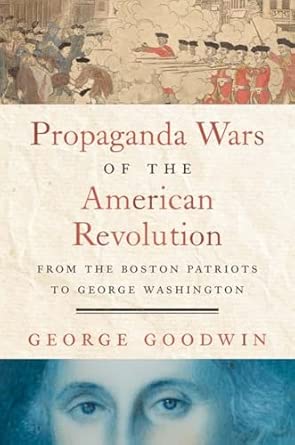
George Goodwin’s Propaganda Wars of the American Revolution comes at a time
of deep crisis in American and global capitalism. As the 1776 semiquincentennial approaches, it coincides with widespread social inequality, imperialist conflicts, and a rapid decline of democratic institutions in the US. It’s no surprise that debates over the meaning of the American Revolution—its origins, class implications, and legacy—have become central in current political discussions. Published by Yale University Press, Goodwin’s book aims to contribute to this debate by exploring how the Patriot movement used pamphlets, sermons, newspapers, broadsides, and political theatre to shape public opinion.
Goodwin is a talented historian and lucid writer. His book makes a significant contribution to a field traditionally dominated by Bernard Bailyn and Gordon S. Wood’s “ideological school.” However, Propaganda Wars also reveals a main weakness of that perspective by isolating ideas from the material class interests that influence them. Consequently, it presents a polished but somewhat idealist view of the Revolution—focusing on persuasion techniques while underplaying the social forces that made those techniques successful.
The Ideological School and Its Strengths
Goodwin’s intellectual legacy is clearly visible. His emphasis on propaganda as a key element places him mainly in the ‘ideological’ school of Revolutionary historiography, established by Bernard Bailyn. This approach, starting with Bailyn’s The Ideological Origins of the American Revolution (1967), argues that the colonists were driven by a unified worldview rooted in radical Whig ideas. Bailyn and Wood carefully analysed pamphlets, sermons, and political debates from that period, opposing the dismissive view that all declarations of principle are driven solely by self-interest.
From a Marxist perspective, this emphasis on ideas is a notable strength. “It was a school that approached the record of human thought with great seriousness.” This is a welcome corrective to the postmodernist trivialisation of intellectual history and to the racialist distortions of the 1619 Project. Goodwin’s book continues this tradition by showing how the Patriot cause deliberately shaped public opinion—how Thomas Paine energised the colonies, how the Boston Tea Party was used as political theatre, and how Washington actively promoted the image of republican virtue.
Goodwin rightly emphasises that propaganda played a crucial role. Revolutions depend not just on economic factors but also on mobilising large groups, expressing grievances, and envisioning a new political future. The real question is: which forces were being mobilised, and for what purpose?
The Ideological School and Its Afterlives: Bailyn, Wood, and Goodwin in Comparative Perspective
Any Marxist critique of George Goodwin’s Propaganda Wars of the American Revolution must place the work within the wider historiographical context from which it originates. Goodwin is part of a broader intellectual tradition. His book represents the latest version of the “ideological school,” originally established by Bernard Bailyn and further expanded with sharper analysis by Gordon S. Wood. The advantages and drawbacks of Goodwin’s research are linked to those of this entire tradition.
The ideological school has significantly influenced modern interpretations of the American Revolution. It has also been the main opposition to postmodernist and racial-essentialist critiques, which culminated in the New York Times’ 1619 Project. The International Committee of the Fourth International, through its collaboration with Wood and its support for Enlightenment universalism, has actively engaged in this historiographical debate. As such, a clear, materialist evaluation of the ideological school is essential.
Bernard Bailyn: Ideology as Prime Mover
Bernard Bailyn’s The Ideological Origins of the American Revolution (1967) marked a major turning point in the study of Revolutionary history. Moving away from the Progressive focus on economic grievances and class struggles, Bailyn proposed that the colonists’ motivations were rooted in a consistent worldview inspired by radical Whig ideas. According to this view, the Revolution was primarily an ideological uprising—a fight to defend liberty against a perceived British plot to wield arbitrary authority.
Bailyn’s contribution was significant. He brought rigour back to the analysis of ideas, elevating Revolutionary pamphlets from scholars’ dismissive view of them as simple rationalisations of self-interest. “It was a school that approached the record of human thought with great seriousness.”
Bailyn’s framework was highly idealistic, portraying ideas as independent forces separate from the material conditions and class dynamics that generate them. The Revolution is depicted as a conflict of political ideas rather than a fight shaped by the contradictions within colonial society. Class conflict is scarcely mentioned; slavery is seen as a minor issue; and the economic and social changes following the Revolution are viewed as minor outcomes rather than fundamental causes. Consequently, Bailyn’s approach is both a significant advance and a limitation—it expanded the scope of intellectual history but also restricted understanding to a non-materialist perspective.
Gordon S. Wood: Ideology as Social Transformation
Gordon S. Wood, Bailyn’s top student, maintained the ideological school’s focus on ideas while expanding its view to include a more vibrant and comprehensive understanding of social change. In his works, The Creation of the American Republic (1969) and The Radicalism of the American Revolution (1992), Wood showed that republican ideology was more than just abstract principles; it was a powerful force that transformed political culture, social structures, and daily life.
Wood’s work represents the most materialist analysis within the ideological school. He demonstrates that the Revolution dismantled monarchical and hierarchical social relationships, empowered the “middling sort,’ and unleashed democratic forces that even the Founders could not fully control. Additionally, he addressed the Revolution’s core contradiction with remarkable clarity: the coexistence of liberty and slavery. Wood argued that the Civil War was an inevitable culmination of a tragedy that originated in the Revolution itself.
Wood’s accomplishment lies in recognising that ideas are rooted in society rather than existing in isolation. However, he avoids adopting a Marxist perspective. He does not view the Revolution as a bourgeois-democratic event, nor does he see slavery as a fundamental aspect of capitalist growth. His approach stays within the ideological tradition, despite pushing against its boundaries.
George Goodwin: Ideology Reduced to Technique
George Goodwin’s Propaganda Wars adopts the strengths of the ideological school but lacks its deeper analytical depth. While Bailyn explored the origins of ideology and Wood examined societal transformations, Goodwin focuses on the
mechanics of persuasion. His emphasis is not on the internal logic of Revolutionary ideas but on how they circulated, were performed, and emotionally resonated.
The book thoroughly explores printers, pamphleteers, preachers, and political leaders, illustrating how the Patriot movement intentionally influenced public opinion. It shows how Paine’s writings inspired the colonies, how the destruction of the tea served as a political spectacle, and how Washington fostered an image of republican virtue. However, Goodwin’s approach is more limited than that of earlier scholars. It’s important to remember that propaganda is grounded in tangible social forces, not just ideas—it is the ideological expression of actual social dynamics.
Goodwin views propaganda primarily as a technological feat rather than a reflection of class-based ideology. He describes how the Patriots succeeded in convincing the public, but does not explore why their messages connected with various social groups. Consequently, the Revolution is seen more as a success of strategic communication than as a bourgeois-democratic upheaval driven by colonial societal conflicts. In this way, Goodwin exemplifies the continuation of the ideological school. This tradition has lost its core intellectual focus and now persists through cultural history, communication analysis, and political technique.
The Marxist Position: Ideas as the Expression of Class Forces
A Marxist analysis acknowledges the valuable contributions of Bailyn, Wood, and Goodwin. It values their honest engagement with ideas and their opposition to the cynical reductionism often seen in modern academia. Nonetheless, it emphasises that ideas gain historical significance only when they align with material interests and social needs.
The American Revolution was a bourgeois-democratic uprising. Its propaganda functioned as the ideological voice of a rising bourgeois class opposing monarchical authority. The contradictions within that system—especially the tension between liberty and slavery—were evident in its language, silences, and evasive tactics. Bailyn studied the key ideas of Revolutionary ideology, while Wood investigated its social effects. Goodwin analysed how these ideas were disseminated.
The ideological school is essential for understanding the intellectual landscape of the American Revolution, but its focus on idealism limits its ability to fully interpret the Revolution’s significance. Goodwin’s Propaganda Wars offers meaningful insight into this tradition, yet it also reveals its inherent limitations, which are amplified here. “Propaganda does not float free of the material world… They were the ideological expression of real social forces.”
This is the core issue. The American Revolution was primarily a bourgeoisdemocratic movement, influenced by the conflicts within colonial society. The pamphlets from Boston radicals, sermons from New England clergy, and Paine’s fiery speeches were not independent forces shaping history but rather ideological expressions of various social classes: a rising colonial bourgeoisie limited by imperial mercantilism, artisans and mechanics opposing British economic policies, small farmers fighting taxation and landlordism, and Southern planters wanting westward expansion but hindered by the Crown.
Goodwin’s emphasis on technique—the “how” of persuasion—shields the underlying reasons. Why did Paine’s Common Sense strike such a chord? Why did conspiracy and liberty rhetoric energise urban crowds, frontier farmers, and some enslaved individuals fleeing to British forces? These questions cannot be answered solely by examining propaganda. Instead, they demand a class-based Analysis of colonial society. The ideological school has always faced challenges despite its achievements. It views ideas as the main drivers of history, rather than as expressions of material interests. Goodwin’s book, despite its merits, still operates within this idealist perspective.
The Revolution “From Above”
The subtitle—From the Boston Patriots to George Washington—reveals a further limitation. It moves from discussing Boston’s radical protests to emphasising Washington, the Virginia planter who represents the Revolution’s consolidation through elite leadership. “The propaganda wars were not just Patriots versus
Loyalists; they were also… a struggle over what kind of republic would emerge.”
This is a pivotal moment. The American Revolution, similar to all bourgeois revolutions, involved a deep tension between the democratic hopes it sparked and the class interests that ultimately constrained it. The urban crowds who brought down the George III statue, the workers who enforced non-importation agreements, and the farmers who later participated in Shays’ Rebellion—these groups drove the Revolution beyond what the colonial elite found acceptable.
Goodwin describes this trajectory but doesn’t question it. The Revolution is portrayed as a story of growing propaganda rather than as a conflict in which different class forces competed to influence the new republic. The ideological perspective often views the Founders as natural leaders of the Revolution, rather than as representatives of a particular class whose interests lay in rallying and controlling popular support.
The Silence at the Heart of Revolutionary Rhetoric: Slavery
No analysis of Revolutionary propaganda can ignore the core contradiction of 1776: the simultaneous fight for liberty and the perpetuation of chattel slavery. This was not accidental but a fundamental aspect of a revolution led by a class that included slaveholders. Revolutionary language used the metaphor of “slavery” to describe the colonists’ relationship with Britain, largely ignoring the reality of actual slavery. Jefferson’s initial objection to the slave trade was removed from the Declaration. Patriot propaganda aimed to preserve unity among both slaveholders and non-slaveholders across North and South.
Goodwin recognises this contradiction but does not incorporate it into his analysis of propaganda. However, the silences, evasions, and metaphors used in Revolutionary rhetoric were not accidental; they were crucial for maintaining the ideological unity of a movement led by a class whose material interests relied on human bondage. As Wood stated in Empire of Liberty, the tragedy was “preordained from the time of the Revolution.” The Civil War was the inevitable outcome of the contradiction that the Revolution could not resolve.
What Goodwin Achieves—and What He Cannot
Goodwin’s book is insightful and well-researched, offering an engaging look at the mechanics of persuasion. It highlights the roles of pamphleteers, printers, preachers, and political figures who influenced public opinion before independence. The book treats the intellectual environment of the Revolution with seriousness, pushing back against modern academic cynicism. However, its focus on an idealist framework limits its ability to explain events fully.
Propaganda was significant because it reflected the material interests and democratic hopes of large sections of colonial society. It was effective because, even if imperfectly, it conveyed the emerging bourgeois order’s challenge to monarchical authority. Seeing propaganda as an independent force is a mistake; it conflates the form with the underlying social content and reality.
Conclusion: Toward a Marxist Understanding of Revolutionary Propaganda
A Marxist view of the American Revolution recognises the influence of ideas but emphasises that ideas only gain power when linked to material interests and historical needs. The Revolution was a bourgeois-democratic uprising that laid the groundwork for capitalist growth, with its propaganda serving as the ideological expression of this change.
While Goodwin’s Propaganda Wars explores persuasion techniques, it does not address the class forces behind their effectiveness. Although a serious work, it remains rooted in the idealist tradition of the ideological school. To fully understand revolutionary propaganda, one must consider it within the context of colonial American social structure, the contradictions of slavery, and the global rise of capitalism. Only then can we comprehend the Revolution’s true historical logic—and its ongoing significance in a time when the crisis in American democracy raises questions about social revolution.
The recent rise in Anti-Stratfordian theories—like Graham Phillips’ claim that there were “two William Shakespeares,” one an actor-playwright in London and the other a wealthy grain merchant in Stratford—is less about new knowledge and more a social phenomenon. It exemplifies a recurring ideological pattern: some middle-class groups refusing to accept that England’s greatest writer came from their perceived lower social classes. As the document rightly observes, this is “simply a new coat of paint on a very old piece of class snobbery.”
The continued existence of these theories isn’t backed by evidence—there is none—but by the social anxieties of their supporters. The anti-Stratfordian movement started in the late Victorian era, a time when the bourgeoisie, having achieved its historic rise, became fearful of the social forces that had helped it reach power. The idea that a glover’s son from a small provincial town could have authored Hamlet or King Lear was unacceptable to a class increasingly focused on controlling cultural boundaries and shielding “high culture” from the masses.
The Historical Record and the Bourgeois Artist
The evidence supporting Shakespeare of Stratford as the author of the works is strong and has been affirmed by numerous scholars over time. The dedications of Venus and Adonis and The Rape of Lucrece, signed “William Shakespeare,” are written in a modest tone typical of a commoner addressing a noble sponsor—an unlikely style for an aristocrat like the Earl of Oxford. Furthermore, Ben Jonson’s tribute in the First Folio refers to him as the “Sweet Swan of Avon,” with no associations to any aristocratic estate or London riverbank. Additionally, the plays reference events after 1604, the year of Oxford’s death, such as the 1609 Bermuda shipwreck that inspired The Tempest.
However, anti-Stratfordians are not genuinely investigating history; instead, they are erasing it. Their argument rests on a completely ahistorical assumption: that someone who bought property, lent money, or traded grain could not also be a playwright. This idea is incorrect. Shakespeare was a shareholder in the Lord Chamberlain’s Men, a part-owner of the Globe, and a savvy investor. He was not a starving artist living a bohemian lifestyle but a prosperous bourgeois during a time when the bourgeoisie was a revolutionary class. To deny this is to deny the social conditions that made Shakespeare possible.
The Class Roots of Anti‑Stratfordianism
The anti-Stratfordian tendency fundamentally reflects a class bias. Jonathan Bate noted that this movement arose as the Victorian middle classes grew more sensitive to perceived threats from lower social groups. Christmas Humphreys, an Oxfordian, candidly expressed this sentiment by calling it “offensive” to credit a “petty-minded tradesman” as the playwright. The quoted statement highlights this bias clearly: the disdain is obvious, and the underlying ideology is unmistakable. This is not genuine scholarship but merely class prejudice disguised as scholarly pursuit.
The “two Shakespeares” theory is just the latest effort to justify this bias by creating unnecessary divisions. It offers no real explanation. It fails to resolve any contradictions. Its only purpose is to uphold the idea that genius must be aristocratic, that culture belongs to the elite, and that the greatest works of human imagination could not have been written by someone who also knew the cost of barley.
Why These Theories Persist
The real question isn’t about who authored the plays but rather why some people doubt that Shakespeare did. The answer is tied to the social role of anti-Stratfordianism. These theories reveal a deep-seated hostility towards the notion that human creativity is universal, meaning that artistic brilliance isn’t limited to individuals of noble birth or privileged education.
Shakespeare’s greatness is tied to the historical context of his era: the ascent of the bourgeoisie, the decline of feudal stability, and the emergence of new intellectual and emotional perspectives. The Elizabethan stage reflected this societal upheaval and a world in flux. His background in the “middling sort” and his deep ties to early modern England’s complex, evolving society enabled him to understand and depict human life comprehensively.
Denying Shakespeare’s authorship is dismissing this history. It also dismisses the revolutionary nature of the bourgeois era and the ability of ordinary individuals to produce extraordinary art.
The Political Meaning of the Attack on Shakespeare
Ultimately, the anti-Stratfordian myth challenges the democratic and egalitarian values reflected in Shakespeare’s life and work. It aims to reassert a feudal view of culture, suggesting that true genius belongs only to the elite. This reactionary idea seeks to deny the historical fact that the greatest English writer was the son of a tradesman. That a ‘petty-minded tradesman’ could have written Hamlet and King Lear is not a problem to be explained away by conspiracy theories—it is a fact to be celebrated.” Indeed. Shakespeare’s life exemplifies humanity’s creative potential. The anti-Stratfordian movement, in all its forms, reveals the insecurity and decline of a ruling class that no longer trusts in that potential..
Today’s interest in Nostradamus, astrology, and mystical prophecies isn’t just innocent fascination. It reflects a deep intellectual decline in bourgeois society. Trying to explain Hitler’s rise with 16th-century cryptic verses isn’t just foolish; it’s a reactionary act. The document notes, “The framing of this question… is itself an expression of the irrationalism that pervades bourgeois culture in decay.” This irrationalism isn’t marginal; it acts as an ideological shield for capitalism during its final crisis.
The ruling elite, troubled by the disastrous consequences of their system, seeks comfort through mystification. The petty-bourgeois classes, bewildered by social upheaval, rely on supernatural explanations. Meanwhile, the academic community, having moved away from the Enlightenment’s emphasis on reason, now promotes the idea that history is driven by fate, myth, or “dark forces,” rather than by class struggle. Hitler’s rise was not predicted by Nostradamus nor written in the stars; it resulted from specific, identifiable, and preventable political betrayals by the leaders of the German workers’ movement.
The Material Foundations of Fascism
The rise of Nazism can only be understood through the Marxist lens of historical materialism. In the early 1930s, Germany was Europe’s most developed industrial economy, yet it was constrained by the Versailles Treaty and the global capitalist crisis. The productive forces had surpassed the limits of the nation-state. German imperialism aimed for expansion, but before fighting abroad, it needed to suppress the working class domestically.
The Nazis were not a supernatural anomaly. As Trotsky described, they were “a party of national despair,” gaining backing from the devastated petty bourgeoisie—“the small artisans and shopkeepers of the cities, petty officials, employees, technical staff, the intelligentsia, and impoverished peasants.” These groups, shattered by the crisis, were whipped into a rage of hatred toward the proletariat, whom they blamed for their social downfall.
However, fascism in power was not merely the rule of these devastated classes. As Trotsky aptly states, “fascism in power is least of all the rule of the petty bourgeoisie. On the contrary, it is the most ruthless dictatorship of monopoly capital.” German industrialists, bankers, and military leaders saw Hitler as the tool they needed to break down workers’ organizations and gear up for imperialist conflict. The Düsseldorf meeting of January 1932, where leading industrialists pledged their support to Hitler, was not a mystical convergence of destiny. It was a class decision.
The Working Class Wanted No Part of Fascism
Contrary to the myth—propagated by both fascists and liberals—that Hitler rose to power on widespread popular support, the German working class largely opposed him. The document clearly states: “The working class did not want fascism.” In the November 1932 elections, the combined votes for the Social Democrats and Communists exceeded those for the Nazis. Furthermore, in the factories, the Nazis were held in contempt.
The decisive factor was not the will of the masses but the treachery of their leaders.
The Stalinist and Social Democratic Betrayals
The Stalinist leadership of the Communist Party, following Moscow’s orders, embraced the harmful theory of “social fascism,” labeling the Social Democrats as the primary enemy. This strategy—one of the worst crimes in workers’ movement history—blocked the creation of a united front for the working class when such unity could have defeated the Nazis. Meanwhile, Social Democratic leaders failed to mobilize their workers, fearing revolution. They surrendered to the bourgeois state, disarming the working class and enabling Hitler to become chancellor in January 1933.
Trotsky’s warnings proved to be prophetic in the true sense: they were based on scientific analysis. He stated that a Nazi victory would lead to “the extermination of the best of the German proletariat, the destruction of its organizations, and the eradication of its self-belief and hope for the future.” He also predicted that Italian fascism would seem “pale” in comparison. Every prediction was confirmed.
Mysticism as a Weapon Against the Working Class
The shift towards Nostradamus and astrology is not impartial. It fulfills specific ideological roles: depicting fascism as unavoidable rather than stoppable; excusing the responsibilities of the ruling class and leaderships like reformist and Stalinist; replacing class analysis with fatalism; and discouraging the working class by implying that supernatural forces shape history. The pursuit of prophecies and astrological justifications for Hitler is not only unserious but also politically reactionary. This type of irrationalism echoes the postwar pessimism of the Frankfurt School, which blamed “the Enlightenment” for fascism, thus diverting attention from capitalism and the failures of the workers’ movement.
The Lessons for Today
The worldwide rise of fascist movements, increasing irrationalism, and the decline of bourgeois democracy are not just predictions but stem from capitalism’s fundamental contradictions. These include economic crises, imperialist competition, and the ruling class’s failure to resolve these issues democratically. The focus shouldn’t be on deciphering old astrological texts, but on cultivating the revolutionary leadership that Germany lacked in 1933.
Osip Mandelstam’s fate epitomises the Stalinist bureaucracy’s suppression of the revolutionary intelligentsia. His life and death unveil, with striking clarity, the fundamental conflict between true artistic independence and the parasitic ruling class that seized political power from the working class. His destruction was not an isolated incident or a tragic accident of a lone poet; it was a deliberate consequence of a political counter-revolution that aimed to silence any voice resisting its ideological dominance.
A new book highlights that “Mandelstam’s fate symbolises the broader destruction of the Soviet artistic and literary avant-garde by Stalinist counter-revolution. The bureaucracy, which seized political power from the working class, could not accept true artistic independence.” This is more than just a biographical note; it serves as a political critique.[1]
The Revolution and the Poet: A Brief Convergence
Mandelstam was not a Bolshevik and never claimed to be one. However, he had something that the bureaucracy feared even more than political allegiance: a spiritual independence that could not be assimilated, a dedication to truth, form, and historical awareness. His early Acmeist emphasis on “clarity, concreteness, and craftsmanship—’ the word as such'” served as a subtle critique of the growing Stalinist aesthetic, which favoured bureaucratic bombast and ideological kitsch.
The October Revolution’s heroic phase fostered an extraordinary surge in artistic experimentation. Mandelstam’s nuanced yet insightful reaction to 1917—as illustrated by his mention of “The Twilight of Freedom”—mirrored the conflicted stance of an artist who recognised the revolution’s global importance while preserving his intellectual independence.
However, the outcome of the revolution remained uncertain. The Civil War, economic devastation, and the Soviet state’s isolation fostered the development of a bureaucratic system whose priorities were essentially at odds with those of the working class and the revolutionary intelligentsia.
Osip Mandelstam and Leon Trotsky: Two Fates in the Grip of the Stalinist Counter‑Revolution
Osip Mandelstam and Leon Trotsky’s lives intersect not just through a brief personal encounter or biographical detail but through the broader historical narrative of the Russian Revolution and its subsequent betrayal. They exemplify two of the most brilliant figures of that revolutionary era—one in politics, the other in poetry—whose downfall under Stalinism exposes the bureaucratic counter-revolution that seized power from the working class.
Mandelstam’s fate exemplifies how the Stalinist counter-revolution destroyed the Soviet artistic and literary avant-garde. He was killed because his poetry represented a spiritual independence that the totalitarian regime could not tolerate. These words highlight not only the poet’s personal tragedy but also the larger historical catastrophe that affected Trotsky and the entire October generation.
Two Figures Formed by the Revolution, Not by Stalinism
Trotsky and Mandelstam belonged to different worlds—one the strategist of the Red Army, the other a poet of Acmeist clarity—but both were products of the same historical rupture: the collapse of the old order and the birth of a new one.
As previously noted, Mandelstam was neither a Bolshevik nor a reactionary. His early works focused on “clarity, concreteness, and craftsmanship,” demonstrating a profound cultural seriousness that resonated with the revolutionary spirit. He viewed the October Revolution as a pivotal world-historical event, though there was some ambivalence. Trotsky, in Literature and Revolution, correctly labelled this type of thinker as a “fellow-traveller,” attracted to the revolution by its cultural and historical significance, even without full political allegiance.
Trotsky’s stance towards these writers was never sectarian. He argued that the workers’ state should safeguard the independence of the intelligentsia rather than subordinate it to bureaucratic control. This was driven not by generosity but by a historical need: the revolution required the finest achievements of human culture, not their suppression.
The Crimea Episode: Trotsky Intervenes to Save Mandelstam
The closest connection between the two men happened in 1920 during the Civil War. After Mandelstam was captured by Wrangel’s counter-revolutionary troops in Crimea, he was later detained again—this time by fervent Cheka agents following the Red Army’s reoccupation of the peninsula. Nadezhda Joffe reports that Trotsky personally stepped in to help secure Mandelstam’s release.
This incident is more than a minor anecdote; it highlights the stark contrast between the revolutionary leadership of 1917–23 and the later bureaucratic system. Trotsky recognised that the revolution’s role was to protect culture, not destroy it. Mandelstam, after this event, “revered” Trotsky, seeing him as a protector of civilisation against both White and Red barbarism. This was the final moment when the revolution still retained its original essence.
The Bureaucracy Rises: Mandelstam and Trotsky Become Targets
By the late 1920s, the Stalinist bureaucracy had solidified its control. The elimination of the Left Opposition, enforced collectivisation, and the cult of Stalin were more than mere political acts—they were cultural. A regime built on falsification and coercion could not tolerate independent thought in any area. Mandelstam was a poet who could not be silenced and could not be co-opted, making him an enemy of the bureaucracy. Similarly, Trotsky became the main political threat to Stalin’s power. The elimination of both figures was not accidental; it was structurally driven by the needs of the bureaucratic caste.
Mandelstam’s “Stalin Epigram”: The Poet Speaks the Truth, Trotsky Theorised
In 1933, Mandelstam wrote the “Stalin Epigram,” depicting the dictator as “the Kremlin mountaineer” with “his cockroach moustache” and “fingers fat as grubs.” The poem served as a poetic parallel to Trotsky’s political critique: a sharp, impactful expose of the bureaucratic despotism that had strangled the revolution.
Trotsky had previously warned that Stalinism was not the continuation of October but its negation. Mandelstam conveyed this same truth through poetry, the only language he could use. Both recognised that the bureaucracy was a destructive, parasitic caste feeding on the revolution’s corpse.
The outcomes were similar. Mandelstam was arrested in 1934, exiled, rearrested in 1938, and died in a transit camp. Trotsky was expelled, exiled, slandered, tried in the Moscow Trials, and ultimately assassinated in 1940. Two different paths driven by a common historical logic.
The Shared Fate: Victims of the Same Counter‑Revolution
Mandelstam and Trotsky were victims of the same historical force: the Stalinist counter-revolution. Trotsky’s assassination in Mexico and Mandelstam’s death in a transit camp near Vladivostok are not isolated tragedies but manifestations of the same process— the destruction of the generation that held the revolutionary and cultural hopes of 1917. Mandelstam was ‘murdered because his poetry embodied a spiritual independence that the totalitarian regime found intolerable,’ which also applies to Trotsky, whose political independence made him a mortal enemy of the bureaucracy. Both represented the living conscience of the revolution and had to be eliminated for the bureaucracy’s survival.
The Bureaucracy Consolidates Power: The Artist Becomes the Enemy
By the late 1920s and early 1930s, the Stalinist bureaucracy had fully expropriated the proletariat politically. The suppression of the Left Opposition, forced collectivization, and the cult of the infallible Leader were not just political acts—they were cultural transformations. A regime that wielded falsification, coercion, and fear could not allow any area of life to be free from its influence. Mandelstam “was a poet who could not be silenced or co-opted.” This is exactly why he had to be eliminated. The Stalinist state demanded obedience over art, flattery over truth, and complete submission of the creative mind to the ruling caste’s needs, rather than independence. Mandelstam’s refusal to conform—his rejection of the grotesque spectacle of bureaucratic self-promotion—made him unacceptable.
The “Stalin Epigram”: A Poet’s Truth Against a Regime of Lies
The “Stalin Epigram” was more than just a poem; it was a daring act of political defiance that displayed remarkable clarity and bravery. The poem vividly depicts Stalin as “the Kremlin mountaineer,” with descriptions like “his cockroach moustache” and “fingers fat as grubs.” These lines were not mere satire—they directly challenged the personality cult that underpinned the bureaucracy’s ideology. In a society where even a careless remark could result in arrest, Mandelstam’s choice to recite this poem, even to a small audience, was an act of revolutionary integrity. It asserted the artist’s right to speak truthfully in a regime built on lies.
The bureaucracy’s response was as expected. His 1934 arrest, exile, 1938 detention, and death at a transit camp near Vladivostok were not due to “excesses” or “mistakes.” Instead, they reflected a regime that could only endure by eradicating all independent voices.
Nadezhda Mandelstam and the Underground Survival of Truth
Dutli’s book rightly emphasises Nadezhda Mandelstam’s remarkable role, describing how she “memorised his unpublished poetry to preserve it – one of the great acts of literary devotion in history.” Her effort was not just personal but also political. In a society where the state aimed to erase its victims’ memories, she became a living testament of resistance. Her memoirs, Hope Against Hope and Hope Abandoned, stand as some of the most powerful condemnations of Stalinism ever written. They reveal the moral and psychological destruction caused by a regime that demands complete obedience and punishes even the faintest hint of dissent.
V. The Historical Meaning of Mandelstam’s Murder
Mandelstam died in 1938, at the peak of the Great Terror, a period when the bureaucracy eradicated the generation that had pioneered the revolution. His death reflected the same political agenda that eliminated the Old Bolsheviks, the Red Army leaders, the Marxist intellectuals, and countless workers and peasants.
Mandelstam “was murdered because his poetry embodied a spiritual independence that the totalitarian regime found intolerable.” While accurate, this statement should be understood within its full historical background. His “spiritual independence” was especially unacceptable because it signified the continued existence of the revolutionary spirit—the essence of truth, clarity, and human dignity—resisting a regime that had betrayed the revolution and maintained control through terror.
The Legacy: Mandelstam Against the Bureaucratic Lie
Today, Mandelstam’s poetry continues to stand as a symbol of artistic achievement and political rebellion. His work endured because individuals—his wife and later scholars like Ralph Dutli—refused to let bureaucratic attempts to destroy culture succeed. Dutli belongs to the group of “deep literary links across generations,” where later figures dedicate themselves to reviving and sharing voices that the Stalinist regime tried to silence.
Mandelstam’s work enduringly survives as a testament against Stalinism, showing that truth, even when hidden, cannot be completely eliminated. It reveals the failure of the bureaucratic system and highlights the lasting strength of the revolutionary intellectuals.
Mandelstam’s story is more than a tragedy; it serves as a political lesson. It highlights the deep conflict between a creative mind and a repressive bureaucratic regime. It shows that fighting for artistic truth is inherently linked to the fight for political freedom. Additionally, it clearly states that the Stalinist counter-revolution was not a continuation of October but its reversal.
[1] Osip Mandelstam: A Biography By Ralph Dutli (Translated from German by Ben Fowkes) Verso 432pp £25
Rachel Nolan’s Guardian Long Read about Claudia Sheinbaum and the so-called “world’s most popular left-wing leader” exemplifies bourgeois mystification. Beneath the sentimental narrative, a political reality that the Guardian avoids emerges: Morena is not genuinely leftist but a bourgeois nationalist movement. It has intensified Mexico’s integration into U.S. imperialism, militarised the state, and maintained oligarchic wealth. Its popularity signifies not socialism but the lack of a revolutionary alternative.[1]
A Headline That Conceals More Than It Reveals
The Guardian’s headline — “How did Mexico’s president become the world’s most popular leftwing leader?” — sets an ideological tone even before reading the article. It assumes Claudia Sheinbaum is “left-wing,” that Morena is progressive, and that their popularity is a political mystery worth exploring. However, Sheinbaum is not a left-wing leader, nor is Morena a socialist party. The framing is deliberate, not a mistake; it serves as a political action to reinforce illusions in reformism at a time when such illusions are collapsing among workers across the Americas. The real question is not why Sheinbaum is popular but why the Guardian continues to label her as left-wing.
The detailed article on Claudia Sheinbaum is more ideological spectacle than genuine journalism. It recycles worn-out liberal sentimentalist notions to depict a bourgeois nationalist government as a beacon of “left-wing” hope. This critique shows that Nolan’s story has a political agenda: to conceal Morena’s class background, to hide its connections to U.S. imperialism, and to prevent workers in Mexico and the U.S. from recognising its revolutionary potential.
The Guardian’s premise is misleading. Nolan starts with a question implying its answer: How did Mexico’s president become the world’s most popular leftist leader? The answer is simply that Sheinbaum is called ‘left-wing,’ and the article takes this as a fact, not as an ideological label. However, this doesn’t match reality. Claudia Sheinbaum isn’t truly a leftist, and Morena isn’t a socialist party. The article relies on concealing this truth, depicting a bourgeois manager as a progressive icon because admitting the limits of reformism would be politically unthinkable.
Nolan’s Method: Sentimentality as Analysis
The Long Read employs a common liberal tactic: personalising politics. Sheinbaum’s background, scientific expertise, and calm demeanour act as proxies for class analysis. Nolan’s writing shows admiration for her “pragmatism,” “discipline,” and “connectivity with ordinary people.” However, this isn’t genuine analysis; it’s branding. The Guardian’s approach shifts from examining social forces to highlighting personalities. The result is a narrative where political issues diminish, replaced by a positive story about a caring leader. This perfectly aligns with your document’s point: “This type of journalism substitutes class analysis with feel-good stories about benevolent rulers.”
What Nolan Omits: Militarisation, Repression, and Subordination to Washington
Nolan’s article intentionally omits certain details, a politically motivated omission. Specifically, she does not mention the significant 150% rise in the military budget, the military’s control over ports, customs, and infrastructure, or the establishment of the National Guard to detain migrants in the U.S. Additionally, she overlooks the constitutional recognition of the armed forces as “the pillar of the Mexican state’ and the deployment of tens of thousands of troops to the U.S. border for ‘migrant containment’ operations. These actions demonstrate that this is not simply left-wing governance but the strengthening of a militarised capitalist state.
The near‑shoring agenda
Nolan praises Mexico’s economic “boom” but fails to mention its true source: U.S. imperialism’s efforts to reshape supply chains to confront China. Sheinbaum’s plan explicitly supports this, which states it aims for Mexico to “replace imports mainly from Asia with regional production”—a clear reflection of Washington’s strategy. Nolan overlooks Sheinbaum’s commitments, such as no tax hikes, corporate incentives, “Republican austerity,” and bi-national security cooperation with the U.S. This approach essentially represents neoliberalism with a nationalist twist.
Popularity Is Not Proof of Left Politics
Nolan interprets Morena’s popularity as evidence of its progressive stance, but this is a category mistake. The support for Morena primarily stems from dislike of the PRI-PAN era, a demand for increased social programs, a lack of revolutionary options, and temporary relief from cash transfers. While Nolan considers this support impressive, it actually reflects genuine public sentiment. Nonetheless, Morena has channelled this popular backing into a dead-end. Popularity alone does not define socialism; it is a sociological fact that can be exploited for either reactionary or reformist ends.
5. The Oligarchy’s Endorsement: The Most Damning Evidence
Nolan’s storyline completely unravels when considering the class that has gained the most from Morena: the Mexican bourgeoisie. According to Oxfam Mexico, the top 1% earn 35% of the country’s income and hold 40% of private wealth, with Carlos Slim’s wealth increasing by 66% since 2020. Slim himself has praised AMLO, stating: “There is social peace, there is no confrontation.” This is the highest compliment the bourgeoisie can give, implying that the working class has been effectively contained. Any truly left-leaning government would not receive such praise.
6. The Guardian’s Political Function
Why does Nolan not include this? Why does the Guardian not publish it? Because the Guardian isn’t a neutral observer, it functions as an ideological tool of the liberal bourgeoisie. Its role is to promote illusions about reformist leaders, prevent workers from seeing social democracy’s limits, redirect discontent into safe, nationalist, pro-capitalist channels, and prevent a revolutionary perspective from emerging. The Guardian’s purpose is to ensure that this conclusion is never reached.
Nolan’s Long Read is not just incorrect; it poses a political risk. It fosters the idea that workers should rely on a bourgeois nationalist agenda, which is already embedded in U.S. imperialism’s economic and military plans. A truly left-wing movement in Mexico will not be built from Morena.
Morena and the Pink Tide: A Familiar Cycle of Populist Containment
Nolan’s narrative portrays Morena as a new phenomenon. In fact, it is a late-stage example of the “pink tide” governments that swept Latin America in the early 2000s. These regimes — from Chávez to Lula to Correa — combined limited social spending with support for capitalist property relations and pragmatic cooperation with U.S. imperialism.
The pattern remains consistent: rhetorical anti-imperialism paired with material subordination to imperialist interests. Morena exemplifies this pattern precisely: cash-transfer programs that reduce extreme poverty without changing class structures; nationalist rhetoric that appeals to popular sentiment while avoiding conflict with capital; collaboration with Washington on security, migration, and nearshoring; and the preservation of oligarchic wealth despite increasing inequality. The Guardian’s sentimental narrative obscures this continuity.
The Militarisation of the Mexican State
A key aspect of Morena’s leadership, not mentioned by Nolan, is the substantial militarisation of Mexican society. Under AMLO, the military budget increased by 150%, and the armed forces took control of ports, customs, and major infrastructure projects. A new National Guard was created, mainly tasked with mass migrant detention following Washington’s orders. The military was legally reinforced as “the pillar of the Mexican state,” deploying tens of thousands of soldiers to the U.S. border to oversee “migrant containment.” AMLO entrusted ports, customs, and infrastructure to the armed forces and stationed numerous troops at the US border. This pattern doesn’t indicate left-wing governance but reflects the rise of a militarised bourgeois state.
Sheinbaum’s Program: Near‑Shoring and Austerity
The Guardian describes Sheinbaum as a scientist-technocrat with a social conscience. Yet, her government’s plan openly aligns Mexico with U.S. strategic interests. It aims to help Mexico “capitalise on the economic situation to replace imported goods—primarily from Asia—with regional production,” supporting Washington’s near-shoring strategy against China. Sheinbaum guarantees no tax increases, corporate incentives, “Republican austerity,” and bi-national security collaboration with the U.S. This rhetoric resembles that of a bourgeois manager rather than a socialist.
Popularity Is Not Socialism
The Guardian interprets Morena’s popularity as evidence of its leftist positioning. However, popularity is a sociological fact that requires explanation rather than being a political characteristic. “The popularity Nolan admires truly reflects a reality: large numbers of Mexican workers and youth genuinely detest the right-wing legacy of austerity, corruption, repression, and subservience to US imperialism.” Morena’s support is rooted in the rejection of the PRI-PAN era, a desire for more social programs, the absence of a revolutionary alternative, and short-term gains from cash transfers. However, this support has reached a dead end. As the document notes, Morena “has handed the Mexican working class — as a source of cheap labour —” directly into the hands of US imperialism’s war efforts.”
The Necessary Conclusion
The Mexican working class doesn’t require a “popular left-wing leader” to manage capitalism more gently. Instead, it needs revolutionary leadership that rejects Morena’s nationalist illusions and pursues socialist unification across the Americas. The goal is to ‘discard the Mexican bourgeoisie and its Morena representatives into the trash bin of history and unite with their class allies in the United States and throughout the Americas to eliminate imperialism and capitalism.”
Fareed Zakaria’s Age of Revolutions: Progress and Backlash from 1600 to the Present Day is a revealing ideological work that reflects the views of the modern bourgeois intelligentsia. Written during the most severe crisis of global capitalism since the 1930s, the book functions more as a political statement than a historical account. It aims to comfort a bewildered ruling class, suggesting that the system’s intensifying contradictions can still be controlled through enlightened technocratic management.
Zakaria’s polished, urbane, and superficially cosmopolitan narrative hinges on a core belief: that capitalism, despite its “excesses,” is the only sustainable social system, and that its occasional crises can be managed by wise elites. The book epitomizes the liberal-imperialist perspective that has long shaped the American establishment, even as the underlying material basis of that worldview crumbles.
The Meaning of Revolution in the Epoch of Capitalist Breakdown
The current political elite, exemplified by figures like Fareed Zakaria, claims we are in an “age of revolutions’ marked by technological, cultural, and political upheavals. However, this recurring narrative in media and academia is a conscious misrepresentation, aiming to hide the true essence of the era: the collapse of capitalism and the return of global socialist revolution as the central issue of the 21st century.
Zakaria’s 2024 book, Age of Revolutions, exemplifies this approach. It simplifies revolution to a sequence of technological advances and policy issues, dismissing large-scale opposition to capitalism as mere irrational “backlash.” This isn’t genuine analysis but ideological distortion. It reflects the perspective of a ruling class that feels the ground changing beneath it and tries to numb public awareness before the next major social upheaval.
Later, we will observe that a Marxist view starts from a different premise: revolutions are not simply psychological responses to “progress,” but are the result of contradictions within capitalism itself. They occur when the advancement of productive forces clashes with existing property relations and state power structures. Unlike other theories, they are propelled not by elites but by the working class, which is the only social force capable of restructuring society based on rationality, democracy, and internationalism.
The meaning of revolution in history lies in the bourgeois revolutions of the 17th and 18th centuries, especially the French Revolution of 1789. These revolutions weren’t driven simply by “ideas” or enlightened elites; rather, they were the inevitable result of a deep contradiction: the growth of capitalist production emerging from the decline of feudal society. For the bourgeoisie to expand the national market, establish modern law, or develop industrial production, they had to dismantle the aristocratic order.
The French Revolution clearly reveals the limitations of Zakaria’s framework. Events like the storming of the Bastille, the end of feudal dues, the radical actions of the sans-culottes, the Jacobin dictatorship, and Napoleon’s rise were not merely setbacks against progress. Instead, they represented class struggle in a society transitioning between modes of production. The Revolution was not carried out according to the wishes of “moderate” elites; it was propelled by the masses, whose material interests pushed them beyond bourgeois constitutional limits. The Terror was not an irrational derailment but a desperate effort by the revolutionary class to defend itself against internal counter-revolution and external invasion.
Zakaria’s narrative fails to explain these aspects because it does not include a concept of class, overlooks the role of the state as a tool of class domination, and ignores that revolutions stem from objective contradictions rather than elite mismanagement.
Revolution Without Class: Zakaria’s Historical Method
Zakaria’s view on “revolution” reveals his core ideological stance. Traditionally, in Marxism, revolution involves a fundamental change in social relations, a transfer of political power between classes, and the overthrow of outdated modes of production. However, Zakaria redefines the term by stripping it of class significance. To him, revolutions are mainly technological, commercial, or administrative changes—like the rise of global trade, digital technology, and market expansion. By grouping events such as the Dutch Revolt, the Glorious Revolution, the Industrial Revolution, and the internet into a single category, he blurs the line between revolutionary rupture and capitalist development.
This is not just an innocent analytical decision; it’s a political strategy. By framing revolution as ongoing innovations within capitalism, Zakaria rules out any possibility of a true revolution against the system. History then appears as a tale of constant progress, wisely guided by elites, with only unlucky moments of ‘backlash’ disrupting it.
The “Progress and Backlash” Mythology
Zakaria’s core interpretive framework—that each phase of progress ultimately provokes a backlash—serves as a liberal morality tale. “Progress” is characterised by expanding markets, globalisation, and liberal institutions. Conversely, ‘backlash’ encompasses resistance or disruption of this process, such as working-class opposition to deindustrialisation, mass protests against austerity, anti-imperialist movements, and even right-wing populist responses.
This schema clearly serves an ideological purpose: it dismisses all forms of mass opposition to capitalism as irrational resentment. The working class protesting plant closures and social issues isn’t defending their material interests; they’re simply reacting with a ‘backlash.’ Likewise, populations resisting imperialist control aren’t engaged in anti-colonial struggles; they are emotionally responding to “progress.’ What Zakaria fails to recognise is that the ‘backlash’ he criticises is actually a consequence of the ‘progress’ he champions.
Zakaria’s framework conceals the basic truth that the social crises over the past fifty years—such as inequality, war, and democratic decline—are not just anomalies but inevitable results of global capitalism.
The Erasure of the Russian Revolution
No liberal perspective on “progress” can accept the Russian Revolution, which remains the most significant challenge to capitalism ever. Unsurprisingly, Zakaria minimises the October Revolution, seeing it as an example of excess rather than a crucial historical milestone. The revolution demonstrated that the working class could seize power, overthrow the bourgeoisie, and establish a new social order, alarming ruling elites across imperialist countries and shaping the entire 20th century. Yet, Zakaria considers it merely a “backlash”—a mass political uprising that got out of elite control. This reflects the Whig view of history in neoliberal guise: history as the gradual improvement of liberal capitalism, with regrettable deviations that must be managed.
The Real Contradiction Zakaria Cannot Resolve.
Zakaria recognises a real contradiction: the conflict between a globalised economy and a political system based on nation-states. However, he fails to see that this contradiction is an intrinsic aspect of capitalism itself. The worldwide integration of production clashes with the national structures of private property and sovereignty. This fundamental contradiction has led to major conflicts such as World Wars I and II, as well as to current trends such as trade wars, militarism, and geopolitical fragmentation.
Zakaria’s suggestion—improving international coordination and enhancing global governance—is unrealistic. The capitalist nation-state system cannot be unified through elite diplomacy alone. It can only be replaced by the international working class, which must act deliberately to reshape the world economy based on socialist principles.
A Book for a Frightened Ruling Class
Ultimately, Age of Revolutions serves more as a political tool for the ruling elite than an in-depth historical analysis. It aims to preserve a faltering system, justify its associated suffering, and weaken the rising efforts of workers. The document explicitly states: “It is an ideological document – a defence of a social order that has lost its historical raison d’être.” Currently, the global situation points to the beginning of a new revolutionary period: the world economy is facing persistent crises marked by stagnation, inflation, and the dominance of parasitic finance capital. Additionally, the nation-state structure is eroding, resulting in trade conflicts, shifting geopolitical alliances, and unprecedented military conflicts since 1945.
Democratic institutions are weakening as ruling classes resort to authoritarian tactics, censorship, and repression. Workers are starting to push back through widespread strikes across Europe and the Americas, as well as uprisings in the Global South. Technological advancements have reached a point where the rational and strategic organisation of the global economy is not only possible but essential to human survival. These are not just minor disruptions to be managed by enlightened elites; they reflect symptoms of a system that has fulfilled its historical role. The true “Age of Revolutions” is upon us.
The ruling class fears the word “revolution” because it senses that the conditions for a new revolutionary wave are maturing. It therefore attempts to redefine the term to mean anything except the transfer of power from one class to another. But the real age of revolutions lies not in the past but in the future. The contradiction between the global character of production and the national character of the capitalist state system cannot be resolved through diplomacy, regulation, or technocratic management.
Zakaria’s book is a symptom of a ruling class that senses its own fragility but cannot conceive of an alternative to its domination. It offers no serious analysis of the crises engulfing the world, only a plea for patience and trust in the very elites who have presided over decades of disaster. Against this liberal fatalism stands the Marxist understanding of history: that the contradictions of capitalism will give rise to revolutionary movements of the working class, and that the future of humanity depends on the conscious struggle for socialism.