The Holocaust: An Unfinished History by Dan Stone (Penguin). £12.99

The Holocaust: An Unfinished History by Dan Stone is a useful if limited account of how and why the Nazi’s perpetrated the murder of six million jews. Reading Stone’s book while a genocide takes place in Gaza and Trump’s fascist government carries out state-sponsored murders is a brutal reminder that fascism is on the rise again and did not end with the Nazi’s Holocaust.

Stone is the director of the Royal Holloway’s Holocaust Research Institute in London.  He is the author of over 20 books, including Fate Unknown: Tracing the Missing after World War II and The Liberation of the Camps. The Holocaust: An Unfinished History (2023), Concentration Camps: A Short History (2017), and Histories of the Holocaust (2010).

Stone’s book has a subtitle called ‘The Unfinished History,’ which probably alludes to the number of books on or about the Holocaust, which is approaching 40,000. But as the Marxist writer David North says:

“Here we encounter a terrible problem: For all that has been said and written about the Holocaust, it remains a strangely obscure event. A vast amount of empirical data about the Holocaust has indeed been collected. We possess detailed information about how the Nazis organised and executed their “Final Solution,” the murder of six million European Jews. And yet the issues that are central to an understanding of the Holocaust—its historical origins, political causes and, finally, its place in the history of the twentieth century—have, with very few exceptions, been dealt with poorly. This is, really, an intolerable state of affairs. The one basic question raised by the Holocaust, “Why did it happen?” is precisely that to which it is most difficult to obtain an answer.”[1]

It must be said that Stone gives a good go at answering North’s question. Stone’s book provides a “brisk, compelling and scholarly” account that seeks to supplement the vast historiography already in place. Stone argues against the historiography that the Holocaust was exclusively a German project, highlighting the extensive collaboration and independent murders from other European nations like Romania and France.

While accepting the idea that the Holocaust was an “industrial genocide” taking place at the main concentration camps, Stone supplements this analysis with other shocking facts that millions were killed elsewhere and by different methods, too. The “Holocaust by bullets” was responsible for 1.5 million Jewish deaths between late 1941 and the spring of 1942. In late 1944, as the Russian army advanced westwards towards Germany, the Nazis evacuated the camps. They forced the 750,000 or so surviving Jewish inmates onto “death marches”, sometimes over vast distances in the winter. This claimed another 250,000 victims, often shot by SS guards when they collapsed and could no longer walk.  

Ideology

Stone’s examination of Nazi ideology is to be welcomed. He argues that for too long, Nazi ideology has been downplayed. Stone is critical of the post-war tendency to deny any political coherence to the Nazis’ ideas. He believes that Nazi ideology represented a radicalisation of ruling class ideas of nationalism, imperialism and race. 

He says that the Nazis didn’t have a developed programme for genocide worked out in advance. But he says we need to take seriously their ideological motivation, which always harboured a genocidal potential capable of being unleashed under certain circumstances. 

While Stone does not accept the right-wing theory that the Holocaust is such a terrible event that it defies a rational explanation, he pays little attention to the historian’s ability to comprehend the forces that drive the social—or, more precisely, the antisocial—activity of man. In other words, Stone tends to downplay Marxist historians’ attempt to use historical science and political theory to understand the Holocaust.

Although Stone uses a large number of historians to examine Nazi ideology, he mostly ignores any Marxist-based historiography. A simple reading of the writings of Leon Trotsky or Abraham Leon, to name just two Marxists, would give a historian a far deeper insight into the rise of fascism and of Nazi Ideology.[2]

Stone’s use of Ernst Bloch is problematic to say the least. Bloch was not a classical Marxist. Bloch (1885–1977) occupies a complex position in Marxist thought. He is best known for his attempt to retrieve utopian hope as an element of Marxist theory—most famously in The Principle of Hope—insisting that human longing and anticipatory consciousness matter for politics. From the standpoint of classical Marxism and the continuity of the Fourth International, Bloch’s contribution must be assessed dialectically: what in his work advances the materialist understanding of history, and what tendencies lead away from the independent revolutionary politics of the working class?

Bloch insisted that utopian impulses—aspirations, anticipations, images of a better world—are not mere illusions but social phenomena rooted in objective contradictions. He sought to recuperate the emotional and imaginative dimensions of social life that orthodox economic or “vulgar” readings of Marxism can marginalise. This emphasis corresponds to Marxism’s insistence that human consciousness is shaped by social being; yet classical Marxism places primary explanatory weight on the development of the productive forces and class relations as the motive forces of history. Bloch’s insistence on hope supplements but must not displace the materialist analysis of how objective conditions—production, class struggle, political institutions—generate revolutionary possibilities. To say that Bloch was “unusually” the only Marxist to take fascism seriously is not only wrong but is a political lie.

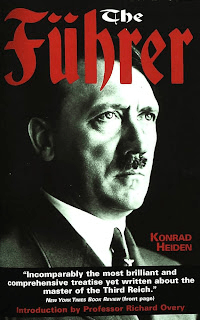
Another writer missing from Stone’s work is Konrad Heiden.[3] Heiden’s biography of Hitler is worth reading. Heiden’s insight into Hitler’s anti-Semitism is worth an extensive examination.

According to Heiden, “Hitler hated the whole great sphere of human existence which is devoted to the regular transference of energy into product, and he hated the men who had let themselves be caught and crushed in this process of production. All his life, the workers were for him a picture of horror, a dismal, gruesome mass … everything which he later said from the speaker’s platform to flatter the manual worker was pure lies.

Heiden explains Hitler’s demonic obsession with the Jews. In Mein Kampf, Hitler explained how his conversion to anti-Semitism flowed from his encounters with the labour movement. It was among the workers that Hitler first came into contact with Jews. He then discovered, to his amazement, that many Jews played prominent roles in the labour movement. “The great light dawned on him,” wrote Heiden. “Suddenly, the ‘Jewish question’ became clear. … The labour movement did not repel him because Jews led it[4]The Jews repelled him because they led the labour movement. Heiden concluded, “It was not Rothschild, the capitalist, but Karl Marx, the Socialist, who kindled Adolf Hitler’s anti-Semitism. ”Stone has profited intellectually from a careful study of Heiden’s biography of Hitler.

Given that Stone has conducted extensive historiographical work, he has written 20 books on or about the Holocaust; his conclusions on how to fight modern-day genocide and the rise of fascism are troubling, to say the least. He writes, “The fact is that Holocaust education goes out of the window if people feel their life chances are narrowing; nothing in the end can stop people from supporting these dark forces in times of crisis.”

This is extraordinarily fatalistic. The goal is not merely to “know” the Holocaust as an isolated tragedy, but to understand its roots in class, imperialism and political defeat—and to transform that understanding into organised political action to build the international socialist movement that can prevent future barbarism. From a Marxist standpoint, Stone’s empirical and historiographical contributions are necessary but not sufficient. Marxism begins with the materialist method: social phenomena, including ideologies and mass crimes, are rooted in concrete material relations—class structures, property relations, state formation and the competitive dynamics of imperialism. The destruction of mass working-class political organisations left the proletariat unable to interpose itself as an independent social force; this political vacuum was decisive.


[1] The Myth of “Ordinary Germans”: A Review of Daniel Goldhagen’s Hitler’s Willing Executioners-www.wsws.org/en/special/library/russian-revolution-unfinished-twentieth-century/15.html

[2]wikipedia.org/wiki/The_Struggle_Against_Fascism_in_Germany

[3]wikipedia.org/wiki/Konrad_Heiden

[4] Konrad Heiden, Der Führer, (Boston: Houghton Mifflin, 1944)

Emil and the Detectives by Erich Kastner E. Hall (Translator) Puffin Paperback – 21 Sept. 1959

(This article is dedicated to the memory of Elisabeth Zimmermann-Modler 1956–2025: Trotskyist and fighter for the working class)

Emil: Are your people well off?

Professor: I don’t really know. Nobody ever talks about money.

Emil: Then I expect you have plenty. 

Dialogue from Emil and the Detectives

“It is sufficient to remember that the German bourgeoisie, with its incomparable technology, philosophy, science and art, allowed the power of the state to lie in the hands of a feudal bureaucratic class as late as 1918 and decided, or, more correctly, was forced to take power into its own hands only when the material foundations of German culture began to fall to pieces.”

Leon Trotsky: Proletarian Culture and Proletarian Art

The story of Kästner’s Emil and the Detectives illuminates Germany in the 1920s, before German culture began to fall to Pieces under the death blow of  Fascism. Published in 1929 and in English in 1931, Kästner would have been politically aware enough to know that the book and himself were living on borrowed time. While the Nazis burned his books, he, however, did not suffer the same fate despite being interviewed by the Gestapo twice.

There are many reasons why adults return to their childhood books. For some, it is a comfort read or just the pure joy of reading. Emil and the Detectives was one of my first reads as a child. Not sure why I was drawn to it, why I chose a foreign author rather than a British one, we will never know. I borrowed it from my school library because it wasn’t on the school reading curriculum. I want to say that I was aware of its political overtones, but I was drawn to it by chance, as I was not yet politically conscious of the world around me, which would arrive when I reached sixteen. Nevertheless, the book will always evoke fond childhood memories.

Perhaps because children and adults, for that matter, face a return to the darkness that fell on Europe with the rise of fascism, that Emil and the Detectives still resonates today. It makes sense that a group of kids from 1929 would represent society’s underdogs, at risk from the forces of fascism, not only in Germany but in America, too.

The text from the 1931 translation by Margaret Goldsmith gives a flavour of the children’s class consciousness in Kastner’s book: “I don’t understand that at all,” little Tuesday declared. “How can I steal what already belongs to me? What’s mine is mine, even if it’s in a stranger’s pocket! ”These things are difficult to understand,” the professor expounded. “Morally, you might be in the right. But the law will find you guilty all the same. Even some grown-ups don’t really understand these things, but they are a fact. Or this dialogue

Emil: Are your people well off? Professor: I don’t really know. Nobody ever talks about money. Emil: Then I expect you have plenty. ”[1]

As Uma Krishnaswami correctly writes, “Emil and the Detectives positions itself squarely on the side of ordinary people and against oppression meted out by the powerful. When a suspicious-looking man, Herr Grundeis, steals the money Emil Tischbein’s mother gave him, young Emil doesn’t go to the police. Instead, he dashes off to find the thief. In the process, the boy sleuth gathers a motley band of friends, including the unforgettable Pony Hütchen and, of course, the endearing Little Tuesday, without whose faithful vigilance the plan could not unfold. Naturally, the kids are victorious in the end.”[2]

Why read Kästner Now

Emil’s story raises perennial questions: how childhood experience is shaped by class, how working-class solidarity takes root in everyday life, and how the state and the market shape civic trust. Studying such literature trains workers and students to read cultural texts as expressions of material conditions.

So Erich Kästner’s Emil and the Detectives (1929) is best read not simply as a children’s adventure but as a social document of the late Weimar Republic: a work that reflects class contrasts, urban life, and the moral questions facing youth in a capitalist society. Again, for workers and students, Kästner offers an accessible entry point into how literature can both reflect social conditions and contribute to political education. For a political framing of Kästner’s broader milieu and politics.[3]

Erich Kästner’s stories, poems and satires—written amid the political turmoil of the Weimar Republic—are rich in social observation: they identify petty‑bourgeois anxieties, the erosion of democratic habits, the everyday humiliations of children and workers, and the moral cowardice of elites. Reading Kästner in the workplace helps workers develop a literary sensibility while equipping them to connect cultural forms to concrete political tasks: building class consciousness, exposing bourgeois ideology, and preparing collective struggle.

One of Kastner’s most crucial works is Fabian or Going to the Dogs. As Bernd Reinhardt perceptively writes, “ Fabian has certain autobiographical traits and who more than once in his literary work blames ‘stupidity’ for social ills, referring to dumb Nazis, stupid Germans, and so on. The voiceover that features from time to time in the film quotes a passage from the novel where the fights between Nazis and Communists are compared to dancehall brawls. Like many other intellectuals, Kästner underestimated the danger of the Nazi movement. After the war, he admitted that they should have been fought earlier, because “threatening dictatorships can only be fought before they have taken power.”[4]

About the Author

Erich Kästner (1899–1974), a pacifist and satirist whose works were famously burned by the Nazis, though Emil and the Detectives was initially spared due to its popularity.


[1] Emil and the Detectives by Erich Kastner E. Hall (Translator) Puffin Paperback – 21 Sept. 1959

[2] Why You Should Read (or Reread) Emil and the Detectives-www.umakrishnaswami.com/blog/why-you-should-read-or-reread-emil-and-the-detectives

[3] See the WSWS discussion of Kästner’s Fabian work and its relation to the Weimar social crisis, on Fabian and the dangers of the 1930s.

[4] German Film Award in Silver for Dominik Graf’s Fabian: Going to the Dogs-www.wsws.org/en/articles/2021/11/13/fabi-n13.html

How to Spot a Fascist: Umberto Eco Harvill Secker Paperback – 13 Aug. 2020 Alastair McEwen (Translator), Richard Dixon (Translator)

 “The historic function of fascism is to smash the working class, destroy its organisations, and stifle political liberties when the capitalists find themselves unable to govern and dominate with the help of democratic machinery.”

Leon Trotsky, in ” Fascism: What It Is and How to Fight It, “

“It would be so much easier for us, if there appeared on the world scene somebody saying “I want to reopen Auschwitz, I want the Black Shirts to parade again in the Italian squares”. Life is not that simple. Ur-Fascism can come back under the most innocent of disguises. Our duty is to uncover it and point our finger at any of its new instances – every day, in every part of the world.”

― Umberto Eco, Il fascismo Eterno

“ but we know. and have always said, that the bourgeoisie is attached to fascism. The bourgeois and fascism stand in the same relation to each other as do the workers and peasants to the Russian Communist Party.”

― Antonio Gramsci, Selections from Political Writings: 1921-1926

“Abraham Lincoln, said, just before his assassination: “I see in the near future a crisis approaching that unnerves me and causes me to tremble for the safety of my country. . . . Corporations have been enthroned, an era of corruption in high places will follow, and the money-power of the country will endeavor to prolong its reign by working upon the prejudices of the people until the wealth is aggregated in a few hands and the Republic is destroyed.”

― Jack London, The Iron Heel

How to Spot a Fascist is a collection of three distinct yet profoundly thought-provoking essays on freedom and fascism. ‘Ur-Fascism’ examines fourteen essential characteristics of fascism. Like the great German author Gunter Grass, Eco was briefly a young fascist. Unlike Grass[1] Eco was not vilified for it. When Mussolini was at the height of his power, Eco was a young child lacking the knowledge and capacity to grasp the criminal character of the organisation he was associated with. He Writes in “Ur-Fascism:

“In 1942, at the age of ten, I received the First Provincial Award of Ludi Juveniles (a voluntary, compulsory competition for young Italian Fascists — that is, for every young Italian). I elaborated with rhetorical skill on the subject “Should we die for the glory of Mussolini and the immortal destiny of Italy?” My answer was positive. I was a smart boy.”

Umberto Eco was undoubtedly one of the greatest writers and historians of the 20th Century. If he were still alive during this modern period of history, he would not have hesitated in calling the latest incumbent in the White House a fascist.  Donald Trump fits most of the criteria cited by Eco in his 1995 essay.

Eco writes “If we still think of the totalitarian governments that ruled Europe before the Second World War we can easily say that it would be difficult for them to reappear in the same form in different historical circumstances. Suppose Mussolini’s fascism was based upon the idea of a charismatic ruler, on corporatism, on the utopia of the Imperial Fate of Rome, on an imperialistic will to conquer new territories, on an exacerbated nationalism, on the ideal of an entire nation regimented in black shirts, on the rejection of parliamentary democracy, on anti-Semitism. In that case, I have no difficulty in acknowledging that today the Italian Alleanza Nazionale, born from the postwar Fascist Party, MSI, and indeed a right-wing party, has now minimal connection to the old fascism. In the same vein, even though I am much concerned about the various Nazi-like movements that have arisen here and there in Europe, including Russia, I do not think that Nazism, in its original form, is about to reappear as a nationwide movement.”[2]

While Eco has several brilliant insights into Italian fascism, his work also has significant weaknesses. One of which was his blindness towards the betrayals of Italian Social Democracy. As Leon Trotsky points out, “ Italian fascism was the immediate outgrowth of the betrayal by the reformists of the Italian proletariat’s uprising. From the time the First World War ended, there was an upward trend in the revolutionary movement in Italy, and in September 1920, it resulted in the seizure of factories and industries by the workers. The dictatorship of the proletariat was a real fact; all that was lacking was to organise it and draw from it all the necessary conclusions. The social democracy took fright and sprang back. After its bold and heroic exertions, the proletariat was left facing the void. The disruption of the revolutionary movement became the most critical factor in the growth of fascism. In September, the revolutionary advance came to a standstill, and November already witnessed the first significant demonstration of the fascists (the seizure of Bologna)[3]

Leon Trotsky was one of the first Marxists to not only define what exactly Italian fascism was, but also to warn of the danger it represented to the Italian and world working class. One of his earliest attempts to define fascism was in November 1931 when he wrote a letter to a friend titled “What is Fascism”. He wrote,

“The Fascist movement in Italy was a spontaneous movement of large masses, with new leaders emerging from the ranks. It is a plebeian movement in origin, directed and financed by big capitalist powers. It issued forth from the petty bourgeoisie, the slum proletariat and even to a certain extent, from the proletarian masses. Mussolini, a former socialist, is a “self-made” man arising from this movement. The movement in Germany is primarily analogous to the Italian movement. It is a mass movement, with its leaders employing a great deal of socialist demagogy. This is necessary for the creation of the mass movement.

The genuine basis is the petty bourgeoisie. In Italy, it is a significant base, comprising the petty bourgeoisie of towns and cities, as well as the peasantry. In Germany, likewise, there is a large base for Fascism. In England, there is less of that base because the proletariat is the overwhelming majority of the population; the peasant or farming stratum is only a relatively insignificant section. It may be said, and this is true to a certain extent, that the new middle class, the functionaries of the state, the private administrators, etc., etc., can constitute such a base. However, this raises a new question that needs to be analysed. This is a supposition. It is necessary to explore just what it will be. It is essential to foresee the Fascist movement growing from this or that element. But this is only a perspective which is controlled by events. I am not affirming that it is impossible for a Fascist movement to develop in England or for a Mosley or someone else to become a dictator. This is a question for the future. It is a far-fetched possibility. To speak of it now as an imminent danger is not a prognosis but a mere prophecy. To be capable of foreseeing anything in the direction of Fascism, it is necessary to have a definition of that idea. What is Fascism? What is its base, its form and its characteristics? How will its development take place?”

This short volume, ‘How to Spot a Fascist,’ was republished in 2019 and is an essential contribution to understanding today’s fascist movement, led by Donald Trump. Eco was an insightful and compassionate writer, but he did not live to see the fascists come back. In the same year as Eco’s collection of essays, Christoph Vandrier’s book Why Are They Back was published by Mehring Books. As Vandrier’s recounts in the book after 81 years after the fall of the Third Reich, the neo-Nazi right has become a major political force in Germany. The book provides a valuable lesson in how to fight today’s fascists by learning the lessons of the past.


[1] Günter Grass and the Waffen SS-https://www.wsws.org/en/articles/2012/05/gras-m04.html

[2] Ur-Fascism Umberto Eco: June 22, 1995 The New York Review of Books  theanarchistlibrary.org/library/umberto-eco-ur-fascism

[3] How Mussolini triumphed-www.wsws.org/en/special/library/fascism-what-it-is-how-to-fight-it-leon-trotsky/02.html

Lost Boys by James Bloodworth (Atlantic Books, £14.99).

‘Every man is a king so long as he has someone to look down on,’

 Sinclair Lewis, It Can’t Happen Here

“A revolution does not deserve its name if it does not help with all its might and all the means at its disposal- if it does not help women, twofold and threefold enslaved in the past, to get on the road of individual and social progress. A revolution does not deserve its name if it does not take the greatest possible care of the children … for whose benefit it has been made. But how can one create … a new life based on mutual consideration, on self-respect, on the real equality of women . . . on the efficient care for children-in an atmosphere poisoned with the roaring, rolling, ringing, and resounding swearing of enslavers and enslaved people, that swearing which spares no one and stops at nothing? The struggle against ‘foul language’ is an essential condition of mental hygiene just as the fight against filth and vermin is a condition of physical hygiene.”

― Leon Trotsky, Problems of Everyday Life & Other Writings on Culture & Science

“The women of the property-owning class will always fanatically defend the exploitation and enslavement of the working people, by which they indirectly receive the means for their socially useless existence.”

Rosa Luxemburg

Lost Boys by James Bloodworth is a journalist’s examination of the reactionary movement that has been somewhat lightly termed the Manosphere. The Manosphere quaintly refers to a motley collection of websites, blogs and online forums promoting misogyny, masculinity and opposition to feminism. It promotes racism, antisemitism, anti-intellectualism, climate change denial, homophobia and transphobia. This movement has become a recruitment centre and training ground for what can only be termed trainee fascists.

It is not surprising that Bloodworth did not want to research and write this book. He replied to his editor, saying, “Why would I want to do that?”. He writes, “Today I feel a bit like a funeral director in the aftermath of a mass casualty event. I would have preferred things to have turned out differently, but considering they haven’t, I intend to put my knowledge to some practical use. Having spent so much time researching the manosphere – including interviewing and interacting with hundreds of men and spending months at a time embedded on a course which purportedly taught men how to become ‘high status alpha males’ – I feel as if I have something worthwhile to contribute.”[1]

Indeed, why should anyone want to associate and talk to a bunch of Nazi like scumbags who give two thousand pounds to learn how to hunt down woman and on some occasions rape them and then brag about their behaviour of social media.

The origins of this so-called pickup movement can be traced back to Neil Strauss’s 2005 bestseller, The Game. His book turned the art of seduction into a woman hunt, which sees women as nothing more than prey and being treated as such. The men within this movement have no comprehension of history but their attitude towards women would not look out of place in the Nazi Party of German fascism.

To his credit, Bloodworth exposes these trainee fascists. He reveals the close links between the manosphere and the far Right, including fascists like Donald Trump. Trump’s fascist partners in the While House who dismiss their enemies as “beta”. His vice-president, JD Vance, describes himself as “red-pilled”. As Bloodworth points out, the rise of the Anti-feminist backlash coincided with the growth of fascist forces worldwide, and it reminded him of Sinclair Lewis’s dystopian novel, It Can’t Happen Here, which enjoyed a resurgence during the first Trump presidency. As Sinclair wrote, ” Every man is a king so long as he has someone to look down on.’  However, his political understanding of how and why these members of the lumpen proletariat and deranged petty bourgeois are cannon fodder for a fascist movement is limited.

Bloodworth’s new book was inspired by his watching of the Netflix series Adolescence. He writes, “It is a striking film that is masterfully shot and powerfully acted. It has also generated a worthwhile public conversation. Much of this conversation has been constructive; however, some of it has been animated by a desire to change the subject – to talk about anything but misogyny and the radicalisation of young men on the internet. I found Adolescence surreal to watch at times.”[2]

As Thomas Scripps writes in his review of the Netflix series, “The reality, as we have been shown, is that the problems are well beyond an individual family’s ability to resolve. Perhaps the most common expression throughout the series is “I don’t know”, or some variant, from kids and adults alike; they are buffeted and bewildered by forces beyond their grasp.

The role of smartphones, the Internet, and social media, in particular, is well-contextualised in this broader social landscape. It would be foolish to deny the role they play in creating an unprecedented level of exposure to peer pressures and corporate advertising, declared and undeclared, and in streamlining the passage of individuals damaged by these influences into darker waters. But the real problem is the poison spilling out of a rotting social system—from misogynist ideologies to the glorification of violence, wealth and selfishness—for which these technologies are a conduit, and the conditions of social neglect which make young people emotionally susceptible: the most vulnerable dangerously so. Conditions which also hinder the social dialogue necessary to help children learn how to interact healthily with new technologies and form genuine relationships.”[3]

So far, the opposition to the rise of the “Manosphere has not come from working-class women, but has taken the form of the middle-class movement centred around the #MeToo movement, which is already eight years old. As the Marxist writer David Walsh wrote, “The ostensible aim of this ongoing movement is to combat sexual harassment and assault, i.e., to bring about some measure of social progress. However, the repressive, regressive means resorted to—including unsubstantiated and often anonymous denunciations and sustained attacks on the presumption of innocence and due process—give the lie to the campaign’s “progressive” claims. Such methods are the hallmark of an anti-democratic, authoritarian movement, and one, moreover, that deliberately seeks to divert attention from social inequality, attacks on the working class, the threat of war and the other significant social and political issues of the day.”[4]

One of the more outspoken and articulate critiques of the “Manosphere has come from the pen of the writer Amia Srinivasan. Her book The Right To sex,[5] while containing so worthwhile observations, it essentially promotes the #MeToo movement’s right to unsubstantiated and often anonymous denunciations and sustained attacks on the presumption of innocence and due process.

Srinivasan is the darling of all the radical groups, who fall over themselves in promoting her idea of social justice.  Her brand of modern-day feminism is dominated mainly by selfish, upper-middle-class champions of “women’s rights”. Srinivasan writes, “It’s essential in any radical political tradition. It’s no surprise that utopian writing always has these wacky ideas. I mean, think about More’s Utopia, full of these strange possibilities, because the same political imagination that leads to the disclosure of new possible social arrangements also sometimes generates some crazy shit. The broadening of the sense of what’s possible, as well as what’s delightful about human life, has to be central to a radical politics.

As Kate Randall points out, “ The fight for women’s rights is a social question that must be resolved in the arena of class struggle, not in the rarified atmosphere of the corporate boardroom and Hollywood. As Rosa Luxemburg once explained: “The women of the property-owning class will always fanatically defend the exploitation and enslavement of the working people, by which they indirectly receive the means for their socially useless existence.”

Notes

James Bloodworth is a journalist and author whose writing has appeared in numerous British newspapers, as well as in many US publications. His book Hired: Undercover in Low Wage Britain was longlisted for the Orwell Prize in 2019 and was selected as The Times Best Current Affairs and Big Ideas Book of the Year in 2018. He has produced and presented documentaries for Channel 4 television and has appeared on many podcasts. He has a new book, Lost Boys: A Personal Journey Through the Manosphere, scheduled for release on June 5, 2025, the result of a five-year investigation into the subculture.


[1] Adolescence’ and the Marketisation of Childhood, by James Bloodworth – 4 April 2025-https://leftrenewal.org/articles-en/bloodworth-adolescence/

[2] ‘Adolescence’ and the Marketisation of Childhood, by James Bloodworth – 4 April 2025-https://leftrenewal.org/articles-en/bloodworth-adolescence/

[3] Adolescence: Gripping realism explores social pressures behind young male violence-https://www.wsws.org/en/articles/2025/03/24/fbxd-m24.html

[4] One year of the #MeToo movement-https://www.wsws.org/en/articles/2018/10/19/year-o19.html

[5] The Right to Sex: Shortlisted for the Orwell Prize 2022 Hardcover – 19 Aug. 2021-Bloomsbury

Disaster Nationalism: The Downfall of Liberal Civilisation by Richard Seymour Verso, 280 pp., £20, October 2024.

“Disaster nationalism is not fascist. These movements do not seek to overthrow electoral democracy. Except the RSS in India – the grass-roots cadre organisation supporting Modi’s BJP – they do not command far-right, paramilitary mass movements.”

Richard Seymour

“Fascism comes only when the working class shows complete incapacity to take into its own hands the fate of society.”

Leon Trotsky, Fascism: What It Is and How to Fight It

“In the meantime, the first characteristic of a revolutionary party is- to be able to look reality in the face.”

 Leon Trotsky, Fascism: What It Is and How to Fight It

“If we place events in this more historically comprehensive context, it is clear that January 6 marks a new stage in a protracted process of democratic breakdown. We have witnessed in recent days efforts by historians and journalists to claim that really nothing of great importance happened on January 6, and that everything will more or less return to normal. This dangerous underestimation of the danger is based not merely on an incorrect evaluation of American conditions.”

David North.

While it is usually not possible to tell a book by its cover, you can usually gauge a book by its first page. Probably the greatest example of this is Charles Dickens’ A Tale of Two Cities, which is arguably the most stunning introduction to a book in modern literature. The same cannot be said about Richard Seymour’s first page.

The quote from Adorno and Horkheimer’s Dialectic of Enlightenment is perhaps fitting, given that Seymour is not a Marxist but a pseudo-leftist, and both Adorno and Horkheimer were anti-Marxists.

As Peter Schwarz says, “The first thing that comes to mind when reading ‘Dialectic of Enlightenment’ is the complete absence of any reference to concrete historical, economic or political events, social classes, political parties or questions of perspective. Neither the policies of the Social Democrats nor those of the Communist Party are examined. Not even Hitler is mentioned. Instead, everything is treated at the level of pure thought, which is presented as an independent subject, completely detached from thinking individuals, social consciousness, the struggle of classes and the struggle of ideas. Horkheimer and Adorno describe this as “thought … reflecting on its own guilt.”[1]

Seymour does examine in a limited manner concrete historical, economic and political events, which is not the problem; however, he does so not from the perspective of a Marxist but from that of a radical leftist. In Richard Seymour’s book, Trump is not a fascist but another far-right leader who is peddling a non-Marxist term called “Disaster Nationalism”.

There are many sides to a Marxist, and one of those sides is clarity of thought and action. Arguably, the greatest Marxist thinker of the 20th century, apart from Vladimir Lenin and the modern-day Trotskyist David North, was Leon Trotsky. You would have thought that if someone was looking to understand modern fascism and be given a book contract to do so, you would consult the most brilliant authority on the subject, and that is Trotsky. Yet in Seymour’s book, Trotsky warrants one tiny mention with no quotes from his major works on German and Italian fascism.

This is Trotsky’s approach: “What is fascism? The name originated in Italy. Were all the forms of counter-revolutionary dictatorship fascist or not (That is to say, before the advent of fascism in Italy)? The former dictatorship in Spain of Primo de Rivera, 1923–30, is called a fascist dictatorship by the Comintern. Is this correct or not? We believe that it is incorrect. The fascist movement in Italy was a spontaneous movement of large masses, with new leaders from the rank and file. It is a plebian movement in origin, directed and financed by big capitalist powers. It issued forth from the petty bourgeoisie, the slum proletariat, and even to a certain extent from the proletarian masses; Mussolini, a former socialist, is a “self-made” man arising from this movement.

Primo de Rivera was an aristocrat. He occupied a high military and bureaucratic post and was chief governor of Catalonia. he accomplished his overthrow with the aid of state and military forces. The dictatorships of Spain and Italy are two different forms of dictatorship. It is necessary to distinguish between them. Mussolini had difficulty in reconciling many old military institutions with the fascist militia.

This problem did not exist for Primo de Rivera. The movement in Germany is analogous mostly to the Italian. It is a mass movement, with its leaders employing a great deal of socialist demagogy. This is necessary for the creation of the mass movement. The genuine basis (for fascism) is the petty bourgeoisie. In Italy, it has a very large base – the petty bourgeoisie of the towns and cities, and the peasantry. In Germany, likewise, there is a large base for fascism. It may be said, and this is true to a certain extent, that the new middle class, the functionaries of the state, the private administrators, etc., can constitute such a base. But this is a new question that must be analysed. To be capable of foreseeing anything about fascism, it is necessary to have a definition of that idea. What is fascism? What are its base, its form, and its characteristics? How will its development take place? It is necessary to proceed in a scientific and Marxian manner.”[2]

Seymour does not proceed in a scientific or Marxist manner. If he did, he would behave like any decent historian or writer and examine the only orthodox or classical Marxist movement on the planet, which is represented by the Marxists who write for the World Socialist Website. They have written extensively on the rise of modern fascism. It suffices to say that Seymour did not contact them or quote their analysis.

Their analysis of the rise of Trump and his brand of American fascism cuts across Seymour’s pseudo-left perspective, which is to downplay the rise of world fascism. Marxist writer Joseph Kishore believes that the return of Donald Trump to power represents “the violent realignment of the American political superstructure to correspond with the real social relations that exist in the United States. Trump’s rise and return to power are not an aberration but the product of deep-rooted crises in American and world capitalism. His administration is carrying out a historic restructuring of the state, tearing apart the remaining democratic constraints on oligarchic rule, and preparing for global war.”

While it is one thing to describe Trump and his gang as fascists, it is another to set his dictatorship in the same context as the rise of Hitlerite fascism in 1933. David North, the chairman of the International Editorial Board of the World Socialist Web Site and national chairman of the Socialist Equality Party (US), in his introductory remarks to the post-election online webinar “The Election Debacle and the Fight Against Dictatorship,” cautions:

“ Now, it is not the position of the SEP and the WSWS that the accession of Trump to the presidency is the equivalent of Hitler’s 1933 victory. The United States is not Weimar Germany, and the transformation of the United States into a police state dictatorship backed by a mass fascist movement will not, whatever Trump’s intentions, be achieved overnight.  But it would be politically irresponsible, and contribute to the success of Trump’s aims, not to recognise the dangerous implications and real consequences of last Tuesday’s election. At the very least, it is necessary to take Trump at his word.[3]

Which Seymour does not. He is not alone in underplaying the dangers of the rise of fascism in America. Alan Woods, leader of the Revolutionary Communist International (RCI), the successor to the International Marxist Tendency (IMT), published an article that starkly illustrates the complacent and anti-Marxist orientation of his and other political tendencies. Revealingly titled “Trump victory: a kick in the teeth for the establishment,” the article echoes Trump’s fraudulent claims of being an anti-establishment figure while downplaying the immense dangers posed by a Trump presidency to the working class.

Woods writes, “The ruling class of America – firmly supported by the governments of Europe – was determined to keep him [Trump] out of office, by fair means or foul. After Trump was ousted in the 2020 election, everything was done to prevent him from running again… All the numerous attacks against him rebounded and turned against those who were seen, correctly, as being involved in a conspiracy to prevent him from re-entering the White House.[4]

The World Socialist Website opposed Wood’s complacency, writing, “This portrayal is false. The ruling class was not ‘determined to keep [Trump] out of office.” Significant sections of the financial and corporate elite, including billionaires like Elon Musk and Peter Thiel, actively supported Trump, viewing his authoritarian and pro-business agenda as a means of furthering their class interests. Others, like Jeff Bezos, have proclaimed their support for Trump after the election.” The article went on to reiterate its position that Trump and his allies were not fascists.

Seymour, like many of his pseudo-left fellow travellers, downplayed the 2006 coup attempt by Trump and his supporters in his latest book. In his article “Myths about the January 6th Capitol Building Events,” written by Roger D. Harris, a member of California’s Peace and Freedom Party, joins Seymour in his criminal underplaying of the coup attempt. Harris writes, “The riot was no attempted coup; it was just a sitting president unprecedentedly calling a march on the Capitol… signifying a breakdown of bourgeois political norms. What did happen is that a sitting president unprecedentedly called for a march on the Capitol to contest an election, signifying a breakdown of bourgeois political norms. Quite unlike Al Gore, who took a hit for elite political stability rather than contest the 2000 presidential election, Trump flagrantly broke the rules of orderly succession.”[5]

There is a degree of confusion, complacency, and even a hint of deception in Seymour’s analysis; when he writes, “ Disaster nationalism is not fascist. These movements do not seek to overthrow electoral democracy. Except for the RSS in India – the grass-roots cadre organisation supporting Modi’s BJP – they do not command far-right, paramilitary mass movements. The fascism that is being prepared through this sequence will not resemble classical fascism. The world that made fascism — colonialism, class civil war, revolution, and intense industrial modernisation-has passed. The new world is one in which the big questions will be those raised by the climate crisis: who gets what and who does without, who lives and who dies. Neonate fascism, whether green or brown, is preparing the terrain for a war on what it sees as mutant or out-of-place biology: the migratory or criminal.”[6]

Analogies with the past are fraught with danger, especially when examining the rise of fascism. Yet, the past can serve as a guide for today. Crucial to understanding the rise of fascism today is a systematic study of the past, especially the work of Leon Trotsky.  As Trotsky writes: “German fascism, like Italian fascism, raised itself to power on the backs of the petty bourgeoisie, which it turned into a battering ram against the organisations of the working class and the institutions of democracy. But fascism in power is least of all the rule of the petty bourgeoisie. On the contrary, it is the most ruthless dictatorship of monopoly capital. Mussolini is right: the middle classes are incapable of independent policies. During periods of great crisis, they are called upon to reduce to absurdity the policies of one of the two basic classes. Fascism succeeded in putting them at the service of capital.

 “Trotsky’s understanding of fascism can be used to understand today’s fascism. Seymour’s reluctance to study or utilise Trotsky’s work on fascism stems from his political views, which are a mishmash of liberal, Stalinist, and reformist traditions. Seymour joined the Socialist Workers Party in 1998 and fully immersed himself in their anti-Trotskyism. Pseudo-leftists Mike Kidron and Chris Harman, for economics; Alex Callinicos, for political philosophy; and Tony Cliff, for the weltanschauung, were his heroes. A second layer of influence was the ‘political Marxists,’ including Ellen Wood and Robert Brenner, and thirdly, Althusser, Gramsci, Poulantzas, Stuart Hall, and the Birmingham School. Is it  any wonder Seymour is completely vague and indelicate regarding the rise of fascism in America

As the Marxist George Lavan Weissman wrote:  “An indiscriminate use of the term (fascism)reflects vagueness about its meaning.” Asked to define fascism, the liberal replies in such terms as dictatorship, mass neurosis, anti-Semitism, the power of unscrupulous propaganda, the hypnotic effect of a mad-genius orator on the masses, etc. Impressionism and confusion among liberals are not surprising. However, Marxism’s superiority lies in its ability to analyse and differentiate among social and political phenomena. That so many of those calling themselves Marxists cannot define fascism any more adequately than the liberals is not wholly their fault. Whether they are aware of it or not, much of their intellectual heritage comes from the social-democratic (reformist socialist) and Stalinist movements, which dominated the left in the 1930s when fascism was scoring victory after victory. These movements not only permitted Nazism to come to power in Germany without a shot being fired against it, but they failed abysmally in understanding the nature and dynamics of fascism and the way to fight it. After fascism’s triumphs, they had much to hide and therefore refrained from making a Marxist analysis, which would, at the very least, have educated subsequent generations.[7]

This book lacks merit and should not have been allowed past the editorial stage by Verso. The fact that the Pabloites at Verso share Seymour’s politics should not come as a surprise. If the Scribes at Verso wanted to understand the rise of global fascism, they could have at least reprinted some of Leon Trotsky’s works. We wait with bated breath for this to happen.


[1] The rise of fascism in Germany and the collapse of the Communist Internationaw.wsws.org/en/articles/2005/10/le9-all.html

[2] Extracts from a letter to an English comrade, November 15, 1931;

printed in The Militant, January 16, 1932-www.marxists.org/archive/trotsky/works/1944/1944-fas.htm#p1

[3] www.wsws.org

[4] Trump victory: a kick in the teeth for the establishment-https://marxist.com/trump-victory-2024.htm

[5] Popular Myths about the January 6th Capitol Building Events-mltoday.com/popular-myths-about-the-january-6th-capitol-building-events/

[6] www.newstatesman.com/politics/2020/03/rise-disaster-nationalism-why-authoritarian-right-resurgent

[7] What It Is and How To Fight It-Leon Trotsky-1969 Pamphlet Introduction-https://www.marxists.org/archive/trotsky/works/1944/1944-fas.htm

Hitler’s People- The faces of the Third Reich 624pp. Allen Lane. £35. Richard J. Evans

 “Not every exasperated petty bourgeois could have become Hitler, but a particle of Hitler is lodged in every exasperated petty bourgeois”.

Leon Trotsky

“For the first thirty years of his life, Adolf Hitler was a nobody. Here lies the utterly compelling paradox.

Richard Evans

“Because I knew better, I was disturbed from the start by the one-sided delegation of blame on German industry, banks, etc.”

Gotz Aly

Although the figure of Adolf Hitler looms large over Richard Evans’ new book, it is first and foremost a biographical study of Hitler’s inner circle. It offers a new way to understand the rise of Fascism in Germany without conceding too much ground to other historians, such as the right-wing Daniel Goldhagen, who blamed “ordinary Germans” for the rise of Nazi Germany.[1]

Never one to shy away from controversy, Evans, in his introduction, makes the bold claim that without Hitler, there would have been no attempt at a “Thousand Year Reich”, and the Holocaust would have never happened. I am at a loss the see how Evans would have come to that conclusion. I am pretty sure that the German bourgeoisie would have found a willing executioner somewhere amongst its Petty Bourgeoisie.

But if we are going to indulge in counterfactuals, a better one would be the great Russian revolutionary Leon Trotsky once said, “ Had I not been present in 1917 in Petersburg, the October Revolution would still have taken place – on the condition that Lenin was present and in command. If neither Lenin nor I had been present in Petersburg, there would have been no October Revolution: the leadership of the Bolshevik Party would have prevented it from occurring – of this, I have not the slightest doubt! If Lenin had not been in Petersburg, I doubt whether I could have managed to conquer the resistance of the Bolshevik leaders … But I repeat, granted the presence of Lenin, the October Revolution would have been victorious anyway”.[2]

Evans draws upon previous writers, such as Joachim Fest’s bestseller The Face of the Third Reich,  published well over half a century ago. The book is meticulously researched and uses large secondary literature as well as recently published primary sources.  As Mary Fulbrook correctly states, Evans “ stands on the shoulders of giants,” acknowledging his debt to Ian Kershaw, whose two-volume biography of Hitler has so far not been surpassed.

However not wanting to be too negative Mary Fulbrook’s’ Bystander society, Laurence Rees The Nazi Mind and Gotz Aly Hitler’s beneficiaries is now joined by Richards Evans in promoting a view point that not only Nazis but large swathes of the German population were responsible for war and the subsequent Holocaust. Indeed, Evans does not go quite so far as Daniel Goldhagen so in her review Fulbrook, is critical of Evans’s attack on historians like Daniel Goldhagen, who shift the blame for the holocaust away from the Nazis and blame “ordinary Germans”. She writes, “ Antisemitism of varying hues is, of course, a refrain throughout, but oddly, the Holocaust remains slightly out of focus, with only cursory and slightly misleading summaries of key controversies, as between Christopher Browning and Daniel Goldhagen. Evans rattles rapidly over several approaches, ending up – surely unintentionally? – by implying that recent scholarly consensus around “interpretations that stress the specificities of the German situation” necessarily entails support for Goldhagen’s ahistorical reification of a supposed German mentality of “eliminationist antisemitism”.

In noting the impact of the Law for the Restoration of the Professional Civil Service of April 7, 1933, on “individuals of ‘non-Aryan descent’ or in other words, Jews”, Evans, in effect, compounds Nazi assumptions by omitting to point out that “non- Aryans” covered even individuals with only a single Jewish grandparent, some previously unaware of any Jewish ancestry or not considering themselves Jewish by religion, let alone “race”. The intricacies of the Nuremberg Laws of 1935 are similarly skated over too briefly, inadvertently buttressing the notion of clear distinctions between “Jews” and non-Jewish Germans. The complexities arising from historical assimilation and high rates of conversion and intermarriage in Germany could have been explored in more detail in the chapter on Luise Solmitz.”[3]

That Evans approaches the problem of German Fascism through “the potted biographies of 18 men and five women” can only take one so far. Although Evans does not subscribe that all Hitler’s henchmen were made up of madmen or psychopaths, his grasp of how these men and women were not only able to pursue a genocidal war and murder 6 million Jews in the Holocaust is tenuous at best. The first step of any historian studying this subject is to comprehend the forces that drive the social—or, more precisely, the antisocial—activity of man. Unless this is undertaken first, then Historical science and political theory will be seen to be helpless in the presence of such unfathomable evil.

In his review of Evan’s book historian Richard Overy makes this startlingly inaccurate point “Those who gravitated to the Nazi movement and gained power and status as a result made a conscious decision. Evans is at pains to emphasise that Germans did have a choice in whether to reject the regime, or what it asked them to do, and he cites at the end the story of a German woman from Hamburg who fled to Denmark in protest when her Jewish employer was arrested. At the same time, he rightly reminds us that this was a regime rooted, ultimately, in the exercise of terror. Under such circumstances, the room for choice is limited. Outright rejection of the regime meant a couple of SA thugs on the doorstep dragging you off for a beating, or worse; choosing to oppose risked the guillotine or the camp. The number of brave people who did reject was small. For most people, choice was circumscribed.”[4]

Overy leaves out one minor detail: the defeat of the German workers’ movement. When fascism came to power, the working class ceased to exist as an organised political and social force. Neither Evans nor Overy examines the role of Stalinism and Social |democracy that led to the rise of Fascism and the smashing of the workers’ movement.

In Evans’ book, the socialist movement is all but invisible. Not a single reference is to be found, in the course of his book, to Karl Marx, Frederick Engels, Ferdinand Lassalle, August Bebel or Wilhelm Liebknecht. He does not mention the anti-socialist laws of 1878–90 implemented by the regime of Bismarck. The Social Democratic Party, the first mass party in history, which by 1912 held the largest number of seats in the German Reichstag, is not mentioned. There is no reference to the 1918 revolution or the uprising of the Spartacus League. These omissions cannot be explained as an oversight. Evans cannot deal with the German socialist movement because its historical existence represents a refutation of the theoretical premise of his book. There was a socialist opposition to German Fascism. The German working class were betrayed by Stalinism and Social democracy.

As the Marxist writer David North points out, “ the victory of fascism was not the direct and inevitable product of anti-Semitism, but the outcome of a political process shaped by the class struggle. In that process, the critical factor was the crisis of the German socialist movement, which was, it must be pointed out, part of a broader political crisis of international socialism. Hitler’s rise was not irresistible, and his victory was not inevitable. The Nazis were able to come to power only after the mass socialist and communist parties had shown themselves, in the course of the entire postwar period, to be politically bankrupt and utterly incapable of providing the distraught masses with a way out of the disaster created by capitalism.  Yet without an examination of the emergence of the German socialist workers’ movement, it is impossible to understand the nature and significance of modern anti-Semitism.[5]

Although Evans is coming to the end of an illustrious career, he still maintains his indifference to orthodox Marxism. Not only does he ignore the writings of the Russian Marxist Leon Trotsky on the rise of German Fascism, but a simple study of his other major works including the superb  The Class, the Party and the Leadership pamphlet would have yielded an infinitely better understanding of the rise of German Fascism than countless academic studies that he has no doubt studied.  

Trotsky writes, “There is an ancient, evolutionary-liberal epigram: Every people gets the government it deserves. History, however, shows that the same people may in the course of a comparatively brief epoch get very different governments (Russia, Italy, Germany, Spain, etc.) and that the order of these governments doesn’t at all proceed in the same direction: from despotism – to freedom as was imagined by the evolutionist liberals. The secret is this, that a people is comprised of hostile classes, and the classes themselves are comprised of different and in part antagonistic layers which fall under different leadership; furthermore, every people falls under the influence of other peoples who are likewise comprised of classes. Governments do not express the systematically growing “maturity” of a “people” but are the product of the struggle between different classes and the different layers within the same class, and, finally, the action of external forces – alliances, conflicts, wars and so on. To this should be added that a government, once it has established itself, may endure much longer than the relationship of forces which produced it. It is precisely out of this historical contradiction that revolutions, coup d’etats, counterrevolutions, etc., arise.

The very same dialectic approach is necessary in dealing with the question of the leadership of a class. Imitating the liberals, our sages tacitly accept the axiom that every class gets the leadership it deserves. In reality, leadership is not at all a mere “reflection” of a class or the product of its free creativeness. Leadership is shaped in the process of clashes between the different classes or the friction between the different layers within a given class. Having once arisen, the leadership invariably rises above its class and thereby becomes predisposed to the pressure and influence of other classes. The proletariat may “tolerate” for a long time a leadership that has already suffered a complete inner degeneration but has not as yet had the opportunity to express this degeneration amid great events. A great historic shock is necessary to reveal sharply the contradiction between the leadership and the class. The mightiest historical shocks are wars and revolutions. Precisely for this reason, the working class is often caught unawares by war and revolution. But even in cases where the old leadership has revealed its internal corruption, the class cannot immediately improvise a new leadership, especially if it has not inherited from the previous period strong revolutionary cadres capable of utilising the collapse of the old leading party. The Marxist, i.e. dialectic and not scholastic interpretation of the inter-relationship between a class and its leadership does not leave a single stone unturned of our author’s legalistic sophistry.[6]

Richard Overy, at the end of his review, poses the question Could it happen again? The simple answer to that question is that it already has. Trump in America is the first fascist in the White House. In the English-language edition of Why Are They Back? Historical Falsification, Political Conspiracy and the Return of Fascism in Germany Christian Vandreier makes this point “In Germany, for the first time since the end of the Nazi regime a far-right party [Alternative for Germany—AfD] has 90 deputies in the federal parliament. “Why Are They Back? is about how this shift to the right was politically and ideologically prepared. “The fascists are not a mass movement but are a hated minority. However, the ruling elite is once again promoting fascism and right-wing ideology to suppress opposition to its militarism and worsening social inequality… That is why an independent movement of the working class is the only way to fight this danger.”

Notes


Daniel Goldhagen, Hitler’s Willing Executioners: Ordinary Germans and the Holocaust (New York: Alfred A. Knopf, 1996)

Leon Trotsky, The Struggle Against Fascism in Germany (New York: Pathfinder Press, 1971),

F.L. Carsten, The German Workers and the Nazis

Why Are They Back? Historical Falsification, Political Conspiracy and the Return of Fascism in Germany, Christian Vandreier

Trotsky, Diary in Exile (London 1958), pages 53-54.     www.marxists.org/archive/cliff/works/1989/trotsky1/00-preface.html#n2

The Myth of “Ordinary Germans”: A Review of Daniel Goldhagen’s Hitler’s Willing Executioners-https://www.wsws.org/en/special/library/russian-revolution-unfinished-twentieth-century/15.html

The Rise of Trump and the Crisis of American Democracy- Mehring Books 2025

Chance and necessity in history: E.H. Carr and Leon Trotsky compared

January 200 Ann Talbot


[1] Hitler’s Willing Executioners: Ordinary Germans and the Holocaust Paperback – 3 Mar. 1997

[2] Trotsky, Diary in Exile (London 1958), pages 53-54.     www.marxists.org/archive/cliff/works/1989/trotsky1/00-preface.html#n2

[3] Ordinary people: The Führer’s accomplices, high and low https://www.the-tls.co.uk/history/twentieth-century-onwards-history/hitlers-people-richard-j-evans-book-review-mary-fulbrook

[4] Hitler’s People by Richard Evans review-https://www.historytoday.com/archive/review/hitlers-people-richard-evans-review

[5] The Myth of “Ordinary Germans”: A Review of Daniel Goldhagen’s Hitler’s Willing Executioners-https://www.wsws.org/en/special/library/russian-revolution-unfinished-twentieth-century/15.html

[6] The Class, the Party and the Leadership https://www.marxists.org/archive/trotsky/1940/xx/party.htm

The Rise of Trump and the Crisis of American Democracy-The World Socialist Website-Mehring Books 2025

 “Hell is empty, and all the devils are here”

William Shakespeare-The Tempest

“I don’t believe lies are something to stand on. I believe lies are something to build on.”

― Philip Roth, Our Gang

“Facts are stubborn things; and whatever may be our wishes, our inclinations, or the dictates of our passion, they cannot alter the state of facts and evidence.”

― John Adams

“The Senator was vulgar, almost illiterate, a public liar easily detected, and in his “ideas” almost idiotic, while his celebrated piety was that of a traveling salesman for church furniture, and his yet more celebrated humour the sly cynicism of a country store. Certainly there was nothing exhilarating in the actual words of his speeches, nor anything convincing in his philosophy. His political platforms were only wings of a windmill.”

― Sinclair Lewis, It Can’t Happen Here

In his introduction to this book Joseph Kishore makes the following point that the return of Donald Trump to power represents “the violent realignment of the American political superstructure to correspond with the real social relations that exist in the United States.”

He continues “Trump’s rise and return to power is not an aberration but the product of deep-rooted crises in American and world capitalism. His administration is carrying out a historic restructuring of the state, tearing apart the remaining democratic constraints on oligarchic rule, and preparing for global war.”

Why is this analysis made by the World Socialist Website so important. Because the analysis, published by the World Socialist Web Site (WSWS) following Trump’s second election, not only traces the emergence of Trump, but the political forces also that enabled him, they provide an essential strategy for opposing his government.

While there is a violent realignment of the American political superstructure to correspond with the real social relations that exist in the United States a similar process taking place in the working class. The working class will need to realign its politics to meet head on the new challenge. Part of that process is a systematic study of the articles contained in this book.

Leon Trotsky was fond of saying that the motive force of history is truth and not lies. The correct and truthful analysis made by the World Socialist website has been met by a number of Pseudo Left organisations with hostility at the temerity of calling Trump a Fascist.

Alan Woods, leader of the Revolutionary Communist International (RCI), the successor to the International Marxist Tendency (IMT), published an article that starkly illustrates the complacent and anti-Marxist orientation of his political tendency. Revealingly titled “Trump victory: a kick in the teeth for the establishment,” the article echoes Trump’s fraudulent claims of being an anti-establishment figure while downplaying the immense dangers posed by a Trump presidency to the working class.[1]

Woods writes “The ruling class of America – firmly supported by the governments of Europe – was determined to keep him [Trump] out of office, by fair means or foul. After Trump was ousted in the 2020 election, everything was done to prevent him from standing again… All the numerous attacks against him rebounded and turned against those who were seen – correctly – as being involved in a conspiracy to prevent him from re-entering the White House.”[2]

The World Socialist Website opposed Woods complacency writing “This portrayal is false. The ruling class was not “determined to keep [Trump] out of office.” Significant sections of the financial and corporate elite, including billionaires like Elon Musk and Peter Thiel, actively supported Trump, viewing his authoritarian and pro-business agenda as a means of furthering their own class interests. Others, like Jeff Bezos, have proclaimed their support for Trump after the election.” [3] The article went on to reiterate its position that Trump and his allies were fascists.

The writer Sinclair Lewis was well aware of people like Woods who downplayed the fascist danger writing “The tyranny of this dictatorship isn’t primarily the fault of Big Business, nor of the demagogues who do their dirty work. It’s the fault of Doremus Jessup! Of all the conscientious, respectable, lazy-minded Doremus Jessup’s, who have let the demagogues wriggle in, without fierce enough protest.”[4]

While the development of an American fascist oligarchy is a new development the fear of an American oligarchy is not. In his book John Adams and the Fear of an American Oligarchy Luke Mayville shows that Adams who was the second American president spent most of his adult life warning about the development of an American Oligarchy. In a letter to Thomas Jefferson dated 2 September 1813 he writes. Now, my Friend, who are the aristoi.? Philosophy may Answer “The Wise and Good.” But the World, Mankind, have by their practice always answered, “the rich the beautiful and well born.” And Philosophers themselves in marrying their Children prefer the rich the handsome and the well descended to the wise and good.”[5]

While it is one thing to describe Trump and his gang as fascists it is another to set his dictatorship in the same context as the rise of Hitlerite fascism in 1933. David North, the chairman of the International Editorial Board of the World Socialist Web Site and national chairman of the Socialist Equality Party (US), in his introductory remarks to the post-election online webinar “The Election Debacle and the Fight Against Dictatorship,” warned:

Now, it is not the position of the SEP and the WSWS that the accession of Trump to the presidency is the equivalent of Hitler’s 1933 victory. The United States is not Weimar Germany, and the transformation of the United States into a police state dictatorship backed by a mass fascist movement will not, whatever Trump’s intentions, be achieved overnight.  But it would be politically irresponsible, and contribute to the success of Trump’s aims, not to recognize the dangerous implications and real consequences of last Tuesday’s election. At the very least, it is necessary to take Trump at his word.[6]

Not all are inclined to take Trump at his word. In a recent collection of essays entitled Did it Happen Here, Perspectives on Fascism and America the British historian Richard Evan took Umbridge that Trump is a fascist, and his gang constituted an albeit small fascist movement.

He writes “The temptation to draw parallels between Trump and the fascist leaders of the 20th century is understandable. How better to express the fear, loathing and contempt that Trump arouses in liberals than by comparing him to the ultimate political evil? But few who have described Trump as a fascist can be called real experts in the field, not even Snyder. The majority of genuine specialists, including the historians Roger Griffin, Matthew Feldman, Stanley Payne and Ruth Ben-Ghiat, agree that whatever else he is, Trump is not a fascist.”[7]

It is perhaps a little surprising that a historian of Evans calibre should be so complacent and wrong. His solution to the crisis of American democracy is also wrong and sows’ dangerous illusions. He writes “Whether the US and its citizens succeed in preserving democracy and its institutions depends largely on whether they succeed in identifying what the real threats are and developing appropriate means to defeat them. Imagining that they are ­experiencing a rerun of the fascist ­seizure of power isn’t going to help them very much in this task. You can’t win the political battles of the present if you’re always stuck in the past.

It is recommended that those workers and youth who recognize that Trump is threatening dictatorship, and is a fascist should carry out a thorough a study of the analysis made on the World Socialist Web Site and especially the articles contained in this book and prepare themselves for the coming momentous battles.


[1] Trump victory: a kick in the teeth for the establishment-https://marxist.com/trump-victory-2024.htm

[2] Trump victory: a kick in the teeth for the establishment-https://marxist.com/trump-victory-2024.htm

[3] Alan Woods, leader of pseudo-left RCI, hails election of Trump as “kick in the teeth” to US ruling class.wsws.org

[4] Sinclair Lewis, It Can’t Happen Here

[5] John Adams to Thomas Jefferson, 2 September 1813- founders.archives.gov/documents/Jefferson/03-06-02-

[6] Alan Woods, leader of pseudo-left RCI, hails election of Trump as “kick in the teeth” to US ruling class

[7] Why Trump isn’t a fascist- https://www.newstatesman.com/world/americas/north-america/us/2021/01/trump-fascist

Murder in Notting Hill Paperback – Illustrated, August 31 2011 by Mark Olden Zero Books 205 pages

Mark Olden’s book Murder in Notting Hill is a well-researched and crafted investigation into the racist murder of Kelso Cochrane in 1959. Unsurprisingly, the killer was never caught despite being well-known in the area. Olden outs the killer in the book, saying, “After I began investigating the case in 2005, I learned that the killer’s identity was “the worst kept secret in Notting Hill”. Three people identified Digby to me as the man who struck the fatal blow. Two of them had been questioned by the police about the murder; the third was Digby’s stepdaughter, Susie Read. Breagan, who insisted he was innocent, told me that when the police detained him, he was placed in a cell next to Digby, where he was able to iron out a discrepancy in their stories – after which the police released them both.”

Cochrane’s murder is one of the first recorded racially motivated murders in the UK. Olden is an excellent journalist and, among other things worked at the BBC. While there, he worked on the BBC programme  Who Killed My Brother? Broadcast in 2006, Which examined the Cochrane Murder. Much of the book is influenced by that programme.

While working at the BBC, he gained access to material that a layperson could only dream of. Olden supplemented his research with a significant number of interviews. Many of the people interviewed were speaking publically for the first time. They give a real sense of what it was like to live in Notting Hill in 1959.

As part of his research for the book, Olden spent significant time at the National Archive in Kew, London. Perhaps unsurprisingly, he found out that the Labour government and police were more interested in suppressing political opposition to the fascists and containing the riots in London and Nottingham than solving a murder.

Olden points out that there are remarkable similarities between the way that Kelso’s death was investigated and the investigation into the murder of Stephen Lawrence. On April 22, 1993, 18-year-old Stephen Lawrence and Duwayne Brooks were attacked by five racist white youths in Eltham, southeast London. Stephen was stabbed to death. It was only in 2012 that two men were convicted of Lawrence’s murder after a long and bitter campaign by his parents. It was only a small measure of justice. Cochrane never did get justice. His murder remains unsolved to this day.

During his time at the National Archives in London, it would be fair to say that Olden would have been astonished to find that the National Archives authorities would thwart his attempts to establish the truth behind the Cochrane murder by refusing to release papers about the murder until 2044/54 on spurious grounds it ‘could put at risk certain law-enforcement matters, including preventing or detecting crime, arresting or prosecuting offenders and the proper administration of justice’. It was all the more galling because the man named by Olden as the probable murderer was dead, but still, a state-led cover-up was in place.

Only after a bitter and long campaign by members of Cochrane’s surviving family and their lawyers did the Metropolitan police permit the National Archives to release the files that were originally to be opened in 2054. Even a cursory look at the new files showed that this was a premeditated murder by outright fascists. It would be naïve to think that after all this time, the police will bring the family justice that can only be achieved by the mobilisation of the one force that can achieve justice, and that is the working class black and white.

While Olden’s book cannot be faulted as a piece of journalism, Olden has no explanation as to what social, economic and political conditions gave rise to the growth of Fascism in London and Nottingham at the time and also how the fascists could be opposed and defeated. The only class that could have opposed the racists and fascists was the working class. However, Olden believes that the white working class was either passive or racist.  

But as Cliff Slaughter explains so well in his article Race Riots: the Socialist Answer,[1]“So long as we look only at the surface of social life, so long as we try to deal with each question separately as it arises, we shall continue to find ourselves bewildered by events like the race riots. But they are no nine days’ wonder. Every worker in the country must clearly understand this. Only if we can trace the social roots of racial conflict shall we be able to weed them out and, with them, those who profit from it. The starting point for the working class must be unity and solidarity against the employers and their political representatives—in the first place, the Tory Party. All the problems the working class now faces—growing unemployment, the housing shortage, rent increases, the rising cost of living, attacks on wages and working conditions, and, above all, the threat of an H-bomb war—can be solved only by the unity and determined action of the working class. It is no accident that the steady growth of unemployment over the last year has been accompanied by an insidiously growing campaign around the slogan ‘Keep Britain-White’.

Slaughter goes on to explain the nature of fascism: “Fascism is a movement financed by big business which seeks support from the ‘middle classes’ and the most backward workers. Fascism’s real aim is to provide a mass basis for the smashing of workers’ organisations by a State machine which permits no democratic rights and rules with the whip and the torture chamber. To succeed, fascism must detach from the working class discontented elements who can be persuaded that something other than big business is their real enemy. This is why the fascists have recently returned to one of their favourite themes—racialism. Fascists were prominent in the Notting Hill riots and will cash in wherever they can on anti-coloured feelings. They will try to create a mob ready to use violence and to attack any scapegoat rather than the workers’ real enemy.”

Murder in Notting Hill is a good book. As a piece of investigative journalism, it is second to none. On the question of fascism, workers and youth need to look elsewhere to understand its rise and how to defeat it. As the great Marxist revolutionary and writer Leon Trotsky wrote, “Fascism comes only when the working class shows complete incapacity to take into its own hands the fate of society.”[2]


[1] Race Riots: the Socialist Answer, Labour Review, Vol. 3 No. 5, December 1958, pages 134-137.

[2] Leon Trotsky, Fascism: What It Is and How to Fight It

BOOK REVIEW: Der Fuehrer: Hitler’s Rise to Power-By Konrad Heiden (translated by Ralph Manheim) Paperback 614 pages

“Heiden was a young socialist student in Munich when he first saw Hitler speak. It was 1923, the year of inflation and political chaos in Germany. Heiden was not impressed by what he saw: a self-centered demagogue at the head of what he calls the army of uprooted and disinherited.”

Richard Overy

“Fascism has opened up the depths of society for politics. Today, not only in peasant homes but also in city skyscrapers, there lives alongside those of the twentieth century, the tenth or the thirteenth. A hundred million people use electricity and still believe in the magic power of signs and exorcisms. The Pope of Rome broadcasts over the radio about the miraculous transformation of water into wine. Movie stars go to mediums. Aviators who pilot miraculous mechanisms created by man’s genius wear amulets on their sweaters. What inexhaustible reserves they possess of darkness, ignorance, and savagery! Despair has raised them to their feet; fascism has given them a banner. Everything that should have been eliminated from the national organism in the form of cultural excrement in the course of the normal development of society has now come gushing out from the throat; capitalist society is puking up the undigested barbarism. Such is the physiology of National Socialism.

Leon Trotsky-From What Is National Socialism

“fascism comes only when the working class shows complete incapacity to take into its own hands the fate of society.”

― Leon Trotsky, Fascism: What It Is and How to Fight It

First published in 1944, Konrad Heiden’s superb biography of Adolf Hitler culminated in 20 years of study and political opposition to Hitler. The book covers from the 1920s up to June 1934. Heiden wrote and researched it in near real-time, and it is one of the best biographies on the subject of Hitler and the rise of German fascism. As Robert Gale Woolbert, in his review, correctly writes Heiden’s book is “A profusion of detail and brilliant psychological understanding. The analysis is not only of the man but of his movement and the economic, social, and intellectual disorder on which it fed and finally attained success”.[1]

While many modern-day historians, such as Daniel Goldhagen,[2] have placed the blame for the rise of German fascism and the Holocaust on “ordinary Germans,” it was, however, a shock to see Gale Woolbert’s 1944 review containing and defending the same right-wing theory. Wollbert writes, “Where many will feel that Heiden’s explanation breaks down is in his unwillingness to place responsibility for Nazism squarely on the German people or any important class or group among them. This ability to dodge the necessity of rigorous and honest self-criticism seems to characterize even the German liberals and German Jews who have suffered most at the hands of their countrymen.[3]

Despite being over eighty years old, Heiden’s book has a contemporary relevance. It should be read alongside Leon Trotsky’s The Struggle Against Fascism by all those who want to understand the development of fascism of the past and the present. The British Historian Richard Overy writes the introduction. Overy highly praises and defends the book against those who have sought to downplay its significance.

Since its publication over eighty years ago, there has been a veritable cottage industry solely devoted to the study of Hitler and German fascism with varying degrees of success. But as John Lukacs writes in his book The History of Hitler, “We are not yet finished with Hitler (“[wir sind] mit Hitler noch lange nicht fertig”), wrote two members of a younger generation of German historians, independently of each other, in the 1980s–and this is so in both the broader and the narrower sense of “finished.” The first of these should be evident. History means the endless rethinking–and reviewing and revisiting–of the past. History, in the broad sense of the word, is revisionist. History involves multiple jeopardy that the law eschews: People and events are retried and retried again. There is nothing profound in this observation since this is what all thinking is about. The past is the only thing we know. All human knowledge springs from past knowledge. All human thinking involves a rethinking of the past.

This is true in the narrower sense, too, involving the historical profession. The notion that once the scientific method has been applied accurately, with all extant documents exhausted, the work will be finished, and the result will be final (“the final and definitive history of the Third Reich, certified by German, American, British, Russian, liberal and conservative, nationalist and Jewish historians”) is a nineteenth-century illusion. There are probably more than one hundred biographies of Hitler, while there is no certainty that the 101st may not furnish something new and valid. What may matter even more than the accumulated quantity of the research (note the word “re-search”) is the quality of the revision. What is its purpose? In the broader sense, the purpose of historical knowledge is more than accuracy; it is understanding. In the narrower sense, the purpose of a revisionist historian may be exposé, scandal, sensation–or the more or less unselfish wish to demolish untruths. It may be his desire for academic or financial success, to further his advancement in the eyes of his colleagues, or, in the greater world, to gain publicity, or to further the cause of a political or national ideology–on which the treatment of his subject sometimes depends. There will be evidence in this book that this applies on this occasion–to the historical treatment of Hitler too.”[4].

Hitler has legitimately long fascinated historians, but the fascination of sections of the British ruling elite and aristocracy[5] who saw Hitler as an ally against Bolshevism is not so legitimate. Hitler’s Mein Kampf was a huge publishing success–in England and the United States, especially before the war. During my research for this article, I paid a trip to the London Library to find other work by Heiden on Hitler and the Nazis (a term that Heiden coined). I don’t know who was surprised more, me or the librarian, to see a copy of Heiden’s History of National Socialism published in 1934 in London by Meuthen and Co. Ltd with a gold embossed swastika on both the spine and cover. Perhaps all the more galling since Heiden was an active socialist. You can draw your own conclusions.

It would be a mistake to see this book as another Hitler biography. Heiden was an active socialist in opposition to Hitler and German fascism. He was a member of the German Social Democratic Party(SPD). Heiden, son of a German trade union official, had studied Hitler for 23 years. So much so that, according to Dorothy Thompson, he followed Hitler “like a Javert tracking down his man.”[6]

As David North writes in his excellent review of Goldhagen’s book “ The History of the German social democracy, in the years when it represented a revolutionary mass movement of the working class—that is, from the 1870s to the outbreak of the First World War I in 1914—is one of unrelenting struggle against anti-Semitism. The exigencies of the political struggle in the working class required an intransigent attitude toward all forms of anti-Semitic propaganda. Aside from democratic principles and moral considerations, the Social Democratic Party saw the association of anti-Semitism with demagogic anticapitalist rhetoric as an attempt to disorient the working class and subordinate it to the political representatives of the middle class.”[7] Heiden completely agreed with the program of the SPD and fought for it with every waking moment. The Gestapo hunted him, and he only just escaped with his life.

I have been unable to ascertain whether Heiden read any of Leon Trotsky’s writings on German fascism, but some of Heiden’s analysis of the class nature of German fascism would not look out of place in the work of Trotsky. Heiden writes, “They drew to them “the flotsam, the stragglers living on the fringe of their class . . . the unemployed . . . the declassed of all classes.” In all ages, this has been the way of counterrevolution: an upper layer that has lost its hold in society seeks the people and finds the rabble. The officers were out to find a demagogue, of whom it could be said that he was a worker. They found their leader in the lowest mass of their subordinates. The spirit of history, in its fantastic mockery, could not have drawn an apter figure.[8]

Perhaps Heiden’s most important contribution has been to understand and explain the nature of Hitler’s hatred of the Jews. Hitler’s anti-Semitism was, according to Heiden, a by-product of his all-consuming hatred of the proletariat. Hitler, he explained,” hated the whole great sphere of human existence which is devoted to the regular transference of energy into a product, and he hated the men who had let themselves be caught and crushed in this production process. All his life, the workers were, for him, a picture of horror, a dismal, gruesome mass. Everything that he later said from the speaker’s platform to flatter the manual worker was pure lies. Herein lies the key to an understanding of Hitler’s demonic obsession with the Jews. In Mein Kampf, Hitler explained how his conversion to anti-Semitism flowed from his encounters with the labor movement. It was among the workers that Hitler first came into contact with Jews. He then discovered, to his amazement, that many Jews played prominent roles in the labour movement. “The great light dawned on him,” wrote Heiden. “Suddenly, the ‘Jewish question’ became clear. … The labour movement did not repel him because it was led by Jews; the Jews repelled him because they led the labour movement.” Heiden concluded, “It was not Rothschild, the capitalist, but Karl Marx, the Socialist, who kindled Adolf Hitler’s anti-Semitism.”[9]

It would be fair to say that history has not been very kind to Heiden’s Marxist analysis of the rise of Hitlerite fascism. The modern-day Marxist writer David North rescued Heiden from the “condescension of history.” Apart from North, Heiden has largely been ignored, and his opposition to the right-wing historiography that is so loved today that “ordinary Germans” were responsible for fascism has been written out of today’s history books. Heiden shared the same fate when he wasWhile still alive. His Heiden’s books and Marxist analysis came under heavy attack.

In an article called The Mass-Man: Hitler, Hans Kohn starts by praising Heiden’s work, saying, “Mr. Heiden’s extremely well-written book is based on expert knowledge of the biographical material and the political background of Hitler’s rise to power. The dramatic terseness and vividness of its narrative have lost nothing in the excellent translation. Its brilliant analysis of German and, curiously enough, also of Russian politics makes the book not only a journalistic masterpiece but an authentic work of historical scholarship.

Kohn’s real opposition to Heiden comes to the fore when he writes, “Yet the crucial question of the essentially German nature of Hitlerism is not answered: Mr. Heiden seems to regard Hitler as representing the mind not only of the German masses but of the modern masses everywhere. Though he perceives the deep tie binding Hitler to the German masses and them to him, he often writes as if Hitler had to conquer the German masses against their innermost will. Hitlerism then appears as an international movement which could have happened anywhere and which found in Germany only its accidental starting point. Such an opinion underrates the deep roots of Hitlerism and Stalinism in the intellectual soil and the social structure of Germany and Russia, and at the same time, the intrinsic strength and the survival value of Western civilization.”[10]

Perhaps the most provocative and repellent review of Heiden’s work comes from the pens of the New York Times. They claimed Heiden was a propagandist and uncritically reported: “To the leaders of the Third Reich. Heiden was a hated and sought-after enemy. One of the Nazis’ acts upon taking over a country was always to ban and burn his books. The writer was a propagandist of a special kind-one who used objectivity and documents to destroy the object of his derision…. In 1932 his first book, History of National Socialism, was publicly burned by the Nazis, who were then on the brink of gaining power. When they took over… In 1933, he fled.”[11]

Despite giving world governments significant examples of the Nazi’s intentions and his books contained some of the earliest first-hand reports of Jews who fell victim to torture and internment at Dachau near Munich, Sachsenhausen or Oranienburg near Berlin, or Buchenwald near Weimar following the mass arrests of 1938 western capitalist governments did nothing to prevent the subsequent Holocaust.

Heiden is well worth reading today, and it is to David North’s credit this great historian of the 20th century can be read in the 21st century.

Further Reading

How To Read Hitler- Neil Gregor

The Struggle Against Fascism in Germany (Merit S.) Paperback – Illustrated, 1 Jun. 1971by L. Trotskii (Author), George Breitman (Editor)

Heiden’s Selected works

History of National Socialism (Berlin, 1932)

Birth of the Third Reich (Zürich, 1934)

Hitler: A Biography (Zürich, appeared in two volumes, 1936–1937)

The New Inquisition (New York City, 1939)

Der Führer – Hitler’s Rise to Power (Boston, 1944)


[1]Der Fuehrer-Reviewed by Robert Gale Woolbert-April 1944

http://www.foreignaffairs.com/reviews/capsule-review/1944-04-01/der-fuehrer

[2] See David North The Myth of “Ordinary Germans”: A Review of Daniel Goldhagen’s Hitler’s Willing Executioners.wsws.org

[3] www.foreignaffairs.com/reviews/capsule-review/1944-04-01/der-fuehrer

[4] The Hitler of History- Chapter One http://www.nytimes.com/books/first/l/lukacs-hitler.html?scp=80&sq=english%20history&st=cse

[5] See The Queen’s Nazi salute: Historical revisionism in the service of state censorship

Julie Hyland-22 July 2015- https://www.wsws.org/en/articles/2015/07/22/nazi-j22.html

[6] National Socialism: Theory and Practice Dorothy Thompson July 1935 Published on July 1, 1935-Foreign Affiairs

[7] David North The Myth of “Ordinary Germans”: A Review of Daniel Goldhagen’s Hitler’s Willing Executioners.wsws.org

[8] Der  Fuehrer, Hitler’s Rise to Power-Konrad Heiden—Haughton, Mifflin

[9] Der  Fuehrer, Hitler’s Rise to Power-Konrad Heiden—Haughton, Mifflin

[10] The Mass-Man: Hitler-By Hans Kohn-April 1944- http://www.theatlantic.com/magazine/archive/1944/04/the-mass-man-hitler/655063

[11] www.spartacus-educational.com/Konrad_Heiden.htm