The Nazi Mind: Twelve Warnings from History-By Laurence Rees Public Affairs, 2025

We meet ordinary Germans who fell in line with a regime that promised them peace and prosperity. Interviewed decades after the destruction of the Third Reich, some still looked back wistfully to the days before the war. “You saw the unemployed disappearing from the streets,” recalled Erna Krantz from Bavaria. “There was order and discipline … It was, I thought, a better time”.

Laurence Rees

The fury of Nazism, which was bent on the unconditional extermination of every Jewish man, woman, and child within its reach, passes the comprehension of a historian, who tries to uncover the motives of human behaviour and to discern the interests behind the motives. Who can analyse the motives and the interests behind the enormities of Auschwitz? We are confronted here by a vast and ominous mystery of the degeneration of the human character that will forever baffle and terrify humanity.

Isaac Deutscher-

The most appropriate, indeed the only relevant, general proper name for the Germans who perpetrated the Holocaust is “Germans.” They were Germans acting in the name of Germany and its highly popular leader, Adolf Hitler.

Daniel Goldhagen

“Life is not an easy matter…. You cannot live through it without falling into frustration and cynicism unless you have before you a great idea which raises you above personal misery, above weakness, above all kinds of perfidy and baseness.”

― Leon Trotsky, Diary in Exile, 1935

The Nazi Mind by the writer, historian and broadcaster Laurence Rees has been described as a “groundbreaking narrative history” of the motivations and mentalities behind the Nazis and their supporters. As will be seen in this critical review it is essentially a rehash of his previous histography that not only downplays the social and economic and political forces at play in the Nazis rise to power but compliments Daniel Goldhagen’s theoretical premise that “Ordinary Germans” were to blame for the rise of German fascism and the subsequent murder of six million jews.[1]

Rees uses previously unpublished testimony from former Nazis and those who grew up in the Nazi system to try and gain insight in to the psychological and social composition of the Nazis.

But as this perspective document elaborates “ Nazism was an expression of the most reactionary and brutal tendencies of German capitalism. That is the key to understanding it. Hitler’s rise from a Viennese homeless shelter and the trenches of World War I to becoming a megalomaniacal dictator cannot be explained by the social composition and psychology of his supporters. He owed his power to the ruling elite, which placed him at the head of the state. The millions that Thyssen, Krupp, Flick and other industrial magnates donated to the NSDAP, Hitler’s appointment as chancellor by Hindenburg, the symbolic figurehead of the army, and finally the agreement of all the bourgeois parties to the Enabling Act are eloquent testimony to the fact that the vast majority of the ruling elite had placed themselves behind Hitler when all other mechanisms to suppress the working class had failed.

The members of the National Socialist movement originated, at least up to its seizure of power, almost exclusively from the middle classes. It recruited from among artisans, peddlers, the civil employees and peasants, whom the war, inflation and crisis had robbed of any faith in democratic parliamentarianism and who longed for order and an iron fist. At the head of the movement were officers and NCOs from the old army, who could not reconcile themselves to Germany’s defeat in World War I. However, the programme of the National Socialist movement was anything but petty bourgeois. It translated the basic needs of German imperialism into the language of mythology and racial theory. The dream of a “thousand-year Reich” and the hunger for “Lebensraum (living space) in the East” expressed the expansionist urge of German capital, whose dynamic productive forces were constricted by Europe’s closely meshed system of states. Racial hatred provided consolation for the German petty bourgeois in the face of his absolute powerlessness and prepared him for a war of extermination.”[2]

Program and perspective

One of the most notable aspects of Laurence Rees’s entire body of work, and that can be said of most historians writing on this subject, is the cursory attention given to issues of program and perspective. In all his books virtually nothing is said about the actual policies pursued by the Social Democrats and the Stalinists, from the German Communist party which demoralized and split the working class, and cleared the way for the Nazi victory. This disinterest dates back to when Rees wrote to me in 2008, saying “I’m afraid I simply didn’t have space to include a discussion of these issues- fascinating as they are – in the Behind Closed Doors book. I decided to begin the story in 1939 and therefore felt it wouldn’t be helpful to refer back to this history. I’m sure others would have written the book differently, but for better or worse, that’s what I thought was the right way forward. Equally, I’m afraid I can’t go into my views on Trotsky here, as I would need several thousand words to represent my thoughts on that intriguing time properly. I believe my friend, Professor Robert Service, is currently writing a comprehensive biography of Trotsky, so it will be exciting to see his thoughts on the subject.[3]

As I said to Laurence Rees at the time, Robert Service was a regrettable choice of historian to assist him with Trotsky. In 2010, Robert Service wrote a biography of Leon Trotsky.[4] The Marxist writer David North called the biography “character assassination”, writing that Trotsky: A Biography is a crude and offensive book, produced without respect for the most minimal standards of scholarship. Service’s “research,” if one wishes to call it that, has been conducted in bad faith. His Trotsky is not history, but rather an exercise in character assassination. Service is not content to distort and falsify Trotsky’s political deeds and ideas. Frequently descending to the level of a grocery store tabloid, Service attempts to splatter filth on Trotsky’s personal life. Among his favourite devices is to refer to “rumours” about Trotsky’s intimate relations, without even bothering to identify the rumour’s source, let alone substantiate its credibility.”[5]

While there are some things to like about Rees’s new book unfortunately it is a reflection of the current historical consensus that ordinary Germans played a crucial part in the rise of Nazis and bear indirect responsibility for the murder of six million jews in the Holocaust. Rees not only believes that “ordinary Germans” were to blame but “such horrors occurred not because the Nazis were Germans, but because they were human beings”.

Rees’s belief that all humans, given the chance, can be murdering fascist monsters echoes William Golding’s Lord of the Flies, who believed that forces of human evil lurk deep in man’s soul or psyche. They can easily gain ascendancy, as they inevitably must, over the restraining moral influences of civilisation.

As North says, “Most of you are, I am sure, familiar with William Golding’s Lord of the Flies, which argued that barbarism is the natural condition of humanity. Release a group of ordinary school boys from the usual restraints of civilisation, and they will, within a few weeks, revert to a state of homicidal savagery. This misanthropic work flowed from the conclusions drawn by Golding from the experiences of the Second World War. “Anyone who moved through those years,” he later wrote, “without understanding that man produces evil as a bee produces honey, must have been blind or wrong in the head.” The popularity of Lord of the Flies reflected the bewilderment and despair provoked by the horrors of World War II. This mood was strengthened by the political relations that arose in the aftermath of the war. It became more challenging to engage in a discussion of the nature of the Third Reich after 1945 than it had been before that time. In the reactionary political environment of the Cold War, it was no longer considered appropriate, especially in the United States, to dwell too seriously on the relation between fascism and modern capitalism.[6]

There is little new about this “new history”. Daniel Goldhagen’s book[7] set the benchmark for this so-called theory. Although a substantial number of historians condemned his book,[8] It still went on to poison the minds of a younger generation, which swallowed hook, line, and sinker his right-wing historiography.

Brandi Lopez, one of those younger historians, wrote in a 2016 essay: “The term ‘ordinary men’ was used throughout several of my sources.” It was about the people that became the leaders of the Nazi party, Hitler’s right hand men as well as the people that became soldiers following his orders blindly and in the end becoming willing executioners. These individuals began as ordinary men, farmers, fathers, and everyday people. In Daniel Goldhagen’s “Hitler’s Willing Executioners: Ordinary Germans and the Holocaust.” Goldhagen’s basic thesis is that most German people became willing executioners in the Holocaust. He states, “eliminationist’ hostility toward the Jewish people was so deeply ingrained in Germany”, that’s how the people were willing to do whatever it took to rid the country of them.

In Laurence Rees’s “Auschwitz: A New History”, he mentions Hoss and his story. His family was a simple farming family, and for them to sell their goods, they had to go through a Jewish man. His father and mother ingrained in him that the Jewish man was scamming them out of money, and the reason his family struggled was because of this. Most of the people that were in the sample size said they resembled more of “real Nazis” than an “Ordinary German”. This article explores the theories of the perpetrators, the evidence, and ultimately, the sample size itself. Some graphs display a visual representation of the number of men who identified with a specific occupational rank, such as elite occupations, lower-middle-class workers, etc. [9]

The best refutation of Goldhagen’s “ordinary Germans” is by the Marxist David North, who wrote: The methodological flaw of Professor Goldhagen’s book is indicated in its title: Hitler’s Willing Executioners: Ordinary Germans and the Holocaust. Let us stop right there: What is meant by “ordinary Germans?” For those of you who would like a textbook example of an “abstract identity,” this is it. This is a category that is so broad, it is capable of including virtually everyone, except, presumably, Germans of Jewish parentage. What, after all, makes any particular German an “ordinary” one? Is it a hefty girth and a fondness for knockwurst and sauerbraten? Is it blond hair, blue eyes and a penchant for sunbathing in the nude? Is it a talent for abstruse philosophizing and a passion for 300-pound Wagnerian sopranos? A concept built upon such foolish and arbitrary stereotypes cannot be of any scientific value in the cognition of objective reality. But if we should attempt to include in our definition more serious sociological characteristics, the worthlessness of the concept of “ordinariness” becomes immediately apparent. In 1933, German society possessed a complex class structure. Was the “ordinary German” at the time of Hitler’s accession to power a factory worker, a ruined shopkeeper, a demoralized member of the lumpenproletariat, a heavily indebted peasant, an East Prussian land-owning Junker or an industrial magnate?

If all these elements of diverse social strata are to be lumped together as “ordinary Germans,” it simply means that the concept of “ordinariness” does not reflect the internal antagonisms and conflicts of German society as it existed in 1933. What Goldhagen, therefore, offers his readers is not a scientific examination of German society as it really was constituted in 1933, but rather—and it is unpleasant to say this—an idealized portrait of a homogeneous society that uncritically substantiates the Nazi myth of a unified German Volk, defined by race and blood.[10]

Another problem with Rees’s book is his take on the Holocaust; for Rees, the political, social and economic reasons for this terrible event are not important. What is essential for Rees is the psychological reasons behind the Nazis genocide of the Jews. Rees joins a long list of writers and historians for whom the Holocaust is unfathomable and should not even be attempted to be understood.

If a Marxist like Isaac Deutscher- can write “The fury of Nazism, which was bent on the unconditional extermination of every Jewish man, woman, and child within its reach, passes the comprehension of a historian, who tries to uncover the motives of human behaviour and to discern the interests behind the motives. Who can analyse the motives and the interests behind the enormities of Auschwitz? We are confronted here by a vast and ominous mystery of the degeneration of the human character that will forever baffle and terrify humanity. “What chance do the rest of us have?.

North answers, “ The situation is rationalised too often with the argument that the Holocaust is such a terrible event that it simply defies a rational explanation. If, as Adorno said, it was no longer possible to write poetry after Auschwitz, it was presumably also no longer possible to place much confidence in the historian’s ability to comprehend the forces that drive the social—or, more precisely, the antisocial—activity of man. Historical science and political theory were seen as powerless in the face of such unfathomable evil.[11]

As I mentioned earlier, there are some aspects to appreciate, but overall, Rees’s work perpetuates a very right-wing historiography. As Leon Trotsky once said, “Maybe I can find the truth by comparing the lies.”


[1] en.wikipedia.org/wiki/Hitler%27s_Willing_Executioners

[2] National Socialism and the Holocaust-https://www.wsws.org/en/special/library/foundations-ger/09.htmlthe theory

[3] https://keith-perspective.blogspot.com/

[4] Trotsky A Biography-Robert Service-Pan 2010

[5] In The Service of Historical Falsification: A Review of Robert Service’s Trotsky-https://www.wsws.org/en/articles/2009/11/serv-n11.html

[6] The Myth of “Ordinary Germans”: A Review of Daniel Goldhagen’s Hitler’s Willing Executioners-https://www.wsws.org/en/special/library/russian-revolution-unfinished-twentieth-century/15.html
[7] Hitler’s Willing Executioners: Ordinary Germans and the Holocaust Paperback – 1 Feb. 1997 by Daniel Jonah Goldhagen

[8] Historians criticise Goldhagen’s book-www.wsws.org/en/articles/1997/11/gold-n17.html

[9] Lopez, Brandi J., “German People and the Holocaust” (2016). Capstone Projects and Master’s Theses. 12. https://digitalcommons.csumb.edu/caps_thes_all/12

[10] The Myth of “Ordinary Germans”: A Review of Daniel Goldhagen’s Hitler’s Willing Executioners-https://www.wsws.org/en/special/library/russian-revolution-unfinished-twentieth-century/15.html

[11] The Myth of “Ordinary Germans”: A Review of Daniel Goldhagen’s Hitler’s Willing Executioners-https://www.wsws.org/en/special/library/russian-revolution-unfinished-twentieth-century/15.html

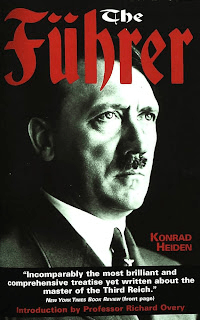
BOOK REVIEW: Der Fuehrer: Hitler’s Rise to Power-By Konrad Heiden (translated by Ralph Manheim) Paperback 614 pages

“Heiden was a young socialist student in Munich when he first saw Hitler speak. It was 1923, the year of inflation and political chaos in Germany. Heiden was not impressed by what he saw: a self-centered demagogue at the head of what he calls the army of uprooted and disinherited.”

Richard Overy

“Fascism has opened up the depths of society for politics. Today, not only in peasant homes but also in city skyscrapers, there lives alongside those of the twentieth century, the tenth or the thirteenth. A hundred million people use electricity and still believe in the magic power of signs and exorcisms. The Pope of Rome broadcasts over the radio about the miraculous transformation of water into wine. Movie stars go to mediums. Aviators who pilot miraculous mechanisms created by man’s genius wear amulets on their sweaters. What inexhaustible reserves they possess of darkness, ignorance, and savagery! Despair has raised them to their feet; fascism has given them a banner. Everything that should have been eliminated from the national organism in the form of cultural excrement in the course of the normal development of society has now come gushing out from the throat; capitalist society is puking up the undigested barbarism. Such is the physiology of National Socialism.

Leon Trotsky-From What Is National Socialism

“fascism comes only when the working class shows complete incapacity to take into its own hands the fate of society.”

― Leon Trotsky, Fascism: What It Is and How to Fight It

First published in 1944, Konrad Heiden’s superb biography of Adolf Hitler culminated in 20 years of study and political opposition to Hitler. The book covers from the 1920s up to June 1934. Heiden wrote and researched it in near real-time, and it is one of the best biographies on the subject of Hitler and the rise of German fascism. As Robert Gale Woolbert, in his review, correctly writes Heiden’s book is “A profusion of detail and brilliant psychological understanding. The analysis is not only of the man but of his movement and the economic, social, and intellectual disorder on which it fed and finally attained success”.[1]

While many modern-day historians, such as Daniel Goldhagen,[2] have placed the blame for the rise of German fascism and the Holocaust on “ordinary Germans,” it was, however, a shock to see Gale Woolbert’s 1944 review containing and defending the same right-wing theory. Wollbert writes, “Where many will feel that Heiden’s explanation breaks down is in his unwillingness to place responsibility for Nazism squarely on the German people or any important class or group among them. This ability to dodge the necessity of rigorous and honest self-criticism seems to characterize even the German liberals and German Jews who have suffered most at the hands of their countrymen.[3]

Despite being over eighty years old, Heiden’s book has a contemporary relevance. It should be read alongside Leon Trotsky’s The Struggle Against Fascism by all those who want to understand the development of fascism of the past and the present. The British Historian Richard Overy writes the introduction. Overy highly praises and defends the book against those who have sought to downplay its significance.

Since its publication over eighty years ago, there has been a veritable cottage industry solely devoted to the study of Hitler and German fascism with varying degrees of success. But as John Lukacs writes in his book The History of Hitler, “We are not yet finished with Hitler (“[wir sind] mit Hitler noch lange nicht fertig”), wrote two members of a younger generation of German historians, independently of each other, in the 1980s–and this is so in both the broader and the narrower sense of “finished.” The first of these should be evident. History means the endless rethinking–and reviewing and revisiting–of the past. History, in the broad sense of the word, is revisionist. History involves multiple jeopardy that the law eschews: People and events are retried and retried again. There is nothing profound in this observation since this is what all thinking is about. The past is the only thing we know. All human knowledge springs from past knowledge. All human thinking involves a rethinking of the past.

This is true in the narrower sense, too, involving the historical profession. The notion that once the scientific method has been applied accurately, with all extant documents exhausted, the work will be finished, and the result will be final (“the final and definitive history of the Third Reich, certified by German, American, British, Russian, liberal and conservative, nationalist and Jewish historians”) is a nineteenth-century illusion. There are probably more than one hundred biographies of Hitler, while there is no certainty that the 101st may not furnish something new and valid. What may matter even more than the accumulated quantity of the research (note the word “re-search”) is the quality of the revision. What is its purpose? In the broader sense, the purpose of historical knowledge is more than accuracy; it is understanding. In the narrower sense, the purpose of a revisionist historian may be exposé, scandal, sensation–or the more or less unselfish wish to demolish untruths. It may be his desire for academic or financial success, to further his advancement in the eyes of his colleagues, or, in the greater world, to gain publicity, or to further the cause of a political or national ideology–on which the treatment of his subject sometimes depends. There will be evidence in this book that this applies on this occasion–to the historical treatment of Hitler too.”[4].

Hitler has legitimately long fascinated historians, but the fascination of sections of the British ruling elite and aristocracy[5] who saw Hitler as an ally against Bolshevism is not so legitimate. Hitler’s Mein Kampf was a huge publishing success–in England and the United States, especially before the war. During my research for this article, I paid a trip to the London Library to find other work by Heiden on Hitler and the Nazis (a term that Heiden coined). I don’t know who was surprised more, me or the librarian, to see a copy of Heiden’s History of National Socialism published in 1934 in London by Meuthen and Co. Ltd with a gold embossed swastika on both the spine and cover. Perhaps all the more galling since Heiden was an active socialist. You can draw your own conclusions.

It would be a mistake to see this book as another Hitler biography. Heiden was an active socialist in opposition to Hitler and German fascism. He was a member of the German Social Democratic Party(SPD). Heiden, son of a German trade union official, had studied Hitler for 23 years. So much so that, according to Dorothy Thompson, he followed Hitler “like a Javert tracking down his man.”[6]

As David North writes in his excellent review of Goldhagen’s book “ The History of the German social democracy, in the years when it represented a revolutionary mass movement of the working class—that is, from the 1870s to the outbreak of the First World War I in 1914—is one of unrelenting struggle against anti-Semitism. The exigencies of the political struggle in the working class required an intransigent attitude toward all forms of anti-Semitic propaganda. Aside from democratic principles and moral considerations, the Social Democratic Party saw the association of anti-Semitism with demagogic anticapitalist rhetoric as an attempt to disorient the working class and subordinate it to the political representatives of the middle class.”[7] Heiden completely agreed with the program of the SPD and fought for it with every waking moment. The Gestapo hunted him, and he only just escaped with his life.

I have been unable to ascertain whether Heiden read any of Leon Trotsky’s writings on German fascism, but some of Heiden’s analysis of the class nature of German fascism would not look out of place in the work of Trotsky. Heiden writes, “They drew to them “the flotsam, the stragglers living on the fringe of their class . . . the unemployed . . . the declassed of all classes.” In all ages, this has been the way of counterrevolution: an upper layer that has lost its hold in society seeks the people and finds the rabble. The officers were out to find a demagogue, of whom it could be said that he was a worker. They found their leader in the lowest mass of their subordinates. The spirit of history, in its fantastic mockery, could not have drawn an apter figure.[8]

Perhaps Heiden’s most important contribution has been to understand and explain the nature of Hitler’s hatred of the Jews. Hitler’s anti-Semitism was, according to Heiden, a by-product of his all-consuming hatred of the proletariat. Hitler, he explained,” hated the whole great sphere of human existence which is devoted to the regular transference of energy into a product, and he hated the men who had let themselves be caught and crushed in this production process. All his life, the workers were, for him, a picture of horror, a dismal, gruesome mass. Everything that he later said from the speaker’s platform to flatter the manual worker was pure lies. Herein lies the key to an understanding of Hitler’s demonic obsession with the Jews. In Mein Kampf, Hitler explained how his conversion to anti-Semitism flowed from his encounters with the labor movement. It was among the workers that Hitler first came into contact with Jews. He then discovered, to his amazement, that many Jews played prominent roles in the labour movement. “The great light dawned on him,” wrote Heiden. “Suddenly, the ‘Jewish question’ became clear. … The labour movement did not repel him because it was led by Jews; the Jews repelled him because they led the labour movement.” Heiden concluded, “It was not Rothschild, the capitalist, but Karl Marx, the Socialist, who kindled Adolf Hitler’s anti-Semitism.”[9]

It would be fair to say that history has not been very kind to Heiden’s Marxist analysis of the rise of Hitlerite fascism. The modern-day Marxist writer David North rescued Heiden from the “condescension of history.” Apart from North, Heiden has largely been ignored, and his opposition to the right-wing historiography that is so loved today that “ordinary Germans” were responsible for fascism has been written out of today’s history books. Heiden shared the same fate when he wasWhile still alive. His Heiden’s books and Marxist analysis came under heavy attack.

In an article called The Mass-Man: Hitler, Hans Kohn starts by praising Heiden’s work, saying, “Mr. Heiden’s extremely well-written book is based on expert knowledge of the biographical material and the political background of Hitler’s rise to power. The dramatic terseness and vividness of its narrative have lost nothing in the excellent translation. Its brilliant analysis of German and, curiously enough, also of Russian politics makes the book not only a journalistic masterpiece but an authentic work of historical scholarship.

Kohn’s real opposition to Heiden comes to the fore when he writes, “Yet the crucial question of the essentially German nature of Hitlerism is not answered: Mr. Heiden seems to regard Hitler as representing the mind not only of the German masses but of the modern masses everywhere. Though he perceives the deep tie binding Hitler to the German masses and them to him, he often writes as if Hitler had to conquer the German masses against their innermost will. Hitlerism then appears as an international movement which could have happened anywhere and which found in Germany only its accidental starting point. Such an opinion underrates the deep roots of Hitlerism and Stalinism in the intellectual soil and the social structure of Germany and Russia, and at the same time, the intrinsic strength and the survival value of Western civilization.”[10]

Perhaps the most provocative and repellent review of Heiden’s work comes from the pens of the New York Times. They claimed Heiden was a propagandist and uncritically reported: “To the leaders of the Third Reich. Heiden was a hated and sought-after enemy. One of the Nazis’ acts upon taking over a country was always to ban and burn his books. The writer was a propagandist of a special kind-one who used objectivity and documents to destroy the object of his derision…. In 1932 his first book, History of National Socialism, was publicly burned by the Nazis, who were then on the brink of gaining power. When they took over… In 1933, he fled.”[11]

Despite giving world governments significant examples of the Nazi’s intentions and his books contained some of the earliest first-hand reports of Jews who fell victim to torture and internment at Dachau near Munich, Sachsenhausen or Oranienburg near Berlin, or Buchenwald near Weimar following the mass arrests of 1938 western capitalist governments did nothing to prevent the subsequent Holocaust.

Heiden is well worth reading today, and it is to David North’s credit this great historian of the 20th century can be read in the 21st century.

Further Reading

How To Read Hitler- Neil Gregor

The Struggle Against Fascism in Germany (Merit S.) Paperback – Illustrated, 1 Jun. 1971by L. Trotskii (Author), George Breitman (Editor)

Heiden’s Selected works

History of National Socialism (Berlin, 1932)

Birth of the Third Reich (Zürich, 1934)

Hitler: A Biography (Zürich, appeared in two volumes, 1936–1937)

The New Inquisition (New York City, 1939)

Der Führer – Hitler’s Rise to Power (Boston, 1944)


[1]Der Fuehrer-Reviewed by Robert Gale Woolbert-April 1944

http://www.foreignaffairs.com/reviews/capsule-review/1944-04-01/der-fuehrer

[2] See David North The Myth of “Ordinary Germans”: A Review of Daniel Goldhagen’s Hitler’s Willing Executioners.wsws.org

[3] www.foreignaffairs.com/reviews/capsule-review/1944-04-01/der-fuehrer

[4] The Hitler of History- Chapter One http://www.nytimes.com/books/first/l/lukacs-hitler.html?scp=80&sq=english%20history&st=cse

[5] See The Queen’s Nazi salute: Historical revisionism in the service of state censorship

Julie Hyland-22 July 2015- https://www.wsws.org/en/articles/2015/07/22/nazi-j22.html

[6] National Socialism: Theory and Practice Dorothy Thompson July 1935 Published on July 1, 1935-Foreign Affiairs

[7] David North The Myth of “Ordinary Germans”: A Review of Daniel Goldhagen’s Hitler’s Willing Executioners.wsws.org

[8] Der  Fuehrer, Hitler’s Rise to Power-Konrad Heiden—Haughton, Mifflin

[9] Der  Fuehrer, Hitler’s Rise to Power-Konrad Heiden—Haughton, Mifflin

[10] The Mass-Man: Hitler-By Hans Kohn-April 1944- http://www.theatlantic.com/magazine/archive/1944/04/the-mass-man-hitler/655063

[11] www.spartacus-educational.com/Konrad_Heiden.htm