The Nazis, Capitalism and the Working Class by Donny Gluckstein Haymarket Books 26 July 2012

“Fascism is the political punishment meted out to the working class for the squandering of opportunities to overthrow the capitalist system”

Leon Trotsky

“If, against all expectations, Germany finds itself in a difficult situation, then she can be sure that the Soviet people will come to Germany’s aid and will not allow Germany to be strangled. The Soviet Union wants to see a strong Germany, and we will not allow Germany to be thrown to the ground.”

Joseph Stalin[1]

“All these things are still apparent today. You Americans can see for yourselves how impossible it is to feed the German people from the German soil itself. From the viewpoint of a historian’s perspective, one could say that Hitler would never have arisen if the Allies had not treated Germany so poorly. Justice Jackson said so himself. Today, things are more impossible than ever. The East has been taken away from Germany – in other words, hunger created Hitler, and paradoxically, Hitler created still greater hunger.”

Hans Frank[2]

“Not only did waging war against Hitler fail to save the Jews, but it may also be that the war itself brought on the Final Solution of genocide. This is not to remove the responsibility from Hitler and the Nazis. Still, there is much evidence that Germany’s anti-Semitic actions, cruel as they were, would not have turned to mass murder were it not for the psychic distortions of war, acting on already distorted minds. Hitler’s early aim was forced emigration, not extermination, but the frenzy of it created an atmosphere in which the policy turned to genocide.”

Howard Zinn[3]

It is a little surprising that a book of this significance has been so little reviewed. In fact, I would go as far as to say it has been completely ignored by the capitalist media. This is not surprising given that it purports to be a Marxist analysis of the rise of fascism in Germany and examines the struggles of the working class.

Gluckstein’s The Nazis, Capitalism and the Working Class is well-written and researched. It addresses a vital question for those interested in what social forces produced Nazism, and how the global working class should respond. This is not merely an academic debate. The answers determine whether workers adopt an independent socialist strategy or are diverted into alliances that preserve capitalism and open the road to mass fascism and barbarism. Gluckstein’s book is a significant attempt to understand the rise of fascism from the standpoint of the materialist conception of history. The reader needs to locate fascism in the development of capitalist class relations, not as an aberrant moral failing or solely a product of culture.

Gluckstein is not an economic historian, but his book does show that structural economic crisis and the disintegration of ruling-class authority created the conditions for the rise of the fascists. Marxist analysis explains Nazism as a political instrument forged out of definite class needs and crisis tendencies within German and world capitalism. Adam Tooze’s economic study, The Wages of Destruction, demonstrates how the Nazi project was shaped by the drive of German capital to overcome its relative decline and secure raw materials, markets and strategic position—in short, the connection of militarism, imperialism and genocide to economic aims.

In the introduction to his book, which is well worth reading, Tooze puts forward his basic thesis: “The originality of National Socialism was that rather than meekly accepting a place for Germany within a global economic order dominated by the affluent English-speaking countries, Hitler sought to mobilise the pent-up frustrations of his population to mount an epic challenge to this order. Repeating what Europeans had done across the globe over the previous three centuries, Germany would carve out its own imperial hinterland; by one last great land grab in the East, it would create the self-sufficient basis both for domestic affluence and the platform necessary to prevail in the coming superpower competition with the United States…. The aggression of Hitler’s regime can thus be rationalised as an intelligible response to the tensions stirred up by the uneven development of global capitalism, tensions that are of course still with us today.”[4] As Tooze points out, the German ruling class, fragmented and terrified by mass working-class struggles, turned to the far right as a means of defending property, reimposing discipline and preparing for future imperialist war aims.

Gluckstein’s work tends to emphasise aspects of this history; however, not being a classical Marxist is a handicap.  A Marxist critique would dig deeper. It needs to be explained how capitalist reorganisation, imperial rivalries and the political sclerosis of working-class leadership created the objective basis for Nazism—and why only a revolutionary alternative rooted in working-class independence could have prevented it.

The political defeat of the German working class was not a result of workers’ “backwardness” alone but of the collapse and betrayal of their organisations: Social Democracy’s subordination to bourgeois parliamentary politics and Stalinism’s bureaucratic compromises and purges left workers without revolutionary leadership. The trade-union bureaucracy and social-democratic leaderships, by integrating into the state apparatus and policing class discipline, blocked independent mass action. As Trotsky warned, the bureaucratized unions tend to “grow together” with state power and capital—creating a political vacuum that fascist movements exploit.

Nazism fused older anti-Jewish prejudices with virulent anti-Bolshevism to mobilise the petty bourgeoisie and small sections of the working class against organised labour and socialism. It should be noted that the genocidal culmination—the Holocaust—cannot be divorced from the imperial-colonial aims of the Nazi regime and its need to smash the labour movement and seize “Lebensraum” in the East (Imperialism and the political economy of the Holocaust). Ideology mattered—but ideology itself was shaped and harnessed to class strategy.

Donny Gluckstein comes from a political milieu associated with the Lambertist tradition; historically, this current has tended toward nationalist and economistic deviations from the Trotskyist method. The Lambertist milieu and the POID‑derived formations trace their politics to Pierre Lambert’s line. Historically, Lambertism emerged as a response to the crisis of the post‑war left: a stress on trade‑union work, factory embedding, and the construction of broad “workers’ parties.” But as documented in the history of the French PCI/OCI, Lambert’s priorities—rooted in unions and seeking broad alliances—produced persistent tendencies toward centrism, accommodation to union bureaucracies, and political compromises that diluted a Leninist program.[5]

Many on the pseudo left tend to treat Nazism primarily as a quasi-irrational cultural or psychological phenomenon, divorced from capitalist interests. These risks mystify its social roots and underestimating the conscious role played by industrialists, financiers and the military bureaucracy in bringing Hitler to power.

Gluckstein’s book came under sustained attack primarily from his fellow pseudo-lefts, and two are worth mentioning. Tom Cord’s article in Fighting Talk, issue 23, addresses fascism as a political phenomenon that the left must confront. His piece raises useful questions about the social roots of far‑right movements and the failures of centrist parties. However, Cord’s article, aside from being a right-wing attack on Gluckstein, suffers from theoretical limits that require correction. The starting point of a genuinely revolutionary analysis must be the materialist method: ideas and movements are rooted in social relations and the class interests that those relations express. Any assessment of Nazism that abstracts from the objective interests and political role of German capitalism will be incomplete and in danger of demagogy, which is precisely the tone and content of Ford’s review of Gluckstein’s book.[6] I am unable to find any reply by Gluckstein regarding Cord’s attack on his book.

The “debate” between German Marxist Horst Haenisch and Donny Gluckstein was a far more substantial matter than Cord’s somewhat simplistic riposte. The debate took place through a series of written exchanges in the journal International Socialism between 2018 and 2019. The debate over whether the Holocaust is a particular specificity to Nazism or a universal manifestation of broader modern imperialism) was at the heart of this discussion. The answer to this conundrum can be found in the realm of dialectics. Particular forms emerge out of universal tendencies: the Holocaust must be understood as both an extreme, historically specific manifestation and as rooted in broader processes. On the universal level, capitalist imperialism, racial ideologies developed in colonialism, and the social crises of a decaying capitalism create conditions in which genocidal solutions become thinkable and implementable. The reader should note that the racialist ideology of the Nazis was the most extreme expression of a wider European and global tradition of colonial, racial pseudo-science and political violence.

Who are the actors?

Donny Gluckstein is a historian associated with the British SWP milieu whose work addresses fascism, class struggle and working‑class resistance. His writings often emphasise political and cultural factors alongside social causes. The British SWP evolved from the revolutionary left and developed into a large extra‑parliamentary organisation; over decades, critics on the Marxist left have charged it with political adaptation to trade‑union and extra‑parliamentary alliances, opportunist united‑front practices, and failures to break decisively with reformist perspectives.

Horst Haenisch is a contemporary German author and scholar associated with German Marxist historiography. He is best known for his 2017 book “Fascism and the Holocaust: Attempt at an Explanation”.

Haenisch’s critique — insofar as it targeted excessive intellectualism, opportunism or sectarianism — has a legitimate core if you believe that Haenisch insists the party must be in organic relation to workers’ struggles. But when such critiques abandon dialectical analysis or slide into petty‑bourgeois rejection of theory, they become politically harmful. The famous debate between Trotsky and James Burnham is relevant to this situation. Trotsky warned that anti‑dialectical tendencies among intellectuals often lead them to inconsistent politics, saying, “The ‘petty-bourgeois opposition’ is fleeing from the hard reality of the world struggle into the ivory tower of abstract ‘reason’. James Burnham’s famous rejection of dialectics in the 1939 debate became a vehicle for abandoning working‑class analysis and led to opportunist conclusions. Burnham ended his days as a right-wing mouthpiece for capitalism.

To summarise Haenisch’s position, he believed the Holocaust was a unique event that was not simply the fault of the ruling class. He claims it is the only Nazi project that falls into the category of the “primacy of politics” over economics.

According to Google’s artificial intelligence, he uses the concept of Bonapartism to describe the Nazi state’s relative autonomy, suggesting the Nazi party acted like a “Praetorian Guard” that could pursue its own racist fantasies independently of immediate capitalist needs. He distinguishes Nazi antisemitism from general racism, characterising it as a deadly “antisemitism of reason” driven by middle-class competition for professional positions.

Readers should ask themselves the relevant methodological question: do arguments rest on a concrete, historically grounded analysis of class relations and state form — a materialist-dialectical determination — or on impressions, eclecticism or petty‑bourgeois moralising that detach ideas from class reality? When theory becomes a matter of rhetorical flourishes or pragmatism, it ceases to serve proletarian politics and becomes a barrier to building working‑class independence.

Intentionalism versus structuralism

The debate between Gluckstein and Haenisch, to put it simplistically, was over two contending historiographical schools of thought which currently dominate historiography regarding the rise of fascism and the Holocaust.

The intentionalist school emphasises decisions and individuals—most prominently Hitler and top Nazi leaders—as the causal centre. Structuralist/functionalist accounts emphasise impersonal social structures, administrative routines and systemic pressures that produced genocidal outcomes without requiring a single master plan. To put it simply, one is relatively close to a Marxist historiography, the other is not.

Do agency and leadership matter: Hitler, Heydrich, Himmler and the Nazi leadership were decisive agents who gave ideological content, legitimacy and directives that escalated persecution to extermination. This move towards extermination appeared at The Wannsee Conference (Berlin, January 20, 1942). It was a high‑level administrative meeting of senior Nazi officials that consolidated and coordinated the implementation of the regime’s policy of mass murder of Jews—what came to be called the “Final Solution.” Far from a sudden, isolated act of criminality, Wannsee formalised a process already rooted in the racist, expansionist and economic policies of the Nazi state that flowed from the contradictions of imperialist capitalism and Germany’s drive for living space in the East.

Structural conditions enabled and shaped those decisions: the bureaucratic-capitalist state, the logic of war and colonisation, the collaboration of local administrations, and the preexisting racism of European imperialism created the technical and social capacity to carry out mass murder.

As Nick Beams argues, if one considers the question very narrowly, as we have noted, then it is easy to show that the mass murder of the Jews ran counter to the immediate economic and military interests of German imperialism. But that is the problem—the narrow perspective through which the issue is viewed. If we widen the horizon, then the underlying interests come into view. The Holocaust arose out of the war against the Soviet Union and the plans of German imperialism for the domination of Europe. The German capital had handed over the reins of power to the Nazis to carry out these tasks. To be sure, as occurred before the war, some of their actions conflicted with the immediate short-term interests of German business—although there is no record of opposition from within the German ruling elites to the mass murder of the Jews—but there was a direct coincidence between the drive of the Nazis for Lebensraum in the East and the interests and needs of German imperialism.[7]

Thus, the explanation is neither “Hitler did it alone” nor “structural forces made individuals irrelevant.” Rather, structural pressures channel and constrain agency; individuals choose within those constraints, and those choices can be decisive. The dialectical relationship between structure and agency is central.

To finish one question the reader should ask is whether this is just a historical debate or whether it helps us understand contemporary politics. Reducing the Holocaust to a metaphysical “evil” or to merely psychological explanations dissolves political responsibility and obscures the social origins of mass barbarism. Conversely, purely structural reductionism that denies conscious decision-making can excuse perpetrators as mere cogs. Both tendencies are politically dangerous and historically inadequate.

Understanding the Holocaust as an outcome of capitalist crisis, imperial rivalry and the betrayal and destruction of workers’ movements reveals the crucial lesson emphasised by Trotsky: the absence of an independent, politically conscious revolutionary leadership permits the rise of barbaric counterrevolutions. Stalinism’s betrayal and the defeats of the workers’ movement in the interwar period were decisive in opening the road to Nazism.

As the global economy careens into a new period of crisis, far-right and explicitly fascist parties are gaining ground across Europe. The urgency of preventing a resurgence of fascism in the twenty-first century makes it more necessary than ever to understand the political and social context of the Nazis’ ascent to power in Germany.

I don’t usually end a review with an advert, but readers of this article would be advised to read two books. The first being Why Are They Back?: Historical falsification, political conspiracy and the return of fascism in Germany by Christoph Vandreier  and secondly, Where is America Going -David North

Notes

German Marxism and the Holocaust-(Summer 2018) www.marxists.org/history/etol/writers/gluckstein/2018/xx/holocaust.html

Imperialism and the political economy of the Holocaust-Nick Beams-www.wsws.org/en/articles/2010/05/holo-m12.html


[1] Statement in September 1939, as quoted in “Stalin’s pact with Hitler” in WWII Behind Closed Doors at PBS http://www.pbs.org/behindcloseddoors/episode-1/ep1_stalins_pact.html Contemporary witnesses/

[2]To Leon Goldensohn, March 16, 1946, from “The Nuremberg Interviews” by Leon Goldensohn, Robert Gellately – History – 2004

[3] Howard Zinn on War (2000), Ch. 21: Just and Unjust War

[4] Adam Tooze, The Wages of Destruction: The Making and Breaking of the Nazi Economy, Allen Lane: 2006, 832 pages,

[5] French revisionist Pierre Lambert dies aged 87- http://www.wsws.org/en/articles/2008/01/lamb-j21.html

[6] libcom.org/article/class-analysis-afa-review-nazis-capitalism-and-working-class-donny-gluckstein

[7] Marxism and the Holocaust-

Nick Beams

Selling Hitler by Robert Harris. New York: Pantheon Books. First American edition, 1986, 402 pp., $18.95, ISBN 0-394-5533-5.

Robert Harris’s Selling Hitler is a well-written and scrupulously researched examination of the “Hitler diaries” forgery. It is a journalistic and fictionalised account of the 1980s forgery case. It raises important questions about ideology, politics, culture and the circulation of false narratives about fascism.

In his review of the book, H. Keith Thompson makes the following point: “The quantities of Third-Reich-related forgeries in circulation can generally be divided into two categories. First, there are the forgeries made by the World War II Allies, and by various international pressure groups, for propaganda purposes, such as the masses of faked material introduced by the Allies at their various postwar “trials” of defeated Axis adherents, e.g., the Russian “evidence” concerning the Katyn Massacre. Most forgeries in the second category (documents, uniforms, medals, weapons and other memorabilia) are merely attempts to make money.”[1]

The Hitler Diaries scandal was perhaps the most stupid blunder by a media outlet. In 1983, the German magazine Stern paid 9 million Deutsche Marks for the “discovery,” only for forensic tests on the ink and paper to reveal they contained chemicals not available during WWII. The so-called handwriting experts brought in to validate the diaries were nothing of the sort. As Harris relates, “Hilton’s report, couched in five pages of professional gobbledy-gook, was conclusive. But, based as it was on the assumption that all the documents he had been given for comparison were authentic, it was also completely wrong…they were all forged by Kujau.”

The book details how the small-time forger, Konrad Kujau, managed to create and sell over 50 fake diaries to a gullible German journalist, Gerd Heidemann, of the magazine Stern. The story reached global headlines in April 1983 when Stern offered to sell the diaries for a substantial sum (around $4 million at the time), and major publications, including The Sunday Times and Newsweek, became embroiled in authenticating and publishing excerpts.

The scam successfully fooled many reputable historians and media executives, who were blinded by the prospect of fame, money, and a historical scoop that could alter perceptions of the Third Reich. The hoax was exposed just a week later when forensic tests proved the diaries were crude forgeries, written on modern paper and with ink that glowed under ultraviolet light.

Harris, while having a journalistic flair and his book reads like a novel, has only a limited understanding of the class interests involved in the story. How did cultural authority, market pressures and political currents combine to produce credence for a lie?. The forgery should be placed in the wider history of political myth-making about Nazism, the post-war rehabilitation of German militarism, and the role of intellectuals in legitimising reactionary narratives.

Enter Hugh Trevor-Roper (1914–2003), who was described as the historian who caused the most trouble. Roper was an Englishman who had built a career on his book, The Last Days of Hitler, but who was in fact a specialist in the 16th and 17th centuries.

Harris notes: “He was not a German scholar. He was not fluent in the language and had admitted as much in a review of Mein Kampf published a decade earlier: “I do not read German,” he confessed, “with great ease or pleasure.” Written in an archaic script, impenetrable to most Germans, the diaries might as well have been composed of Egyptian hieroglyphics for all the sense Trevor-Roper could make of them. He had to rely on the Stern men for translation. The conversation was entirely in English”.

Hugh Trevor‑Roper was one of the most prominent English historians of the mid-20th century. He rose to public prominence through scholarly work on early modern Britain and Nazi Germany, serving as Regius Professor of Modern History at Oxford and as a public intellectual whose judgments carried great weight in the bourgeois media and academic establishment. His career—most famously marked by the episode of the forged “Hitler Diaries” in 1983—illustrates key lessons about the social basis of historical authority, the limits of individualist scholarship under capitalism, and the political stakes of historiography.

Trevor‑Roper’s name became synonymous with the controversy when he initially authenticated material presented as Hitler’s diaries, a judgment later shown to be wrong when forensic evidence proved the texts to be modern forgeries. That mistake was not merely a personal lapse, for it reflected the institutional pressures and prestige relations in which a bourgeois historian operates. The eagerness of major newspapers and magazines to publish sensational claims, and the weight accorded to a single eminent expert’s word, produced a social environment in which haste could substitute for collective, methodical verification.

The unchecked authority given to persons like Trevor‑Roper often rests as much on social position and institutional prestige as on methodical, collective inquiry. The careers of such figures illustrate how bourgeois historiography can serve ideological functions, to legitimate national myths, to placate ruling‑class anxieties, or to manage memories of criminal regimes in ways compatible with present political needs.

Trevor‑Roper’s mistake thus demonstrates a dialectical relation: individual fallibility and institutional tendencies interpenetrate. The scandal exposed contradictions—authority versus truth, spectacle versus method—that are inherent in bourgeois cultural life.

Trevor Roper’s scholarship indeed made significant historiographical contributions; his errors do not nullify all of his work. But a historical materialist appraisal must treat individual scholars as social products: their interpretations reflect the material and institutional contexts in which they live and work. The proper response to episodes like the Hitler Diaries is not merely to censure but to insist on strengthening collective, methodical historical practice grounded in material evidence and social analysis.

In sum, the Hugh Trevor-Roper affair is a cautionary tale: under capitalism, historiography is vulnerable to commodification, to authority concentrated among social elites, and to ideological manipulation. The remedy is not reliance on isolated historians but the development of democratic, scientifically disciplined historical practice.


[1] Selling Hitler-A Review By H. Keith Thompson ∙ December 1, 1986-codoh.com/library/document/selling-hitler/

The Nazi Mind: Twelve Warnings from History-By Laurence Rees Public Affairs, 2025

We meet ordinary Germans who fell in line with a regime that promised them peace and prosperity. Interviewed decades after the destruction of the Third Reich, some still looked back wistfully to the days before the war. “You saw the unemployed disappearing from the streets,” recalled Erna Krantz from Bavaria. “There was order and discipline … It was, I thought, a better time”.

Laurence Rees

The fury of Nazism, which was bent on the unconditional extermination of every Jewish man, woman, and child within its reach, passes the comprehension of a historian, who tries to uncover the motives of human behaviour and to discern the interests behind the motives. Who can analyse the motives and the interests behind the enormities of Auschwitz? We are confronted here by a vast and ominous mystery of the degeneration of the human character that will forever baffle and terrify humanity.

Isaac Deutscher-

The most appropriate, indeed the only relevant, general proper name for the Germans who perpetrated the Holocaust is “Germans.” They were Germans acting in the name of Germany and its highly popular leader, Adolf Hitler.

Daniel Goldhagen

“Life is not an easy matter…. You cannot live through it without falling into frustration and cynicism unless you have before you a great idea which raises you above personal misery, above weakness, above all kinds of perfidy and baseness.”

― Leon Trotsky, Diary in Exile, 1935

The Nazi Mind by the writer, historian and broadcaster Laurence Rees has been described as a “groundbreaking narrative history” of the motivations and mentalities behind the Nazis and their supporters. As will be seen in this critical review it is essentially a rehash of his previous histography that not only downplays the social and economic and political forces at play in the Nazis rise to power but compliments Daniel Goldhagen’s theoretical premise that “Ordinary Germans” were to blame for the rise of German fascism and the subsequent murder of six million jews.[1]

Rees uses previously unpublished testimony from former Nazis and those who grew up in the Nazi system to try and gain insight in to the psychological and social composition of the Nazis.

But as this perspective document elaborates “ Nazism was an expression of the most reactionary and brutal tendencies of German capitalism. That is the key to understanding it. Hitler’s rise from a Viennese homeless shelter and the trenches of World War I to becoming a megalomaniacal dictator cannot be explained by the social composition and psychology of his supporters. He owed his power to the ruling elite, which placed him at the head of the state. The millions that Thyssen, Krupp, Flick and other industrial magnates donated to the NSDAP, Hitler’s appointment as chancellor by Hindenburg, the symbolic figurehead of the army, and finally the agreement of all the bourgeois parties to the Enabling Act are eloquent testimony to the fact that the vast majority of the ruling elite had placed themselves behind Hitler when all other mechanisms to suppress the working class had failed.

The members of the National Socialist movement originated, at least up to its seizure of power, almost exclusively from the middle classes. It recruited from among artisans, peddlers, the civil employees and peasants, whom the war, inflation and crisis had robbed of any faith in democratic parliamentarianism and who longed for order and an iron fist. At the head of the movement were officers and NCOs from the old army, who could not reconcile themselves to Germany’s defeat in World War I. However, the programme of the National Socialist movement was anything but petty bourgeois. It translated the basic needs of German imperialism into the language of mythology and racial theory. The dream of a “thousand-year Reich” and the hunger for “Lebensraum (living space) in the East” expressed the expansionist urge of German capital, whose dynamic productive forces were constricted by Europe’s closely meshed system of states. Racial hatred provided consolation for the German petty bourgeois in the face of his absolute powerlessness and prepared him for a war of extermination.”[2]

Program and perspective

One of the most notable aspects of Laurence Rees’s entire body of work, and that can be said of most historians writing on this subject, is the cursory attention given to issues of program and perspective. In all his books virtually nothing is said about the actual policies pursued by the Social Democrats and the Stalinists, from the German Communist party which demoralized and split the working class, and cleared the way for the Nazi victory. This disinterest dates back to when Rees wrote to me in 2008, saying “I’m afraid I simply didn’t have space to include a discussion of these issues- fascinating as they are – in the Behind Closed Doors book. I decided to begin the story in 1939 and therefore felt it wouldn’t be helpful to refer back to this history. I’m sure others would have written the book differently, but for better or worse, that’s what I thought was the right way forward. Equally, I’m afraid I can’t go into my views on Trotsky here, as I would need several thousand words to represent my thoughts on that intriguing time properly. I believe my friend, Professor Robert Service, is currently writing a comprehensive biography of Trotsky, so it will be exciting to see his thoughts on the subject.[3]

As I said to Laurence Rees at the time, Robert Service was a regrettable choice of historian to assist him with Trotsky. In 2010, Robert Service wrote a biography of Leon Trotsky.[4] The Marxist writer David North called the biography “character assassination”, writing that Trotsky: A Biography is a crude and offensive book, produced without respect for the most minimal standards of scholarship. Service’s “research,” if one wishes to call it that, has been conducted in bad faith. His Trotsky is not history, but rather an exercise in character assassination. Service is not content to distort and falsify Trotsky’s political deeds and ideas. Frequently descending to the level of a grocery store tabloid, Service attempts to splatter filth on Trotsky’s personal life. Among his favourite devices is to refer to “rumours” about Trotsky’s intimate relations, without even bothering to identify the rumour’s source, let alone substantiate its credibility.”[5]

While there are some things to like about Rees’s new book unfortunately it is a reflection of the current historical consensus that ordinary Germans played a crucial part in the rise of Nazis and bear indirect responsibility for the murder of six million jews in the Holocaust. Rees not only believes that “ordinary Germans” were to blame but “such horrors occurred not because the Nazis were Germans, but because they were human beings”.

Rees’s belief that all humans, given the chance, can be murdering fascist monsters echoes William Golding’s Lord of the Flies, who believed that forces of human evil lurk deep in man’s soul or psyche. They can easily gain ascendancy, as they inevitably must, over the restraining moral influences of civilisation.

As North says, “Most of you are, I am sure, familiar with William Golding’s Lord of the Flies, which argued that barbarism is the natural condition of humanity. Release a group of ordinary school boys from the usual restraints of civilisation, and they will, within a few weeks, revert to a state of homicidal savagery. This misanthropic work flowed from the conclusions drawn by Golding from the experiences of the Second World War. “Anyone who moved through those years,” he later wrote, “without understanding that man produces evil as a bee produces honey, must have been blind or wrong in the head.” The popularity of Lord of the Flies reflected the bewilderment and despair provoked by the horrors of World War II. This mood was strengthened by the political relations that arose in the aftermath of the war. It became more challenging to engage in a discussion of the nature of the Third Reich after 1945 than it had been before that time. In the reactionary political environment of the Cold War, it was no longer considered appropriate, especially in the United States, to dwell too seriously on the relation between fascism and modern capitalism.[6]

There is little new about this “new history”. Daniel Goldhagen’s book[7] set the benchmark for this so-called theory. Although a substantial number of historians condemned his book,[8] It still went on to poison the minds of a younger generation, which swallowed hook, line, and sinker his right-wing historiography.

Brandi Lopez, one of those younger historians, wrote in a 2016 essay: “The term ‘ordinary men’ was used throughout several of my sources.” It was about the people that became the leaders of the Nazi party, Hitler’s right hand men as well as the people that became soldiers following his orders blindly and in the end becoming willing executioners. These individuals began as ordinary men, farmers, fathers, and everyday people. In Daniel Goldhagen’s “Hitler’s Willing Executioners: Ordinary Germans and the Holocaust.” Goldhagen’s basic thesis is that most German people became willing executioners in the Holocaust. He states, “eliminationist’ hostility toward the Jewish people was so deeply ingrained in Germany”, that’s how the people were willing to do whatever it took to rid the country of them.

In Laurence Rees’s “Auschwitz: A New History”, he mentions Hoss and his story. His family was a simple farming family, and for them to sell their goods, they had to go through a Jewish man. His father and mother ingrained in him that the Jewish man was scamming them out of money, and the reason his family struggled was because of this. Most of the people that were in the sample size said they resembled more of “real Nazis” than an “Ordinary German”. This article explores the theories of the perpetrators, the evidence, and ultimately, the sample size itself. Some graphs display a visual representation of the number of men who identified with a specific occupational rank, such as elite occupations, lower-middle-class workers, etc. [9]

The best refutation of Goldhagen’s “ordinary Germans” is by the Marxist David North, who wrote: The methodological flaw of Professor Goldhagen’s book is indicated in its title: Hitler’s Willing Executioners: Ordinary Germans and the Holocaust. Let us stop right there: What is meant by “ordinary Germans?” For those of you who would like a textbook example of an “abstract identity,” this is it. This is a category that is so broad, it is capable of including virtually everyone, except, presumably, Germans of Jewish parentage. What, after all, makes any particular German an “ordinary” one? Is it a hefty girth and a fondness for knockwurst and sauerbraten? Is it blond hair, blue eyes and a penchant for sunbathing in the nude? Is it a talent for abstruse philosophizing and a passion for 300-pound Wagnerian sopranos? A concept built upon such foolish and arbitrary stereotypes cannot be of any scientific value in the cognition of objective reality. But if we should attempt to include in our definition more serious sociological characteristics, the worthlessness of the concept of “ordinariness” becomes immediately apparent. In 1933, German society possessed a complex class structure. Was the “ordinary German” at the time of Hitler’s accession to power a factory worker, a ruined shopkeeper, a demoralized member of the lumpenproletariat, a heavily indebted peasant, an East Prussian land-owning Junker or an industrial magnate?

If all these elements of diverse social strata are to be lumped together as “ordinary Germans,” it simply means that the concept of “ordinariness” does not reflect the internal antagonisms and conflicts of German society as it existed in 1933. What Goldhagen, therefore, offers his readers is not a scientific examination of German society as it really was constituted in 1933, but rather—and it is unpleasant to say this—an idealized portrait of a homogeneous society that uncritically substantiates the Nazi myth of a unified German Volk, defined by race and blood.[10]

Another problem with Rees’s book is his take on the Holocaust; for Rees, the political, social and economic reasons for this terrible event are not important. What is essential for Rees is the psychological reasons behind the Nazis genocide of the Jews. Rees joins a long list of writers and historians for whom the Holocaust is unfathomable and should not even be attempted to be understood.

If a Marxist like Isaac Deutscher- can write “The fury of Nazism, which was bent on the unconditional extermination of every Jewish man, woman, and child within its reach, passes the comprehension of a historian, who tries to uncover the motives of human behaviour and to discern the interests behind the motives. Who can analyse the motives and the interests behind the enormities of Auschwitz? We are confronted here by a vast and ominous mystery of the degeneration of the human character that will forever baffle and terrify humanity. “What chance do the rest of us have?.

North answers, “ The situation is rationalised too often with the argument that the Holocaust is such a terrible event that it simply defies a rational explanation. If, as Adorno said, it was no longer possible to write poetry after Auschwitz, it was presumably also no longer possible to place much confidence in the historian’s ability to comprehend the forces that drive the social—or, more precisely, the antisocial—activity of man. Historical science and political theory were seen as powerless in the face of such unfathomable evil.[11]

As I mentioned earlier, there are some aspects to appreciate, but overall, Rees’s work perpetuates a very right-wing historiography. As Leon Trotsky once said, “Maybe I can find the truth by comparing the lies.”


[1] en.wikipedia.org/wiki/Hitler%27s_Willing_Executioners

[2] National Socialism and the Holocaust-https://www.wsws.org/en/special/library/foundations-ger/09.htmlthe theory

[3] https://keith-perspective.blogspot.com/

[4] Trotsky A Biography-Robert Service-Pan 2010

[5] In The Service of Historical Falsification: A Review of Robert Service’s Trotsky-https://www.wsws.org/en/articles/2009/11/serv-n11.html

[6] The Myth of “Ordinary Germans”: A Review of Daniel Goldhagen’s Hitler’s Willing Executioners-https://www.wsws.org/en/special/library/russian-revolution-unfinished-twentieth-century/15.html

[7] Hitler’s Willing Executioners: Ordinary Germans and the Holocaust Paperback – 1 Feb. 1997 by Daniel Jonah Goldhagen

[8] Historians criticise Goldhagen’s book-www.wsws.org/en/articles/1997/11/gold-n17.html

[9] Lopez, Brandi J., “German People and the Holocaust” (2016). Capstone Projects and Master’s Theses. 12. https://digitalcommons.csumb.edu/caps_thes_all/12

[10] The Myth of “Ordinary Germans”: A Review of Daniel Goldhagen’s Hitler’s Willing Executioners-https://www.wsws.org/en/special/library/russian-revolution-unfinished-twentieth-century/15.html

[11] The Myth of “Ordinary Germans”: A Review of Daniel Goldhagen’s Hitler’s Willing Executioners-https://www.wsws.org/en/special/library/russian-revolution-unfinished-twentieth-century/15.html

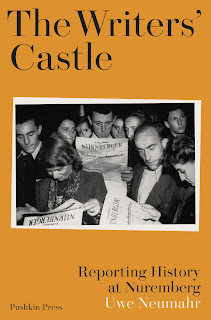
Review: The Writers’ Castle: Reporting History at Nuremberg-Uwe Neumahr, translated by Jefferson Chase Pushkin Press, 352pp, £25

“The wrongs which we seek to condemn and punish have been so calculated, so malignant, and so devastating that civilisation cannot tolerate their being ignored because it cannot survive their being repeated. We must never forget that the record on which we judge these defendants today is the record upon which history will judge us tomorrow.”

Chief Prosecutor Robert H. Jackson

“To initiate a war of aggression, therefore, is not only an international crime; it is the supreme international crime differing only from other war crimes in that it contains within itself the accumulated evil of the whole.”

“War makes murderers out of otherwise decent people. All wars, and all decent people.”—Ben Ferencz

The leader by will of the people differs from the leader by will of God in that the former is compelled to clear the road for himself or, at any rate, to assist the conjuncture of events in discovering him. Nevertheless, the leader is always a relation between people, the individual supply to meet the collective demand. The controversy over Hitler’s personality becomes the sharper the more the secret of his success is sought in himself. In the meantime, another political figure would be difficult to find that is, in the same measure, the focus of anonymous historical forces. Not every exasperated petty bourgeois could have become Hitler, but a particle of Hitler is lodged in every exasperated petty bourgeois.

Leon Trotsky- What Is National Socialism? (June 1933)

This is an interesting and well-researched book on the writers who covered the Nuremburg Trials of leading Nazis after the Second World War. The magnitude of the trials drew in journalists and writers from all over the world. Writers John Dos Passos, Rebecca West, Martha Gellhorn, Janet Flanner, William Shirer, and future German politicians such as Willy Brandt all observed the trials. The title of the writers’ castle was because the journalists were housed in the Schloss Faber-Castell castle in Stein, a nearby town.

Neumahr is a German author and literary agent, and his book is less about the crimes of the Nazis but more about the writer’s reaction to the crimes of the Nazis. As Neumahr points out in the book, not all journalists or writers cover themselves with glory. Even a cursory glance at their reports of the trials shows that some resorted to outright lying and presented less-than-objective accounts of the proceedings. Alfred Döblin, the author of Berlin Alexanderplatz, offered a first-hand account of the courtroom he never went to.

Others brought their ideological baggage with them, which showed in their articles. Erika Mann was the daughter of the novelist Thomas Mann. Because of the Nazi’s treatment of the Jews, (she was considered a Jew by the Nazis) she held an abiding hatred of the Nazis, which coloured her writings on the trial. The French Stalinist writer Elsa Triolet wrote many misleading and downright false reports to support her belief that the Anglo-American judges and lawyers were pro-Nazi.

Neumahr’s approach is “biographical and kaleidoscopic”. Given the highly political nature of the trial, it is a little strange that NeuMahr rarely delves into the politics of prosecutions or the writers that covered it, which is a big weakness in the book. As Bill Niven points out, “In most cases, he is as much, if not more, preoccupied with the lives of his chosen protagonists before, during and after their time at the Faber-Castell castle than he is with their actual journalistic response to the military tribunal. Neumahr is especially interested in all the social goings-on at the castle, whose guests – despite the separation of male and female quarters and, eventually, of Soviet reporters from all others – enjoyed a high level of fraternisation. Neumahr follows the various relationships of his protagonists. Erika Mann moved into the castle with her partner and fellow reporter Betty Knox (whom she referred to as her ‘beloved lunatic’) despite the press camp being run by the American military, for whom homosexuality was a punishable crime. Rebecca West and Francis Biddle, a US judge at Nuremberg, had an affair. As Neumahr tells it, this was something of a relief for both parties: ‘Like Biddle, the fifty-three-year-old West was sexually frustrated’, he writes, because ‘she hadn’t had sex with her husband in years.’ In his chapter on Gellhorn, we learn about her tempestuous relationship with Ernest Hemingway, while the chapter on the Prix Goncourt-winning Russian-French writer Elsa Triolet – who stayed in Nuremberg’s Grand Hotel and not the castle – focuses heavily on her relationship with the poet Louis Aragon.”[1]

The book’s strongest part is how Neumahr relates to how many writers and journalists were morally tarnished by political bias or other prejudices. This applies to author Eric Kästner[2]. One of my favourite childhood books was Emil and the Detectives. Despite having his books burnt by the Nazis in 1933, Kastner made a career for himself under the Nazis.

According to his Wikipedia page, “ The Gestapo interrogated Kästner several times, the national writers’ guild expelled him, and the Nazis burned his books as “contrary to the German spirit” during the book burnings of 10 May 1933, instigated by Joseph Goebbels. Kästner witnessed the event in person and later wrote about it. He was denied membership in the new Nazi-controlled national writers’ guild, Reichsverband deutscher Schriftsteller (RDS), because of what its officials called the “culturally Bolshevist attitude in his writings before 1933. During the Third Reich, Kästner published apolitical novels such as Drei Männer im Schnee (Three Men in the Snow) (1934) in Switzerland. In 1942, he received a special exemption to write the screenplay for Münchhausen, using the pseudonym Berthold Bürger. The film was a prestige project by Ufa Studios to celebrate the twenty-fifth anniversary of its establishment, an enterprise backed by Goebbels.

In 1944, Kästner’s home in Berlin was destroyed during a bombing raid. In early 1945, he and others pretended that they had to travel to the rural community of Mayrhofen in Tyrol for location shooting for a (non-existent) film, Das falsche Gesicht (The Wrong Face). The actual purpose of the journey was to avoid the final Soviet assault on Berlin. Kästner had also received a warning that the SS planned to kill him and other Nazi opponents before the arrival of the Soviets.[8] He was in Mayrhofen when the war ended. He wrote about this period in a diary published in 1961 under the title Notabene 45. Another edition, closer to Kästner’s original notes, was published in 2006 under the title Das Blaue Buch (The Blue Book).”[3]

Neumahr’s intention was never to write about the political nature or the duplicity of those prosecuting the Nazis. As Bill Hunter points “During this ten months, while the prosecutors of Britain, France, America and the Soviet Union, listed the sickening crimes of Nazism, world events showed the hypocrisy of the prosecuting Allies. Even while the aggressions of the Nazis were being recounted. British imperialism was maintaining a regime of terror and oppression in Greece, suppressing the colonial peoples struggling for freedom, and strafing Indonesian villages.The British prosecutor prated about justice. Meanwhile, Dr Kiesselbach, according to Tribune 6 September a declared opponent of de-Nazification was placed by British imperialism in charge of the German “Central Office of Justice”.

While the courtroom resounded with castigations of Nazi oppression and racial discrimination, American imperialist suppression was active in the Philippines, and lynch law was rampant in the Southern States.The prosecutors denounced the occupation methods of the Nazis. Yet, even while the French prosecutor mouthed phrases of indignation, the agents of French imperialism were torturing the natives of Indo-China and burning their villages.The miseries of slave labour under the Nazis were related to the court at the same time as 10 million Germans were uprooted and wandered homeless as a result of the wholesale expulsion policy of the Soviet bureaucracy. In the face of world events during the trial, who can deny that at Nuremberg, the pot called the kettle black, blackening itself still further even while doing so?[4]


[1] The Writers’ Castle’ by Uwe Neumahr review- https://www.historytoday.com/archive/review/writers-castle-uwe-neumahr-review 

[2] https://en.wikipedia.org/wiki/Erich_K%C3%A4stner

[3]  https://en.wikipedia.org/wiki/Erich_K%C3%A4stner

[4]  Bill Hunter on the Nuremberg Trial-). It was published in Socialist Appeal in October 1946. http://www.marxists.org/history/etol/revhist/otherdox/nurember.htm