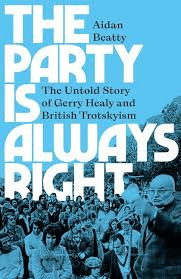
Despite being subtitled “The Untold Story of Gerry Healy”, this book contains nothing new and is a rehash of all the old lies and slanders that have been heaped on Healy and the Trotskyist movement for decades. The historian Thomas Carlyle was fond of saying that he had to clear a large pile of dead dogs off the body of Oliver Cromwell to reach the real person underneath. The same could be said of Beatty’s book. However, once all the dead dogs have been removed from this book, all you are left with is a worthless pile of crap.
While Beatty’s book is probably his own work, Pluto Press must be held accountable for publishing this hack work. As David North writes, Beatty’s book is a political hit job, not a scholarly biography. There are many questions about the writing of this piece of hack work. There is good reason to believe that Mr. Beatty is not the sole author of this work and that he had substantial assistance in collecting this mass of odoriferous material. As it is published by Pluto Press, which is affiliated with a political tendency hostile to the International Committee, one can reasonably assume that it provided Beatty with substantial support in the “researching” and writing this volume.”
I did ask Pluto Press for a review copy and was granted one by James K, to whom I gave my address. The book never arrived. The non-arrival coincided with the publication of David North’s review on the World Socialist website.
Pluto Press, who are largely made up of renegades from Marxism, has its own axe to grind against orthodox Trotskyism. It gave free rein to the political scoundrel Paul Le Blanc to write on the back cover saying, “’Displaying scant sympathy for Gerry Healy, the substantial groups that Healy led, and the Leninist-Trotskyist traditions that Healy claimed to represent, Aidan Beatty nonetheless produces a very readable, meticulously documented take-down that will be seen as a “must-read” source on left-wing politics from the 1930s to the dawn of the twenty-first century.’
This book is so bad it is difficult to know where to start. Writing a biography is an extraordinarily complex and time-consuming event. Writing a political biography is an art form. At 148 pages long, Beatty’s piece of art barely rises above second-grade level. There are many examples of excellent biographical writing. Currently, I am reading Bernard Crick’s biography of George Orwell[1]. It took Crick ten years to write. Whether Crick agrees with Orwell’s politics or not, it is a superb read and deserves every plaudit it has got. Honestly, Beatty is not fit to tie Crick‘s shoelaces.
The Marxist writer David North writes, “ Historians who undertake the arduous task of writing a serious biography—among the most difficult of genres—often introduce their work with an effort to explain to their readers why they embarked on a project that usually requires years of intensive research. When the subject of study is a political figure, the interactions of the individual and the epoch in which they lived are immensely complex. There is a profound truth in the adage that a man resembles the age in which he lives more than he resembles his father. A vast amount of work is required, not to mention a command of the historical landscape and intellectual subtlety, to understand the historically conditioned personality, psychology, motivations, aims, ideals, decisions, and actions of another human being.
Whether the writers admire or despise their subject, they are still obligated to understand in historical terms the person about whom they are writing. When the author genuinely admires his subject, they must still retain a critical distance that avoids a descent into hagiography. The great biographies of political figures—Samuel Baron’s study of Plekhanov, J.P. Nettl’s two volumes on Rosa Luxemburg, and Isaac Deutscher’s Trotsky trilogy—managed to maintain an objective attitude toward subjects for whom they clearly felt great empathy. Perhaps even more challenging was the task confronting Ian Kershaw, who devoted years of work to the study and explanation of the ideological, political, and psychological motivations of one of the worst mass murderers in history, Adolf Hitler.”[2]
The Psuedo Left community has welcomed Beatty’s book. Jacobin’s David Broder, from the main pseudo-left journal of the pro-genocide Democratic Party, interviewed DSA member Aidan J. Beatty. Beatty was allowed free rein to spew out his slanderous allegations against Gerry Healy and the British Trotskyists that they employed violence against political opponents and party members.
Beatty writes, “There is quite a notorious incident in 1966 when Ernie Tate, a Northern Iridefenceer of the International Marxist Group, was very violently attacked by a group of Healy’s supporters outside a party meeting in London; Healy was present for this and essentially supervised the assault. The attack was bad enough that not only was Tate hospitalized, but Healy was later forced to appear at a meeting with Isaac Deutscher and apologize. This assault was unplanned, but as I say in the book, “Healy propagated an aura of total ruthlessness but could benefit from that aura, since potential followers believed he was ruthless, in a kind of feedback loop. One former member told me that he never questioned that the party had to be structured in a very top-down, authoritarian manner because that would be needed to carry out a revolution in Britain. In general, I think many people who stuck with Healy accepted the verbal and physical abuse because they believed it was necessary to maintain discipline or because the revolution was more important than their own personal well-being.”[3]
Beatty supplies no new evidence and repeats every slanderous accusation against Healy and the SLL. David North replies to this piece of garbage history, “Libelous” is the appropriate word. Healy and the Socialist Labour League went to court to demand that two publications that had printed the allegations—Socialist Leader and Peace News—retract the story and issue a public apology to Gerry Healy. “A conscientious historian, adhering to the appropriate standards of scholarship, would have carefully researched all available sources to uncover what actually occurred in 1966. But Beatty is not a principled scholar. His book is anti-Trotskyist hack work”.[4]
Beatty’s biography relies heavily on oral history. However, his interviews are all with former members of the SLL/WRP who have personal axes to grind or are renegades from Trotskyism, such as Tariq Ali, who is an outright political scoundrel with a history of betrayal as long as my arm. Beatty’s interviews were not conducted critically, and the majority, if not all, testimonies in the book are unreliable. North says, “ The relation of the interviewee to the subject must be carefully appraised. The historian must be able to distinguish between flattery and slander, between facts and gossip, and between truth and lies. The historian must determine whether the claims of one or another interviewee are reliable, whether they are supported by evidence of a more objective character, i.e., documents”.
Suffice it to say Beatty did not ask me for an interview, which I would have refused and told him where to go. On a personal note, I joined the WRP in 1982/83. I think my probation period was nine months, a record inside the Trotskyist movement. The first few years were difficult for me, and I left just before the split occurred. I had no idea how politically sick the WRP was at the time. Perhaps the highlight was being taken to Vanessa Redgrave’s house just before the split. She was supposedly downsizing and wanted to get rid of her Library. I paid her a lot and got many books, including the proof copy of One Long Night: A Tale of Truth by Maria Joffe, translated by V. Dixon. If Mr North is reading this article, I would like to donate it to your Library where it belongs.
After the split, I joined the Minority and had the best time of my life, politically speaking. As Lenin was fond of saying, “There are decades where nothing happens, and there are weeks where decades happen.” That is exactly what happened during the split.
I only met Healy twice. He was cordial and polite. The first time was at an international Workers’ school in Derbyshire before the split. There was a lot of confusion there, and I left early. It was probably the worst decision of my political career as I missed the opportunity to meet and talk to the international comrades from the ICFI. I heard Healy speak three times twice before the split and once after it. Despite the political degeneration that was taking place, Healy was still a fantastic speaker. To see him in his prime would have been a sight to behold. The third time I heard him was after the split. He was a broken man, both physically and politically. He was the leader of the Marxist Party, and they held a public meeting in London. The ICFI wanted to tape the meeting and had planned an intervention. During Healy’s speech, I cannot remember what he said a member of the French section of the ICFI got up and accused Healy of capitulating to Pabloite opportunism. Suffice it to say you could have heard a pin drop. Unfortunately, my tape machine hidden inside my jacket ended, and a very audible click was heard. I was immediately manhandled out of the meeting by a phalanx of goons, and my machine was stripped of its tape. Before Professor Beatty rips this story out of context and uses it to justify his lie that Healy was a violent maniac, I would like to say that at no time in my albeit brief time in the WRP did I feel threatened or witness any violence towards me or others.
This brings me to Beatty’s motive for writing such a book. It must be said Beatty’s book is not the only diatribe written against the Trotskyist movement. Beatty’s soulmate in anti-Trotskyism is John Kelly, who is still an avowed Stalinist and has written two books recently.[5]
Beatty’s book is different in the respect that it is factionally motivated. North explains, “ What then is the connection between Beatty’s so-called Healy biography and his denunciation of the SEP and WSWS in the Epilogue? It is a dishonest attempt to link Healy’s abusive behaviour in the 1970s and 1980s to the Marxist class-based politics of the Socialist Equality Party.
Beatty writes: “The SEP has its roots in the Workers League that had once been led by Tim Wohlforth and closely influenced by Gerry Healy. Developing the ideas it learned from the WRP, the SEP’s privileging of class over all else has ended up not just downplaying race and gender, but outright sexism and racism.” [6]
North says, “By this point, the political motivations underlying Beatty’s book become all too clear. He is writing not as a historian but as a political flack for the Democratic Party. He denounces the SEP for its “ultra-leftist perspectives on current events and bad faith attacks on the recent crop of democratic socialist politicians, Alexandria Ocasio-Cortez especially, but also Bernie Sanders and Jeremy Corbyn.” What he calls “bad faith” is the well-known Marxist critique of the middle-class political agents of imperialism.
The last words of this article should be from David North. “Whatever the truth may be, one thing is certain: with the writing of this miserable book, Mr. Beatty has dealt a blow to his professional reputation from which it will never recover. Despite the tragic character of his final years, Gerry Healy will be remembered as a significant figure in the history of the British working class and the international struggle for socialism. All that he contributed to the defence of the revolutionary perspective against the betrayals and crimes of the Stalinists and social democrats over many decades will not be forgotten. But unhappily for Beatty, the fate of books and their authors are inextricably linked. The evil men write lives after them. This is the book for which Beatty will be remembered.”.
[1] George Orwell: A Life Paperback – 30 July 1992
[2] Biography as demonology: Aidan Beatty’s The Party is Always Right: The Untold Story of Gerry Healy and British Trotskyism-www.wsws.org/en/articles/2024/09/18/nizy-s18.html
[3] The Damage Gerry Healy Wrought-Jacobin.com/2024/09/gerry-healy-trotskyism-wrp
[4] Jacobin and DSA member Aidan Beatty falsify the so-called “Tate Affair” http://www.wsws.org/en/articles/2024/10/01/kifs-o01.htm
[5] See Two books by John Kelly-keith-perspective.blogspot.com/2024/10/two-books-by-john-kelly.html
[6] The Party is Always Right-The Untold Story of Gerry Healy and British Trotskyism page 137- https://www.plutobooks.com/9780745348728/the-party-is-always-right/

 A Trumpet of Sedition