This is an important compilation of stories from unaccompanied Central American teenage refugees who risk death to cross the U.S.–Mexico border. Recounted in short vignettes readers learn about the harrowing journey and treatment meted out to young children seeking a better life for themselves and their family. Juan Pablo Villalobos’s introduction indicates that all these stories are true except when he wrote their story to protect some minors’ identities.
The book is aimed at a 12+ audience. It contains significant allusions to violence, including murder and sexual assault. Which unfortunately adds to the compelling nature of the stories. The book is presented in such a way that it works on many levels.
Most of the children are from Honduras, Guatemala and El Salvador. Such is the massive scale of the problem that in 2016 the United Nations High Commissioner for Refugees published a major report called Children on the Run: In one interview with 15-year-old Maritza, from El Salvador, she explained to researchers that “I’m here because I was threatened by the gang. One of them “liked” me. Another gang member told my uncle that he should get me out of there because the guy who liked me was going to do me harm. In El Salvador, they take young girls, rape them and throw them in plastic bags. My uncle told me it wasn’t safe for me to stay there, and that I should go to the U.S.”[1]
Juan Pablo Villalobos called this collection nonfiction because the stories were collected via first-person interviews. The book is based on a series of interviews Villalobos held did in 2016; The Other Side examines Central American migration through the stories of 10 children who made the murderous trip to the U.S. on their own.
Villalobos adds , my literary ambition, if I can admit to that, was to write a book that is about Central American immigration and the migration of unaccompanied minors, but these stories are happening all over the world — in Syria, in the north of Africa, in Europe — and it was my hope that the book should resonate beyond the specific moment and the American and Central American contexts.”
With the Fascist Trump in the White House, the situation will only get worse. Figures released recently by the Department of Homeland Security (DHS) revealed that the United States has detained record numbers of unaccompanied minors attempting to cross its southwestern border. In the last few days, various US media have reported, that the Trump White House is imminently planning to invoke the Alien Enemies Act of 1798 as part of his administration’s ongoing criminal deportation operations.
[1] Children on the Run-www.unhcr.org/us/media/children-run-full-report
“His personal traits and public acts are better known to the American people than are those of any other man of his age. He was a mystery to no man who saw him and heard him. Though high in position, the humblest could approach him and feel at home in his presence. Though deep, he was transparent; though strong, he was gentle; though decided and pronounced in his convictions, he was tolerant towards those who differed from him and patient under reproaches. Even those who only knew him through his public utterances obtained a tolerably clear idea of his character and personality. The image of the man went out with his words, and those who read them knew him.”
Frederick Douglas
“one of the rare men who succeed in becoming great, without ceasing to be good.”
Karl Marx
“Lincoln’s significance lies in his not hesitating before the most severe means, once they were found to be necessary, in achieving a great historic aim posed by the development of a young nation.”
― Leon Trotsky, Their Morals and Ours:
In the January 2020 issue of The Critic, the politician, historian and writer Alan Sked wrote an article entitled Dishonest Abe. To eternal shame and damnation, Sked was given a space in the Times Literary Supplement’s (TLS) recent letters page to again attack Abraham Lincoln. Sked is a right-winger. He was a founding member of UKIP in 1993. He was formerly a member of the Anti-Federalist League and the “Brugge Group”, which regarded the decision of Thatcher’s successor, John Major, to sign up to the Maastricht Treaty in 1992 as a betrayal of her legacy. Sked is still a Conservative member.
Sked’s first paragraph in the Critic article sets the tone for the diatribe. He writes:
“Today, Abraham Lincoln remains America’s most popular president, and historians devote enormous efforts to ensuring that his reputation survives unscathed. Yet during his presidency, he was hated by millions, and in 1865, he was assassinated. Even before the Civil War, he was loathed by perhaps a majority of his fellow countrymen, and in the presidential election of 1860, 61 per cent of the electorate voted against him.”[1]
From its tone, it would appear that Sked would like to assassinate Lincoln again. Regardless of how many people voted for or liked him, Lincoln was hell-bent on saving the Union. Whether He wanted war or not Lincoln was driven by the logic of the bloody civil war to resort to revolutionary measures. As Niles Niemuth writes, “During the brutal struggle, Lincoln expressed the revolutionary-democratic aspirations that inspired hundreds of thousands of Americans to fight and sacrifice their lives for a “new birth of freedom.”[2]
Sked further writes, “Rather than accept him as president, the South seceded from the Union. The Founding Fathers had indicated that secession was entirely legal. Lincoln should have taken the advice of the Supreme Court, but rather than that, he manipulated an attack on Fort Sumter to give him an excuse for war. Lincoln vetoed an attempted constitutional compromise and got his way by illegally organising a military invasion of Virginia. There, his troops were humiliated.”
This paragraph shows not only Sked’s revisionist credentials but is a fabrication of historical events. When the Union commanding officer, Major Robert Anderson of Kentucky, refused to turn the fort over to the Confederacy, the South laid siege to the small federal detachment, refusing to allow supplies. According to Tom Mackaman:
“That Fort Sumter should have been the trigger event for all of this was itself the outcome of an unpredicted chain of events. Located next to Charleston, the citadel of fire-eating, pro-slavery secessionism, Sumter was part of a constellation of lightly guarded federal bases and arsenals scattered across the South and the border states that had become the focal point of preparations for war. In the period before the war, secessionists concentrated on taking, by hook or crook, federal positions. This was the great hope of the South. Its cash crop agriculture was bound to the “workshop of the world,” British industrial capitalism. It did little manufacturing and could produce little of its war material.[3]
Towards the end of his article, and I could be wrong Sked makes the point that I believe no other historian has ever said. Aside from saying that Lincoln had no liking for blacks, he writes :
“The Civil War was fought between two deeply racist societies who differed only over the fate of slavery. After 12 years of Reconstruction following his death, the North and South agreed on a racist political system for the South, which by the end of the century became the Solid South governed by Jim Crow laws. Blacks only began to experience equality after the civil rights movement of the 1960s. Lincoln’s role in their long journey to emancipation must be treated with great caution.[4]
It is difficult to find words that adequately express the sense of revulsion produced by the fabrication of history. Leon Trotsky once pointed out that lies about history are meant to conceal real social contradictions.
Sked’s lies are indirectly refuted by Niemuth, who points out, “ While not an open abolitionist, Lincoln’s political record before the Civil War was outstanding, and he had come to be seen years before 1860 as the leading spokesman of the antislavery forces in the United States. The southern slavocracy certainly understood what it meant when he won the presidency, responding to his rise to the White House with secession. To the extent that any individual in history can be credited with playing a decisive role in destroying slavery, it is undoubtedly Lincoln.
Perhaps we should leave the last word to the great Frederick Douglas, who said of Lincoln:
“Few great public men have ever been the victims of fiercer denunciation than Abraham Lincoln was during his administration. He was often wounded in the house of his friends. Reproaches came thick and fast upon him from within and from without and from opposite quarters. He was assailed by Abolitionists; he was assailed by slave-holders; he was assailed by the men who were for peace at any price; he was assailed by those who were for a more vigorous prosecution of the war; he was assailed for not making the war an abolition war; and he was bitterly assailed for making the war an abolition war. But now behold the change: the judgment of the present hour is that taking him for all in all, measuring the tremendous magnitude of the work before him, considering the necessary means to ends, and surveying the end from the beginning, infinite wisdom has seldom sent any man into the world better fitted for his mission than Abraham Lincoln.[5]
Note
In the past I would have sent a copy of this article to the TLS as a form of reply to Sked’s letter in the recent TLS. But as the TLS has never printed a letter or had an article from an orthodox Marxist I do not see the point.
“Oh Heaven, could you have been with me at a hospital dinner last Monday! There were men there who made such speeches and expressed such sentiments as any moderately intelligent dustman would have blushed through his cindery bloom to have thought of. Sleek, slobbering, bow-paunched, over-fed, apoplectic, snorting cattle, and the auditory leaping up in their delight! I never saw such an illustration of the power of purse, or felt so degraded and debased by its contemplation since I have had eyes and ears. The absurdity of the thing was too horrible to laugh at”.
Charles Dickens
“[t]he present splendid brotherhood of fiction-writers in England whose graphic and eloquent pages have issued to the world more political and social truths than have been uttered by all the professional politicians, publicists and moralists put together”.
Karl Marx
“Dickens is a beloved figure, first of all, because of the deep sympathy in his novels for those mistreated and oppressed by official, respectable society, especially children. It is difficult to think of another writer who conveyed such sympathy in significant fiction, with the possible exception of Leo Tolstoy, the great Russian novelist. Dickens, of course, enjoyed the “advantage” of having suffered poverty and abuse as a child, including during his stint, at 12 years old, working ten-hour days at a blacking (boot polish) factory while his father was locked up in a debtors’ prison.”
David Walsh
“ In the little world in which children have their existence whosoever brings them up, there is nothing so finely perceived and so finely felt as injustice. It may be only small injustice that the child can be exposed to, but the child is small, its world is small, and its rocking horse stands as many hands high, according to scale, as a big-boned Irish hunter. Within myself, I had sustained, from my babyhood, a perpetual conflict with injustice. ”
Charles Dickens, Great Expectations
I would be lying if I said I celebrate Christmas. It is a time to eat and relax and probably write, as this article written on Christmas day, testifies. I tend to observe Christmas, and one of my few traditions is to spend Christmas with Charles Dickens.
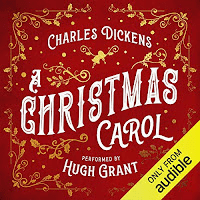
Specifically A Christmas Carol. First, I read the book for the first time this Christmas, and second, I listened to this excellent audiobook by Hugh Grant. Grant is a much-underrated actor, and this audiobook is superbly narrated.
Everyone knows the story inside out. First published as a novella by Chapman & Hall on Dec. 19 1843. Dickens was not the only social commentator at the time of writing a Christmas Carol. Karl Marx, a great admirer of Dickens, walked the same London streets for over 20 years. Marx, Engels and Dickens were horrified by and wrote about the squalor produced by the Industrial Revolution. Engel’s famous work captured the poverty and squalor in England.[1]
There is, of course, a world of difference between Marx, Engels and Dickens. However, you would not glean that from numerous radical organisations that want to claim Dickens as a radical socialist and champion of the working class. As the Stalinist Nick Matthews writes, “It would be nice to think, too, that Marx’s use of the metaphor of the spectre that begins The Communist Manifesto, “A spectre is haunting Europe…” so soon after those in A Christmas Carol, is more than coincidental.”[2]
This may well be correct, but the writer George Orwell understood Dicken’s class position much better. He wrote, “Dickens had grown up near enough to poverty to be terrified of it, and despite his generosity of mind, he is not free from the special prejudices of the shabby-genteel. It is usual to claim him as a ‘popular’ writer, a champion of the ‘oppressed masses’. So he is, so long as he thinks of them as oppressed, but there are two things that condition his attitude. In the first place, he is a south-of-England man and a Cockney at that, and therefore out of touch with the bulk of the real oppressed masses, the industrial and agricultural labourers.
It is interesting to see how Chesterton, another Cockney, always presents Dickens as the spokesman of ‘the poor’ without showing much awareness of who ‘the poor’ really are. To Chesterton, ‘the poor’ means small shopkeepers and servants. Sam Weller, he says, ‘is the great symbol in English literature of the populace peculiar to England’, and Sam Weller is a valet! The other point is that Dickens’s early experiences have given him a horror of proletarian roughness. He shows this unmistakably whenever he writes of the very poorest of the poor, the slum-dwellers. His descriptions of the London slums are always full of undisguised repulsion: “The ways were foul and narrow; the shops and houses wretched; and people half naked, drunken, slipshod and ugly. Alleys and archways, like so many cesspools, disgorged their offences of smell, dirt, and life upon the straggling streets, and the whole quarter reeked with crime, and filth, and misery, etc., etc.”[3]
While Vladimir Lenin hated Dickens, Marx liked him and wrote “ “[t]he present splendid brotherhood of fiction-writers in England whose graphic and eloquent pages have issued to the world more political and social truths than have been uttered by all the professional politicians, publicists and moralists put together”.
To close, as Paul Bond wrote, “ It is In the 154 years since the death of the author, none of the central contradictions of the existing social order have been resolved. The exploitation so vividly portrayed in Dickens’s works continues to be a feature of everyday life over vast swathes of the planet, from Africa to Asia and Latin America. Yet, even in those countries where grinding poverty was ameliorated in some measure through the struggles of the working class and the establishment of the welfare state introduced under the shadow of the Russian Revolution, there is a serious risk of a return to the Dickensian nightmare.”[4]
“If there was hope, it must lie in the Proles because only there, in those swarming disregarded masses, eighty-five per cent of the population of Oceania, could the force to destroy the Party ever be generated.”
George Orwell 1984
“All animals are equal, but some animals are more equal than others.”― George Orwell, Animal Farm.
The ancient philosopher said that strife is the father of all things. No new values can be created where a free conflict of ideas is impossible. To be sure, a revolutionary dictatorship means, by its very essence, strict limitations of freedom. But for that same reason, epochs of revolution have never been directly favourable to cultural creation; they have only cleared the arena for it. The dictatorship of the proletariat opens a wider scope to human genius the more it ceases to be a dictatorship. The socialist culture will flourish only in proportion to the dying away of the state.
Leon Trotsky Revolution Betrayed (1936)
The essence of Marxism consists in that it approaches society concretely, as a subject for objective research, and analyses human history as one would a colossal laboratory record. Marxism appraises ideology as a subordinate integral element of the material social structure. Marxism examines the class structure of society as a historically conditioned form of the development of the productive forces; Marxism deduces from the productive forces of society the inter-relations between human society and surrounding nature, and these, in turn, are determined at each historical stage by man’s technology, his instruments and weapons, his capacities and methods for struggle with nature. Precisely this objective approach arms Marxism with the insuperable power of historical foresight.
Leon Trotsky’s Dialectical Materialism and Science (1925)
D J Taylor’s new book is an extremely good introduction to the work of George Orwell. However, it joins an already overcrowded market, so much so Taylor was encouraged to justify his new book. It must said Taylor’s book is one of the better book releases. It is a well-researched perceptive analysis of the work of Orwell. Unfortunately, that cannot be said of many new releases and articles attempting the “uncover the real Orwell”. Some of these books and articles have been nothing more than hack work aimed at character assignation and burying Orwell ‘s reputation under a large pile of dead dogs.
Before I review Taylor’s book, I would like to say something about a recent article from the Orwell’s Society’s website[1]. The article in question was by Patrick Homes called Can We Truly Rebel? Fisher and Orwell[2]. Homes begin by mislabeling Fisher as a Marxist. Fischer was nothing of the sort. He was a pseudo-left masquerading as a Marxist and a very pessimistic one at that.
Fisher’s 2008 book Capitalist Realism offers no real alternative to Capitalism. It was easier for him to “imagine the end of the world than the end of Capitalism”. Fisher cannot imagine a modern world without Capitalism. Not a very classical Marxist position I might add. While offering mild criticism of Capitalism, Fisher accepts that Capitalism “entails subordinating oneself to a reality that is infinitely plastic, capable of reconfiguring itself at any moment.”[3] It would appear that Fisher has accepted Francis Fukuyama’s Mantra that we have reached the “End of History” and that Liberal Capitalism is now the only game in town.[4]
Fisher writes, “The catastrophe in Children of Men is neither waiting down the road nor has it already happened. Rather, it is being lived through. There is no punctual moment of disaster; the world doesn’t end with a bang. It winks out, unravels, and gradually falls apart. What caused the catastrophe to occur, who knows; its cause lies long in the past, so absolutely detached from the present as to seem like the caprice of a malign being: a negative miracle, a malediction which no penitence can ameliorate. Such a blight can only be eased by an intervention that can no more be anticipated than was the onset of the curse in the first place. Action is pointless; only senseless hope makes sense. Superstition and religion, the first resorts of the helpless, proliferate. But what of the catastrophe itself? It is evident that the theme of sterility must be read metaphorically as the displacement of another kind of anxiety. I want to argue this anxiety cries out to be read in cultural terms, and the question the film poses is: how long can a culture persist without the new? What happens if the young are no longer capable of producing surprises?”[5]
Unfortunately there are no surprises in Fisher’s book. He is both hostile and disdains orthodox Marxism and its history in equal measure, writing, “One of the left’s vices is its endless rehearsal of historical debates, its tendency to keep going over Kronstadt or the New Economic Policy rather than planning and organising for a future that it believes in.”
Unlike Homes, I do not believe Fisher’s intellectual framework offers an insightful understanding of George Orwell’s work, particularly Nineteen Eighty-Four. Regardless of his faults, and there were many, Orwell did not share Fisher’s total pessimism or despair. His “Hope Lies in the Proles “ from 1984 is a clear indication that Orwell saw the working class as a revolutionary class and was the only force that could overthrow Capitalism. Orwell was not a Marxist, but throughout his life, he sought to understand and live by Marx’s theory that “The history of all hitherto existing society is the history of class struggles.”[6] I am pretty sure that Orwell would have concurred with Marx’s understanding of the role of the individual in history. Marx wrote, “Men make their history, but they do not make it as they please; they do not make it under self-selected circumstances, but under circumstances existing already, given and transmitted from the past. The tradition of all dead generations weighs like a nightmare on the brains of the living. And just as they seem to be occupied with revolutionising themselves and things, creating something that did not exist before, precisely in such epochs of revolutionary crisis, they anxiously conjure up the spirits of the past to their service, borrowing from them names, battle slogans, and costumes to present this new scene in world history in time-honoured disguise and borrowed language.”[7]
As was said earlier Taylor’s book is a fine introduction to the literature of Orwell. D. J. Taylor is a leading scholar on Orwell, and this book is the product of decades of work on Orwell. Taylor concentrates mostly on Orwell’s literary output and focuses less on his political involvement. Orwell’s trip to Spain had an enormous impact on him, and if you want to understand the real Orwell, you have to study Orwell’s experience in Spain and his book Homage To Catalonia. This book is far more important than Animal Farm or 1984. As Taylor writes, “Spain, it is safe to say, politicised Orwell in a way that his exposure to homegrown Socialism in the previous five years had not. To begin with, it offered him a vision of how an alternative world, founded on the principles of freedom and equality, might work.”[8] Taylor is not a Marxist and can only offer a perfunctory analysis of Orwell’s experiences in Spain.
A closer approximation of Orwell’s time in Spain can be found in the analysis of the Marxist writer Vicky Shaw, who wrote, “Orwell’s experience was different from most other artists and intellectuals, who went to Spain as supporters of the Stalinist Communist Parties, which many still associated with Lenin’s Bolshevik party and the revolutionary traditions of October 1917 and which possessed a massive apparatus for both propaganda and direct repression of dissent. For George Orwell to produce and publish such material then was, therefore, no small task. The Kremlin bureaucracy was actively seeking the physical annihilation of the entire generation of Marxist workers and intellectuals who had made the Russian Revolution in 1917 possible, while internationally, the Communist Parties were acting as the agents of Stalin in suppressing any opposition to the bureaucracy’s interests wherever such opposition appeared. Orwell’s honest account of the Spanish events also conflicted with the reigning perceptions amongst large layers of revolutionary-minded working people.
Homage to Catalonia is, therefore, a seminal text and remains an excellent introduction to the Spanish events and the strangling of the revolution by Stalinism. However, Orwell could not elaborate on a revolutionary alternative to Stalinism. Eventually, the domination of the workers’ movement by the bureaucracy, combined with the victories this gave Fascism, led him to extreme forms of political demoralisation, as is seen in his book 1984. He supported the democratic imperialist powers in the Second World War”.[9]
Taylor does not make much of Orwell’s faith in the working class. In 1984, he believed the “proles were the only hope for the future. If there was hope, it MUST lie in the proles, because only there, in those swarming disregarded masses, eighty-five per cent of the population of Oceania, could the force to destroy the Party ever be generated.” If only they could somehow become conscious of their strength needed only to rise and shake themselves like a horse shaking off flies. If they chose, they could blow the Party to pieces tomorrow morning. The proles had stayed human. They had not become hardened. They had a “vitality which the Party did not share and could not kill…the future belonged to the proles”.
That said, Orwell never clarified his position towards the 1917 October Revolution. As Fred Mazellis correctly states, “Orwell was always ambivalent about the genuine legacy of the October Revolution which Trotsky represented. His identification with the working class was based more on emotion and sentiment than scientific conviction. He associated with centrists like the Independent Labour Party in Britain and the POUM in Spain. The ILP called for “left unity,” adapting to the Stalinists and criticising Trotsky’s merciless critique of Stalinism as “sectarian.” In Spain, the POUM played a similar role, supporting the Popular Front government, which turned around and suppressed it. At the same time, the Stalinists assassinated the POUM leaders because they could not tolerate any independent left-wing working-class movement.”[10]
To conclude, the discussion about Stalinism and the betrayal of revolutions has little interest for Taylor, which is certainly reflected in this book. His main concern is literature and culture. As John Newsinger correctly points out, “Taylor’s achievement is to construct an Orwell who is acceptable to the literary establishment, someone non-threatening, irredeemably one of them. As far as he is concerned, two major influences on Nineteen Eighty-Four were Orwell’s rat phobia and the totalitarian horrors he had experienced at his prep school, St Cyprian’s!”.
“If there was hope, it must lie in the Proles because only there, in those swarming disregarded masses, eighty-five per cent of the population of Oceania, could the force to destroy the Party ever be generated.”
George Orwell 1984
“All animals are equal, but some animals are more equal than others.”― George Orwell, Animal Farm.
The ancient philosopher said that strife is the father of all things. No new values can be created where a free conflict of ideas is impossible. To be sure, a revolutionary dictatorship means, by its very essence, strict limitations of freedom. But for that same reason, epochs of revolution have never been directly favourable to cultural creation; they have only cleared the arena for it. The dictatorship of the proletariat opens a wider scope to human genius the more it ceases to be a dictatorship. The socialist culture will flourish only in proportion to the dying away of the state.
Leon Trotsky Revolution Betrayed (1936)
The essence of Marxism consists in that it approaches society concretely, as a subject for objective research, and analyses human history as one would a colossal laboratory record. Marxism appraises ideology as a subordinate integral element of the material social structure. Marxism examines the class structure of society as a historically conditioned form of the development of the productive forces; Marxism deduces from the productive forces of society the inter-relations between human society and surrounding nature, and these, in turn, are determined at each historical stage by man’s technology, his instruments and weapons, his capacities and methods for struggle with nature. Precisely this objective approach arms Marxism with the insuperable power of historical foresight.
Leon Trotsky’s Dialectical Materialism and Science (1925)
D J Taylor’s new book is an extremely good introduction to the work of George Orwell. However, it joins an already overcrowded market, so much so Taylor was encouraged to justify his new book. It must said Taylor’s book is one of the better book releases. It is a well-researched perceptive analysis of the work of Orwell. Unfortunately, that cannot be said of many new releases and articles attempting the “uncover the real Orwell”. Some of these books and articles have been nothing more than hack work aimed at character assignation and burying Orwell ‘s reputation under a large pile of dead dogs.
Before I review Taylor’s book, I would like to say something about a recent article from the Orwell’s Society’s website[1]. The article in question was by Patrick Homes called Can We Truly Rebel? Fisher and Orwell[2]. Homes begin by mislabeling Fisher as a Marxist. Fischer was nothing of the sort. He was a pseudo-left masquerading as a Marxist and a very pessimistic one at that.
Fisher’s 2008 book Capitalist Realism offers no real alternative to Capitalism. It was easier for him to “imagine the end of the world than the end of Capitalism”. Fisher cannot imagine a modern world without Capitalism. Not a very classical Marxist position I might add. While offering mild criticism of Capitalism, Fisher accepts that Capitalism “entails subordinating oneself to a reality that is infinitely plastic, capable of reconfiguring itself at any moment.”[3] It would appear that Fisher has accepted Francis Fukuyama’s Mantra that we have reached the “End of History” and that Liberal Capitalism is now the only game in town.[4]
Fisher writes, “The catastrophe in Children of Men is neither waiting down the road nor has it already happened. Rather, it is being lived through. There is no punctual moment of disaster; the world doesn’t end with a bang. It winks out, unravels, and gradually falls apart. What caused the catastrophe to occur, who knows; its cause lies long in the past, so absolutely detached from the present as to seem like the caprice of a malign being: a negative miracle, a malediction which no penitence can ameliorate. Such a blight can only be eased by an intervention that can no more be anticipated than was the onset of the curse in the first place. Action is pointless; only senseless hope makes sense. Superstition and religion, the first resorts of the helpless, proliferate. But what of the catastrophe itself? It is evident that the theme of sterility must be read metaphorically as the displacement of another kind of anxiety. I want to argue this anxiety cries out to be read in cultural terms, and the question the film poses is: how long can a culture persist without the new? What happens if the young are no longer capable of producing surprises?”[5]
Unfortunately there are no surprises in Fisher’s book. He is both hostile and disdains orthodox Marxism and its history in equal measure, writing, “One of the left’s vices is its endless rehearsal of historical debates, its tendency to keep going over Kronstadt or the New Economic Policy rather than planning and organising for a future that it believes in.”
Unlike Homes, I do not believe Fisher’s intellectual framework offers an insightful understanding of George Orwell’s work, particularly Nineteen Eighty-Four. Regardless of his faults, and there were many, Orwell did not share Fisher’s total pessimism or despair. His “Hope Lies in the Proles “ from 1984 is a clear indication that Orwell saw the working class as a revolutionary class and was the only force that could overthrow Capitalism. Orwell was not a Marxist, but throughout his life, he sought to understand and live by Marx’s theory that “The history of all hitherto existing society is the history of class struggles.”[6] I am pretty sure that Orwell would have concurred with Marx’s understanding of the role of the individual in history. Marx wrote, “Men make their history, but they do not make it as they please; they do not make it under self-selected circumstances, but under circumstances existing already, given and transmitted from the past. The tradition of all dead generations weighs like a nightmare on the brains of the living. And just as they seem to be occupied with revolutionising themselves and things, creating something that did not exist before, precisely in such epochs of revolutionary crisis, they anxiously conjure up the spirits of the past to their service, borrowing from them names, battle slogans, and costumes to present this new scene in world history in time-honoured disguise and borrowed language.”[7]
As was said earlier Taylor’s book is a fine introduction to the literature of Orwell. D. J. Taylor is a leading scholar on Orwell, and this book is the product of decades of work on Orwell. Taylor concentrates mostly on Orwell’s literary output and focuses less on his political involvement. Orwell’s trip to Spain had an enormous impact on him, and if you want to understand the real Orwell, you have to study Orwell’s experience in Spain and his book Homage To Catalonia. This book is far more important than Animal Farm or 1984. As Taylor writes, “Spain, it is safe to say, politicised Orwell in a way that his exposure to homegrown Socialism in the previous five years had not. To begin with, it offered him a vision of how an alternative world, founded on the principles of freedom and equality, might work.”[8] Taylor is not a Marxist and can only offer a perfunctory analysis of Orwell’s experiences in Spain.
A closer approximation of Orwell’s time in Spain can be found in the analysis of the Marxist writer Vicky Shaw, who wrote, “Orwell’s experience was different from most other artists and intellectuals, who went to Spain as supporters of the Stalinist Communist Parties, which many still associated with Lenin’s Bolshevik party and the revolutionary traditions of October 1917 and which possessed a massive apparatus for both propaganda and direct repression of dissent. For George Orwell to produce and publish such material then was, therefore, no small task. The Kremlin bureaucracy was actively seeking the physical annihilation of the entire generation of Marxist workers and intellectuals who had made the Russian Revolution in 1917 possible, while internationally, the Communist Parties were acting as the agents of Stalin in suppressing any opposition to the bureaucracy’s interests wherever such opposition appeared. Orwell’s honest account of the Spanish events also conflicted with the reigning perceptions amongst large layers of revolutionary-minded working people.
Homage to Catalonia is, therefore, a seminal text and remains an excellent introduction to the Spanish events and the strangling of the revolution by Stalinism. However, Orwell could not elaborate on a revolutionary alternative to Stalinism. Eventually, the domination of the workers’ movement by the bureaucracy, combined with the victories this gave Fascism, led him to extreme forms of political demoralisation, as is seen in his book 1984. He supported the democratic imperialist powers in the Second World War”.[9]
Taylor does not make much of Orwell’s faith in the working class. In 1984, he believed the “proles were the only hope for the future. If there was hope, it MUST lie in the proles, because only there, in those swarming disregarded masses, eighty-five per cent of the population of Oceania, could the force to destroy the Party ever be generated.” If only they could somehow become conscious of their strength needed only to rise and shake themselves like a horse shaking off flies. If they chose, they could blow the Party to pieces tomorrow morning. The proles had stayed human. They had not become hardened. They had a “vitality which the Party did not share and could not kill…the future belonged to the proles”.
That said, Orwell never clarified his position towards the 1917 October Revolution. As Fred Mazellis correctly states, “Orwell was always ambivalent about the genuine legacy of the October Revolution which Trotsky represented. His identification with the working class was based more on emotion and sentiment than scientific conviction. He associated with centrists like the Independent Labour Party in Britain and the POUM in Spain. The ILP called for “left unity,” adapting to the Stalinists and criticising Trotsky’s merciless critique of Stalinism as “sectarian.” In Spain, the POUM played a similar role, supporting the Popular Front government, which turned around and suppressed it. At the same time, the Stalinists assassinated the POUM leaders because they could not tolerate any independent left-wing working-class movement.”[10]
To conclude, the discussion about Stalinism and the betrayal of revolutions has little interest for Taylor, which is certainly reflected in this book. His main concern is literature and culture. As John Newsinger correctly points out, “Taylor’s achievement is to construct an Orwell who is acceptable to the literary establishment, someone non-threatening, irredeemably one of them. As far as he is concerned, two major influences on Nineteen Eighty-Four were Orwell’s rat phobia and the totalitarian horrors he had experienced at his prep school, St Cyprian’s!”.
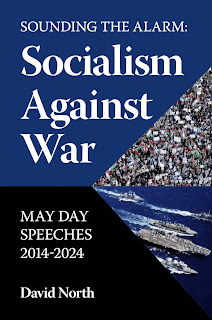
The publication by Mehring Books of Sounding the Alarm: Socialism Against War by WSWS International Editorial Board Chairman David North is extremely prescient. The election of a fascist as president will be a trigger point for a massive escalation of the attacks on the working class.
As Joseph Kishore points out, “Trump’s reelection signifies the violent realignment of American politics with its underlying social reality: a society dominated by staggering inequality and ruled by a capitalist oligarchy. This realignment is expressed not only in Trump’s appointments but in the Democratic Party’s swift accommodation to—and even embrace of—the incoming regime. Trump is assembling a government that epitomizes the naked rule of the rich. Each appointment reflects two overriding criteria: personal loyalty to Trump and an unwavering commitment to a program of war, repression and social counterrevolution.”
This new book contains the speeches delivered at the International Committee of the Fourth International’s Online May Day celebrations from 2014 to 2024. In the foreword, King’s College historian Thomas Mackaman writes, “This volume consists principally of the speeches with which David North has opened the May Day rallies of the past ten years. Also included are essays related to the May Day events written by North. This compilation merits careful study for those who wish to understand the causes of imperialist war and how to fight it. The central theme of North’s speeches is that the struggle against militarism and war must be revolutionary, i.e., only through the overthrow of capitalism by the working class in a world socialist revolution can the drive toward catastrophe be stopped. There is no other way.”[1]
North’s use of the Marxist method is an antidote the the rubbish that has come from writers and historians over the last twenty years. The sharpest expression of this reaction came from the pen of Francis Fukuyama, whose essay entitled “The End of History?” was published in the journal The National Interest. He wrote: “What we may be witnessing is not just the end of the Cold War, or the passing of a particular period of post-war history, but the end of history as such: that is, the end point of mankind’s ideological evolution and the universalization of Western liberal democracy as the final form of human government.[2]
North replies, “ Fukuyama’s analysis combined bourgeois political triumphalism with extreme philosophical pessimism. It might have been appropriate for the publisher to insert in every copy of Fukuyama’s book a prescription for Prozac. If the existing capitalist reality was, for all intents and purposes, as good as it could get, mankind’s future was very bleak. But how realistic was Fukuyama’s hypothesis? Though he claimed to draw inspiration from Hegel, Fukuyama’s grasp of dialectics was extremely limited. The claim that history had ended could make sense only if it could be demonstrated that capitalism had somehow solved and overcome the internal and systemic contradictions that generated conflict and crisis.”[3]
The speeches in this volume are not just a testament to the power of the Marxist method but give us a perspective and a guide to fight. The book deserves the widest readership.
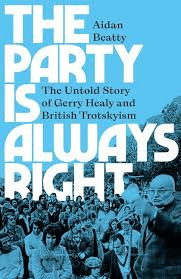
Despite being subtitled “The Untold Story of Gerry Healy”, this book contains nothing new and is a rehash of all the old lies and slanders that have been heaped on Healy and the Trotskyist movement for decades. The historian Thomas Carlyle was fond of saying that he had to clear a large pile of dead dogs off the body of Oliver Cromwell to reach the real person underneath. The same could be said of Beatty’s book. However, once all the dead dogs have been removed from this book, all you are left with is a worthless pile of crap.
While Beatty’s book is probably his own work, Pluto Press must be held accountable for publishing this hack work. As David North writes, Beatty’s book is a political hit job, not a scholarly biography. There are many questions about the writing of this piece of hack work. There is good reason to believe that Mr. Beatty is not the sole author of this work and that he had substantial assistance in collecting this mass of odoriferous material. As it is published by Pluto Press, which is affiliated with a political tendency hostile to the International Committee, one can reasonably assume that it provided Beatty with substantial support in the “researching” and writing this volume.”
I did ask Pluto Press for a review copy and was granted one by James K, to whom I gave my address. The book never arrived. The non-arrival coincided with the publication of David North’s review on the World Socialist website.
Pluto Press, who are largely made up of renegades from Marxism, has its own axe to grind against orthodox Trotskyism. It gave free rein to the political scoundrel Paul Le Blanc to write on the back cover saying, “’Displaying scant sympathy for Gerry Healy, the substantial groups that Healy led, and the Leninist-Trotskyist traditions that Healy claimed to represent, Aidan Beatty nonetheless produces a very readable, meticulously documented take-down that will be seen as a “must-read” source on left-wing politics from the 1930s to the dawn of the twenty-first century.’
This book is so bad it is difficult to know where to start. Writing a biography is an extraordinarily complex and time-consuming event. Writing a political biography is an art form. At 148 pages long, Beatty’s piece of art barely rises above second-grade level. There are many examples of excellent biographical writing. Currently, I am reading Bernard Crick’s biography of George Orwell[1]. It took Crick ten years to write. Whether Crick agrees with Orwell’s politics or not, it is a superb read and deserves every plaudit it has got. Honestly, Beatty is not fit to tie Crick‘s shoelaces.
The Marxist writer David North writes, “ Historians who undertake the arduous task of writing a serious biography—among the most difficult of genres—often introduce their work with an effort to explain to their readers why they embarked on a project that usually requires years of intensive research. When the subject of study is a political figure, the interactions of the individual and the epoch in which they lived are immensely complex. There is a profound truth in the adage that a man resembles the age in which he lives more than he resembles his father. A vast amount of work is required, not to mention a command of the historical landscape and intellectual subtlety, to understand the historically conditioned personality, psychology, motivations, aims, ideals, decisions, and actions of another human being.
Whether the writers admire or despise their subject, they are still obligated to understand in historical terms the person about whom they are writing. When the author genuinely admires his subject, they must still retain a critical distance that avoids a descent into hagiography. The great biographies of political figures—Samuel Baron’s study of Plekhanov, J.P. Nettl’s two volumes on Rosa Luxemburg, and Isaac Deutscher’s Trotsky trilogy—managed to maintain an objective attitude toward subjects for whom they clearly felt great empathy. Perhaps even more challenging was the task confronting Ian Kershaw, who devoted years of work to the study and explanation of the ideological, political, and psychological motivations of one of the worst mass murderers in history, Adolf Hitler.”[2]
The Psuedo Left community has welcomed Beatty’s book. Jacobin’s David Broder, from the main pseudo-left journal of the pro-genocide Democratic Party, interviewed DSA member Aidan J. Beatty. Beatty was allowed free rein to spew out his slanderous allegations against Gerry Healy and the British Trotskyists that they employed violence against political opponents and party members.
Beatty writes, “There is quite a notorious incident in 1966 when Ernie Tate, a Northern Iridefenceer of the International Marxist Group, was very violently attacked by a group of Healy’s supporters outside a party meeting in London; Healy was present for this and essentially supervised the assault. The attack was bad enough that not only was Tate hospitalized, but Healy was later forced to appear at a meeting with Isaac Deutscher and apologize. This assault was unplanned, but as I say in the book, “Healy propagated an aura of total ruthlessness but could benefit from that aura, since potential followers believed he was ruthless, in a kind of feedback loop. One former member told me that he never questioned that the party had to be structured in a very top-down, authoritarian manner because that would be needed to carry out a revolution in Britain. In general, I think many people who stuck with Healy accepted the verbal and physical abuse because they believed it was necessary to maintain discipline or because the revolution was more important than their own personal well-being.”[3]
Beatty supplies no new evidence and repeats every slanderous accusation against Healy and the SLL. David North replies to this piece of garbage history, “Libelous” is the appropriate word. Healy and the Socialist Labour League went to court to demand that two publications that had printed the allegations—Socialist Leader and Peace News—retract the story and issue a public apology to Gerry Healy. “A conscientious historian, adhering to the appropriate standards of scholarship, would have carefully researched all available sources to uncover what actually occurred in 1966. But Beatty is not a principled scholar. His book is anti-Trotskyist hack work”.[4]
Beatty’s biography relies heavily on oral history. However, his interviews are all with former members of the SLL/WRP who have personal axes to grind or are renegades from Trotskyism, such as Tariq Ali, who is an outright political scoundrel with a history of betrayal as long as my arm. Beatty’s interviews were not conducted critically, and the majority, if not all, testimonies in the book are unreliable. North says, “ The relation of the interviewee to the subject must be carefully appraised. The historian must be able to distinguish between flattery and slander, between facts and gossip, and between truth and lies. The historian must determine whether the claims of one or another interviewee are reliable, whether they are supported by evidence of a more objective character, i.e., documents”.
Suffice it to say Beatty did not ask me for an interview, which I would have refused and told him where to go. On a personal note, I joined the WRP in 1982/83. I think my probation period was nine months, a record inside the Trotskyist movement. The first few years were difficult for me, and I left just before the split occurred. I had no idea how politically sick the WRP was at the time. Perhaps the highlight was being taken to Vanessa Redgrave’s house just before the split. She was supposedly downsizing and wanted to get rid of her Library. I paid her a lot and got many books, including the proof copy of One Long Night: A Tale of Truth by Maria Joffe, translated by V. Dixon. If Mr North is reading this article, I would like to donate it to your Library where it belongs.
After the split, I joined the Minority and had the best time of my life, politically speaking. As Lenin was fond of saying, “There are decades where nothing happens, and there are weeks where decades happen.” That is exactly what happened during the split.
I only met Healy twice. He was cordial and polite. The first time was at an international Workers’ school in Derbyshire before the split. There was a lot of confusion there, and I left early. It was probably the worst decision of my political career as I missed the opportunity to meet and talk to the international comrades from the ICFI. I heard Healy speak three times twice before the split and once after it. Despite the political degeneration that was taking place, Healy was still a fantastic speaker. To see him in his prime would have been a sight to behold. The third time I heard him was after the split. He was a broken man, both physically and politically. He was the leader of the Marxist Party, and they held a public meeting in London. The ICFI wanted to tape the meeting and had planned an intervention. During Healy’s speech, I cannot remember what he said a member of the French section of the ICFI got up and accused Healy of capitulating to Pabloite opportunism. Suffice it to say you could have heard a pin drop. Unfortunately, my tape machine hidden inside my jacket ended, and a very audible click was heard. I was immediately manhandled out of the meeting by a phalanx of goons, and my machine was stripped of its tape. Before Professor Beatty rips this story out of context and uses it to justify his lie that Healy was a violent maniac, I would like to say that at no time in my albeit brief time in the WRP did I feel threatened or witness any violence towards me or others.
This brings me to Beatty’s motive for writing such a book. It must be said Beatty’s book is not the only diatribe written against the Trotskyist movement. Beatty’s soulmate in anti-Trotskyism is John Kelly, who is still an avowed Stalinist and has written two books recently.[5]
Beatty’s book is different in the respect that it is factionally motivated. North explains, “ What then is the connection between Beatty’s so-called Healy biography and his denunciation of the SEP and WSWS in the Epilogue? It is a dishonest attempt to link Healy’s abusive behaviour in the 1970s and 1980s to the Marxist class-based politics of the Socialist Equality Party.
Beatty writes: “The SEP has its roots in the Workers League that had once been led by Tim Wohlforth and closely influenced by Gerry Healy. Developing the ideas it learned from the WRP, the SEP’s privileging of class over all else has ended up not just downplaying race and gender, but outright sexism and racism.” [6]
North says, “By this point, the political motivations underlying Beatty’s book become all too clear. He is writing not as a historian but as a political flack for the Democratic Party. He denounces the SEP for its “ultra-leftist perspectives on current events and bad faith attacks on the recent crop of democratic socialist politicians, Alexandria Ocasio-Cortez especially, but also Bernie Sanders and Jeremy Corbyn.” What he calls “bad faith” is the well-known Marxist critique of the middle-class political agents of imperialism.
The last words of this article should be from David North. “Whatever the truth may be, one thing is certain: with the writing of this miserable book, Mr. Beatty has dealt a blow to his professional reputation from which it will never recover. Despite the tragic character of his final years, Gerry Healy will be remembered as a significant figure in the history of the British working class and the international struggle for socialism. All that he contributed to the defence of the revolutionary perspective against the betrayals and crimes of the Stalinists and social democrats over many decades will not be forgotten. But unhappily for Beatty, the fate of books and their authors are inextricably linked. The evil men write lives after them. This is the book for which Beatty will be remembered.”.
[1] George Orwell: A Life Paperback – 30 July 1992
[2] Biography as demonology: Aidan Beatty’s The Party is Always Right: The Untold Story of Gerry Healy and British Trotskyism-www.wsws.org/en/articles/2024/09/18/nizy-s18.html
[3] The Damage Gerry Healy Wrought-Jacobin.com/2024/09/gerry-healy-trotskyism-wrp
All animals are equal, but some animals are more equal than others.
George Orwell
“If there was hope, it must lie in the Proles because only there, in those swarming disregarded masses, eighty-five per cent of the population of Oceania, could the force to destroy the Party ever be generated.”
George Orwell 1984
Who controls the past controls the future: who controls the present controls the past.”
George Orwell 1984
“If you want a picture of the future, imagine a boot stamping on a human face—forever.”
George Orwell
The ancient philosopher said that strife is the father of all things. No new values can be created where a free conflict of ideas is impossible. To be sure, a revolutionary dictatorship means, by its very essence, strict limitations of freedom. But for that very reason, epochs of revolution have never been directly favourable to cultural creation; they have only cleared the arena for it. The dictatorship of the proletariat opens a wider scope to human genius the more it ceases to be a dictatorship. The socialist culture will flourish only in proportion to the dying away of the state.
Leon Trotsky Revolution Betrayed (1936)
The essence of Marxism consists in this that it approaches society concretely, as a subject for objective research, and analyses human history as one would a colossal laboratory record. Marxism appraises ideology as a subordinate integral element of the material social structure. Marxism examines the class structure of society as a historically conditioned form of the development of the productive forces; Marxism deduces from the productive forces of society the inter-relations between human society and surrounding nature, and these, in turn, are determined at each historical stage by man’s technology, his instruments and weapons, his capacities and methods for struggle with nature. Precisely this objective approach arms Marxism with the insuperable power of historical foresight.
Leon Trotsky’s Dialectical Materialism and Science (1925)
The Socialist Patriot, published in 2023, joins an extremely busy book market on the English writer George Orwell, one of the most important and influential writers of the 20th century. There is no special reason for reviewing Stansky’s book other than to place it in the context of recent Orwell studies.
The majority of recent publications, it must said, have not been very good. Some have been written by paid-up members of the #MeToo movement that have been nothing short of character assassination. The attack on Orwell by Anna Funder in her book Wifedom is particularly nasty.[1] Given the caustic nature of the attack, it is not surprising that Orwell’s son, Richard Blair, took to his father’s defence in the Spring edition of the Orwell Society’s journal. In the same journal, John Rodden argues that Orwell was neither a “plagiarist” nor a “predator”. Other writers have written in defence of Orwell.
In an essay for The Article, Jeffrey Meyers defends Orwell. He relates how “In Barcelona in May 1937, the Stalinists attacked POUM, their supposed anti-fascist allies, and began a civil war within the Civil War that led to their defeat. Orwell was in the losing faction of the losing side. While he was fighting at the front, the Stalinist police searched Eileen’s hotel room. She was not arrested and hid their passports and chequebooks under the mattress while she remained in bed. Funder says Orwell “abandoned” Eileen by returning to the front, but he went to Spain to fight the fascists, not to take care of her. It is true that when he was shot through the throat, she devotedly nursed him. In July, the Stalinist secret tribunal condemned Orwell and Eileen to death for espionage and high treason, and they barely managed to escape with their lives into France.
Anna Funder, extremely imperceptive, says she’d read Orwell’s Homage to Catalonia (1938) twice without realising that Eileen had been in Spain with him. Though there are in fact 37 references to Eileen in his book, Funder, determined to put a malign interpretation on everything Orwell does, states that she’s scarcely mentioned and never named and that he wrote her out of the story. She doesn’t realise that Homage is about Spain, not Eileen and that his sense of privacy and decorum prevented him from naming her. (Orwell would have been sickened by the current dedications “To my beautiful and brilliant wife” that are deleted in the post-divorce edition.) More important, after being convicted of treason and condemned to death, he feared he could be murdered by Soviet agents whom he knew were operating in England, and wanted to protect Eileen from dangerous reprisals by hiding her connection to POUM Funder repeatedly calls his very real fear “paranoia”. But millions of people were murdered in Stalin’s Purges of 1936-38, and Leon Trotsky was assassinated in Mexico in 1940. The Communists continued to murder their enemies for the next 80 years. Recently, Sergei Skripal was poisoned in England, and Yevgeny Prigozhin was blown up for opposing the present Russian dictator.[2]
While containing biographical elements, The Socialist Patriot is more polemic than biography. Stansky is broadly politically sympathetic towards Orwell. While reading Stansky’s book, one is struck by how contemporary much of what Orwell wrote about. Room 101, Ignorance is Strength, Big Brother, and doublethink – to name but a few are Orwellian phrases instantly recognisable even today’s phrase-laden society. Despite being born over one hundred years ago, Orwell’s writing is still part of our everyday culture.
Orwell was a brilliant writer who took the study of culture very seriously and was one of many writers in the 20th century to chart its influence. Orwell had an extraordinary range. He wrote about the 19th-century British novelists Charles Dickens and Rudyard Kipling, the Irish poet W.B. Yeats, the American writer Henry Miller, and Donald McGill’s postcards, to name but a few. While Orwell’s Novels and cultural writings are important, I believe Orwell’s greatest book is neither Animal Farm nor 1984 but his Homage To Catalonia.
In a letter he wrote to Cyril Connolly from the hospital in Barcelona where he was being treated for a bullet wound to his throat and arm by the fascists, he wrote: “Thanks also for recently telling the public that I should probably write a book on Spain, as I shall, of course, once this bloody arm is right. I have seen wonderful things and I believe in Socialism, which I never did before. On the whole, though I am sorry not to have seen Madrid, I am glad to have been on a comparatively little-known front among Anarchists and POUM [Workers Party of Marxist Unification] people instead of in the International Brigade, as I should have been if I had come here with CP [Communist Party] credentials instead of ILP [Independent Labour Party] ones. “[3]
In Another letter to his publisher, Victor Gollancz On 1 May 1937, he wrote “ I shall be going back to the front probably in a few days & barring accidents I expect to be there till about August. After that, I think I shall come home, as it will be about time I started on another book. I greatly hope I come out of this alive, if only to write a book about it. It is not easy here to get hold of any facts outside the circle of one’s own experience, but with that limitation, I have seen a great deal that is of immense interest to me. Owing partly to an accident, I joined the POUM militia instead of the International Brigade, one which was a pity in one way because it meant that I had never seen the Madrid front; on the other hand, it has brought me into contact with Spaniards rather than Englishmen & especially with genuine revolutionaries. I hope I shall get a chance to write the truth about what I have seen. The stuff appearing in the English papers is largely the most appalling lies – more, I can’t say, owing to the censorship. If I can get back in August I hope to have a book ready for you about the beginning of next year.[4]
After Orwell returned from Spain, he elaborated his commitment to Socialism by writing the essay/pamphlet The Lion and the Unicorn, Socialism and the English Genius. Orwell’s essay was not just a knee-jerk reaction to the war. Gregory Claeys writes, “Before he wrote The Lion and the Unicorn, Orwell had briefly suggested three of its central themes: first, patriotism was not inherently conservative or reactionary, but might be expressed as a legitimate sentiment among those on the left; second, patriotism alone would not prevent England’s defeat, but instead the social revolution must progress (and here his Spanish ideals were carried forward). Third, Orwell argued that it was those who were most patriotic who were least likely to “flinch from revolution when the moment comes.” John Cornford, a Communist killed while serving in the International Brigades, had been “public school to the core.” This proved, Orwell thought, that one kind of loyalty could transmute itself into another and that it was necessary for the coming struggle to recognise “the spiritual need for patriotism and the military virtues.”[5]
Orwell is crystal clear that the only way to beat the fascists was for the working class to make the war a revolutionary one. He writes, “It is only by revolution that the native genius of the English people can be set free. Revolution does not mean red flags and street fighting; it means a fundamental power shift. Whether it happens with or without bloodshed is largely an accident of time and place. Nor does it mean the dictatorship of a single class. The people in England who grasp what changes are needed and are capable of carrying them through are not confined to any one class, though it is true that very few people with over £2,000 a year are among them. Ordinary people want a conscious, open revolt against inefficiency, class privilege and the rule of the old. It is not primarily a question of change of government. British governments do, broadly speaking, represent the will of the people, and if we alter our structure from below, we shall get the government we need. Ambassadors, generals, officials and colonial administrators who are senile or pro-Fascist are more dangerous than Cabinet ministers whose follies have to be committed in public. Right through our national life, we have got to fight against privilege, against the notion that a half-witted public schoolboy is better for command than an intelligent mechanic. Although there are gifted and honest individuals among them, we have to break the grip of the monied class. England has got to assume its real shape. The England that is only beneath the surface, in the factories and the newspaper offices, in the aeroplanes and the submarines, has got to take charge of its destiny.”
Stansky spends a fair amount of time and space writing about Orwell’s The Lion and the Unicorn essay. It is then all the more bizarre that he could conclude on page 73 of his book that Orwell disdained theory and had an empirical outlook. He further elaborates that Orwell was part of an unbroken radical tradition. This is a line that is perpetrated by the Pseudo Lefts, who see the working class as inherently radical and in no need of a revolutionary perspective. It must be said that the paragraph looks out of place from the rest of the book. It seems like another writer might have inserted it.
Orwell spent the last few years before his death coming to terms with the defeat of the Russian Revolution and the rise of Stalinism. Orwell’s Animal Farm was his second attempt at reckoning with Stalinism, his first being the book Homage to Catalonia. At 120 pages, the book Animal Farm can be read on many levels. As John Newsinger points out, “The politics of the book were pretty straightforward: a capitalist farmer had been quite properly overthrown by the worker animals, and an egalitarian socialist system had been introduced on the farm. The pigs had then betrayed the revolution with the revolutionary Snowball (Trotsky) driven out and the dictator Napoleon (Stalin) establishing a murderous police state”.
Right-wing ideologues have attempted to portray the book as anti-revolutionary. Orwell refuted this slander saying, “I meant the moral to be that revolutions only effect a radical improvement when the masses are alert and know how to chuck out their leaders as soon as the latter have done their job. The turning point of the story was supposed to be when the pigs kept the milk and apples for themselves (Kronstadt). If the other animals had had the sense to put their foot down, then it would have been all right…I was trying to say, “You can’t have a revolution unless you make it for yourself; there is no such thing as a benevolent dictatorship.”
Despite having serious political differences with Leon Trotsky, there is no doubt that Orwell respected and was heavily influenced by the writings of Trotsky. As Jeffrey Meyers writes in his not-too-friendly essay on Trotsky and Orwell, “In May 1946 Orwell tried to persuade his publisher Fredric Warburg to publish the English edition of Trotsky’s Life of Stalin (1941): “I have read a good deal of it, mostly the bits dealing with Stalin’s childhood, with the civil war and with the alleged murder of Lenin” by Stalin. The earlier parts were “particularly interesting because they demonstrate the difficulty of establishing any fact about a public figure who has been a subject for propaganda. It might be worth trying to get a little more information about the circumstances of Trotsky’s assassination, which may have been partly decided on because of the knowledge that he was writing this very book.”
Remarkably, the political discussion over Orwell’s opposition to Stalinism continues unabated today. At a recent election meeting held by the Uk Socialist Equality Party,[6] a member of the audience used Orwell’s book Animal Farm to conclude that revolutions have always been defeated. In his reply, Chris Marsden said that despite Orwell being a brilliant writer and an opponent of Stalinism, he nonetheless drew pessimistic conclusions from the victory of Stalinism in the former USSR. One example of this confusion was his turning over some 35 of these names, a year before he died in 1950, to a secret government unit called the Information Research Department. This arm of the British Foreign Office had been set up to organise anti-Soviet and anticommunist propaganda.
Marsden made the point that The co-leader of the Russian Revolution and his Left Opposiiton opposed Stalinism from the standpoint of Marxism and had faith in the working class overthrowing it. They worked under extraordinary political and physical pressure to provide a Marxist opposition to Stalinism, something Orwell could never have done.
As the Marxist writer Fred Mazelis wrote, “The Trotskyists showed that there was a socialist alternative to Stalinism and that the bourgeois-democratic regimes headed by Churchill and Roosevelt, the same regimes which praised the Soviet government at the time of the Moscow Trials and were its allies during WWII, and whose predecessors had intervened to destroy the Russian Revolution, were no defenders of democracy at all. Those who today praise Orwell as a solitary opponent of Stalinist are the same ones who deliberately censor any mention of Trotsky, the Left Opposition and the Fourth International.”
“But won’t this just be another Animal Farm?” The reports delivered to the Socialist Equality Party general election rally in Holborn and St Pancras provoked an important discussion, centred on why there were not more socialists and wouldn’t there be a degeneration of any socialist government. This raised an important discussion on Stalinism, which was warmly received. #GazaGenocide#GeneralElection#socialism#AnimalFarm
I am working on a review of George Orwell and Russia by Masha Karp. There are several new books on Orwell out now, so I will be kept busy doing reviews. I have paid primary visits to the archives of George Orwell held at UCL, and Bernard Crick’s archive is at Birkbeck.
Three long-term projects are the books. I will update the collection of the Why I Write series that is already in eBook form on Amazon. I want to add some more writers to a new version. The second will be a collection of essays on the historian Raphael Samuel. The third will be a short book or long essay on Oliver Cromwell and the Putney Debates. Cromwell was the subject of my car crash 2003 dissertation for my BA History at Birkbeck.
I will write a short letter to the London Review of Books. It published a terrible letter from B. Letzler called The Shoah after Gaza. He managed to call Bob Dylan’s With God on Our Side “Dud”
Recent Book Purchases
The Carnation Revolution by Alex Fernandes. I have written previously on this subject.
Until I Find You by Rachel Nolan. An extraordinary book well researched on the disappeared children and coercive adoptions in Guatemala.
Cancion by Eduardo Halfon
The Great Revolutions by Duncan Hallas. I fine SWP tradition seems to concentrate on What happened rather than why.
The Blazing World by J Healey. This is the paperback version. I have been meaning to get around to reviewing this for ages.
Travellers of the World Revolution by B Studer, Verso
Marxism and the English Revolution by John Rees. This has not been released yet. I will get a review copy, hopefully.
Recent Events
I regularly attend the online SEP Postal Workers Committee. I follow their work closely and their stuff on the Post is way better than I can write. They write about it. I work it. A good combination.
I have started to watch a few episodes of Sky’s Royal Kill List. What a terrible piece of television. If there was a historian consulted on this programme, he should share the same fate as Charles 1st. When a series has so much swearing, it has very little to say and even less history.
Q.How did you get involved in the project of José Feeds the World?
A. I’ve been friends with Mauricio Velázquez, the publisher of Duopress, for over 20 years. Mauricio is a Mexican national who has been living in the U.S. for maybe 25 years and worked previously as an editor for Rosen Publishers. In the fall of 2022, knowing of my previous children’s books, he asked me if I would be interested in writing a non-fiction book about Chef José Andrés. Since I was familiar with the chef and the amazing work of his World Central Kitchen, I jumped at the chance. Mauricio offered valuable editorial comments, but basically he allowed me to craft my own book. It has been an amazing experience.
Q. How different is writing a children’s book than one with more adult themes.
A I published La Casita, my first children’s book in 2012, and I have published four other kid’s books since then. What you might not know, Keith, is that I have translated 8 children’s books, including three by Guatemalan Nobelist Rigoberta Menchú, for the Canadian publisher Groundwood Books. Through this translation work, I went through a kind of apprenticeship. Obviously writing children’s books requires a different skill set than writing adult fiction. In all my work, I have been interested in how characters adjust and change, and how experience transforms their lives—this obsession is imbedded in me…It also helps that I have three daughters and five grandchildren.
Q.What was the relationship between you and Marta? Did the illustrations come first or did the words.
A. I was familiar with the children’s books that Marta did for Source Books, now the parent company of Duopress. Her illustrations for the books The Girl Who Heard the Music, Dinosaur Lady and Shark Lady really impressed me: they are lyrical, expansive and very child oriented. I wrote the text and I was overjoyed when Mauricio said that Marta, who comes from a village close to Jose Andres’s birthplace, WANTED to illustrate my book, for obvious reasons. I am the beneficiary of her amazing talent.
Q. I can see on Facebook you have already taken the book into schools etc. How has it been received both in schools and in the media.
A.It has been a wonderful experience to present the book, primarily in book store presentations. There is nothing greater than feeling the enthusiasm of young readers—their responses are always uncensored and quite electric. Younger kids respond more to the illustrations, but 7- and 8-year-olds understand the narrative that Marta has illustrated and ask quite interesting questions.
Q.what are you working on now? Do you plan any more collaborations with Marta?
A.I have written a couple of other children’s book texts, but haven’t found a publisher. I would love to collaborate with Marta or with Marcela Calderón, the illustrator of my previous kid’s book called Topo pecoso/Moley Mole. Both are so talented, but publishers decide what is printed and who illustrates text.




 A Trumpet of Sedition