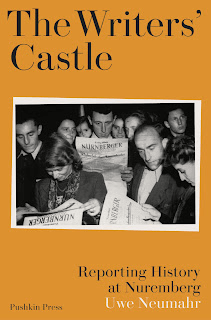
Review: The Writers’ Castle: Reporting History at Nuremberg-Uwe Neumahr, translated by Jefferson Chase Pushkin Press, 352pp, £25

“The wrongs which we seek to condemn and punish have been so calculated, so malignant, and so devastating that civilisation cannot tolerate their being ignored because it cannot survive their being repeated. We must never forget that the record on which we judge these defendants today is the record upon which history will judge us tomorrow.”

Chief Prosecutor Robert H. Jackson

“To initiate a war of aggression, therefore, is not only an international crime; it is the supreme international crime differing only from other war crimes in that it contains within itself the accumulated evil of the whole.”

“War makes murderers out of otherwise decent people. All wars, and all decent people.”—Ben Ferencz

The leader by will of the people differs from the leader by will of God in that the former is compelled to clear the road for himself or, at any rate, to assist the conjuncture of events in discovering him. Nevertheless, the leader is always a relation between people, the individual supply to meet the collective demand. The controversy over Hitler’s personality becomes the sharper the more the secret of his success is sought in himself. In the meantime, another political figure would be difficult to find that is, in the same measure, the focus of anonymous historical forces. Not every exasperated petty bourgeois could have become Hitler, but a particle of Hitler is lodged in every exasperated petty bourgeois.

Leon Trotsky- What Is National Socialism? (June 1933)

This is an interesting and well-researched book on the writers who covered the Nuremburg Trials of leading Nazis after the Second World War. The magnitude of the trials drew in journalists and writers from all over the world. Writers John Dos Passos, Rebecca West, Martha Gellhorn, Janet Flanner, William Shirer, and future German politicians such as Willy Brandt all observed the trials. The title of the writers’ castle was because the journalists were housed in the Schloss Faber-Castell castle in Stein, a nearby town.

Neumahr is a German author and literary agent, and his book is less about the crimes of the Nazis but more about the writer’s reaction to the crimes of the Nazis. As Neumahr points out in the book, not all journalists or writers cover themselves with glory. Even a cursory glance at their reports of the trials shows that some resorted to outright lying and presented less-than-objective accounts of the proceedings. Alfred Döblin, the author of Berlin Alexanderplatz, offered a first-hand account of the courtroom he never went to.

Others brought their ideological baggage with them, which showed in their articles. Erika Mann was the daughter of the novelist Thomas Mann. Because of the Nazi’s treatment of the Jews, (she was considered a Jew by the Nazis) she held an abiding hatred of the Nazis, which coloured her writings on the trial. The French Stalinist writer Elsa Triolet wrote many misleading and downright false reports to support her belief that the Anglo-American judges and lawyers were pro-Nazi.

Neumahr’s approach is “biographical and kaleidoscopic”. Given the highly political nature of the trial, it is a little strange that NeuMahr rarely delves into the politics of prosecutions or the writers that covered it, which is a big weakness in the book. As Bill Niven points out, “In most cases, he is as much, if not more, preoccupied with the lives of his chosen protagonists before, during and after their time at the Faber-Castell castle than he is with their actual journalistic response to the military tribunal. Neumahr is especially interested in all the social goings-on at the castle, whose guests – despite the separation of male and female quarters and, eventually, of Soviet reporters from all others – enjoyed a high level of fraternisation. Neumahr follows the various relationships of his protagonists. Erika Mann moved into the castle with her partner and fellow reporter Betty Knox (whom she referred to as her ‘beloved lunatic’) despite the press camp being run by the American military, for whom homosexuality was a punishable crime. Rebecca West and Francis Biddle, a US judge at Nuremberg, had an affair. As Neumahr tells it, this was something of a relief for both parties: ‘Like Biddle, the fifty-three-year-old West was sexually frustrated’, he writes, because ‘she hadn’t had sex with her husband in years.’ In his chapter on Gellhorn, we learn about her tempestuous relationship with Ernest Hemingway, while the chapter on the Prix Goncourt-winning Russian-French writer Elsa Triolet – who stayed in Nuremberg’s Grand Hotel and not the castle – focuses heavily on her relationship with the poet Louis Aragon.”[1]

The book’s strongest part is how Neumahr relates to how many writers and journalists were morally tarnished by political bias or other prejudices. This applies to author Eric Kästner[2]. One of my favourite childhood books was Emil and the Detectives. Despite having his books burnt by the Nazis in 1933, Kastner made a career for himself under the Nazis.

According to his Wikipedia page, “ The Gestapo interrogated Kästner several times, the national writers’ guild expelled him, and the Nazis burned his books as “contrary to the German spirit” during the book burnings of 10 May 1933, instigated by Joseph Goebbels. Kästner witnessed the event in person and later wrote about it. He was denied membership in the new Nazi-controlled national writers’ guild, Reichsverband deutscher Schriftsteller (RDS), because of what its officials called the “culturally Bolshevist attitude in his writings before 1933. During the Third Reich, Kästner published apolitical novels such as Drei Männer im Schnee (Three Men in the Snow) (1934) in Switzerland. In 1942, he received a special exemption to write the screenplay for Münchhausen, using the pseudonym Berthold Bürger. The film was a prestige project by Ufa Studios to celebrate the twenty-fifth anniversary of its establishment, an enterprise backed by Goebbels.

In 1944, Kästner’s home in Berlin was destroyed during a bombing raid. In early 1945, he and others pretended that they had to travel to the rural community of Mayrhofen in Tyrol for location shooting for a (non-existent) film, Das falsche Gesicht (The Wrong Face). The actual purpose of the journey was to avoid the final Soviet assault on Berlin. Kästner had also received a warning that the SS planned to kill him and other Nazi opponents before the arrival of the Soviets.[8] He was in Mayrhofen when the war ended. He wrote about this period in a diary published in 1961 under the title Notabene 45. Another edition, closer to Kästner’s original notes, was published in 2006 under the title Das Blaue Buch (The Blue Book).”[3]

Neumahr’s intention was never to write about the political nature or the duplicity of those prosecuting the Nazis. As Bill Hunter points “During this ten months, while the prosecutors of Britain, France, America and the Soviet Union, listed the sickening crimes of Nazism, world events showed the hypocrisy of the prosecuting Allies. Even while the aggressions of the Nazis were being recounted. British imperialism was maintaining a regime of terror and oppression in Greece, suppressing the colonial peoples struggling for freedom, and strafing Indonesian villages.The British prosecutor prated about justice. Meanwhile, Dr Kiesselbach, according to Tribune 6 September a declared opponent of de-Nazification was placed by British imperialism in charge of the German “Central Office of Justice”.

While the courtroom resounded with castigations of Nazi oppression and racial discrimination, American imperialist suppression was active in the Philippines, and lynch law was rampant in the Southern States.The prosecutors denounced the occupation methods of the Nazis. Yet, even while the French prosecutor mouthed phrases of indignation, the agents of French imperialism were torturing the natives of Indo-China and burning their villages.The miseries of slave labour under the Nazis were related to the court at the same time as 10 million Germans were uprooted and wandered homeless as a result of the wholesale expulsion policy of the Soviet bureaucracy. In the face of world events during the trial, who can deny that at Nuremberg, the pot called the kettle black, blackening itself still further even while doing so?[4]


[1] The Writers’ Castle’ by Uwe Neumahr review- https://www.historytoday.com/archive/review/writers-castle-uwe-neumahr-review 

[2] https://en.wikipedia.org/wiki/Erich_K%C3%A4stner

[3]  https://en.wikipedia.org/wiki/Erich_K%C3%A4stner

[4]  Bill Hunter on the Nuremberg Trial-). It was published in Socialist Appeal in October 1946. http://www.marxists.org/history/etol/revhist/otherdox/nurember.htm
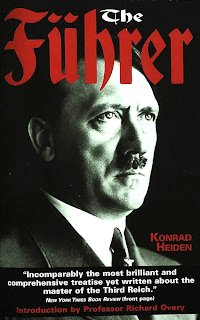
BOOK REVIEW: Der Fuehrer: Hitler’s Rise to Power-By Konrad Heiden (translated by Ralph Manheim) Paperback 614 pages

“Heiden was a young socialist student in Munich when he first saw Hitler speak. It was 1923, the year of inflation and political chaos in Germany. Heiden was not impressed by what he saw: a self-centered demagogue at the head of what he calls the army of uprooted and disinherited.”

Richard Overy

“Fascism has opened up the depths of society for politics. Today, not only in peasant homes but also in city skyscrapers, there lives alongside those of the twentieth century, the tenth or the thirteenth. A hundred million people use electricity and still believe in the magic power of signs and exorcisms. The Pope of Rome broadcasts over the radio about the miraculous transformation of water into wine. Movie stars go to mediums. Aviators who pilot miraculous mechanisms created by man’s genius wear amulets on their sweaters. What inexhaustible reserves they possess of darkness, ignorance, and savagery! Despair has raised them to their feet; fascism has given them a banner. Everything that should have been eliminated from the national organism in the form of cultural excrement in the course of the normal development of society has now come gushing out from the throat; capitalist society is puking up the undigested barbarism. Such is the physiology of National Socialism.

Leon Trotsky-From What Is National Socialism

“fascism comes only when the working class shows complete incapacity to take into its own hands the fate of society.”

― Leon Trotsky, Fascism: What It Is and How to Fight It

First published in 1944, Konrad Heiden’s superb biography of Adolf Hitler culminated in 20 years of study and political opposition to Hitler. The book covers from the 1920s up to June 1934. Heiden wrote and researched it in near real-time, and it is one of the best biographies on the subject of Hitler and the rise of German fascism. As Robert Gale Woolbert, in his review, correctly writes Heiden’s book is “A profusion of detail and brilliant psychological understanding. The analysis is not only of the man but of his movement and the economic, social, and intellectual disorder on which it fed and finally attained success”.[1]

While many modern-day historians, such as Daniel Goldhagen,[2] have placed the blame for the rise of German fascism and the Holocaust on “ordinary Germans,” it was, however, a shock to see Gale Woolbert’s 1944 review containing and defending the same right-wing theory. Wollbert writes, “Where many will feel that Heiden’s explanation breaks down is in his unwillingness to place responsibility for Nazism squarely on the German people or any important class or group among them. This ability to dodge the necessity of rigorous and honest self-criticism seems to characterize even the German liberals and German Jews who have suffered most at the hands of their countrymen.[3]

Despite being over eighty years old, Heiden’s book has a contemporary relevance. It should be read alongside Leon Trotsky’s The Struggle Against Fascism by all those who want to understand the development of fascism of the past and the present. The British Historian Richard Overy writes the introduction. Overy highly praises and defends the book against those who have sought to downplay its significance.

Since its publication over eighty years ago, there has been a veritable cottage industry solely devoted to the study of Hitler and German fascism with varying degrees of success. But as John Lukacs writes in his book The History of Hitler, “We are not yet finished with Hitler (“[wir sind] mit Hitler noch lange nicht fertig”), wrote two members of a younger generation of German historians, independently of each other, in the 1980s–and this is so in both the broader and the narrower sense of “finished.” The first of these should be evident. History means the endless rethinking–and reviewing and revisiting–of the past. History, in the broad sense of the word, is revisionist. History involves multiple jeopardy that the law eschews: People and events are retried and retried again. There is nothing profound in this observation since this is what all thinking is about. The past is the only thing we know. All human knowledge springs from past knowledge. All human thinking involves a rethinking of the past.

This is true in the narrower sense, too, involving the historical profession. The notion that once the scientific method has been applied accurately, with all extant documents exhausted, the work will be finished, and the result will be final (“the final and definitive history of the Third Reich, certified by German, American, British, Russian, liberal and conservative, nationalist and Jewish historians”) is a nineteenth-century illusion. There are probably more than one hundred biographies of Hitler, while there is no certainty that the 101st may not furnish something new and valid. What may matter even more than the accumulated quantity of the research (note the word “re-search”) is the quality of the revision. What is its purpose? In the broader sense, the purpose of historical knowledge is more than accuracy; it is understanding. In the narrower sense, the purpose of a revisionist historian may be exposé, scandal, sensation–or the more or less unselfish wish to demolish untruths. It may be his desire for academic or financial success, to further his advancement in the eyes of his colleagues, or, in the greater world, to gain publicity, or to further the cause of a political or national ideology–on which the treatment of his subject sometimes depends. There will be evidence in this book that this applies on this occasion–to the historical treatment of Hitler too.”[4].

Hitler has legitimately long fascinated historians, but the fascination of sections of the British ruling elite and aristocracy[5] who saw Hitler as an ally against Bolshevism is not so legitimate. Hitler’s Mein Kampf was a huge publishing success–in England and the United States, especially before the war. During my research for this article, I paid a trip to the London Library to find other work by Heiden on Hitler and the Nazis (a term that Heiden coined). I don’t know who was surprised more, me or the librarian, to see a copy of Heiden’s History of National Socialism published in 1934 in London by Meuthen and Co. Ltd with a gold embossed swastika on both the spine and cover. Perhaps all the more galling since Heiden was an active socialist. You can draw your own conclusions.

It would be a mistake to see this book as another Hitler biography. Heiden was an active socialist in opposition to Hitler and German fascism. He was a member of the German Social Democratic Party(SPD). Heiden, son of a German trade union official, had studied Hitler for 23 years. So much so that, according to Dorothy Thompson, he followed Hitler “like a Javert tracking down his man.”[6]

As David North writes in his excellent review of Goldhagen’s book “ The History of the German social democracy, in the years when it represented a revolutionary mass movement of the working class—that is, from the 1870s to the outbreak of the First World War I in 1914—is one of unrelenting struggle against anti-Semitism. The exigencies of the political struggle in the working class required an intransigent attitude toward all forms of anti-Semitic propaganda. Aside from democratic principles and moral considerations, the Social Democratic Party saw the association of anti-Semitism with demagogic anticapitalist rhetoric as an attempt to disorient the working class and subordinate it to the political representatives of the middle class.”[7] Heiden completely agreed with the program of the SPD and fought for it with every waking moment. The Gestapo hunted him, and he only just escaped with his life.

I have been unable to ascertain whether Heiden read any of Leon Trotsky’s writings on German fascism, but some of Heiden’s analysis of the class nature of German fascism would not look out of place in the work of Trotsky. Heiden writes, “They drew to them “the flotsam, the stragglers living on the fringe of their class . . . the unemployed . . . the declassed of all classes.” In all ages, this has been the way of counterrevolution: an upper layer that has lost its hold in society seeks the people and finds the rabble. The officers were out to find a demagogue, of whom it could be said that he was a worker. They found their leader in the lowest mass of their subordinates. The spirit of history, in its fantastic mockery, could not have drawn an apter figure.[8]

Perhaps Heiden’s most important contribution has been to understand and explain the nature of Hitler’s hatred of the Jews. Hitler’s anti-Semitism was, according to Heiden, a by-product of his all-consuming hatred of the proletariat. Hitler, he explained,” hated the whole great sphere of human existence which is devoted to the regular transference of energy into a product, and he hated the men who had let themselves be caught and crushed in this production process. All his life, the workers were, for him, a picture of horror, a dismal, gruesome mass. Everything that he later said from the speaker’s platform to flatter the manual worker was pure lies. Herein lies the key to an understanding of Hitler’s demonic obsession with the Jews. In Mein Kampf, Hitler explained how his conversion to anti-Semitism flowed from his encounters with the labor movement. It was among the workers that Hitler first came into contact with Jews. He then discovered, to his amazement, that many Jews played prominent roles in the labour movement. “The great light dawned on him,” wrote Heiden. “Suddenly, the ‘Jewish question’ became clear. … The labour movement did not repel him because it was led by Jews; the Jews repelled him because they led the labour movement.” Heiden concluded, “It was not Rothschild, the capitalist, but Karl Marx, the Socialist, who kindled Adolf Hitler’s anti-Semitism.”[9]

It would be fair to say that history has not been very kind to Heiden’s Marxist analysis of the rise of Hitlerite fascism. The modern-day Marxist writer David North rescued Heiden from the “condescension of history.” Apart from North, Heiden has largely been ignored, and his opposition to the right-wing historiography that is so loved today that “ordinary Germans” were responsible for fascism has been written out of today’s history books. Heiden shared the same fate when he wasWhile still alive. His Heiden’s books and Marxist analysis came under heavy attack.

In an article called The Mass-Man: Hitler, Hans Kohn starts by praising Heiden’s work, saying, “Mr. Heiden’s extremely well-written book is based on expert knowledge of the biographical material and the political background of Hitler’s rise to power. The dramatic terseness and vividness of its narrative have lost nothing in the excellent translation. Its brilliant analysis of German and, curiously enough, also of Russian politics makes the book not only a journalistic masterpiece but an authentic work of historical scholarship.

Kohn’s real opposition to Heiden comes to the fore when he writes, “Yet the crucial question of the essentially German nature of Hitlerism is not answered: Mr. Heiden seems to regard Hitler as representing the mind not only of the German masses but of the modern masses everywhere. Though he perceives the deep tie binding Hitler to the German masses and them to him, he often writes as if Hitler had to conquer the German masses against their innermost will. Hitlerism then appears as an international movement which could have happened anywhere and which found in Germany only its accidental starting point. Such an opinion underrates the deep roots of Hitlerism and Stalinism in the intellectual soil and the social structure of Germany and Russia, and at the same time, the intrinsic strength and the survival value of Western civilization.”[10]

Perhaps the most provocative and repellent review of Heiden’s work comes from the pens of the New York Times. They claimed Heiden was a propagandist and uncritically reported: “To the leaders of the Third Reich. Heiden was a hated and sought-after enemy. One of the Nazis’ acts upon taking over a country was always to ban and burn his books. The writer was a propagandist of a special kind-one who used objectivity and documents to destroy the object of his derision…. In 1932 his first book, History of National Socialism, was publicly burned by the Nazis, who were then on the brink of gaining power. When they took over… In 1933, he fled.”[11]

Despite giving world governments significant examples of the Nazi’s intentions and his books contained some of the earliest first-hand reports of Jews who fell victim to torture and internment at Dachau near Munich, Sachsenhausen or Oranienburg near Berlin, or Buchenwald near Weimar following the mass arrests of 1938 western capitalist governments did nothing to prevent the subsequent Holocaust.

Heiden is well worth reading today, and it is to David North’s credit this great historian of the 20th century can be read in the 21st century.

Further Reading

How To Read Hitler- Neil Gregor

The Struggle Against Fascism in Germany (Merit S.) Paperback – Illustrated, 1 Jun. 1971by L. Trotskii (Author), George Breitman (Editor)

Heiden’s Selected works

History of National Socialism (Berlin, 1932)

Birth of the Third Reich (Zürich, 1934)

Hitler: A Biography (Zürich, appeared in two volumes, 1936–1937)

The New Inquisition (New York City, 1939)

Der Führer – Hitler’s Rise to Power (Boston, 1944)


[1]Der Fuehrer-Reviewed by Robert Gale Woolbert-April 1944

http://www.foreignaffairs.com/reviews/capsule-review/1944-04-01/der-fuehrer

[2] See David North The Myth of “Ordinary Germans”: A Review of Daniel Goldhagen’s Hitler’s Willing Executioners.wsws.org

[3] www.foreignaffairs.com/reviews/capsule-review/1944-04-01/der-fuehrer

[4] The Hitler of History- Chapter One http://www.nytimes.com/books/first/l/lukacs-hitler.html?scp=80&sq=english%20history&st=cse

[5] See The Queen’s Nazi salute: Historical revisionism in the service of state censorship

Julie Hyland-22 July 2015- https://www.wsws.org/en/articles/2015/07/22/nazi-j22.html

[6] National Socialism: Theory and Practice Dorothy Thompson July 1935 Published on July 1, 1935-Foreign Affiairs

[7] David North The Myth of “Ordinary Germans”: A Review of Daniel Goldhagen’s Hitler’s Willing Executioners.wsws.org

[8] Der  Fuehrer, Hitler’s Rise to Power-Konrad Heiden—Haughton, Mifflin

[9] Der  Fuehrer, Hitler’s Rise to Power-Konrad Heiden—Haughton, Mifflin

[10] The Mass-Man: Hitler-By Hans Kohn-April 1944- http://www.theatlantic.com/magazine/archive/1944/04/the-mass-man-hitler/655063

[11] www.spartacus-educational.com/Konrad_Heiden.htm