“Give me liberty, or give me death!” – Patrick Henry, speaking at the Second Virginia Convention (1775)
“These are the times that try men’s souls.” – Thomas Paine, The American Crisis (1776)
“We must all hang together, or assuredly we shall all hang separately.” –
Attributed to Benjamin Franklin at the signing of the Declaration of Independence (1776)
“Join, or Die” – A famous political cartoon and slogan created by Benjamin Franklin to promote colonial unity against the French and their Native American allies, which later became a symbol of unity against British rule.
Introduction: Propaganda, Class, and the American Revolution
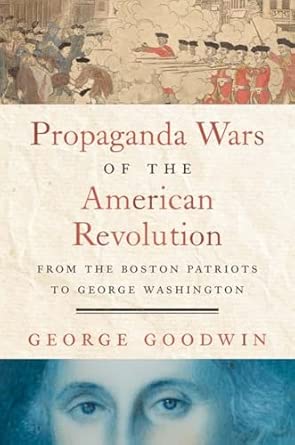
George Goodwin’s Propaganda Wars of the American Revolution comes at a time
of deep crisis in American and global capitalism. As the 1776 semiquincentennial approaches, it coincides with widespread social inequality, imperialist conflicts, and a rapid decline of democratic institutions in the US. It’s no surprise that debates over the meaning of the American Revolution—its origins, class implications, and legacy—have become central in current political discussions. Published by Yale University Press, Goodwin’s book aims to contribute to this debate by exploring how the Patriot movement used pamphlets, sermons, newspapers, broadsides, and political theatre to shape public opinion.
Goodwin is a talented historian and lucid writer. His book makes a significant contribution to a field traditionally dominated by Bernard Bailyn and Gordon S. Wood’s “ideological school.” However, Propaganda Wars also reveals a main weakness of that perspective by isolating ideas from the material class interests that influence them. Consequently, it presents a polished but somewhat idealist view of the Revolution—focusing on persuasion techniques while underplaying the social forces that made those techniques successful.
The Ideological School and Its Strengths
Goodwin’s intellectual legacy is clearly visible. His emphasis on propaganda as a key element places him mainly in the ‘ideological’ school of Revolutionary historiography, established by Bernard Bailyn. This approach, starting with Bailyn’s The Ideological Origins of the American Revolution (1967), argues that the colonists were driven by a unified worldview rooted in radical Whig ideas. Bailyn and Wood carefully analysed pamphlets, sermons, and political debates from that period, opposing the dismissive view that all declarations of principle are driven solely by self-interest.
From a Marxist perspective, this emphasis on ideas is a notable strength. “It was a school that approached the record of human thought with great seriousness.” This is a welcome corrective to the postmodernist trivialisation of intellectual history and to the racialist distortions of the 1619 Project. Goodwin’s book continues this tradition by showing how the Patriot cause deliberately shaped public opinion—how Thomas Paine energised the colonies, how the Boston Tea Party was used as political theatre, and how Washington actively promoted the image of republican virtue.
Goodwin rightly emphasises that propaganda played a crucial role. Revolutions depend not just on economic factors but also on mobilising large groups, expressing grievances, and envisioning a new political future. The real question is: which forces were being mobilised, and for what purpose?
The Ideological School and Its Afterlives: Bailyn, Wood, and Goodwin in Comparative Perspective
Any Marxist critique of George Goodwin’s Propaganda Wars of the American Revolution must place the work within the wider historiographical context from which it originates. Goodwin is part of a broader intellectual tradition. His book represents the latest version of the “ideological school,” originally established by Bernard Bailyn and further expanded with sharper analysis by Gordon S. Wood. The advantages and drawbacks of Goodwin’s research are linked to those of this entire tradition.
The ideological school has significantly influenced modern interpretations of the American Revolution. It has also been the main opposition to postmodernist and racial-essentialist critiques, which culminated in the New York Times’ 1619 Project. The International Committee of the Fourth International, through its collaboration with Wood and its support for Enlightenment universalism, has actively engaged in this historiographical debate. As such, a clear, materialist evaluation of the ideological school is essential.
Bernard Bailyn: Ideology as Prime Mover
Bernard Bailyn’s The Ideological Origins of the American Revolution (1967) marked a major turning point in the study of Revolutionary history. Moving away from the Progressive focus on economic grievances and class struggles, Bailyn proposed that the colonists’ motivations were rooted in a consistent worldview inspired by radical Whig ideas. According to this view, the Revolution was primarily an ideological uprising—a fight to defend liberty against a perceived British plot to wield arbitrary authority.
Bailyn’s contribution was significant. He brought rigour back to the analysis of ideas, elevating Revolutionary pamphlets from scholars’ dismissive view of them as simple rationalisations of self-interest. “It was a school that approached the record of human thought with great seriousness.”
Bailyn’s framework was highly idealistic, portraying ideas as independent forces separate from the material conditions and class dynamics that generate them. The Revolution is depicted as a conflict of political ideas rather than a fight shaped by the contradictions within colonial society. Class conflict is scarcely mentioned; slavery is seen as a minor issue; and the economic and social changes following the Revolution are viewed as minor outcomes rather than fundamental causes. Consequently, Bailyn’s approach is both a significant advance and a limitation—it expanded the scope of intellectual history but also restricted understanding to a non-materialist perspective.
Gordon S. Wood: Ideology as Social Transformation
Gordon S. Wood, Bailyn’s top student, maintained the ideological school’s focus on ideas while expanding its view to include a more vibrant and comprehensive understanding of social change. In his works, The Creation of the American Republic (1969) and The Radicalism of the American Revolution (1992), Wood showed that republican ideology was more than just abstract principles; it was a powerful force that transformed political culture, social structures, and daily life.
Wood’s work represents the most materialist analysis within the ideological school. He demonstrates that the Revolution dismantled monarchical and hierarchical social relationships, empowered the “middling sort,’ and unleashed democratic forces that even the Founders could not fully control. Additionally, he addressed the Revolution’s core contradiction with remarkable clarity: the coexistence of liberty and slavery. Wood argued that the Civil War was an inevitable culmination of a tragedy that originated in the Revolution itself.
Wood’s accomplishment lies in recognising that ideas are rooted in society rather than existing in isolation. However, he avoids adopting a Marxist perspective. He does not view the Revolution as a bourgeois-democratic event, nor does he see slavery as a fundamental aspect of capitalist growth. His approach stays within the ideological tradition, despite pushing against its boundaries.
George Goodwin: Ideology Reduced to Technique
George Goodwin’s Propaganda Wars adopts the strengths of the ideological school but lacks its deeper analytical depth. While Bailyn explored the origins of ideology and Wood examined societal transformations, Goodwin focuses on the
mechanics of persuasion. His emphasis is not on the internal logic of Revolutionary ideas but on how they circulated, were performed, and emotionally resonated.
The book thoroughly explores printers, pamphleteers, preachers, and political leaders, illustrating how the Patriot movement intentionally influenced public opinion. It shows how Paine’s writings inspired the colonies, how the destruction of the tea served as a political spectacle, and how Washington fostered an image of republican virtue. However, Goodwin’s approach is more limited than that of earlier scholars. It’s important to remember that propaganda is grounded in tangible social forces, not just ideas—it is the ideological expression of actual social dynamics.
Goodwin views propaganda primarily as a technological feat rather than a reflection of class-based ideology. He describes how the Patriots succeeded in convincing the public, but does not explore why their messages connected with various social groups. Consequently, the Revolution is seen more as a success of strategic communication than as a bourgeois-democratic upheaval driven by colonial societal conflicts. In this way, Goodwin exemplifies the continuation of the ideological school. This tradition has lost its core intellectual focus and now persists through cultural history, communication analysis, and political technique.
The Marxist Position: Ideas as the Expression of Class Forces
A Marxist analysis acknowledges the valuable contributions of Bailyn, Wood, and Goodwin. It values their honest engagement with ideas and their opposition to the cynical reductionism often seen in modern academia. Nonetheless, it emphasises that ideas gain historical significance only when they align with material interests and social needs.
The American Revolution was a bourgeois-democratic uprising. Its propaganda functioned as the ideological voice of a rising bourgeois class opposing monarchical authority. The contradictions within that system—especially the tension between liberty and slavery—were evident in its language, silences, and evasive tactics. Bailyn studied the key ideas of Revolutionary ideology, while Wood investigated its social effects. Goodwin analysed how these ideas were disseminated.
The ideological school is essential for understanding the intellectual landscape of the American Revolution, but its focus on idealism limits its ability to fully interpret the Revolution’s significance. Goodwin’s Propaganda Wars offers meaningful insight into this tradition, yet it also reveals its inherent limitations, which are amplified here. “Propaganda does not float free of the material world… They were the ideological expression of real social forces.”
This is the core issue. The American Revolution was primarily a bourgeoisdemocratic movement, influenced by the conflicts within colonial society. The pamphlets from Boston radicals, sermons from New England clergy, and Paine’s fiery speeches were not independent forces shaping history but rather ideological expressions of various social classes: a rising colonial bourgeoisie limited by imperial mercantilism, artisans and mechanics opposing British economic policies, small farmers fighting taxation and landlordism, and Southern planters wanting westward expansion but hindered by the Crown.
Goodwin’s emphasis on technique—the “how” of persuasion—shields the underlying reasons. Why did Paine’s Common Sense strike such a chord? Why did conspiracy and liberty rhetoric energise urban crowds, frontier farmers, and some enslaved individuals fleeing to British forces? These questions cannot be answered solely by examining propaganda. Instead, they demand a class-based Analysis of colonial society. The ideological school has always faced challenges despite its achievements. It views ideas as the main drivers of history, rather than as expressions of material interests. Goodwin’s book, despite its merits, still operates within this idealist perspective.
The Revolution “From Above”
The subtitle—From the Boston Patriots to George Washington—reveals a further limitation. It moves from discussing Boston’s radical protests to emphasising Washington, the Virginia planter who represents the Revolution’s consolidation through elite leadership. “The propaganda wars were not just Patriots versus
Loyalists; they were also… a struggle over what kind of republic would emerge.”
This is a pivotal moment. The American Revolution, similar to all bourgeois revolutions, involved a deep tension between the democratic hopes it sparked and the class interests that ultimately constrained it. The urban crowds who brought down the George III statue, the workers who enforced non-importation agreements, and the farmers who later participated in Shays’ Rebellion—these groups drove the Revolution beyond what the colonial elite found acceptable.
Goodwin describes this trajectory but doesn’t question it. The Revolution is portrayed as a story of growing propaganda rather than as a conflict in which different class forces competed to influence the new republic. The ideological perspective often views the Founders as natural leaders of the Revolution, rather than as representatives of a particular class whose interests lay in rallying and controlling popular support.
The Silence at the Heart of Revolutionary Rhetoric: Slavery
No analysis of Revolutionary propaganda can ignore the core contradiction of 1776: the simultaneous fight for liberty and the perpetuation of chattel slavery. This was not accidental but a fundamental aspect of a revolution led by a class that included slaveholders. Revolutionary language used the metaphor of “slavery” to describe the colonists’ relationship with Britain, largely ignoring the reality of actual slavery. Jefferson’s initial objection to the slave trade was removed from the Declaration. Patriot propaganda aimed to preserve unity among both slaveholders and non-slaveholders across North and South.
Goodwin recognises this contradiction but does not incorporate it into his analysis of propaganda. However, the silences, evasions, and metaphors used in Revolutionary rhetoric were not accidental; they were crucial for maintaining the ideological unity of a movement led by a class whose material interests relied on human bondage. As Wood stated in Empire of Liberty, the tragedy was “preordained from the time of the Revolution.” The Civil War was the inevitable outcome of the contradiction that the Revolution could not resolve.
What Goodwin Achieves—and What He Cannot
Goodwin’s book is insightful and well-researched, offering an engaging look at the mechanics of persuasion. It highlights the roles of pamphleteers, printers, preachers, and political figures who influenced public opinion before independence. The book treats the intellectual environment of the Revolution with seriousness, pushing back against modern academic cynicism. However, its focus on an idealist framework limits its ability to explain events fully.
Propaganda was significant because it reflected the material interests and democratic hopes of large sections of colonial society. It was effective because, even if imperfectly, it conveyed the emerging bourgeois order’s challenge to monarchical authority. Seeing propaganda as an independent force is a mistake; it conflates the form with the underlying social content and reality.
Conclusion: Toward a Marxist Understanding of Revolutionary Propaganda
A Marxist view of the American Revolution recognises the influence of ideas but emphasises that ideas only gain power when linked to material interests and historical needs. The Revolution was a bourgeois-democratic uprising that laid the groundwork for capitalist growth, with its propaganda serving as the ideological expression of this change.
While Goodwin’s Propaganda Wars explores persuasion techniques, it does not address the class forces behind their effectiveness. Although a serious work, it remains rooted in the idealist tradition of the ideological school. To fully understand revolutionary propaganda, one must consider it within the context of colonial American social structure, the contradictions of slavery, and the global rise of capitalism. Only then can we comprehend the Revolution’s true historical logic—and its ongoing significance in a time when the crisis in American democracy raises questions about social revolution.


